Page 294 of 374

Materials Added To Engine Oils
The manufacturerstrongly recommendsagainst the ad-
dition of any additives (other than leak detection dyes) to
engine oil. Engine oil is an engineered product and it's
performance may be impaired by supplemental addi-
tives.
Disposing of Used Engine Oil
Care should be taken in disposing of used engine oil from
your vehicle. Used oil and oil filters, indiscriminately
discarded, can present a problem to the environment.
Contact your authorized dealer, service station, or gov-
ernmental agency for advice on how and where used oil
can be safely discarded in your area.
Engine Oil Filter
The engine oil filter should be replaced at every engine
oil change.
Engine Oil Filter Selection
All of the manufacturer's engines have a full-flow type
disposable oil filter. Use a filter of this type for replace-
ment. The quality of replacement filters varies consider-
ably. Only high quality filters should be used to assure
most efficient service. Mopartengine oil filters are high
quality oil filters and are recommended.
Drive Belts Ð Check Condition and Tension
At the mileage shown in the appropriate ªMaintenance
Schedule,º check all drive belts for condition and proper
tension. Improper belt tension can cause belt slippage
and failure.
Inspect the drive belt for evidence of cuts, cracks, or
glazing and replace them if there is any sign of damage
which could result in belt failure. If adjustment is re-
quired, adjust the belts according to the specifications
and procedures shown in the Service Manual.
294 MAINTAINING YOUR VEHICLE
Page 300 of 374

Refrigerant Recovery and Recycling
R-134a Air Conditioning Refrigerant is a hydrofluorocar-
bon (HFC) that is endorsed by the Environmental Pro-
tection Agency and is an ozone-saving product. How-
ever, the manufacturer recommends that air conditioning
service be performed by dealers or other service facilities
using recovery and recycling equipment.
NOTE:Air Conditioning systems found to be contami-
nated with A/C System Sealers, Stop Leak Products, Seal
Conditioners, Compressor Oil, or Refrigerants not ap-
proved by the manufacturer, voids the warranty for the
Air Conditioning system.
Power Steering Fluid Check
Checking the power steering fluid level at a defined
service interval is not required. The fluid should only be
checked if a leak is suspected, abnormal noises areapparent, and/or the system is not functioning as antici-
pated. Coordinate inspection efforts through a certified
ªDaimlerChrysler Dealership.º
WARNING!
Fluid level should be checked on a level surface with
the engine off to prevent injury from moving parts,
and to insure accurate fluid level reading. Do not
overfill. Use only the manufacturer's recommended
fluid.
If necessary, add fluid to restore to the proper indicated
level. With a clean cloth, wipe any spilled fluid from all
surfaces. Refer to Recommended Fluids, Lubricants, and
Genuine Parts for correct fluid type.
300 MAINTAINING YOUR VEHICLE
Page 302 of 374
remove frost or ice from the windshield. Keep the blade
rubber out of contact with petroleum products such as
engine oil, gasoline, etc.
Windshield Washers
The fluid reservoir for the windshield washers and the
rear window washer is shared. It is located in the front of
the engine compartment on the passenger side andshould be checked for fluid level at regular intervals. Fill
the reservoir with windshield washer solvent (not radia-
tor antifreeze) and operate the system for a few seconds
to flush out the residual water.
WARNING!
Commercial windshield washer solvents are flam-
mable. They could ignite and burn you. Care must
be exercised when filling or working around the
washer solution.
Exhaust System
The best protection against carbon monoxide entry into
the vehicle body is a properly maintained engine exhaust
system.
If you notice a change in the sound of the exhaust system;
or if the exhaust fumes can be detected inside the vehicle;
302 MAINTAINING YOUR VEHICLE
Page 303 of 374

or when the underside or rear of the vehicle is damaged;
have an authorized technician inspect the complete ex-
haust system and adjacent body areas for broken, dam-
aged, deteriorated, or mispositioned parts. Open seams
or loose connections could permit exhaust fumes to seep
into the passenger compartment. In addition, inspect the
exhaust system each time the vehicle is raised for lubri-
cation or oil change. Replace as required.
Cooling System
WARNING!
You or others can be badly burned by hot coolant or
steam from your radiator. If you see or hear steam
coming from under the hood, don't open the hood
until the radiator has had time to cool. Never try to
open a cooling system pressure cap when the radia-
tor or coolant bottle is hot.
Coolant Checks
Check coolant protection every 12 months (before the
onset of freezing weather, where applicable). If coolant is
dirty or rusty in appearance, the system should be
drained, flushed and refilled with fresh coolant.
Check the front of the radiator for any accumulation of
bugs, leaves, etc. Clean the radiator by gently spraying
water from a garden hose at the back of the core.
Check the engine cooling system hoses for condition and
tightness of connection. Inspect the entire system for
leaks. Any hoses that show cuts or severe abrasion must
be replaced.
Cooling System Ð Drain, Flush, And Refill
At the intervals shown in the appropriate ªMaintenance
Schedule,º the system should be drained, flushed, and
refilled.
MAINTAINING YOUR VEHICLE 303
7
Page 309 of 374
Inspect all hose clamps and couplings to make sure they
are secure and no leaks are present.
NOTE:Often fluids such as oil, power steering fluid,
and brake fluid are used during assembly plant opera-
tions to ease the assembly of hoses to couplings. There-
fore, oil wetness at the hose-coupling area is not neces-
sarily an indication of leakage. Actual dripping of hot
fluid when systems are under pressure (during vehicle
operation) should be noted before hose is replaced based
on leakage.NOTE:Inspection of brake hoses should be done when-
ever the brake system is serviced and every engine oil
change.
WARNING!
Worn brake hoses can burst and cause brake failure.
You could have an accident. If you see any signs of
cracking, scuffing, or worn spots, have the brake
hoses replaced immediately.
MAINTAINING YOUR VEHICLE 309
7
Page 312 of 374

To check the automatic transmission fluid level properly,
the following procedure must be used:
1. The vehicle must be on level ground.
2. The engine should be running at curb idle speed for a
minimum of 60 seconds.
3. Fully apply parking brake.
4. Apply the brakes and shift the transmission into P
(Park).
5. The fluidMUSTbe checked with the transmission in
P (Park) to be sure that the fluid level is accurate.
6. Wipe the dipstick clean and reinsert until seated.
Remove dipstick and note reading.
At normal operating temperature (approximately 180É F
(82É C), the fluid level is correct if it is in the HOT region(cross-hatched area) on the oil level indicator. The fluid
level indicator should be in the COLD region at 70É F (21É
C) fluid temperature.
If the fluid level is low, add sufficient fluid to bring to the
proper level. Refer to Recommended Fluids, Lubricants
and Genuine Parts for correct fluid type.
Fluid is added through the dipstick tube.
NOTE:To prevent dirt and water from entering the
transmission after checking or replenishing fluid, make
certain that the dipstick cap is properly reseated.
Special Additives
The manufacturer recommends against the addition of
any additives to the transmission. Exception to this
policy is the use of special dyes to aid in detecting fluid
leaks.
312 MAINTAINING YOUR VEHICLE
Page 326 of 374
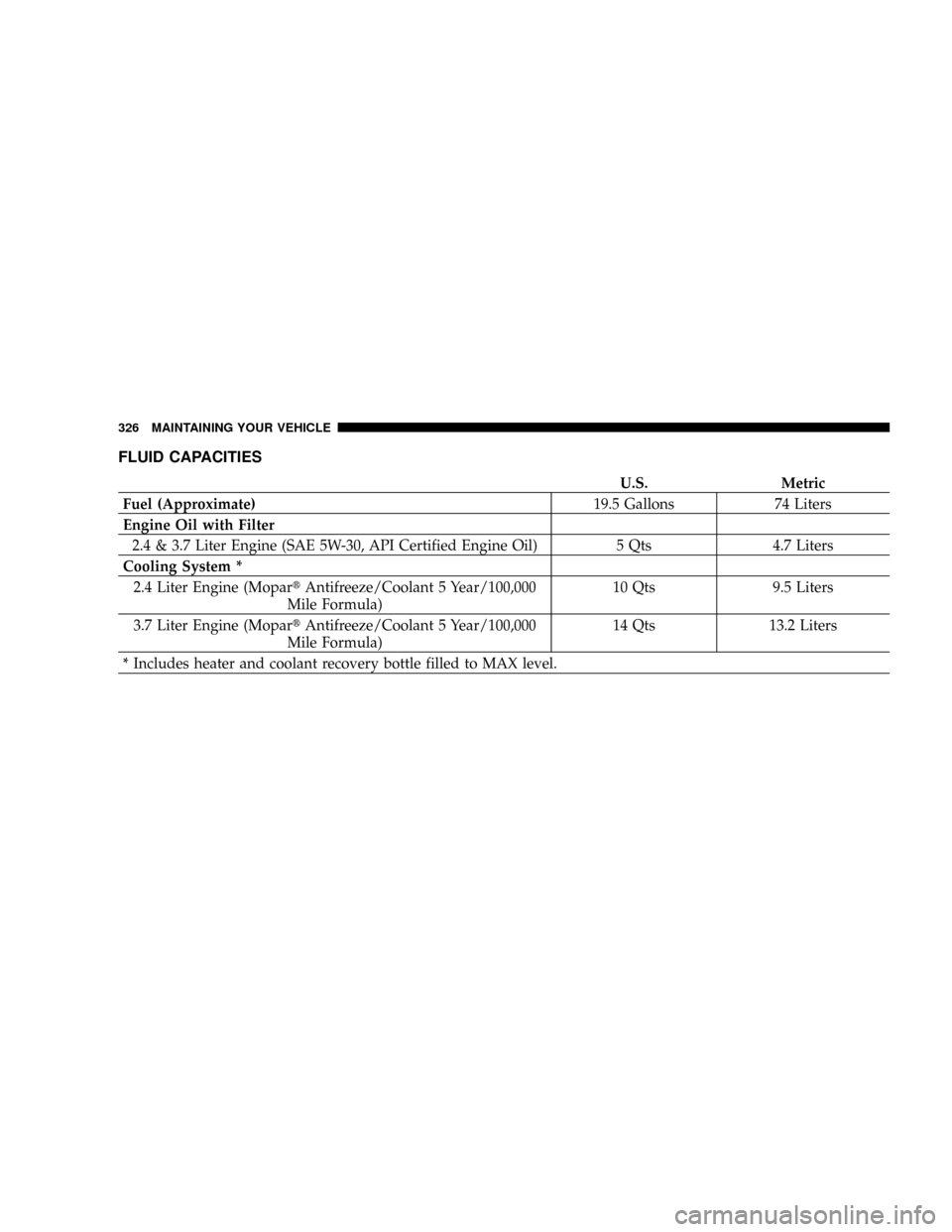
FLUID CAPACITIES
U.S. Metric
Fuel (Approximate)19.5 Gallons 74 Liters
Engine Oil with Filter
2.4 & 3.7 Liter Engine (SAE 5W-30, API Certified Engine Oil) 5 Qts 4.7 Liters
Cooling System *
2.4 Liter Engine (MopartAntifreeze/Coolant 5 Year/100,000
Mile Formula)10 Qts 9.5 Liters
3.7 Liter Engine (MopartAntifreeze/Coolant 5 Year/100,000
Mile Formula)14 Qts 13.2 Liters
* Includes heater and coolant recovery bottle filled to MAX level.
326 MAINTAINING YOUR VEHICLE
Page 327 of 374
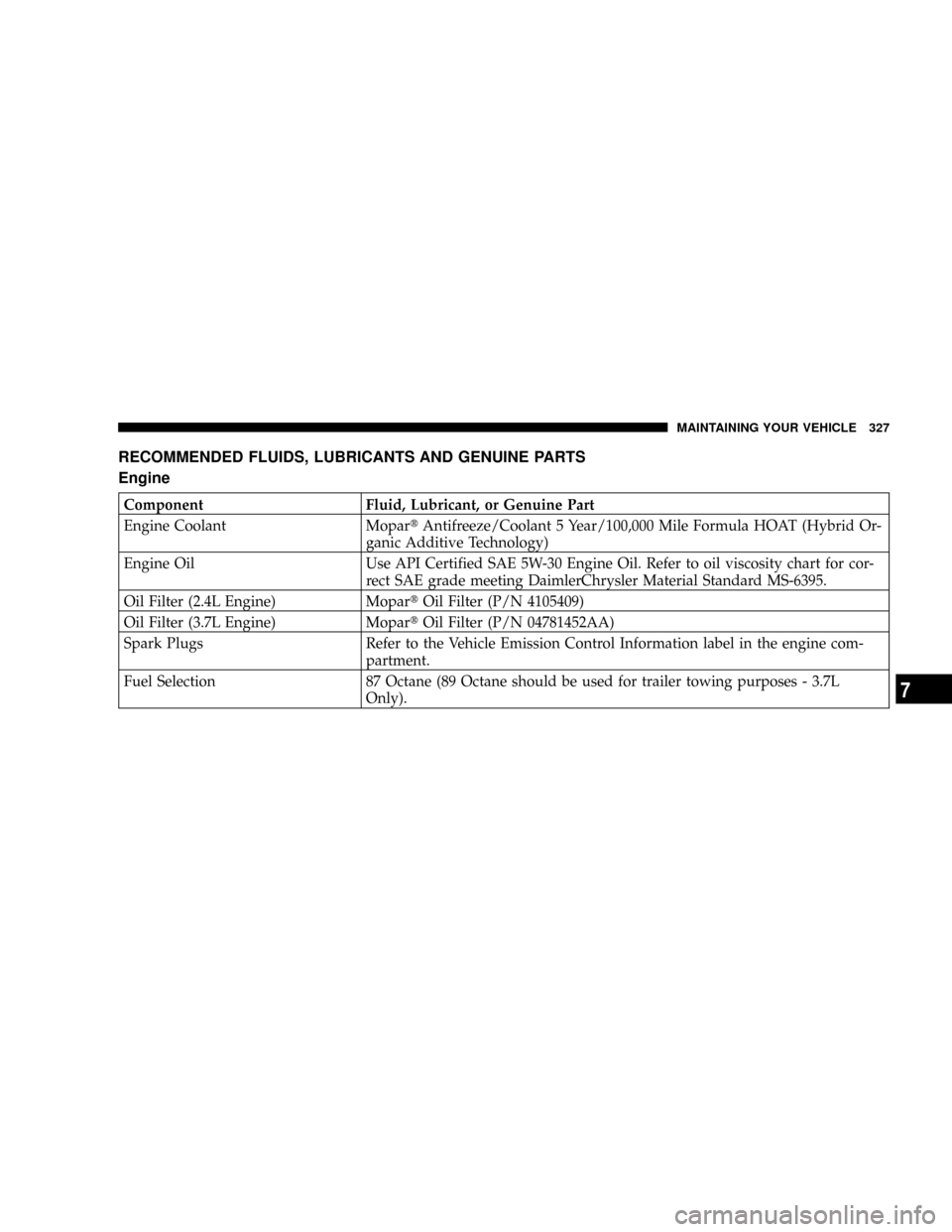
RECOMMENDED FLUIDS, LUBRICANTS AND GENUINE PARTS
Engine
Component Fluid, Lubricant, or Genuine Part
Engine Coolant MopartAntifreeze/Coolant 5 Year/100,000 Mile Formula HOAT (Hybrid Or-
ganic Additive Technology)
Engine Oil Use API Certified SAE 5W-30 Engine Oil. Refer to oil viscosity chart for cor-
rect SAE grade meeting DaimlerChrysler Material Standard MS-6395.
Oil Filter (2.4L Engine) MopartOil Filter (P/N 4105409)
Oil Filter (3.7L Engine) MopartOil Filter (P/N 04781452AA)
Spark Plugs Refer to the Vehicle Emission Control Information label in the engine com-
partment.
Fuel Selection 87 Octane (89 Octane should be used for trailer towing purposes - 3.7L
Only).
MAINTAINING YOUR VEHICLE 327
7