Page 135 of 374
CIGAR LIGHTER Ð IF EQUIPPED
The lighter is a direct feed from the battery so it receives
power whether the ignition is in the ON or OFF position.
It heats when pushed in and pops out automatically
when ready for use.To preserve the heating element, do
not hold the lighter element in the heating position.
GLOVE COMPARTMENT
To open the glove box, lift up on the latch.
UNDERSTANDING THE FEATURES OF YOUR VEHICLE 135
3
Page 153 of 374

light will come on when the ignition switch is turned to
the ON position and may stay on for as long as three
seconds.
If the light comes back on immediately or comes on
during driving, it indicates that the Anti-Lock portion of
the brake system is not functioning and that service is
required, however, the conventional brake system will
continue to operate normally provided that the BRAKE
warning light is not on. Also, a chime will sound if the
light comes back on.
If the ABS light is on, the brake system should be serviced
as soon as possible to restore the benefit of Anti-Lock
Brakes.
The operation of the ABS light can be checked by turning
the ignition switch from the OFF position to the ON
position. The light should illuminate for approximately
two seconds. The light should then turn off unless theparking brake is applied or a brake fault is detected. If the
light does not illuminate, have the light inspected by an
authorized dealer.
10. Charging System Warning Light
This light shows the status of the electrical charg-
ing system. The light should come on for three
seconds when the ignition is first turned ON. If the light
comes back on immediately or comes on while driving, it
means that there is a problem with the charging system
or the battery is low. Also, a chime will sound if the light
comes back on. See your authorized dealer immediately.
11. Temperature Gage
Indicates engine coolant temperature. Any read-
ing within the normal range indicates that the
cooling system is operating satisfactorily.
The gage pointer will likely indicate a higher temperature
(above center scale) when driving in hot weather, up
mountain grades, in heavy stop and go traffic, or when
UNDERSTANDING YOUR INSTRUMENT PANEL 153
4
Page 205 of 374
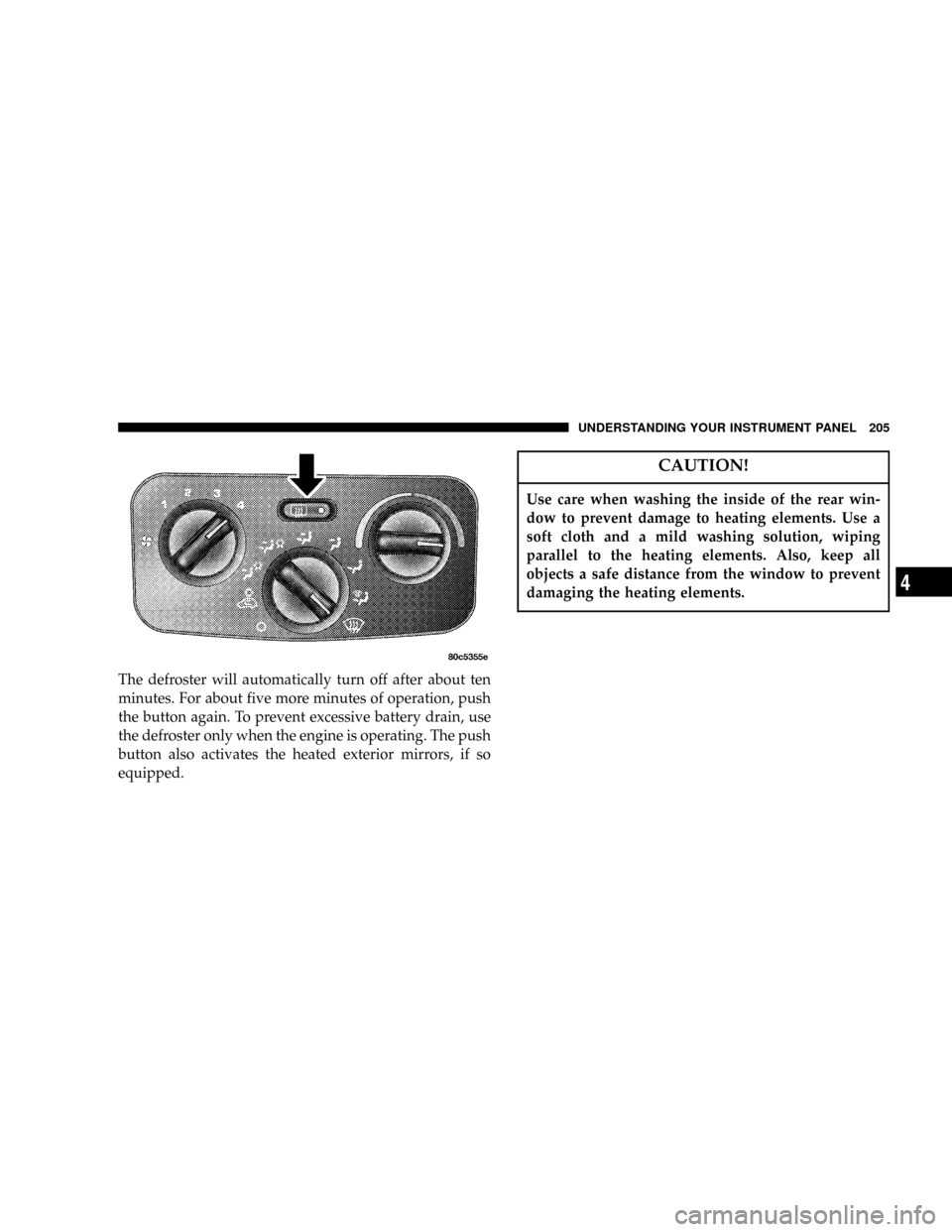
The defroster will automatically turn off after about ten
minutes. For about five more minutes of operation, push
the button again. To prevent excessive battery drain, use
the defroster only when the engine is operating. The push
button also activates the heated exterior mirrors, if so
equipped.
CAUTION!
Use care when washing the inside of the rear win-
dow to prevent damage to heating elements. Use a
soft cloth and a mild washing solution, wiping
parallel to the heating elements. Also, keep all
objects a safe distance from the window to prevent
damaging the heating elements.
UNDERSTANDING YOUR INSTRUMENT PANEL 205
4
Page 272 of 374
HAZARD WARNING FLASHERS
Your vehicle's hazard warning flasher is an emergency
warning system. When you activate it, all front and rear
directional signals will flash intermittently. Use it when
your vehicle is disabled on or near the road. It warns
other drivers to steer clear of you and your vehicle. This
is an emergency warning system, not to be used when the
vehicle is in motion.
To activate the warning flashers, press the button on the
instrument panel (between center air outlets). To turn the
warning flashers off, press the button again.
NOTE:With extended use, the flashers may run down
your battery.
272 WHAT TO DO IN EMERGENCIES
Page 279 of 374

²Do not let passengers sit in the vehicle when it is on a
jack.
²Do not get under the vehicle when it is on a jack.
²Failure to follow the ªTire Changing Procedureº may
result in personal injury or damage to your vehicle.
²Only use the jack in the positions indicated.
JUMP STARTING PROCEDURE
NOTE:Check the charge indicator on the battery. If the
indicator is light or yellow, replace the battery.
1. Wear eye protection and remove any metal jewelry
such as watch bands or bracelets that might make an
unintended electrical contact.
2. When boost is provided by a battery in another
vehicle, park that vehicle within booster cable reach but
without letting the vehicles touch. Set the parking brake,place the automatic transmission in P (Park), or manual
transmission in N (Neutral), and turn the ignition to OFF
for both vehicles.
3. Turn off the heater, radio and all unnecessary electrical
loads.
4. Connect one end of a jumper cable to the positive
terminal of the discharged battery. Connect the other end
of the same cable to the positive terminal of the booster
battery.
5. Connect the other cable, first to the negative terminal
of the booster battery and then connect the other end to
a non-paint metal surface on the engine of the vehicle
with the discharged battery. Make sure you have a good
contact on the engine.
6. Start the engine in the vehicle which has the booster
battery, let the engine idle a few minutes, then start the
engine in the vehicle with the discharged battery.
WHAT TO DO IN EMERGENCIES 279
6
Page 280 of 374

7. When removing the jumper cables, reverse the above
sequence exactly. Be careful of the moving belts and fan.
NOTE:To start the vehicle following connection of a
booster battery, the Security Alarm System must first be
disabled by cycling a front door key cylinder or by using
the keyless entry transmitter.
WARNING!
Jump starting can be dangerous. To avoid personal
injury or damage to electrical components in vehicle,
observe the following warnings:
²Battery fluid is a corrosive acid solution and can burn
or even blind you. Don't allow battery fluid to contact
your eyes, skin, or clothing. Don't lean over a batterywhen attaching clamps. If acid splashes in eyes or on
skin, flush the area immediately with large amounts of
water.
²Do not use a booster battery or any other booster
source that has a greater than 12±volt system, i.e., do
not use a 24±volt power source.
²Never attempt to jump start a discharged battery that
is frozen, because it could rupture or explode during
jump starting.
²Be sure your vehicle is not touching the jump start
vehicle.
²Observe all Battery Warnings in Section 7 of this
manual, while jump starting your vehicle.
280 WHAT TO DO IN EMERGENCIES
Page 283 of 374
MAINTAINING YOUR VEHICLE
CONTENTS
m2.4L Engine...........................285
m3.7L Engine...........................286
mOnboard Diagnostic System Ð OBD II........287
mEmissions Inspection And Maintenance
Programs............................288
mReplacement Parts......................289
mDealer Service.........................289
mMaintenance Procedures..................290
NEngine Oil..........................290NDrive Belts Ð Check Condition And Tension . . 294
NSpark Plugs.........................295
NCatalytic Converter....................295
NEngine Timing Belt Ð 2.4L Engine.........297
NIgnition Wiring System Ð 2.4L Engine......297
NCrankcase Emission Control System........297
NAir Cleaner Filter.....................297
NMaintenance-Free Battery................298
NAir Conditioner Maintenance.............299
7
Page 288 of 374

EMISSIONS INSPECTION AND MAINTENANCE
PROGRAMS
In some localities, it may be a legal requirement to pass
an inspection of your vehicle's emissions control system.
Failure to pass could prevent vehicle registration.
For states which have an I/M (Inspection and
Maintenance) requirement, this check verifies the
following: the MIL (Malfunction Indicator Lamp)
is functioning and is not on when the engine is running,
and that the OBD (On Board Diagnostic) system is ready
for testing.
Normally, the OBD system will be ready. The OBD
system maynotbe ready if your vehicle was recently
serviced, if you recently had a dead battery, or a battery
replacement. If the OBD system should be determined
not ready for the I/M test, your vehicle may fail the test.Your vehicle has a simple ignition key actuated test
which you can use prior to going to the test station. To
check if your vehicle's OBD system is ready, you must do
the following:
1. Insert your ignition key into the ignition switch.
2. Turn the ignition to the ON position, but do not crank
or start the engine.
3. If you crank or start the engine, you will have to start
this test over.
4. As soon as you turn your key to the ON position, you
will see your MIL symbol come on as part of a normal
bulb check.
5. Approximately 15 seconds later, one of two things will
happen:
a. The MIL will flash for about 10 seconds and then
return to being fully illuminated until you turn off the
288 MAINTAINING YOUR VEHICLE