2004 JAGUAR XJ air con
[x] Cancel search: air conPage 92 of 227

On the Road 4 - 21
CRUISE
ENGAGED None None Displayed when cruise control system is operating.
CRUISE
CANCELLED None None Driver has cancelled cruise control or is braking.
CRUISE
OVERRIDE None None Driver is pressing the accelerator pedal.
The following messages only apply to vehi cles fitted with adaptive cruise control.
DRIVER
INTERVENE Red Action by the driver to ap
ply the brakes is required.
SETSPEED
XXX MPH (or km/h) None Speed set for adaptive cruise control.
GAP None Set the distance (time gap).
ACC SENSOR BLOCKED Amber Clean the front of the vehicle in the area of the sensor unit (the sensor is mounted
behind the left-hand cover in the lower cooling air inlet).
Message
Warning
Light Priority
Indicator Meaning
Page 116 of 227
On the Road 4 - 45
Limp-home mode
In the unlikely event of an electrical or
mechanical failure, transmission
operation will be impaired. The vehicle
gear selector ranges P, R, N, D can still be
used to enable the vehicle to be driven to
a safe area. In this event consult a Jaguar
Retailer immediately.
!WARNING:
The driver should be aware that the
vehicle’s performance will be
reduced and must take this into
account when driving.
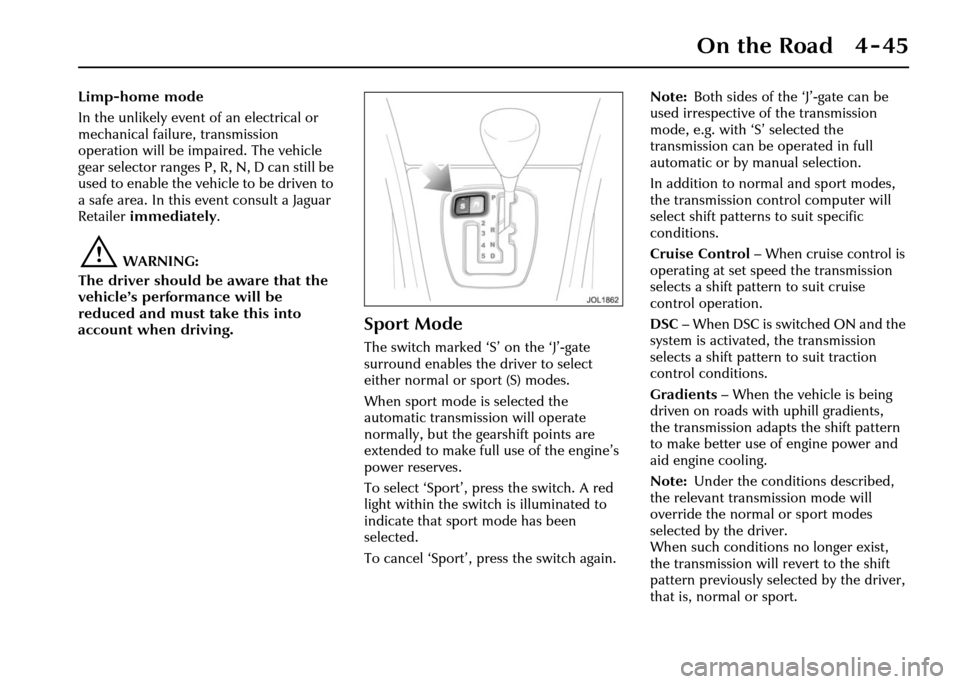
Sport Mode
The switch marked ‘S ’ on the ‘J’-gate
surround enables the driver to select
either normal or sport (S) modes.
When sport mode is selected the
automatic transmission will operate
normally, but the ge arshift points are
extended to make full use of the engine’s
power reserves.
To select ‘Sport’, press the switch. A red
light within the switch is illuminated to
indicate that sport mode has been
selected.
To cancel ‘Sport’, press the switch again. Note:
Both sides of the ‘J’-gate can be
used irrespective of the transmission
mode, e.g. with ‘S’ selected the
transmission can be operated in full
automatic or by manual selection.
In addition to norm al and sport modes,
the transmission control computer will
select shift patterns to suit specific
conditions.
Cruise Control – When cruise control is
operating at set speed the transmission
selects a shift pattern to suit cruise
control operation.
DSC – When DSC is switched ON and the
system is activated, the transmission
selects a shift pattern to suit traction
control conditions.
Gradients – When the vehicle is being
driven on roads with uphill gradients,
the transmission adapts the shift pattern
to make better use of engine power and
aid engine cooling.
Note: Under the conditions described,
the relevant transmission mode will
override the normal or sport modes
selected by the driver.
When such conditions no longer exist,
the transmission will revert to the shift
pattern previously selected by the driver,
that is, normal or sport.
Page 129 of 227

4-58 On the Road
Vehicle Suspension
This vehicle is fitted with a fully
automatic air suspension system.
It ensures that the vehicle is always at the
correct ride height with varying load
conditions, including luggage
compartment load or when towing.
The system will automatically adjust the
amount of air in the springs to level the
vehicle. Air is supplied either from an air
reservoir or a compressor.
The compressor will run periodically to
refill the reservoir.
Changes in ambient temperature will also
have an effect on vehicle height when the
vehicle is parked.
Caution:
1. Do not overload the vehicle. Vehicle load weights are shown
on page 8 - 4.
2. A slight air loss is expected over time causing the vehicle to lower,
so do not store or place anything
under the vehicle if it is to be left
for an extended period. Speed lowering
When driving at motorway speeds,
the system will lower the vehicle to
improve aerodynamics and vehicle
stability. The suspension will
automatically return the vehicle to the
normal height when the vehicle slows.
Caution: Speed lowering is
undesirable when towing.
Only Jaguar approved towing
equipment will not allow this feature.
Warning messages
If the message ‘VEHICLE TOO LOW’ is
displayed when the ignition is switched
on, start the engine and wait for the
suspension to raise. The vehicle should
not be driven until the message is
cleared.
If the message ‘VEHICLE TOO LOW’ is
displayed when driv
ing, restrict the
vehicle speed and wait for the system to
regain the correct height and the message
will then clear. If the message is displayed
frequently, it is advisable to inform your
Retailer to have the system attended to.
If the message ‘AIR SUSPENSION FAULT’
is displayed at any time, drive with
caution. Have the vehicle checked by a
Retailer at the earliest opportunity.
Note: If your vehicle needs to be
recovered by a roadside emergency
service ensure that the vehicle is securely
lashed by the wheels and NOT the body.
Page 133 of 227

4-62 On the Road
Towing a Trailer
Your Jaguar Retailer, and the main
motoring organisations can advise you on
towing, towing weight capacities and
about regulations that apply in other
countries.
The following are important points of
safety, stability and comfort upon which
further advice should be sought:
• Maximum braked towing weight is permissible, provided long periods of
uphill driving on gradients over 8%
are not undertaken.
• In high altitude mountainous regions, the thinner atmosphere can reduce
engine performance. Above 3280 feet
(1000 metres) the stipulated
maximum permitted gross train
weight must be reduced by 10% for
every 3280 feet (1000 metres) in
altitude.
• The kerbside weight of the vehicle can be found on page 8 - 4.
• When towing at the maximum permissible rear axle load keep within
legal towing speeds but in any case do
not exceed 62 mph (100 km/h). • Tyres must be inflated to the normal
(higher) pressures shown on the tyre
pressure label on the fuel filler flap.
• The recommended maximum tow-ball nose weight is shown
on page 8 - 5. Having a lower nose
weight or exceeding the maximum
nose weight limit may impair the
vehicle’s handling.
• When towing, the nose weight of the trailer and the tow-bar assembly must
be deducted from the permissible
maximum load, see page 8 - 5.
• Avoid heavy braking. As the overrun brake on the traile r is not connected
to the ABS, heavy trailer braking
could critically affect the stability of
the outfit as a whole.
• Ensure that the towing vehicle’s engine, transmission, suspension,
brakes and tyres are fully efficient and
regularly serviced. Similarly check the
wheels, tyres, brakes and wheel
bearings of the trailer. Caution:
1. When not in use, it is
recommended that the removable
tow-ball is either securely stowed
in the luggage compartment or,
preferably, not in the vehicle.
Do not leave it loose in the
vehicle.
2. It is essential that only a Jaguar tow-bar and Jaguar electrical tow-
bar kit are supplied and fitted by a
Jaguar Retailer. Contact your
Jaguar Retailer for details of
additional parts that are advised
to be fitted before towing. This is
particularly important with this
vehicle having air suspension.
If unapproved towing equipment
is used whilst towing, the air
suspension speed lowering
function will not be inhibited.
This may result in a change in
trailer weight distribution and
attitude.
Page 136 of 227

On the Road 4 - 65
Fuel capacity
Avoid the risk of running out of fuel and never intentionally
drive the car when the fuel gauge indicates that the tank is
empty. When refuelling your vehicle after the fuel gauge reads
empty, you may not be able to add the fuel quantity shown
below to the tank as there will be a small reserve remaining in
the tank.Fuel Economy
The following tips not only lead to greater fuel economy but also
reduce air pollution causing less environmental damage:
• Try to avoid using the car for short journeys – this will lead
to greater fuel economy and reduce wear on the engine.
• Plan ahead – choose uncongested routes, combine car trips and share cars where possible.
• Drive off as soon as possible after starting a cold engine – do not leave the engine idling until it has warmed up.
• Drive smoothly and efficiently – harsh acceleration and heavy braking have a significant effect on fuel
consumption – driving more smoothly saves fuel.
• Slow down – driving at high speeds significantly increases fuel consumption.
• Switch off – sitting stationary is zero miles per gallon, switch
off the engine when it is safe to do so.
• Unnecessary weight – do not carry unnecessary weight and remove roof-racks when not in use.
• Regular servicing keeps the engine at best efficiency.
• Ensure that tyres are inflated to the correct pressure for the journey.
• Use air conditioning and all vehicle electrical devices sparingly – all increase fuel consumption.
• Check your fuel consumption – it will help you get the most from your car and any significant change in consumption
may indicate a vehicle fault.
Normally
Aspirated
Supercharged
Tank capacity 22.4 US gallons
85 litres 22.3 US gallons
84.5 litres
Fill capacity (when fuel
gauge indicates empty) 20.9 US gallons
79 litres20.3 US gallons
77 litres
Reserve capacity (when fuel
gauge indicates empty) 1.5 US gallons
5.8 litres2.0 US gallons
7.5 litres
Page 139 of 227

4-68 On the Road
Catalytic Converters
A few precautions on the use of vehicles
fitted with catalytic converters are
necessary. These are:
1. In order to maintain the efficiency of the emission control system it is
essential that unleaded fuel is used.
Use of leaded fuel will seriously
damage the catalytic converters.
2. Heavy impact on the converter casings must be avoided.
3. The engine settings must not be altered; they have been established to
ensure that the vehicle will comply
with stringent exhaust emission
regulations. Incorrect engine settings
could cause unusually high catalytic
converter temperatures and thus
result in damage to the converter and
vehicle. If adjustment to the settings is
considered necessary, this should be
performed by a Jaguar Retailer. 4. A correctly tuned engine optimises
exhaust emissions, performance and
fuel economy and it is recommended
that the vehicle is regularly
maintained.
5. Do not continue to operate the vehicle if any engine malfunction is evident;
malfunctions should be rectified
immediately. For instance, misfire,
loss of engine performance, excessive
oil consumption or engine run-on may
lead to unusually high catalytic
converter temperatures and may
result in damage to the converters and
vehicle.
6. The use of catalytic converters increases exhaust system
temperatures, therefore, do not
operate or park the vehicle in areas
where combustible materials such as
dry grass or leaves may come into
contact with the exhaust system. 7. Do not run the engine with either a
spark plug lead disconnected or a
spark plug removed. Do not use any
device that requires an insert into a
spark plug hole in order to generate air
pressure e.g. tyre pump, paint spray
attachment etc., as this could also
result in catalyti c converter damage.
8. The vehicle is designed for normal road use. Below are examples of abuse
which could damage the catalytic
converters and vehicle. These may
lead to a dangerous condition due to
excessively high catalytic converter
temperatures.
• Competition or off-road use.
• Excessive engine speed.
• Overloading the vehicle.
• Switching off the engine whilst in gear.
Page 142 of 227

Climate Control 5 - 3
5 Climate Control
Introduction
The cabin is supplied with filtered air
from a fully automatic electronic climate
control system with manual overrides.
Two systems are available:
• A two zone system which allows the front occupants to set individual
temperatures for the left and right
sides of the interior.
• A four zone system which allows front and rear occupants to set individual
temperatures, i.e. two front zones and
two rear zones.
Occupant controls
The main climate control panel is located
in the centre console above the radio and
audio controls. There are two types of
control panel for either two or four zone
systems:
• A dedicated control panel with LCD (liquid crystal display) screen
(see page 5 - 6).
• A multi-function touch control and display unit shared with navigation
and other systems. Where this control
unit is fitted, refer to the Jaguar
Touch-screen Handbook for the
detailed operating instructions. Where the four zone climate control
system is fitted, an additional control/
display panel for rear passenger use is
located at the rear of the centre console,
between the front seats.
Voice control
The climate control system may also be
operated by spoken commands if the
optional voice activation system is fitted.
For full information on the use of this
system refer to the JaguarVoice
Handbook.
Recommended Operation
Automatic climate control
Automatic climate control provides
efficient regulation of the vehicle
environment without constant
adjustments from the occupant.
Sensors inside the vehicle monitor
temperature, humidity and direct
sunlight. In response, the electronic
control system automatically adjusts the
heat input, blower speed, air intake and
airflow distribution so as to maintain the
selected temperature(s) and reduce
misting.
Automatic operation provides optimum
comfort under most driving conditions. It is recommended that automatic
control (AUTO) is selected as the
normal operating mode.
Use of air conditioning
Air conditioning is an integral part of the
climate control system, providing cooled
and dehumidified
air for occupant
comfort; the dry airflow is also effective
in preventing misting of the windows.
While the air conditioner can be
manually switched off, it is recommended
that it is used in all climatic conditions
throughout the year, preferably in AUTO
mode.
Close all windows and the sunroof when
the air conditioning is on to ensure
satisfactory operation.
Use of air recirculation
The air conditioner/heater system is
supplied with fresh air via an intake flap.
Closing the flap causes the air inside the
vehicle to be recirculated. This helps to
prevent unpleasant odours from being
drawn into the vehicle and also to
improve the performance of the air
conditioner in very hot conditions.
However, the use of recirculated air will
cause screen misting after a short period
and should only be used as necessary.
Page 143 of 227

5 - 4 Climate Control
In AUTO mode, the air intake flap is
controlled automatically. If required,
air recirculation may be manually
selected for either a short or indefinite
period.
Air Recirculation
Timed air recirculationPress the button briefly to select
timed air recirculation.
The fresh air intake is opened
and the button LED extinguished at the
end of the time out period.
Latched air re circulation
Press and hold the button for a
few seconds to select latched air
recirculation. Selection is
indicated by the scre en symbol and two
beeps.
Selecting latched air recirculation cancels
AUTO operation.
To deselect latched air recirculation,
press the recirculat ion button again,
or select AUTO.
!WARNING:
To prevent humidity build up inside
the vehicle and possible screen
misting, avoid driving with the air
conditioning system off or with
manual air recirculation selected for
prolonged periods.
General Points
To ensure the satisfactory operation of
the climate control system, note the
following points:
• Ensure that the external grille at the base of the windscreen, which
provides fresh air for the climate
control system, is kept clear of leaves,
snow or obstructions.
• A solar sensor is mounted on the centre top of the fascia, as shown
opposite ( A) . E n s u r e t h a t this sensor is
not covered.
• Temperature and humidity sensors are located behind the small grille ( B).
Do not cover or obstruct the opening.
• Air ducts under the front seats supply the rear passenger footwells (see
illustration opposite). Objects or
material placed under the seats may
block or obstruct the open ducts. • The external air intake to the air
conditioner/heater system is fitted
with a filter. Ensure that the filter is
changed at the specified service
intervals to maintain efficient
operation.
• If the air conditioning system is not used frequently, it should be run
briefly at least once each week, with a
cold setting, to prevent the seals from
drying out with subsequent
refrigerant leaks.
• Moisture removed from the air by the air conditioning unit is discharged
onto the road underneath the vehicle.
After stopping, puddles of water may
form underneath the vehicle.
Air Distribution
The illustration opposite shows the
location of the air vents within the
vehicle. The airflow from the fascia face
level vents is regulated using thumbwheel
controls and adjustable direction vanes.
Air distribution between the windscreen,
fascia and floor levels is selected
automatically when operating in AUTO
mode but can be selected manually.