2004 JAGUAR XJ warning
[x] Cancel search: warningPage 171 of 227

6 - 20 Roadside Emergency
Fire Extinguisher
Many countries make it compulsory to
carry a fire extinguisher. Your Jaguar
Retailer can supply and fit one.
Mexican vehicles have a factory fitted fire
extinguisher which contains 2.2 lbs (1 kg)
of BC powder pressurised with nitrogen
to a working pressure of 180 psi (12 bar)
at 68°F (20°C).
This extinguisher can be used on liquid
fires, electrical equipment fires and, if no
explosion risk, gaseous fires.
!WARNING:
1. Do not test the fire extinguisher prior to use. Partial discharge will
render the extinguisher
inoperative.
2. Do not use the fire extinguisher closer than 8 feet (2.4 m) to the
base of a liquid fire as the force
may splatter the burning liquid to
the surrounding area. To operate the fire extinguisher:
1. Unclip and remove the extinguisher
from the bracket.
2. Put your finger through the yellow safety wedge ring ( A) and pull hard to
remove the wedge. The operating
lever will be exposed.
3. Hold the extinguisher upright and aim at the base of the fire.
4. Press the lever down firmly.
5. Release the lever to stop the flow of powder. Maintenance
Every six months:
• Remove the extinguisher from its
bracket and check that the nozzle is
clear.
• Check that the safety wedge strap ( B)
is secure.
• Check the pressure gauge on the base of the extinguisher. If the gauge is in
the red area report it to your Jaguar
Retailer immediately as the
extinguisher may not work in an
emergency.
Page 172 of 227

Roadside Emergency 6 - 21
Fuses and Fuse Boxes
Do not fit a new fuse if the wiring is
damaged; contact a Jaguar Retailer.
After renewing a fuse have the circuit
checked by a Jaguar Retailer.
Two types of fuses are fitted in the fuse
boxes, ATO type and Midi type.
Spare fuses and a special tool for
removing and replacing fuses are located
on a removable panel clipped to the rear
of the trunk ( A).
Use only the spare fuses supplied. If a
spare fuse is used, renew it with a Jaguar
approved fuse of the same amperage
rating.
Checking and Renewing a
Blown Fuse
Make sure the new fuse is the correct
rating (amperage).
Fuses are colour coded according to the
amperage and the rating is also marked
on each fuse.
Caution: When a fuse box lid is
removed, take care to protect the box
from moisture, and refit the lid at the
earliest opportunity. ATO-fuse replacement
Push the tool on to the suspect ATO fuse
and withdraw the fuse. If the wire in the
fuse is broken, the fuse has blown.
Fit a new fuse using the tool.
Midi fuse replacement
(not shown)
Unscrew the two nuts and remove the
fuse. Note that the fuse is supplied
directly from the battery +ve; take care
not to short a spanner or other metal tool
to the chassis when removing the nuts.!WARNING:
1. Do not fit a fuse of a different amperage from that removed.
The electrical circuits may
become overloaded with the
subsequent possibility of a fire.
2. No attempt should be made to repair a fuse that has blown as this
may cause a fire hazard or serious
damage elsewhere in the
electrical circuit.
Page 184 of 227

Maintenance
Regular Checks . . . . . . . . . . . . . . . . . . . . . . . . . . 7 - 3
Hood Release . . . . . . . . . . . . . . . . . . . . . . . . . . . 7 - 4
Checking and Top Up . . . . . . . . . . . . . . . . . . . . . 7 - 6
Check Engine Oil Level . . . . . . . . . . . . . . . . . . . . 7 - 6
Check Power Steering Fluid Level . . . . . . . . . . . . 7 - 8
Check Brake Fluid Reservoir . . . . . . . . . . . . . . . . 7 - 9
Check Windscreen/Headlight Washer Reservoir. . . . . . . . . . . . . . . . . . . . . . . . . . . 7 - 10
Check Coolant Level . . . . . . . . . . . . . . . . . . . . . 7 - 11
Capacities . . . . . . . . . . . . . . . . . . . . . . . . . . . . . 7 - 12
Battery . . . . . . . . . . . . . . . . . . . . . . . . . . . . . . . 7 - 13
Battery Warning Signs. . . . . . . . . . . . . . . . . . . . 7 - 14
Check/Top Up Battery Electrolyte . . . . . . . . . . . 7 - 15
Windscreen Wipers . . . . . . . . . . . . . . . . . . . . . 7 - 17
Tyres . . . . . . . . . . . . . . . . . . . . . . . . . . . . . . . . 7 - 18
Tyre Pressures . . . . . . . . . . . . . . . . . . . . . . . . . 7 - 18
Vehicle Care . . . . . . . . . . . . . . . . . . . . . . . . . . . 7 - 22
Interior Care . . . . . . . . . . . . . . . . . . . . . . . . . . . 7 - 22
Exterior Care . . . . . . . . . . . . . . . . . . . . . . . . . . 7 - 23
Electrical Accessories . . . . . . . . . . . . . . . . . . . . 7 - 25
Page 186 of 227

Maintenance 7 - 3
7 Maintenance
Regular Checks
In the interests of safety and reliability,
it is advisable to carry out the following
checks at the recommended intervals,
and always before starting on a long
journey.
Daily
Check that there is sufficient fuel for the
journey intended, particularly at night
and before joining motorways.
Weekly
Tyres– Check the tyres, including the
spare, for condition and pressure.
Tyre pressures are explained on page 8 - 8
and shown on a label inside the fuel filler
flap.
Lights – Check that all exterior lights and
direction indicators function correctly
and that the lenses are clean.
Engine oil – With the vehicle standing
on level ground, check the oil level and
top up if necessary with oil of the correct
grade.
Engine coolant – With the engine cold,
check the level of the coolant in the
coolant reservoir header tank. Any loss of
fluid must be checked by a Jaguar
Retailer. Brake fluid
– Check the level of the fluid
in the brake fluid reservoir. Top up if
necessary with new, unused Jaguar
approved brake fluid.
The reservoir is initially nearly full,
but the level will drop as the brake pads
wear. If the level appears unusually low,
location of the fluid leakage must be
checked by a Jaguar Retailer.
Power steering fluid – With the engine
cold, check the level of the fluid in the
power steering fluid reservoir. Top up if
necessary with fluid of the correct
specification. Any loss of fluid should be
checked by a Jaguar Retailer.
Windscreen washer fluid – Top up
with windscreen washer fluid and clean
soft water. Check the operation of the
washers. It is recommended that you
use Jaguar Windscreen Washer Fluid to
keep the glass clean and also to prevent
the fluid from freezing during cold
weather.
Monthly
Wiper blades – Check the quality of the
wipe. If smearing or juddering is evident,
clean the windscreen and wiper blades.
Used Engine Oil
!WARNING:
Prolonged and repeated contact may
cause serious skin disorders,
including dermatitis and cancer.
Always use a hand cream to protect the
skin from oil contamination.
Avoid contact with the skin as far as
possible and wash thoroughly after any
contact. Keep oils out of reach of
children.
PROTECT THE ENVIRONMENT: It is
illegal to pollute drai ns, watercourses and
soil. Use authorised waste collection
facilities, including civic amenity sites and
garages providing fa cilities for the
disposal of used oi l, oil filters and
batteries. If in doubt, contact your Local
Authority for advice on disposal.
Page 187 of 227

7 - 4 Maintenance
Hood Release
!WARNING:
Take care to keep away from rotating components if the
engine is running when you open the hood.
Release the hood lock by pullin g the lever below the fascia on
the left-hand side of the vehicle.
Lift the hood slightly and push the safety catch, located under
the centre of the front edge of th e hood. The gas filled struts will
assist raising the hood, and retain it in the fully open position.
!WARNING:
Before closing the hood ensure that no-one is obstructing
the closing area and that hands and clothes are clear.
Remove tools, cleaning cloths, etc., from the engine
compartment.
Close the hood to within a distance of 12 to 14 inches
(30 to 35 cm) of the fully closed position, then let go to allow
the hood to shut. Check by pulling the hood that both the right-
hand and left-hand latches are engaged.
Page 191 of 227

7 - 8 Maintenance
Check Power Steering Fluid
Level
Caution: It is imperative that the
power steering system does not
become contaminated in any way.
Always dispense fluid from a fresh
sealed container and clean the area
around the reservoir neck both
before and after topping up.
Never return drained fluid to the
system.Refer to page 7 - 5 for power steering fluid
reservoir location.
Check the fluid level when the engine is
‘COLD’ and the vehicle is on a flat, level
surface.
The fluid is visible through the
translucent casing of the reservoir.
Check that the fluid level is between the
MIN and MAX marks on the side of the
reservoir.
If necessary, top up with power steering
fluid as specified by your Jaguar Retailer.
Wipe clean and remove the filler cap
from the reservoir;
take great care to
prevent any foreign matter from entering.
DO NOT OVERFILL.
Refit the filler cap.
Should the level be ve ry low, report the
loss of fluid to the nearest Jaguar Retailer.
!WARNING:
1. Do not allow power steering fluid to make contact with skin or eyes.
If this happens, rinse the affected
area immediately with plenty of
water.
2. Power steering fluid is toxic and flammable. Be sure to observe all
warnings indicated on the power
steering fluid container.
Page 192 of 227

Maintenance 7 - 9
Check Brake Fluid Reservoir
Refer to page 7 - 5 for brake fluid reservoir
location. The brake fluid reservoir is
concealed by a lift-out cover.
To remove the lift-out cover, pull the two
clips on the rear edge of the cover
towards the front of the car, and lift the
cover out.
Caution:
1. While handling brake fluid, take extreme care; brake fluid must not
contact the vehicle paintwork.
2. Always use fresh, clean fluid from a new container. Never introduce
used brake fluid into the system. The fluid is visible through the
translucent casing of the reservoir and
must be maintained at the ‘MAX’ mark.
!WARNING:
The fluid level will drop as the brake
pads wear. If the le vel is very low
report the loss of fluid to the nearest
Jaguar Retailer. Do not drive the
vehicle until the cause is rectified.
If necessary, top up as follows:
Before removing the cap, clean the
reservoir and cap thoroughly with a non-
fluffy cloth to ensure that no foreign
matter enters the reservoir.
Unscrew the filler cap and top up to the
‘MAX’ level using brake fluid to
specification Jaguar Super DOT 4
(ESA-M6C25-A) .
Refit the filler cap securely.
To avoid contamination should any brake
fluid be spilt, replace the cap on the
reservoir before cleaning the spilt fluid
from the vehicle. Hydraulic fluid
The brake hydraulic fluid in the master
cylinder and brake operating system uses
non-mineral polyglycol based brake fluid
with a minimum standard of JAGUAR
SUPER DOT 4. ONLY FLUID OF THIS
TYPE AND STANDARD MAY BE USED.
!WARNING:
1. Contamination of the brake system fluid by as little as
1 per cent will cause rapid
deterioration of t he system seals.
Ensure that the brake fluid
reservoir cap is securely fitted.
2. Do not allow brake fluid to make contact with skin or eyes. If this
happens, rinse the affected area
immediately with plenty of water.
3. Brake fluid is toxic and flammable. Be sure to observe all warnings
indicated on the brake fluid
container.
Page 193 of 227
7-10 Maintenance
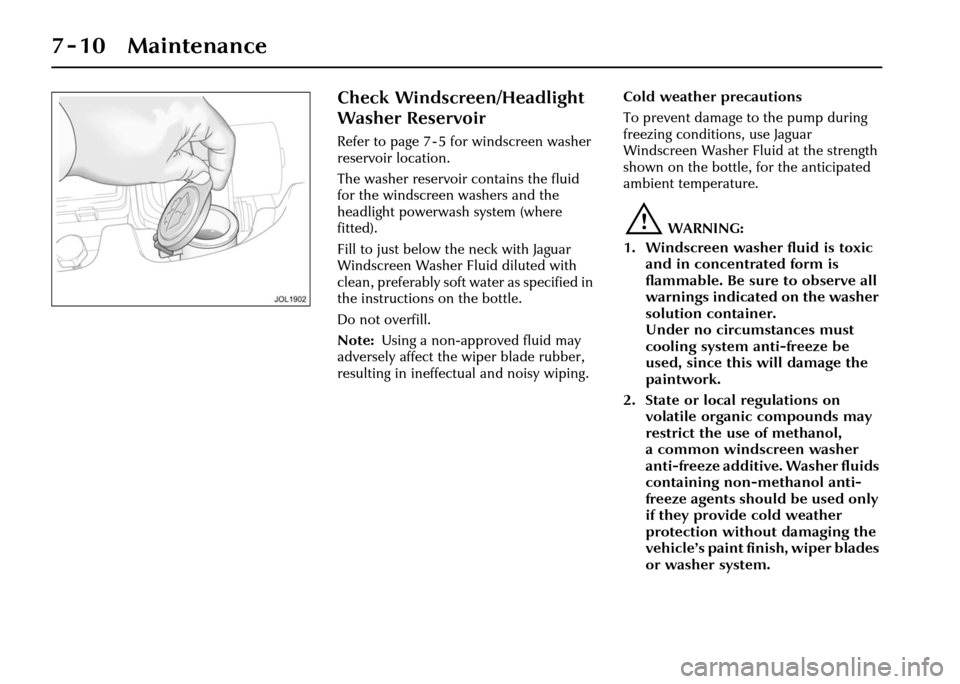
Check Windscreen/Headlight
Washer Reservoir
Refer to page 7 - 5 for windscreen washer
reservoir location.
The washer reservoir contains the fluid
for the windscreen washers and the
headlight powerwash system (where
fitted).
Fill to just below th e neck with Jaguar
Windscreen Washer Fl uid diluted with
clean, preferably soft water as specified in
the instructions on the bottle.
Do not overfill.
Note: Using a non-approved fluid may
adversely affect the wiper blade rubber,
resulting in ineffectual and noisy wiping. Cold weather precautions
To prevent damage to the pump during
freezing conditions, use Jaguar
Windscreen Washer Fluid at the strength
shown on the bottle, for the anticipated
ambient temperature.
!WARNING:
1. Windscreen washer fluid is toxic and in concentrated form is
flammable. Be sure to observe all
warnings indicated on the washer
solution container.
Under no circumstances must
cooling system anti-freeze be
used, since this will damage the
paintwork.
2. State or local regulations on volatile organic compounds may
restrict the use of methanol,
a common windscreen washer
anti-freeze additive. Washer fluids
containing non-methanol anti-
freeze agents should be used only
if they provide cold weather
protection without damaging the
vehicle’s paint finish, wiper blades
or washer system.