2004 Hyundai Sonata severe
[x] Cancel search: severePage 3 of 208
A010A02A-AATWARRANTIES FOR YOUR HYUNDAI VEHICLE
o New Vehicle 60 Months/60,000 Miles Limited Warranty
o New Vehicle 120 Months/100,000 Miles Limited Powertrain Warranty (original owner only)
o Anti-Perforation Limited Warranty
o Emission Defect Warranty - Federal Vehicle
o California Emission Control System Warranty (if applicable)
o Emission Performance Warranty - Federal Vehicle
o Replacement Parts and Accessories Limited Warranty
NOTE:Detailed warranty information is provided in your Hyundai Owner's Handbook.
A020A01A-AAT
RESPONSIBILITY FOR MAINTENANCE
The maintenance requirements for your new Hyundai are found in Section 5. As the owner, it is your responsibility
to see that all maintenance operations specified by the manufacturer are carried out at the appropriate intervals.
When the vehicle is used in severe driving conditions, more frequent maintenance is required for some operations.
Maintenance requirements for severe operating conditions are also included in Section 5.
Page 5 of 208
A040A01A-AAT
FOREWORD
Thank you for choosing Hyundai. We are pleased to welcome you to the growing number of discriminating people who
drive Hyundais. The advanced engineering and high-quality construction of each Hyundai we build is something of which
we're very proud.
Your Owner's Manual will introduce you to the features and operation of your new Hyundai. It is suggested that you read
it carefully since the information it contains can contribute greatly to the satisfaction you receive from your new car.
The manufacturer also recommends that all service and maintenance on your car be performed by an authorized Hyundai
dealer. Hyundai dealers are prepared to provide high-quality service, maintenance and any other assistance that may
be required.
A050A04A-AATHYUNDAI MOTOR COMPANY
Note:Because future owners will also need the information included in this manual, if you sell this Hyundai, please leave
the manual in the vehicle for their use. Thank you.
CAUTION:Severe engine and transaxle damage may result from the use of poor quality fuels and lubricants that do not
meet Hyundai specifications. You must always use high quality fuels and lubricants that meet the specifica-
tions listed on Page 9-3 in the Vehicle Specifications section of the Owner's Manual and which also appear
in the Service Station Information on the back cover of the Owner's Manual.
Copyright 2003 Hyundai Motor Company. All rights reserved. No part of this publication may be reproduced, stored in
any retrieval system or transmitted in any form or by any means without the prior written permission of Hyundai Motor
Company.
!
Page 23 of 208
FEATURES OF YOUR HYUNDAI 1- 11
!
B080C01A-AATAdjusting Seatback Angle
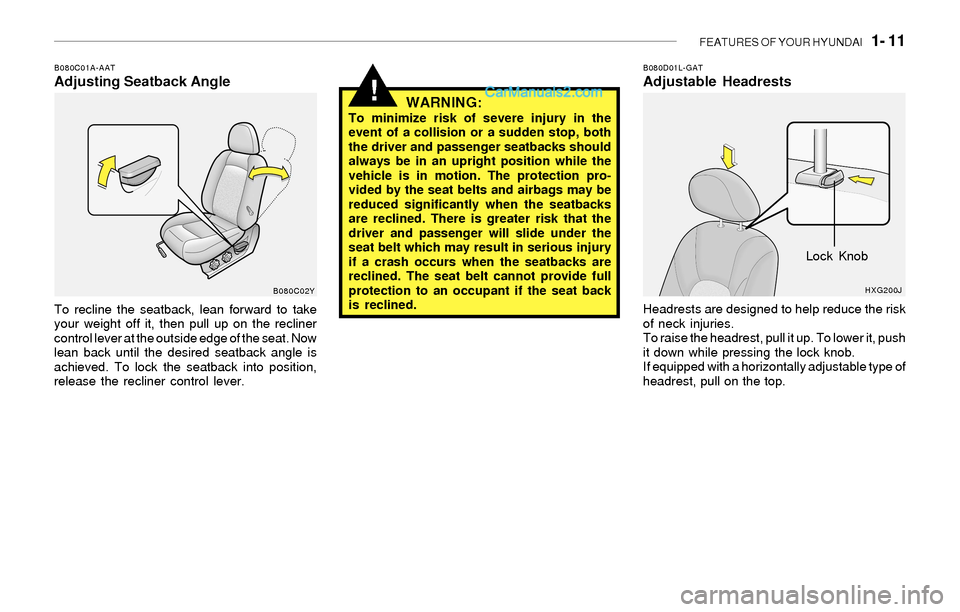
To recline the seatback, lean forward to take
your weight off it, then pull up on the recliner
control lever at the outside edge of the seat. Now
lean back until the desired seatback angle is
achieved. To lock the seatback into position,
release the recliner control lever.
WARNING:To minimize risk of severe injury in the
event of a collision or a sudden stop, both
the driver and passenger seatbacks should
always be in an upright position while the
vehicle is in motion. The protection pro-
vided by the seat belts and airbags may be
reduced significantly when the seatbacks
are reclined. There is greater risk that the
driver and passenger will slide under the
seat belt which may result in serious injury
if a crash occurs when the seatbacks are
reclined. The seat belt cannot provide full
protection to an occupant if the seat back
is reclined.
B080D01L-GATAdjustable Headrests
Headrests are designed to help reduce the risk
of neck injuries.
To raise the headrest, pull it up. To lower it, push
it down while pressing the lock knob.
If equipped with a horizontally adjustable type of
headrest, pull on the top.
B080C02YHXG200J
Lock Knob
Page 24 of 208
1- 12 FEATURES OF YOUR HYUNDAI
B080E01Y-AATLumbar Support Control
(Driver's seat only) (If installed)
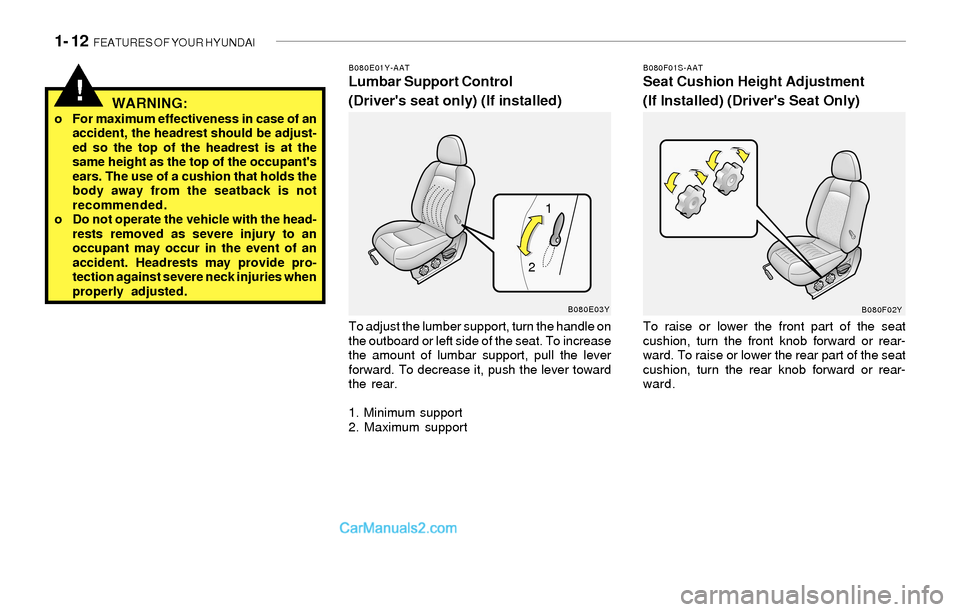
To adjust the lumber support, turn the handle on
the outboard or left side of the seat. To increase
the amount of lumbar support, pull the lever
forward. To decrease it, push the lever toward
the rear.
1. Minimum support
2. Maximum support
B080F01S-AATSeat Cushion Height Adjustment
(If Installed) (Driver's Seat Only)
To raise or lower the front part of the seat
cushion, turn the front knob forward or rear-
ward. To raise or lower the rear part of the seat
cushion, turn the rear knob forward or rear-
ward.
WARNING:o For maximum effectiveness in case of an
accident, the headrest should be adjust-
ed so the top of the headrest is at the
same height as the top of the occupant's
ears. The use of a cushion that holds the
body away from the seatback is not
recommended.
o Do not operate the vehicle with the head-
rests removed as severe injury to an
occupant may occur in the event of an
accident. Headrests may provide pro-
tection against severe neck injuries when
properly adjusted.
B080E03Y
B080F02Y
!
1
2
Page 34 of 208

1- 22 FEATURES OF YOUR HYUNDAI
!
B230A02Y-AATCHILD RESTRAINT SYSTEM
Children riding in the car should sit in the rear
seat and must always be properly restrained to
minimize the risk of injury in an accident, sudden
stop or sudden maneuver. According to acci-
dent statistics provided by the National High-
way Traffic Safety Administration (NHTSA),
children are safer when properly restrained in
the rear seats than in the front seat. Larger
children should use one of the seat belts pro-
vided.
All 50 states have child restraint laws. You
should be aware of the specific requirements in
your state. Child and/or infant safety seats must
be properly placed and installed in the rear seat.
You must use a commercially available child
restraint system that meets the requirements of
the Federal Motor Vehicle Safety Standards
(FMVSS).
Children could be injured or killed in a crash if
their restraints are not properly secured. For
small children and babies, a child seat or infant
seat must be used. Before buying a particular
child restraint system, make sure it fits your car
and seat belts, and fits your child. Follow all the
instructions provided by the manufacturer when
installing the child restraint system.WARNING:o A child restraint system must be placed
in the rear seat. Never install a child or
infant seat on the front passenger's seat.
Should an accident occur and cause the
passenger side airbag to deploy, it could
severely injure or kill an infant or child
seated in an infant or child seat. thus,
only use a child restraint in the rear seat
of your vehicle.
o Since a safety belt or child restraint sys-
tem can become very hot if it is left in a
closed vehicle, be sure and check the
seat cover and buckles before placing a
child there.
o When the child restraint system is not in
use, store it in the trunk or fasten it with
a safety belt so that it will not be thrown
forward in the case of a sudden stop or
an accident.
o Children who are too large to be in a child
restraint should still sit in the rear seat
and be restrained with the available lap/
shoulder belts. Never allow children to
ride in the front passenger seat.
o Always make sure that the shoulder belt
portion of the lap/shoulder belt is posi-
tioned midway over the shoulder and
never across the neck or behind the
back. Moving the child closer to the
center of the vehicle may help provide a
good shoulder belt fit. The lap belt por-tion of the lap/shoulder belt must always
be positioned as low as possible on the
child's hips, and as snug as possible.
o If the seat belt will not properly fit the
child, we recommend the use of an ap-
proved booster seat in the rear seat in
order to raise the child's seating height
so that the seat belt will properly fit the
child.
Before purchasing a booster seat, make
sure that it meets applicable Federal
Motor Vehicle Safety Standards and that
it is satisfactory for use with this vehicle.
o Never allow a child to stand up or kneel
on the seat.
o Never use an infant carrier or a child
safety seat that "hooks" over a seatback;
it may not provide adequate security in
an accident.
o Never allow a child to be held in a person's
arms while they are in a moving vehicle,
as this could result in serious injury to
the child in the event of an accident or a
sudden stop. Holding a child in a moving
vehicle does not provide the child with
any means of protection during an acci-
dent, even if the person holding the child
is wearing a seat belt.
Page 36 of 208

1- 24 FEATURES OF YOUR HYUNDAI
!
!
B230G03Y-AATInstallation on Rear Seats
WARNING:
If the tether strap is clipped incorrectly, the
child restraint seat may not be restrained
properly in the event of a collision.
6. Tighten the tether strap to secure the seat.
To install a child restraint system in the rear
seats, extend the shoulder/lap belt entirely from
its retractor until a "click" is felt. This will engage
the seat belt retractor automatic locking feature,
which allows the seat belt to retract but not
extend. Install the child restraint system, buckle
the seat belt and allow the seat belt to take up
any slack. Make sure that the lap portion of the
belt is tight around the child restraint system and
the shoulder portion of the belt is positioned so
that it can not interfere with the child's head or
neck. Also, double check to be sure that the
retractor has engaged the Automatic Locking
feature by trying to extend webbing out of the
retractor. If the retractor is in the Automatic
Locking mode, the belt will be locked. After
installation of the child restraint system, try to
move it in all directions to be sure the childrestraint system is securely installed. If you
need to tighten the belt, pull more webbing
toward the retractor. When you unbuckle the
seat belt and allow it to retract, the retractor will
automatically revert back to its normal seated
passenger Emergency Locking usage condi-
tion.
NOTE:o Before installing the child restraint sys-
tem in any seating position, read the
instructions supplied by the child re-
straint system manufacturer.
o If the seat belt does not operate as de-
scribed, have the system checked imme-
diately by your authorized Hyundai
dealer.
WARNING:o If the retractor is not in the Automatic
Locking mode, the child restraint sys-
tem can move when your vehicle turns or
stops abruptly.
o Do not install any child restraint system
in the front passenger seat. Should an
accident occur and cause the passenger
side airbag to deploy, it could severely
injure or kill an infant or child seated in
an infant or child seat. Therefore, only
use a child restraint system in the rear
seat of your vehicle.
B235G01Y
Page 38 of 208
1- 26 FEATURES OF YOUR HYUNDAI
!
!WARNING:If the child restraint seat is not anchored
properly, the risk of a child being seriously
injured or killed in a collision greatly in-
creases.
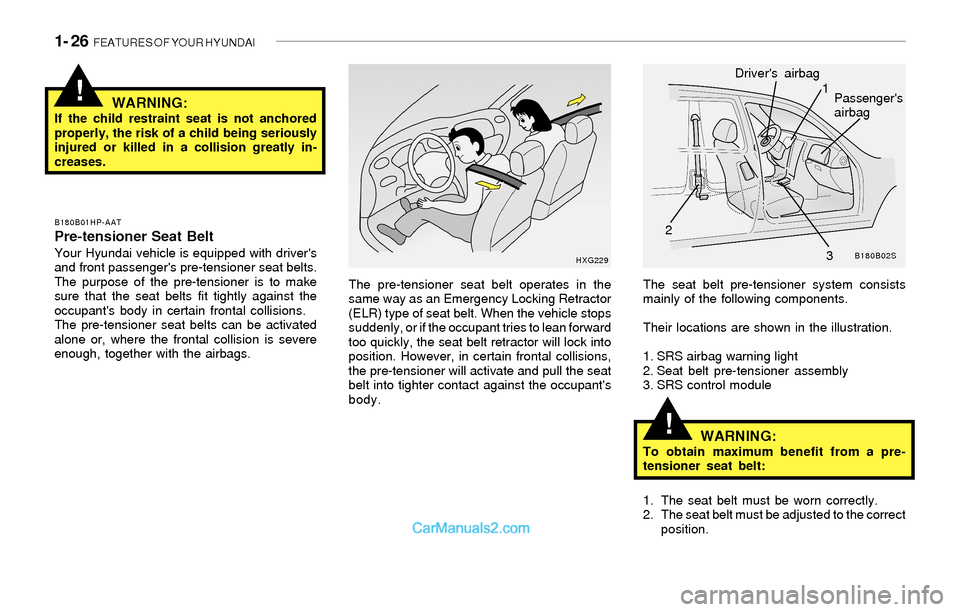
The pre-tensioner seat belt operates in the
same way as an Emergency Locking Retractor
(ELR) type of seat belt. When the vehicle stops
suddenly, or if the occupant tries to lean forward
too quickly, the seat belt retractor will lock into
position. However, in certain frontal collisions,
the pre-tensioner will activate and pull the seat
belt into tighter contact against the occupant's
body.The seat belt pre-tensioner system consists
mainly of the following components.
Their locations are shown in the illustration.
1. SRS airbag warning light
2. Seat belt pre-tensioner assembly
3. SRS control module
B180B01HP-AATPre-tensioner Seat Belt
Your Hyundai vehicle is equipped with driver's
and front passenger's pre-tensioner seat belts.
The purpose of the pre-tensioner is to make
sure that the seat belts fit tightly against the
occupant's body in certain frontal collisions.
The pre-tensioner seat belts can be activated
alone or, where the frontal collision is severe
enough, together with the airbags.
WARNING:To obtain maximum benefit from a pre-
tensioner seat belt:
1. The seat belt must be worn correctly.
2. The seat belt must be adjusted to the correct
position.
HXG229B180B02S
1
2
3 Driver's airbag
Passenger's
airbag
Page 39 of 208

FEATURES OF YOUR HYUNDAI 1- 27
NOTE:o Both the driver's and front passenger's
pre-tensioner seat belts will be activated
in certain frontal collisions. The pre-
tensioner seat belts can be activated
alone or, where the frontal collision is
severe enough, together with the
airbags.
o When the pre-tensioner seat belts are
activated, a loud noise may be heard and
fine dust, which may appear to be smoke,
may be visible in the passenger com-
partment. These are normal operating
conditions and are not hazardous.
o Although it is harmless, the fine dust
may cause skin irritation and should not
be breathed for prolonged periods. Wash
your hands and face thoroughly after an
accident in which the pre-tensioner seat
belts were activated.
CAUTION:o Because the sensor that activates the
SRS airbag is connected with pre-
tensioner seat belt, the SRS airbag warn-
ing light on the instrument panel will
blink for approximately 6 seconds after
the ignition key has been turned to the
"ON" position, and then it should turn
off.
o If the pre-tensioner seat belt is not work-
ing properly, this warning light will illu-
minate even if there is no malfunction of
SRS airbag system. If the SRS airbag
warning light does not illuminate when
the ignition key is turned to "ON" or if it
remains illuminated after blinking for
approximately 6 seconds, or if it illumi-
nates while the vehicle is being driven,
please have an authorized Hyundai dealer
inspect the pre-tensioner seat belt or
SRS airbag system as soon as possible.
!
AIR
BAG
WARNING:o Pre-tensioners are designed to operate
only one time. After activation, pre-
tensioner seat belts must be replaced.
All seat belts, of any type, should always
be replaced after they have been worn
during a collision.
o The pre-tensioner seat belt assembly
mechanisms become hot during activa-
tion. Do not touch the pre-tensioner seat
belt assemblies for several minutes after
they have been activated.
o Do not attempt to inspect or replace the
pre-tensioner seat belts yourself. This
must be done by an authorized Hyundai
dealer.
o Do not strike the pre-tensioner seat belt
assemblies.
o Do not attempt to service or repair the
pre-tensioner seat belt system in any
manner.
o Improper handling of the pre-tensioner
seat belt assemblies, and failure to heed
the warnings to not strike, modify, in-
spect, replace, service or repair the pre-
tensioner seat belt assemblies may lead
to improper operation or inadvertent
activation and serious injury.
o Always wear the seat belts when driving
or riding in a motor vehicle.
!