2004 Hyundai Sonata tire
[x] Cancel search: tirePage 142 of 208

WHAT TO DO IN AN EMERGENCY 3- 9
D080A01A-AATIF YOUR CAR MUST BE TOWEDD060I01Y-AAT8. Lower Vehicle and Tighten NutsD060J01A-AATAfter Changing Wheels
Lower the car to the ground by turning the jack
handle counterclockwise. Then position the
wrench as shown in the drawing and tighten the
wheel nuts. Be sure the socket is seated com-
pletely over the nut. Do not stand on the wrench
handle or use an extension pipe over the wrench
handle.
Go around the wheel tightening every other nut
until they are all tight. Then double-check each
nut for tightness and reinstall the wheel cover.
After changing wheels, have a technician tighten
the wheel nuts to their proper torque as soon as
possible.
Wheel nut tightening torque:Steel wheel & aluminium alloy wheel:
65-80 lb.ft (900-1,100 kg.cm)If you have a tire gauge, remove the valve cap
and check the air pressure. If the pressure is
lower than recommended, drive slowly to the
nearest service station and inflate to the correct
pressure. If it is too high, adjust it until it is correct.
Always reinstall the valve cap after checking or
adjusting tire pressure. If the cap is not re-
placed, air may leak from the tire. If you lose a
valve cap, buy another and install it as soon as
possible.
After you have changed wheels, always secure
the flat tire in its place in the trunk and return the
jack, jack handle, and tools to their proper
storage locations.
CAUTION:Your car can be damaged if towed incor-
rectly!
If your car has to be towed, it should be done by
your Hyundai dealer or a commercial tow truck
service. This will help assure that your car is not
damaged in towing. Also, professionals are
generally aware of state and local laws govern-
ing towing. In any case, rather than risk damage
to your car, it is suggested that you show this
information to the tow truck operator. Be sure
that a safety chain system is used and that all
state and local laws are observed.
!
o OK FOR AUTOMATIC OR MANUAL
TRANSAXLE EQUIPPED VEHICLE
D060D02Y
D040B01YHEF-209
Page 147 of 208
CORROSION PREVENTION AND APPEARANCE CARE 4- 3
E020E01A-AATDon't Neglect the Interior
Moisture can collect under the floor mats and
carpeting to cause corrosion. Check under the
mats periodically to be sure the carpeting is dry.
Use particular care if you carry fertilizers, clean-
ing materials or chemicals in the car.
These should be carried only in proper contain-
ers and any spills or leaks should be cleaned up,
flushed with clear water and thoroughly dried.
E020D01A-AATKeep Paint and Trim in Good Condition
Scratches or chips in the finish should be
covered with "touch-up" paint as soon as pos-
sible to reduce the possibility of corrosion. If
bare metal is showing through, the attention of
a qualified body and paint shop is recommended.
E020C01A-AATKeep Your Garage Dry
Don't park your car in a damp, poorly ventilated
garage. This creates a favorable environment
for corrosion. This is particularly true if you
wash your car in the garage or drive it into the
garage when it is still wet or covered with snow,
ice or mud. Even a heated garage can contrib-
ute to corrosion unless it is well ventilated so
moisture is dispersed.
E030A01A-AATWASHING AND WAXING
Washing Your Hyundai
Never wash your car when the surface is hot
from being in the sun. Always wash your car in
the shade.
Wash your car frequently. Dirt is abrasive and
can scratch the paint if it is not removed. Air
pollution or acid rain may damage the paint and
trim through chemical action if pollutants are
allowed to remain in contact with the surface. If
you live near the ocean or in an area where road
salts or dust control chemicals are used, you
should pay particular attention to the underside
of the car. Start by rinsing the car to remove dust
and loose dirt. In winter, or if you have driven
through mud or muddy water, be sure to thor-
oughly clean the underside as well. Use a hard
direct stream of water to remove accumulations
of mud or corrosive materials. Use a good
quality car-washing solution and follow the
manufacturer's directions on the package.
These are available at your Hyundai dealer or
auto parts outlet. Don't use strong household
detergents, gasoline, strong solvents or abra-
sive cleaning powders as these may damage
the finish.
Use a clean sponge or cloth, rinse it frequently
and don't damage the finish by rubbing too hard.
For stubborn spots, dampen them frequently
and remove them a little at a time.
To clean whitewall tires, use a stiff brush or
soapy steel-wool scouring pad.To clean plastic wheel covers, use a clean
sponge or soft cloth and water.
To clean cast aluminum alloy wheels, use a mild
soap or neutral detergent. Do not use abrasive
cleaners. Protect the bare-metal surfaces by
cleaning, polishing and waxing. Because alumi-
num is subject to corrosion, be sure to give
aluminum alloy wheels special attention in win-
ter. If you drive on salted roads, clean the
wheels thoroughly afterwards.
After washing, be sure to rinse thoroughly. If
soapy water dries on the finish, streaking will
result.
When the weather is warm and the humidity low,
you may find it necessary to rinse each section
immediately after washing to avoid streaking.
After rinsing, dry the car using a damp chamois
or soft, absorbent cloth. The reason for drying
the car is to remove water from the car so it will
dry without water spots. Don't rub, this can
damage the finish.
If you find any nicks or scratches in the paint,
use touch-up paint to cover them to prevent
corrosion. To protect the paintwork of the car
against corrosion, you must clean your Hyundai
(at least once a month). Give special attention
to the removal of salt, mud and other sub-
stances on the underside of the splashboards
of the car. Make sure that the outlets and the
Page 162 of 208
6- 4 DO-IT-YOURSELF MAINTENANCE
G020C01A-AATVehicle Interior
The following should be checked each time
when the vehicle is driven:
o Lights operation
o Windshield wiper operation
o Horn operation
o Defroster, heating system operation (and air
conditioning, if installed)
o Steering operation and condition
o Mirror condition and operation
o Turn signal operation
o Accelerator pedal operation
o Brake operation, including parking brake
o Manual transaxle operation, including clutch
operation
o Automatic transaxle operation, including
"Park" mechanism operation
o Seat control condition and operation
o Seat belt condition and operation
o Sunvisor operation
If you notice anything that does not operate
correctly or appears to be functioning incor-
rectly, inspect it carefully and seek assistance
from your Hyundai dealer if service is needed.
G020B01A-AATVehicle Exterior
The following should be checked monthly:
o Overall appearance and condition
o Air filter condition
o Wheel condition and wheel nut torque
o Exhaust system condition
o Light condition and operation
o Windshield glass condition
o Wiper blade condition
o Paint condition and body corrosion
o Fluid leaks
o Door and hood lock condition
o Tire pressure and condition (including spare
tire)
G020A01A-AATGENERAL CHECKS
Engine Compartment
The following should be checked regularly:
o Engine oil level and condition
o Transaxle fluid level and condition
o Brake fluid level
o Clutch fluid level
o Engine coolant level
o Windshield washer fluid level
o Accessory drive belt condition
o Engine Coolant hose condition
o Fluid leaks (on or below components)
o Power steering fluid level
o Battery condition
Page 176 of 208

6- 18 DO-IT-YOURSELF MAINTENANCE
G200A01Y-GATCHECKING AND REPLACING
FUSES
Replacing a Fusible Link
G200B01Y-GAT
Replacing Accessory Fuses
G190A01A-AATCHECKING DRIVE BELTS
Drive belts should be checked periodically for
proper tension and adjusted if necessary. At the
same time, belts should be examined for cracks,
wear, fraying or other evidence of deterioration
and replaced if necessary.
Belt routing should also be checked to be sure
there is no interference between the belts and
other parts of the engine. After a belt is replaced,
the new belt should be adjusted again after two
or three weeks to eliminate slack resulting from
initial stretching after use.A fusible link will melt if the electrical circuits from
the battery are ever overloaded, thus prevent-
ing damage to the entire wiring harness. (This
could be caused by a short in the system
drawing too much current.) If this ever happens,
have a Hyundai dealer determine the cause,
repair the system and replace the fusible link.
The fusible links are located in a under hood
junction box for easy inspection.
!
The instrument panel junction box for the lights
and other electrical accessories will be found
low on the dashboard on the driver’s side. Inside
the box you will find a list showing the circuits
protected by each fuse.
CAUTION:When replacing a fusible link, never use
anything but a new fusible link with the
same or lower amperage rating. Never use
a piece of wire or a higher-rated fusible link.
This could result in serious damage and
create a fire hazard.
HSM396
G200A01L
G200B01Y
Good
V6
Power
steeringPower
steering Auto
tensioner
Generator
Generator
Eng.pulley Eng.pulleyCOMP COMPEng.coolant
0.30~0.48in.
0.24~0.35in.
DOHC
Open-
Replace
Page 184 of 208
6- 26 DO-IT-YOURSELF MAINTENANCE
!
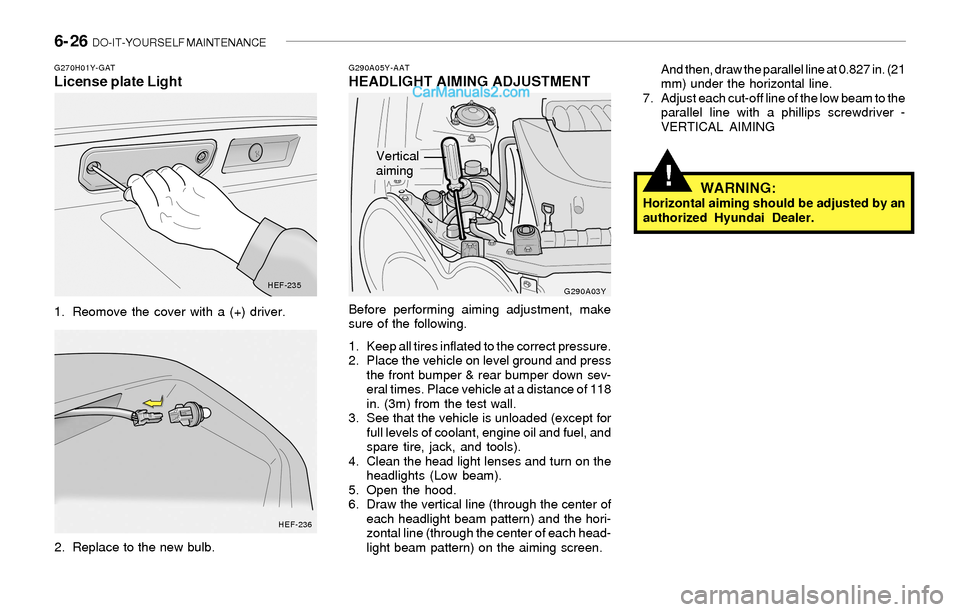
G290A05Y-AATHEADLIGHT AIMING ADJUSTMENT
Before performing aiming adjustment, make
sure of the following.
1. Keep all tires inflated to the correct pressure.
2. Place the vehicle on level ground and press
the front bumper & rear bumper down sev-
eral times. Place vehicle at a distance of 118
in. (3m) from the test wall.
3. See that the vehicle is unloaded (except for
full levels of coolant, engine oil and fuel, and
spare tire, jack, and tools).
4. Clean the head light lenses and turn on the
headlights (Low beam).
5. Open the hood.
6. Draw the vertical line (through the center of
each headlight beam pattern) and the hori-
zontal line (through the center of each head-
light beam pattern) on the aiming screen.And then, draw the parallel line at 0.827 in. (21
mm) under the horizontal line.
7. Adjust each cut-off line of the low beam to the
parallel line with a phillips screwdriver -
VERTICAL AIMING
WARNING:Horizontal aiming should be adjusted by an
authorized Hyundai Dealer.
G290A03Y
G270H01Y-GATLicense plate Light
1. Reomove the cover with a (+) driver.
2. Replace to the new bulb.
HEF-235
HEF-236
Vertical
aiming
Page 192 of 208
8. CONSUMER INFORMATION
Vehicle Identification Number (VIN) ................................................. 8-2
Engine number ................................................................................. 8-2
Recommended inflation pressures ................................................... 8-2
Snow tires ........................................................................................ 8-3
Tire chains ....................................................................................... 8-3
Tire rotation ...................................................................................... 8-3
Tire balancing ................................................................................... 8-4
Tire traction ...................................................................................... 8-4
When to replace tires ....................................................................... 8-4
Spare tire and tools .......................................................................... 8-5
Warranties for Your Hyundai Vehicle ............................................... 8-5
Consumer Information ...................................................................... 8-5
Reporting Safety Defects ................................................................. 8-7
8
Page 193 of 208
8- 2 CONSUMER INFORMATION & REPORTING SAFETY DEFECTS
I030A04Y-AATRECOMMENDED INFLATION PRES-
SURES
I020A01A-AATTIRE INFORMATION
The tires supplied on your new Hyundai are
chosen to provide the best performance for
normal driving.
I010B01A-AATEngine NumberI010A01L-AATVEHICLE IDENTIFICATION
NUMBER (VIN)
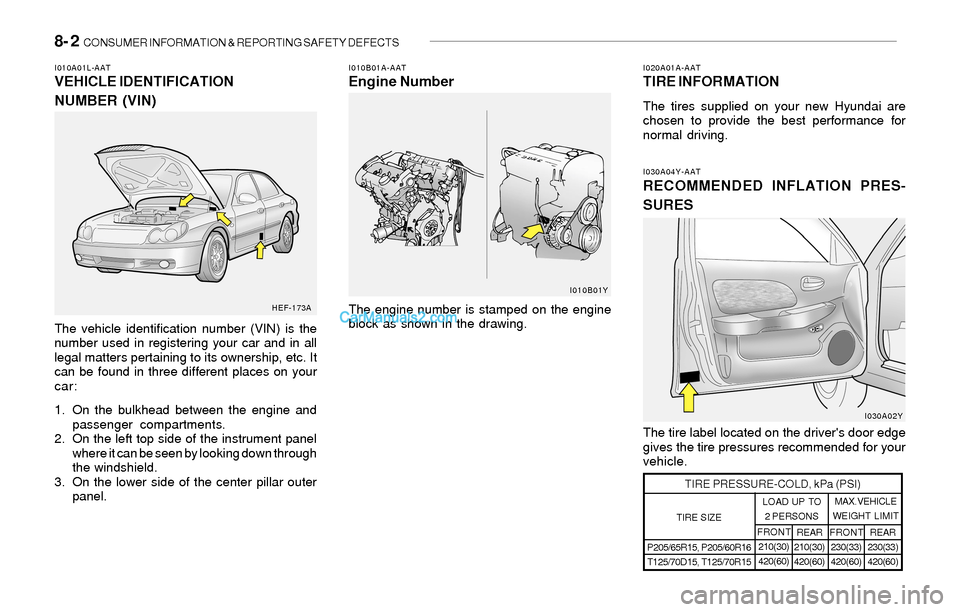
The vehicle identification number (VIN) is the
number used in registering your car and in all
legal matters pertaining to its ownership, etc. It
can be found in three different places on your
car:
1. On the bulkhead between the engine and
passenger compartments.
2. On the left top side of the instrument panel
where it can be seen by looking down through
the windshield.
3. On the lower side of the center pillar outer
panel.The engine number is stamped on the engine
block as shown in the drawing.
The tire label located on the driver's door edge
gives the tire pressures recommended for your
vehicle.
TIRE SIZE
TIRE PRESSURE-COLD, kPa (PSI)
P205/65R15, P205/60R16
T125/70D15, T125/70R15REAR
210(30)
420(60)FRONT
230(33)
420(60) LOAD UP TO
2 PERSONSMAX.VEHICLE
WEIGHT LIMIT
REAR
230(33)
420(60) FRONT
210(30)
420(60)
HEF-173AI010B01Y
I030A02Y
Page 194 of 208
CONSUMER INFORMATION & REPORTING SAFETY DEFECTS 8- 3
!
I050A02Y-AATTIRE CHAINS
Tire chains, if necessary, should be installed on
the front wheels. Be sure that the chains are the
proper size and that they are installed in accor-
dance with the manufacturer's instructions.
To minimize tire and chain wear, do not continue
to use tire chains when they are no longer
needed.
I040A01S-AATSNOW TIRES
If you equip your car with snow tires, they should
be the same size and have the same load
capacity as the original tires. Snow tires should
be installed on all four wheels; otherwise, poor
handling may result.
Snow tires should carry 4 psi (28 kPa) more air
pressure than the pressure recommended for
the standard tires on the tire label on the driver's
door edge , or up to the maximum pressure
shown on the tire sidewall whichever is less.
Do not drive faster than 75 mph (120 km/h)
when your car is equipped with snow tires. These pressures were chosen to provide the
most satisfactory combination of ride comfort,
tire wear and stability under normal conditions.
Tire pressures should be checked at least
monthly. Proper tire inflation pressures should
be maintained for these reasons:
o Lower-than-recommended tire pressures
cause uneven tread wear and poor handling.
o Higher-than-recommended tire pressures
increase the chance of damage from im-
pacts and cause uneven tread wear.
!
WARNING:o When driving on roads covered with
snow or ice, drive at less than 20 mph (30
km/h).
o Use the SAE "S" class or wire & plastic
chains.
o If you have noise caused by chains con-
tacting the body, retighten the chain to
avoid contact with the vehicle body.
o To prevent body damage, retighten the
chains after driving 0.3~0.6 miles.
CAUTION:Always observe the following:
o Check pressures when the tires are cold.
That is, after the car has been parked for
at least three hours and hasn't been
driven more than one mile or 1.6 km since
starting up.
o Check the pressure of your spare tire
each time you check the pressure of
other tires.
o Never overload your car. Be especially
careful about overloading if you equip
your car with a luggage rack or car top
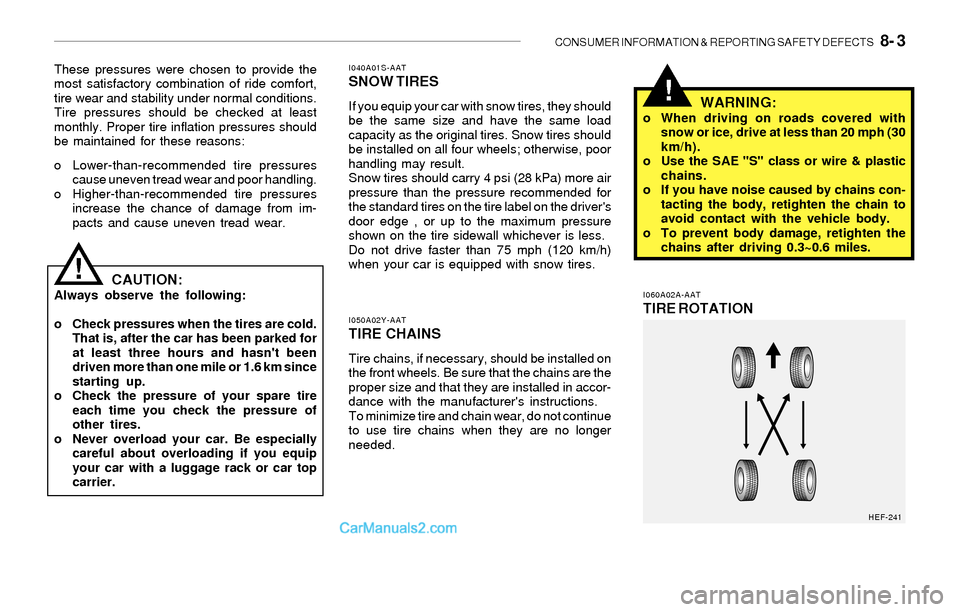
carrier.I060A02A-AATTIRE ROTATION
HEF-241