Page 165 of 208
DO-IT-YOURSELF MAINTENANCE 6- 7
!
!
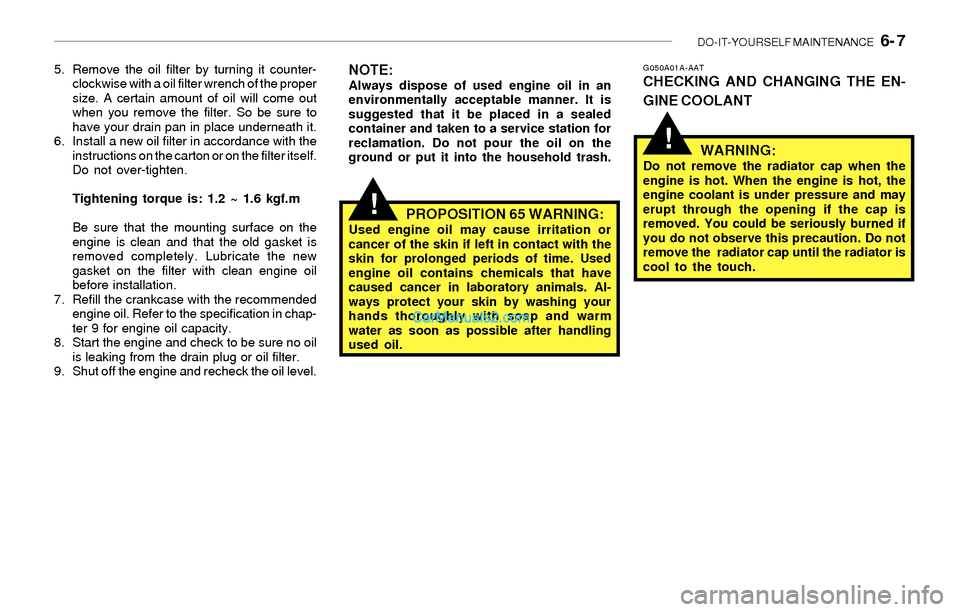
5. Remove the oil filter by turning it counter-
clockwise with a oil filter wrench of the proper
size. A certain amount of oil will come out
when you remove the filter. So be sure to
have your drain pan in place underneath it.
6. Install a new oil filter in accordance with the
instructions on the carton or on the filter itself.
Do not over-tighten.
Tightening torque is: 1.2 ~ 1.6 kgf.m
Be sure that the mounting surface on the
engine is clean and that the old gasket is
removed completely. Lubricate the new
gasket on the filter with clean engine oil
before installation.
7. Refill the crankcase with the recommended
engine oil. Refer to the specification in chap-
ter 9 for engine oil capacity.
8. Start the engine and check to be sure no oil
is leaking from the drain plug or oil filter.
9. Shut off the engine and recheck the oil level.G050A01A-AATCHECKING AND CHANGING THE EN-
GINE COOLANT
WARNING:
Do not remove the radiator cap when the
engine is hot. When the engine is hot, the
engine coolant is under pressure and may
erupt through the opening if the cap is
removed. You could be seriously burned if
you do not observe this precaution. Do not
remove the radiator cap until the radiator is
cool to the touch.
NOTE:Always dispose of used engine oil in an
environmentally acceptable manner. It is
suggested that it be placed in a sealed
container and taken to a service station for
reclamation. Do not pour the oil on the
ground or put it into the household trash.
PROPOSITION 65 WARNING:Used engine oil may cause irritation or
cancer of the skin if left in contact with the
skin for prolonged periods of time. Used
engine oil contains chemicals that have
caused cancer in laboratory animals. Al-
ways protect your skin by washing your
hands thoroughly with soap and warm
water as soon as possible after handling
used oil.
Page 169 of 208

DO-IT-YOURSELF MAINTENANCE 6- 11
G070A03Y-AATCHANGING THE AIR CLEANER FILTER
The replacement of air cleaner filter is per-
formed in the following manner.
1. Unsnap the clips around the cover.
2. When this is done, the cover can be lifted off,
the old filter removed and the new filter put in
its place.
Genuine Hyundai replacement parts are rec-
ommended.
G080A02A-AATWINDSHIELD WIPER BLADES
The wiper blades should be carefully inspected
from time to time and cleaned to remove accu-
mulations of road film or other debris. To clean
the wiper blades and arms, use a clean sponge
or cloth with a mild soap or detergent and water.
If the wipers continue to streak or smear the
glass, replace them with genuine Hyundai re-
placement parts or their equivalent.
NOTE:o Do not operate the wipers on dry glass.
This can result in more rapid wear of the
wiper blades and may scratch the glass.
o Keep the blade rubber out of contact
with petroleum products such as engine
oil, gasoline, etc.
G090A01A-AATFILLING THE WASHER RESERVOIR
The washer fluid reservoir supplies fluid to the
windshield washer system.
A good quality washer fluid should be used to fill
the washer reservoir. The fluid level should be
checked more frequently during bad weather or
whenever the washer system is in more fre-
quent use.
The capacity of the washer reservoir is 3.2 U.S.
quarts (3.0 Liters).
CAUTION:Operating your vehicle without using a
proper air cleaner filter in place can result in
excessive engine wear.
CAUTION:o Radiator anti-freeze (engine coolant)
should not be used in the washer system
because it will damage the car’s finish.
o The washer lever should not be pulled
and the washer should not be operated
if the washer reservoir is empty. This can
damage the washer fluid pump.
G070A01YTHEF119
G230A03YT
!
!
Page 190 of 208

7- 2 EMISSION CONTROL SYSTEMS
H010E01Y-AATEGR System (If installed)
This system helps reduce nitrogen oxides by
recirculating a part of the exhaust gas into the
engine, thereby reducing cylinder combustion
temperature, which results in lower output of
oxides of nitrogen.
H010D01A-AAT3. Exhaust Emission Control System
The Exhaust Emission Control System is a
highly effective system which controls exhaust
emissions while maintaining good vehicle
performace.
H010B01A-AAT1. Crankcase Emission Control
System
The positive crankcase ventilation system is
employed to prevent air pollution caused by
blow-by gases being emitted from the crank-
case. This system supplies filtered air to the
crankcase through the air intake hose. Inside
the crankcase, the fresh air mixes with blow-by
gases, which then pass through the PCV valve
and into the induction system.
H010A01L-AATEMISSION CONTROL SYSTEM
Your Hyundai is equipped with an emission
control system to meet all requirements of the
U.S. Environmental Protection Agency or Cali-
fornia Air Resources Board.
There are three emission control systems which
are as follows.
(1) Crankcase emission control system
(2) Evaporative emission control system
(3) Exhaust emission control system
In order to assure the proper function of the
emission control systems, it is recommended
that you have your car inspected and main-
tained by an authorized Hyundai dealer in ac-
cordance with the maintenance schedule in this
manual.
Caution for Inspection and Maintenance
Test (2.7 V6 Vehicle with Traction Control
System)
o To prevent the vehicle from misfiring
during dynamometer testing, discon-
nect the ABS connector located on the
left side of the engine compartment.
o For more information, see shop manual
(BR-67, Wheel Speed Sensor)
H010C02S-AAT
2. Evaporative Emission Control
(Including ORVR: Onboard Refueling
Vapor Recovery) System
The Evaporative Emission Control System is
designed to prevent fuel vapors from escaping
into the atmosphere.
(The ORVR system is designed to allow the
vapors from the fuel tank to be loaded into a
canister while refueling at the gas station, pre-
venting the escape of fuel vapors into the
atmosphere.)
Canister
Fuel vapors generated inside the fuel tank are
absorbed and stored in the onboard canister.
When the engine is running, the fuel vapors
absorbed in the canister are drawn into the
surge tank through the purge control solenoid
valve.
Purge Control Solenoid Valve (PCSV)
The purge control solenoid valve is controlled
by the Engine Control Module (ECM); when the
engine coolant temperature is low during idling,
the PCSV closes so that evaporated fuel is not
taken into the engine. After the engine warms-
up during ordinary driving, the PCSV opens to
introduce evaporated fuel to the engine.
Page 201 of 208
VEHICLE SPECIFICATIONS 9- 3
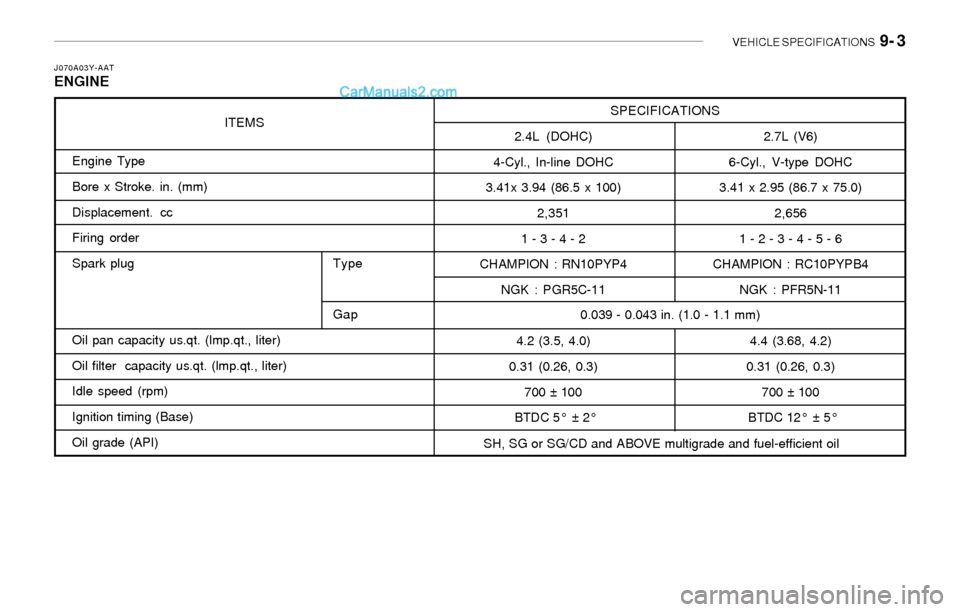
J070A03Y-AATENGINE
ITEMS
Engine Type
Bore x Stroke. in. (mm)
Displacement. cc
Firing order
Spark plugType
Gap
Oil pan capacity us.qt. (lmp.qt., liter)
Oil filter capacity us.qt. (lmp.qt., liter)
Idle speed (rpm)
Ignition timing (Base)
Oil grade (API)2.4L (DOHC)
4-Cyl., In-line DOHC
3.41x 3.94 (86.5 x 100)
2,351
1 - 3 - 4 - 2
CHAMPION : RN10PYP4
NGK : PGR5C-11
4.2 (3.5, 4.0)
0.31 (0.26, 0.3)
700 ± 100
BTDC 5° ± 2°2.7L (V6)
6-Cyl., V-type DOHC
3.41 x 2.95 (86.7 x 75.0)
2,656
1 - 2 - 3 - 4 - 5 - 6
CHAMPION : RC10PYPB4
NGK : PFR5N-11
4.4 (3.68, 4.2)
0.31 (0.26, 0.3)
700 ± 100
BTDC 12° ± 5°
SPECIFICATIONS
0.039 - 0.043 in. (1.0 - 1.1 mm)
SH, SG or SG/CD and ABOVE multigrade and fuel-efficient oil
Page 202 of 208
9- 4 VEHICLE SPECIFICATIONS
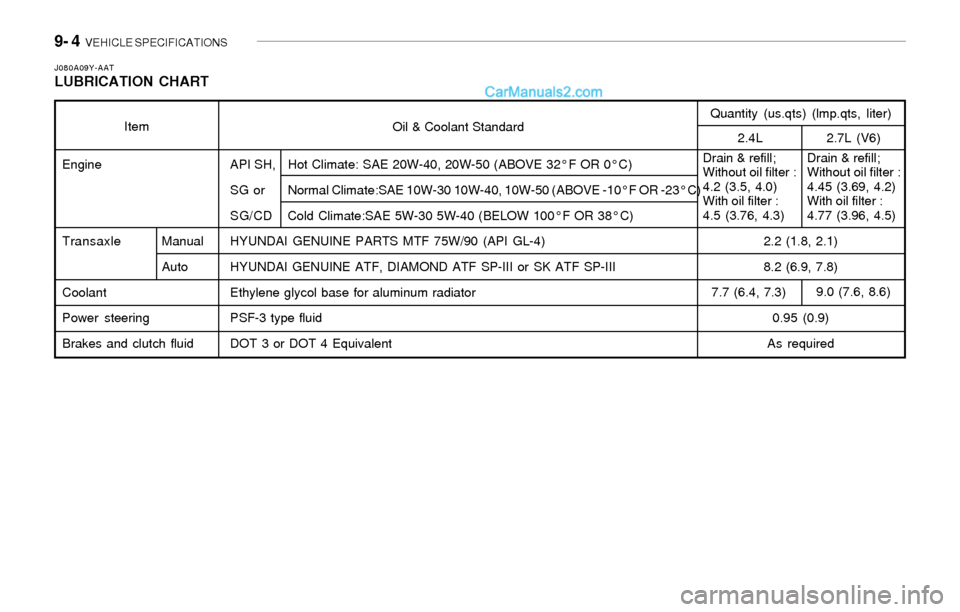
J080A09Y-AATLUBRICATION CHART
API SH, Hot Climate: SAE 20W-40, 20W-50 (ABOVE 32°F OR 0°C)
SG or Normal Climate:SAE 10W-30 10W-40, 10W-50 (ABOVE -10°F OR -23°C)
SG/CDCold Climate:SAE 5W-30 5W-40 (BELOW 100°F OR 38°C)
HYUNDAI GENUINE PARTS MTF 75W/90 (API GL-4)
HYUNDAI GENUINE ATF, DIAMOND ATF SP-III or SK ATF SP-III
Ethylene glycol base for aluminum radiator
PSF-3 type fluid
DOT 3 or DOT 4 Equivalent Engine
TransaxleManual
Auto
Coolant
Power steering
Brakes and clutch fluid
Quantity (us.qts) (lmp.qts, liter)
2.2 (1.8, 2.1)
8.2 (6.9, 7.8)
0.95 (0.9)
As requiredItem
Oil & Coolant Standard2.4L 2.7L (V6)
Drain & refill;
Without oil filter :
4.2 (3.5, 4.0)
With oil filter :
4.5 (3.76, 4.3)Drain & refill;
Without oil filter :
4.45 (3.69, 4.2)
With oil filter :
4.77 (3.96, 4.5)
7.7 (6.4, 7.3)9.0 (7.6, 8.6)