2004 Hyundai Getz tow
[x] Cancel search: towPage 363 of 445

2- 20 DRIVING YOUR HYUNDAI
When being passed by a large ve- hicle, keep a constant speed andsteer straight ahead. If there is toomuch wind buffeting slow down toget out of the other vehicle's air turbulence.
8. When parking your car and trailer, especially on a hill, be sure to follow all the normal precautions. Turn yourfront wheel into the curb, set theparking brake firmly, and put the transaxle in 1st or Reverse (manual) or Park (automatic). In addition,place wheel chocks at each of thetrailer's tyres.
9. If the trailer has electric brakes,
start your vehicle and trailer mov- ing, and then apply the trailer brake controller by hand to be sure thebrakes are working. This lets youcheck your electrical connection atthe same time.
10. During your trip, check occasion- ally to be sure that the load issecure, and that the lights andany trailer brakes are still working.
11. Avoid jerky starts, sudden accel- eration or sudden stops.
12. Avoid sharp turns and rapid lane changes. 13. Avoid holding the brake pedal
down too long or too frequently.This could cause the brakes tooverheat, resulting in reduced brak-ing efficiency.
14. When going down a hill, shift into
a lower gear and use the enginebraking effect.When ascending a long grade,
downshift the transaxle to a lowergear and reduce speed to reduce chances of engine overloading and/ or overheating.
15. If you have to stop while going
uphill, do not hold the vehicle inplace by pressing on the accelera-tor. This can cause the automatic transaxle to overheat. Use the park- ing brake or footbrake.
NOTE: When towing check transaxle fluid more frequently. CAUTION:
If overheating should occur whentowing, (temperature gauge reads near red zone), taking the following action may reduce or eliminate theproblem.
1. Turn off the air conditioner.
2. Reduce highway speed.
3. Select a lower gear when going uphill.
4. While in stop and go traffic, place the gear selection in park or neu- tral and idle the engine at a higherspeed.
!
tbuk-2.p65 3/23/04, 4:55 PM
20
Page 364 of 445

3. WHAT TO DO IN AN EMERGENCYIf the engine will not start ....................... ......................................... 3-2
Jump starting ...................................... ............................................ 3-3
If the engine overheats ................................................... ................ 3-4
Spare tyre ................................................... .................................... 3-5
In the event of a pun cture .............................................. ................. 3-6
Vehicle Towing or Recovery ........................................... ..............3-11
Emergency tow ing ................................................ ........................3-13
If you lose your keys ................................................... ..................3-13
3
tbuk-3.p65 3/23/04, 4:24 PM
1
Page 365 of 445

3- 2 WHAT TO DO IN AN EMERGENCY
HTB165
SD020B1-E
IF THE ENGINE CANNOT BE
CRANKED
1. If the vehicle is fitted with manual
transaxle, ensure that the clutch
pedal is depressed whilst cranking
the engine. If the vehicle is fitted
with automatic transaxle, ensure
that the transaxle selector is at the
"P" or"N" position.
2. Check the battery terminals and
connections to ensure that these
are clean and also tight.
3. If the ignition warning lights dim
when the engine is cranked and the
battery terminals have been
checked, a discharged battery is
indicated. SD020C1-F
If Engine Turns Over Normally
but Does Not Start
SD020A1-E
IF THE ENGINE WILL NOT START
Seek assistance from the nearest
Hyundai dealer with regard to the
method of ignition and fuel system
diagnosis.
!
HTB221
CAUTION:
If the engine refuses to start, no
attempt should be made to push or
tow start the vehicle. Vehicles with
automatic transaxle or fuel injec-
tion will not be able to be started in
this manner since no drive is trans-
mitted through the automatic
transaxle whilst the engine is not
running, and in the case of fuel
injected derivatives, the fuel pump
will not operate under tow start
conditions. In addition, if the ve-
hicle is equipped with an exhaust
catalyst, damage to the catalyst may
result if the vehicle is tow started. 4. Do not attempt to push or tow start
the vehicle, refer to "Jump Starting"
for information regarding engine
starting when the battery is dis-
charged.
1. Check fuel Level
2. Check all connectors at ignition coil and spark plugs.
Replace any that may be discon-
nected or loose.
3. Check fuel line in the engine com- partment.
4. If engine still refuses to start, call a
Hyundai dealer or seek other quali-
fied assistance.
tbuk-3.p65 3/23/04, 4:24 PM
2
Page 374 of 445

WHAT TO DO IN AN EMERGENCY 3- 11
o OK FOR AUTOMATIC OR MANUAL
TRANSAXLE EQUIPPED VEHICLE
WITH NO DAMAGE HTB208
HTB151B080A02TB-EAT
VEHICLE TOWING OR
RECOVERY
CAUTION:
An incorrect tow or recovery could
result in serious damage to the ve-
hicle. If any damage to the suspen-
sion, steering or transaxle is appar-
ent or suspected, a towing ambu-
lance must be used. o OK FOR AUTOMATIC OR MANUAL
TRANSAXLE EQUIPPED VEHICLE
HTB207
!
SD070K1-E
AFTER CHANGING WHEELS
The pressure of the spare tyre should
be checked at the first available oppor-
tunity. If any doubt exists as to the tyre
pressure, the vehicle should be driven
slowly to the nearest service station
and the tyre pressure checked and
adjusted as required.
If the valve cap is lost from any of the
valves, a replacement should be ob-
tained and fitted at the first available
opportunity. The valve cap prevents
the ingress of dirt which may cause the
valve to stick and therefore leak and is
part of the valve sealing function. Ensure that the spare wheel, jack and
wheel nut wrench as well tools are
correctly located in the boot of the
vehicle to prevent damage and noise.
The vehicle may be towed by the con-
ventional method using the towing eye
at the front of the vehicle as an attach-
ment point. In addition, a suspended
tow with or without a towing dolly may
be used with either the front or the rear
wheels being suspended, provided the
above caution is observed.
tbuk-3.p65 3/23/04, 4:24 PM
11
Page 375 of 445
3- 12 WHAT TO DO IN AN EMERGENCY
!
CAUTION:
The following restriction must be
observed in order to avoid serious
damage to the transaxle .
The vehicle must never be towed
from the rear with the front wheels
on the ground.
The vehicle must not be towed until
transaxle fluid has been added to
bring the level up to the "HOT"
marking on the dipstick. (The level
will need to be reduced again after
towing).
The vehicle must not be towed at
speeds faster than 25 mph. or dis-
tances greater than fifty miles. The
general points regarding the steer-
ing lock etc. described in the pre-
ceding section (Manual transaxle
vehicle) should be observed.
SD100A3-E
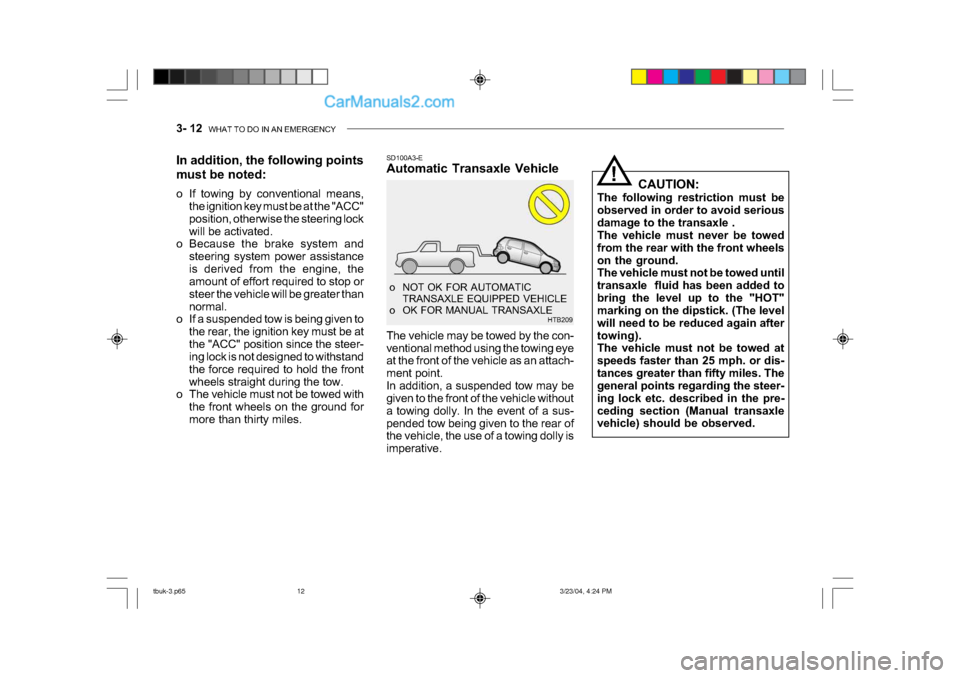
Automatic Transaxle Vehicle
The vehicle may be towed by the con-
ventional method using the towing eye
at the front of the vehicle as an attach-
ment point.
In addition, a suspended tow may be
given to the front of the vehicle without
a towing dolly. In the event of a sus-
pended tow being given to the rear of
the vehicle, the use of a towing dolly is
imperative.
o NOT OK FOR AUTOMATIC
TRANSAXLE EQUIPPED VEHICLE
o OK FOR MANUAL TRANSAXLE HTB209
In addition, the following points
must be noted:
o If towing by conventional means,
the ignition key must be at the "ACC"
position, otherwise the steering lock
will be activated.
o Because the brake system and
steering system power assistance
is derived from the engine, the
amount of effort required to stop or
steer the vehicle will be greater than
normal.
o If a suspended tow is being given to
the rear, the ignition key must be at
the "ACC" position since the steer-
ing lock is not designed to withstand
the force required to hold the front
wheels straight during the tow.
o The vehicle must not be towed with
the front wheels on the ground for
more than thirty miles.
tbuk-3.p65 3/23/04, 4:24 PM
12
Page 376 of 445
WHAT TO DO IN AN EMERGENCY 3- 13
D120A01A-EAT
IF YOU LOSE YOUR KEYS
Information about the key of immobi-
lizer system will be found on page 1-4.CAUTION:
If the car is being towed with all
four wheels on the ground, it can
be towed only from the front. Be
sure that the transaxle is in neu-
tral. Do not tow at speeds greater
than 30 mph (50 km/h) and for more
than 15 miles(25 km).
Be sure the steering is unlocked by
placing the key in the "ACC" posi-
tion. A driver must be in the towed
vehicle to operate the steering and
brakes.
!
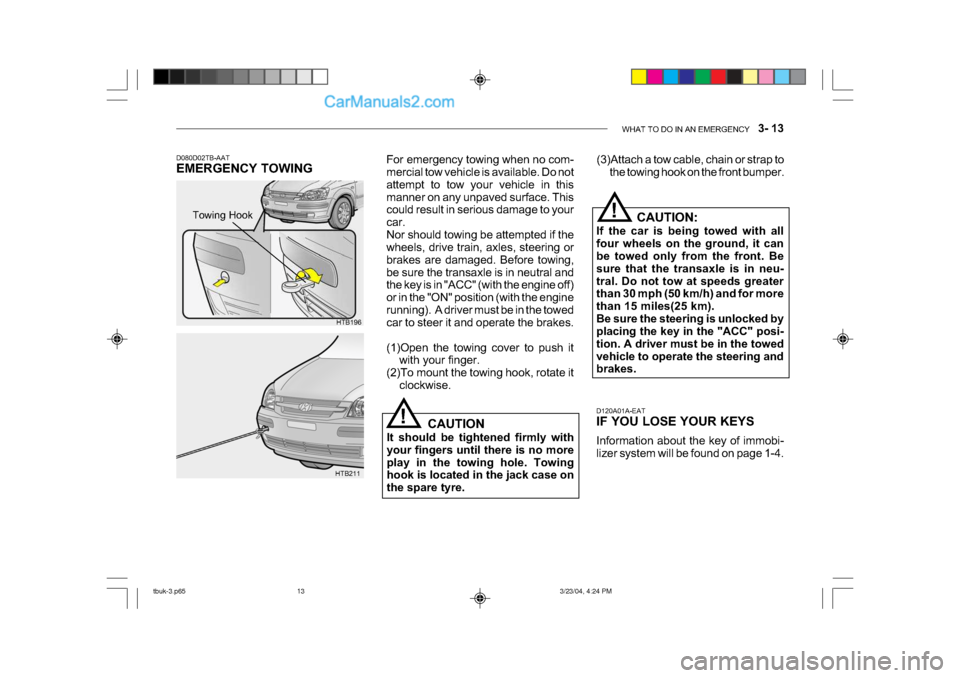
(3)Attach a tow cable, chain or strap to
the towing hook on the front bumper.
D080D02TB-AAT
EMERGENCY TOWING For emergency towing when no com-
mercial tow vehicle is available. Do not
attempt to tow your vehicle in this
manner on any unpaved surface. This
could result in serious damage to your
car.
Nor should towing be attempted if the
wheels, drive train, axles, steering or
brakes are damaged. Before towing,
be sure the transaxle is in neutral and
the key is in "ACC" (with the engine off)
or in the "ON" position (with the engine
running). A driver must be in the towed
car to steer it and operate the brakes.
(1)Open the towing cover to push it
with your finger.
(2)To mount the towing hook, rotate it clockwise.
HTB196
HTB211 CAUTION
It should be tightened firmly with
your fingers until there is no more
play in the towing hole. Towing
hook is located in the jack case on
the spare tyre.
!
Towing Hook
tbuk-3.p65
3/23/04, 4:24 PM
13
Page 387 of 445

5- 6 VEHICLE MAINTENANCE REQUIREMENTS
MAINTENANCE UNDER SEVERE USAGE CONDITIONS
The following items must be serviced more frequently on cars normally used under severe driving conditions. Refer to the chart below for the appropriate maintenance intervals. R : REPLACE I : INSPECT AND, AFTER INSPECTION, CLEAN, ADJUST, REPAIR OR REPLACE IF NECESSARY
F040A06A-EAT
SEVERE DRIVING CONDITIONS
A - Repeated short distance driving
B - Extensive idling
C - Driving in dusty, rough roads
D - Driving in areas using salt or other corrosive materials or in very cold weather
ENGINE OIL AND FILTER AIR CLEANER FILTERSPARK PLUGSTIMING BELTBRAKE PADSREAR BRAKE LININGS AND CYLINDERSSUSPENSION AND STEERING SYSTEM MANUAL TRANSAXLE OIL AUTOMATIC TRANSAXLE FLUIDPOLLEN FILTER(FOR EVAPORATOR AND BLOWER UNIT)
EVERY 4,500MILES OR 6 MONTHS
MORE FREQUENTLYMORE FREQUENTLY EVERY 37,000MILES OR 48 MONTHSMORE FREQUENTLY MORE FREQUENTLY MORE FREQUENTLYEVERY 60,000MILES EVERY 27,000MILES
MORE FREQUENTLY
MAINTENANCE OPERATIONMAINTENANCE ITEM
R RR RI II
RR R A, B, C, F, H C, EB, H D, E, F, G C, D, G, HC, D, G, HC, D, E, F A, C, D, E, F, G, H, I, J A, C, E, F, G, H, I C,E
MAINTENANCE INTERVALS
DRIVING
CONDITION
E - Driving in sandy areas
F - More than 50% driving in heavy city traffic during hot weather
above 90°F (32°C)
G - Driving in mountainous areas
H - Towing a trailer
I - Driving for patrol car, taxi, commercial car or vehicle towing
J - Driving over 100MPH
tbuk-5.p65 7/3/2008, 4:10 PM
6
Page 404 of 445

DO-IT-YOURSELF MAINTENANCE 6- 13
SG060A1-E
SPARKING PLUG REPLACE-
MENT
G060A01L
0.039 ~ 0.043 in.
(1.0 ~ 1.1 mm )
This operation should only be performed
when the engine is cold.
1. Remove the centre cover from the engine rocker cover.
2. Remove plug lead from the sparking plug to be replaced, pulling the lead
by the rubber cap. (Pulling the lead
may damage the carbon conductor).
3. Clean around the base of the plug to be removed, and install the plug
socket ensuring that the ceramic
insulator does not become damaged.
Turn the socket counterclockwise to
remove the plug. CAUTION:
Sparking plugs must only be cleaned
using purpose designed equipment.
Wire brushing may damage the cen-
tre electrodein-sulator causing mis-
firing to occur. Only the correct grade
of sparking plug should be used.
Use of an incorrect grade may result
in serious engine damage.
Prior to installing a sparking plug, the
gap between the centre and outer elec-
trodes must be checked and adjusted
as necessary.
Adjustment is facilitated by bending the
outer electrode towards or away from
the centre electrode. Under no circum-
stances should attempts be made to
adjust the position of the centre elec-
trode.
4. Insert the sparking plug into the cyl- inder head and screw by the wrench
and until the plug contacts the seat-
ing area. Tighten the plug with the
socket by a further 1/2 to 3/4 of a turn
only. 5. Replace the plug lead ensuring that
the cap is pushed firmly into place.
Confirm that the cap is correctly
seated by lightly pulling upon it.
NOTE:
When replacing the spark plug, al-
ways use the genuine parts recom-
mended.
Recommended Spark Plugs
CHAMPION
NGK RC10YC
BKR5ES
Unleaded
engine Leaded
engine
RC10YC4
BKR5ES-11
!
tbuk-6.p65 3/23/04, 4:26 PM
13