2004 Hyundai Getz ESP
[x] Cancel search: ESPPage 249 of 445
Responsibilty For Maintenance
It is the responsibility of the vehicle owner/driver to ensure that all routine mainte- nance services are undertaken in line with the recommendations specified in Section 5 of this manual. In addition, in order to ensure continued validity of the new vehiclewarranty and safe operation of the vehicle, non scheduled maintenance/running repairs should be undertaken at the earliest available opportunity. Under severe operating conditions, more frequent maintenance is required. Detailsof the maintenance schedule for such conditions are also given in section 5. It is recommended that all maintenance operations and repairs are entrusted to a franchised Hyundai dealer to ensure that the latest repair methods, specializedtooling and genuine Hyundai parts are used to ensure the continued reliability and safety of the vehicle.
SA020A1-E
tbuk-0.p65
3/23/04, 4:21 PM
3
Page 250 of 445
The information in this Owner's Manual is current at the time of publication. However, the right to amend specifications without
notice or obligation to incorporate such amendments into vehicles already produced is reserved. This manual applies to all markets and includes descriptions and explanations of optional as well as standard equipment. As a result, some of the equipment operating descriptions referred to may not apply to the particular vehicle with which this manual is supplied. Please refer to the nearest franchised Hyundai dealer for information regarding current standard and optional equipment levels. HTB089
SA010A1-E OWNER'S MANUAL Operation MaintenanceSpecifications
tbuk-0.p65
3/23/04, 4:21 PM
4
Page 263 of 445
FEATURES OF YOUR HYUNDAI 1- 5
B040A02Y-EAT
DOOR LOCKS B040B01A-AAT
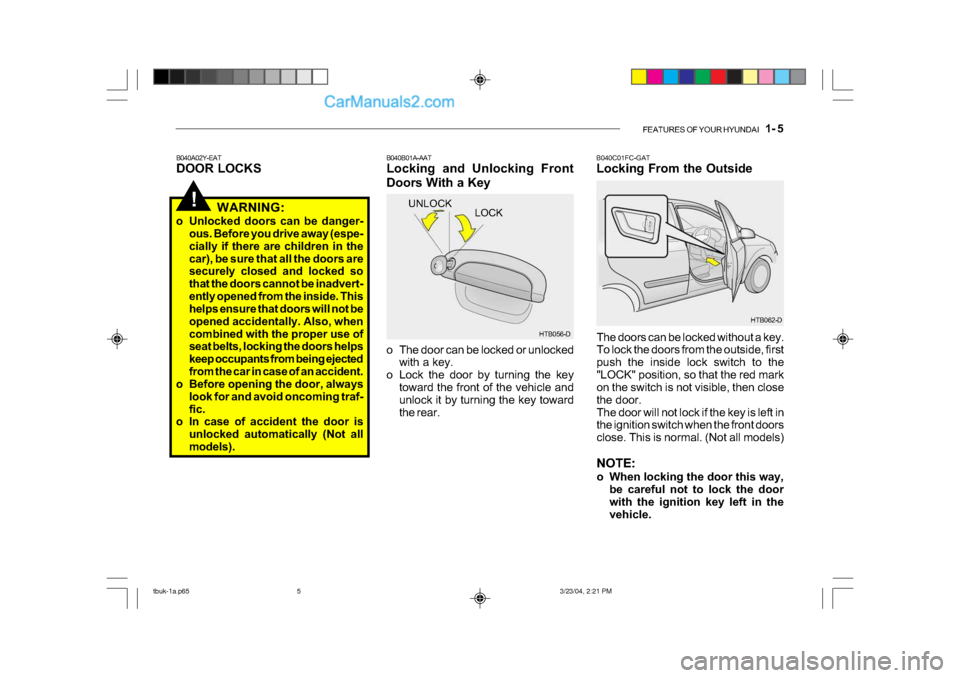
Locking and Unlocking Front
Doors With a Key
o The door can be locked or unlocked
with a key.
o Lock the door by turning the key toward the front of the vehicle and
unlock it by turning the key toward
the rear. B040C01FC-GAT
Locking From the Outside
The doors can be locked without a key.
To lock the doors from the outside, first
push the inside lock switch to the
"LOCK" position, so that the red mark
on the switch is not visible, then close
the door.
The door will not lock if the key is left in
the ignition switch when the front doors
close. This is normal. (Not all models)
NOTE:
o When locking the door this way, be careful not to lock the door
with the ignition key left in the
vehicle.
LOCK
HTB056-D
UNLOCK
HTB062-D
!WARNING:
o Unlocked doors can be danger- ous. Before you drive away (espe-
cially if there are children in the
car), be sure that all the doors are
securely closed and locked so
that the doors cannot be inadvert-
ently opened from the inside. This
helps ensure that doors will not be
opened accidentally. Also, when
combined with the proper use of
seat belts, locking the doors helps
keep occupants from being ejected
from the car in case of an accident.
o Before opening the door, always
look for and avoid oncoming traf-
fic.
o In case of accident the door is
unlocked automatically (Not all
models).
tbuk-1a.p65 3/23/04, 2:21 PM
5
Page 284 of 445
1- 26 FEATURES OF YOUR HYUNDAI
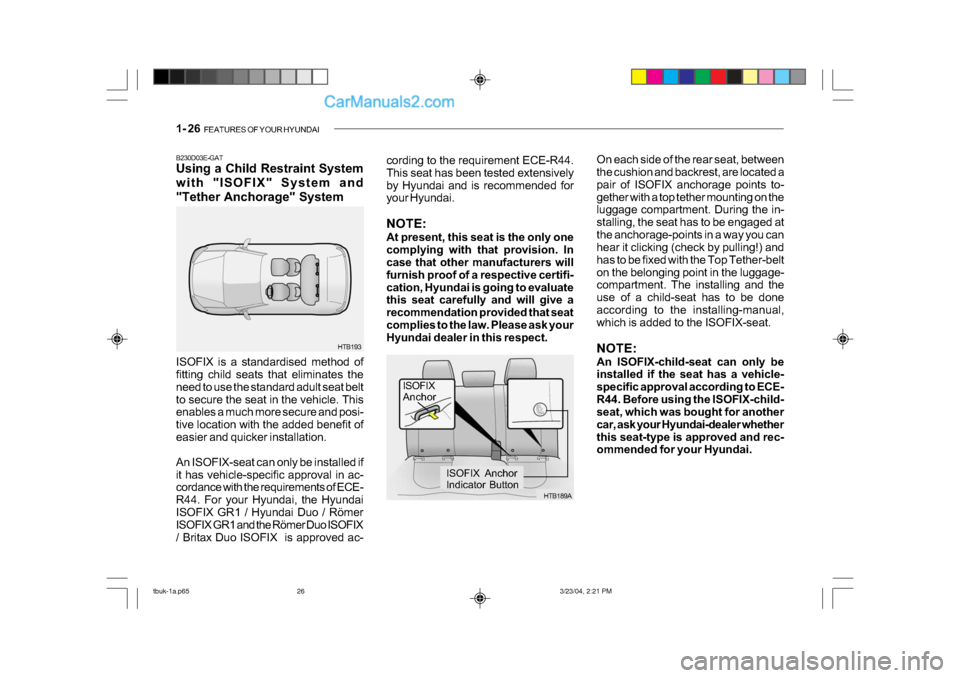
On each side of the rear seat, between
the cushion and backrest, are located a
pair of ISOFIX anchorage points to-
gether with a top tether mounting on the
luggage compartment. During the in-
stalling, the seat has to be engaged at
the anchorage-points in a way you can
hear it clicking (check by pulling!) and
has to be fixed with the Top Tether-belt
on the belonging point in the luggage-
compartment. The installing and the
use of a child-seat has to be done
according to the installing-manual,
which is added to the ISOFIX-seat.
NOTE:
An ISOFIX-child-seat can only be
installed if the seat has a vehicle-
specific approval according to ECE-
R44. Before using the ISOFIX-child-
seat, which was bought for another
car, ask your Hyundai-dealer whether
this seat-type is approved and rec-
ommended for your Hyundai.
cording to the requirement ECE-R44.
This seat has been tested extensively
by Hyundai and is recommended for
your Hyundai.
NOTE:
At present, this seat is the only one
complying with that provision. In
case that other manufacturers will
furnish proof of a respective certifi-
cation, Hyundai is going to evaluate
this seat carefully and will give a
recommendation provided that seat
complies to the law. Please ask your
Hyundai dealer in this respect.
HTB189A
ISOFIX
Anchor
ISOFIX Anchor
Indicator Button
B230D03E-GAT
Using a Child Restraint System
with "ISOFIX" System and
"Tether Anchorage" System
ISOFIX is a standardised method of
fitting child seats that eliminates the
need to use the standard adult seat belt
to secure the seat in the vehicle. This
enables a much more secure and posi-
tive location with the added benefit of
easier and quicker installation.
An ISOFIX-seat can only be installed if
it has vehicle-specific approval in ac-
cordance with the requirements of ECE-
R44. For your Hyundai, the Hyundai
ISOFIX GR1 / Hyundai Duo / R
Page 298 of 445

1- 40 FEATURES OF YOUR HYUNDAI
!
SB210J1-E
HIGH BEAM INDICATOR
LIGHT
The high beam indicator light will illumi-
nate whenever the headlights are
switched to high beam of flash position.
B260H03A-EATPARKING BRAKE/
BRAKE FLUID LEVEL
WARNING LIGHT
SB210K1-E
OIL PRESSURE
WARNING LIGHT
!CAUTION:
If the oil pressure light illuminates
when the engine is running, an in-
sufficient oil pressure level for con-
tinued safe operation of the engine
exists. Continued operation of the
engine in this condition may result
in serious engine damage.
Under normal circumstances, the
light will illuminate when the igni-
tion is turned "on" and will be extin-
guished when the engine is started.
If the oil pressure warning light illu-
minates whilst the engine is run-
ning, stop the engine immediately
and check the engine oil level. If the
level is insufficient, add the required amount of oil as indicated by the
engine oil dipstick. If the light fails to
extinguish when the engine is re-
started, do not continue to operate
the vehicle.
If the oil pressure light illuminates
during normal operation and the
cause is not an insufficient oil level,
or the light fails to illuminate when
the ignition is turned "on", contact
the nearest Hyundai dealer before
further operating the vehicle.
Warning light operation
The parking brake/brake fluid level warn-
ing light will be illuminated whenever
the ignition switch is turned to the "ON"
position irrespective of whether or not
the parking brake is applied and must
be extinguished when the engine starts
and the parking brake released.
If the warning light fails to extinguish or
illuminates at any other time, the ve-
hicle must be brought to rest in a safe
location and the level of brake fluid in
the reservoir checked. If the fluid level
is incorrect, fluid conforming to DOT 3
or DOT 4 specifications should be added.
If, after correcting the brake fluid level,
the warning light continues to be illumi-
nated, the advice of the nearest Hyundai
dealer must be sought before the ve-
hicle is driven again.
Your Hyundai is equipped with a diago-
nally split dual braking system which
will ensure that in the event of one of the
brake circuits becoming defective, ap-
proximately fifty per cent of the normal
braking performance will be available.
If failure of one of the circuits occurs,
the required amount of pedal effort,
pedal travel and stopping distance will
be increased. Use of the gearbox is
WARNING:
In the event of problems being sus-
pected with the braking system, the
advice of the nearest Hyundai dealer
must be sought before the vehicle is
driven. Driving the vehicle with ei-
ther an electrical or hydraulic brak-
ing system defect may be danger-
ous, resulting in accident or per-
sonal injury.
tbuk-1a.p65 3/23/04, 2:22 PM
40
Page 349 of 445
2- 6 DRIVING YOUR HYUNDAI
C050B01HP
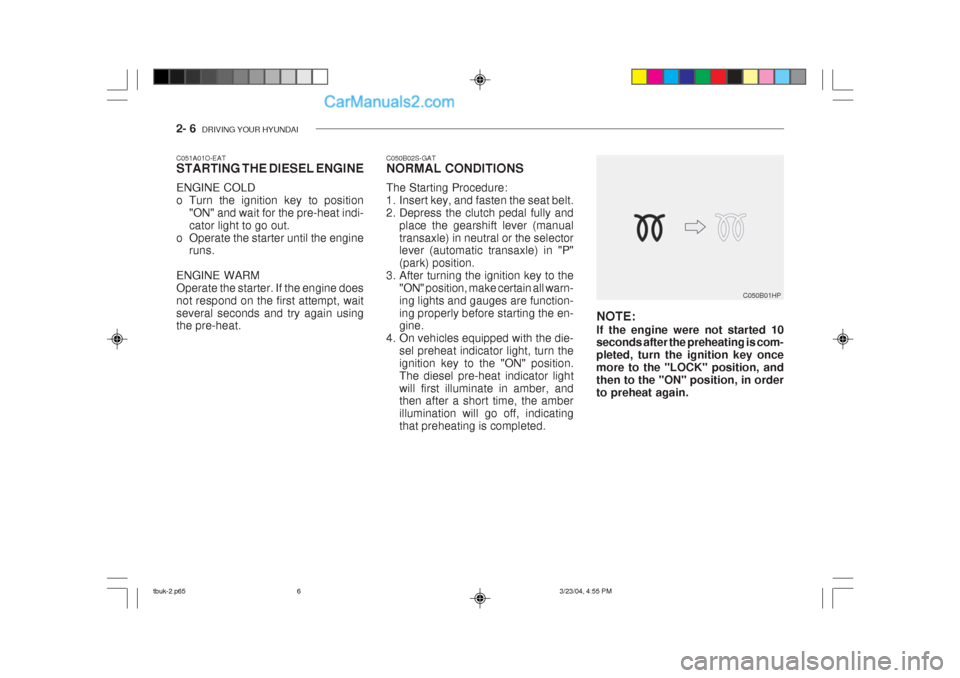
NOTE: If the engine were not started 10 seconds after the preheating is com- pleted, turn the ignition key oncemore to the "LOCK" position, andthen to the "ON" position, in orderto preheat again.
C051A01O-EAT STARTING THE DIESEL ENGINE ENGINE COLD
o Turn the ignition key to position
"ON" and wait for the pre-heat indi-cator light to go out.
o Operate the starter until the engine runs.
ENGINE WARMOperate the starter. If the engine doesnot respond on the first attempt, waitseveral seconds and try again using the pre-heat. C050B02S-GAT NORMAL CONDITIONS The Starting Procedure:
1. Insert key, and fasten the seat belt.
2. Depress the clutch pedal fully and
place the gearshift lever (manualtransaxle) in neutral or the selector lever (automatic transaxle) in "P" (park) position.
3. After turning the ignition key to the
"ON" position, make certain all warn-ing lights and gauges are function-ing properly before starting the en- gine.
4. On vehicles equipped with the die-
sel preheat indicator light, turn the ignition key to the "ON" position.The diesel pre-heat indicator lightwill first illuminate in amber, and then after a short time, the amber illumination will go off, indicatingthat preheating is completed.
tbuk-2.p65 3/23/04, 4:55 PM
6
Page 353 of 445

2- 10 DRIVING YOUR HYUNDAI
YC090A1-E SELECTOR POSITIONS o P (Park): With the selector in this position, no drive is transmitted from the engineand the transaxle output and thereforethe front wheels locked. The enginemay be started with the selector in this position.
!
CAUTION:
The selector must NEVER be shifted to the "P" position whilst the ve-hicle is in motion, otherwise seri-ous transaxle damage will result. DC110C1-E o R (Reverse): With the selector in this position, re- verse gear will be engaged. The en-gine may not be started with the selec-tor in this position.
CAUTION:
The selector must NEVER be shiftedto the "R" position whilst the ve-hicle is in motion.
! DC110D1-E o N (Neutral): With the selector in this position, no gear is selected and no drive is trans-mitted from the engine. The enginemay be started with the selector in thisposition.
!
CAUTION:
Do not coast with the selector at the "N" position. DC110E1-E o D (Drive): With the selector in this position, first gear will be engaged from rest and thetransmission will automatically upshiftto second, third and fourth depending upon the vehicle speed, throttle posi- tion and the position of the overdriveswitch. The engine may not be startedwith the selector in this position. DC110F1-E o 2 (Second Gear): With the selector in this position, first gear will be engaged from rest. Thetransmission will upshift to second geardepending upon the vehicle speed andthrottle position. No upshift to third or fourth will occur. The engine may not be started with the selector in thisposition. DC110G2-E o L (Low Gear): With the selector in this position, first gear will be engaged from rest. Noupshift will occur regardless of vehiclespeed and throttle opening. The en-gine may not be started with the selec-tor in this position.
!
CAUTION:
Do not move the selector to the "L" position when the vehicle speed isin excess of 50 m.p.h.
tbuk-2.p65 3/23/04, 4:55 PM
10
Page 357 of 445

2- 14 DRIVING YOUR HYUNDAI
!WARNING:
ABS will not prevent accidents due to improper or dangerous drivingmaneuvers. Even though vehicle control is improved during emer- gency braking, always maintain asafe distance between you and ob-jects ahead. Vehicle speeds shouldalways be reduced during extremeroad conditions. The braking distance for cars equipped with an anti-lock brakingsystem may be longer than for thosewithout it in the following road con-ditions.
o Driving on rough, gravel or snow- covered roads.
o Driving with tyre chains installed.
o Driving on roads where the road
surface is pitted or has differentsurface height. These roads should be driven at reduced speeds. The safety features of an ABS equipped vehicle shouldnot be tested by high speed drivingor cornering. This could endangerthe safety of yourself or others. SC150A1-F DRIVING FOR ECONOMY You can save fuel and get more miles from your car if you follow these sug-gestions:
o Drive smoothly. Accelerate at a
moderate rate. Don't make "jack- rabbit" starts or full-throttle shiftsand maintain a steady cruisingspeed. Don't race between stop-lights. Try to adjust your speed tothat of the other traffic so you don't have to change speeds unneces- sarily.Avoid heavy traffic whenever pos-sible. Al-ways maintain a safe dis-tance from other vehicles so youcan avoid unnecessary braking. This also reduces brake wear. o Drive at a moderate speed. The
faster you drive, the more fuel your car uses. Driving at a moderatespeed, especially on the highway, isone of the most effective ways to reduce fuel consumption.
o Don't "ride" the brake or clutch pedal. This can increase fuel consumption and also increase wear on thesecomponents. In addition, driving withyour foot resting on the brake pedal may cause the brakes to overheat, which reduces their effectivenessand may lead to more serious con-sequences.
o Take care of your tyres. Keep them inflated to the recommended pres- sure. Incorrect infla-tion, either too much or too little, results in unnec-essary tyre wear. Check the tyrepres-sures at least once a month.
o Be sure that the wheels are aligned correctly. Improper alignment can result from hitting curbs or driving too fast over irregular surfaces. Pooralignment causes faster tyre wearand may also result in other prob-lems as well as greater fuel con-sumption.
tbuk-2.p65 3/23/04, 4:55 PM
14