2004 Hyundai Getz weight
[x] Cancel search: weightPage 350 of 445

DRIVING YOUR HYUNDAI 2- 7
!
!
C055B01B-GAT STARTING AND STOPPING THE ENGINE FOR TURBO CHARGER INTERCOOLER (DIESEL EN-GINE)
(1) Do not race the engine or sudden
accelerate the engine immediately after start it. If the engine is cold,allow the engine to idle for severalseconds before it is driven to en-sure sufficient lubrication of the turbo charger unit.
(2) After high speed or extended driv- ing, requiring a heavy engine load, the engine should be allowed to idleabout 1 minute before turning it off.This idle time will allow the turbo charger to cool prior to shutting the engine off.
WARNING:
Do not turn the engine off immedi-ately after it has been subjected to a heavy load. Doing so may cause severe damage to the engine orturbo charger unit.
WARNING:
Be sure that the clutch is fully de-pressed when starting a manualtransaxle vehicle. Otherwise thereis the potential to cause damage tothe vehicle or injury to someone inside or outside the vehicle as a result of the forward or backwardmovement of the vehicle that willoccur if the clutch is not depressedwhen the vehicle is started. SC060B1-E FUEL ECONOMY The following suggestions are made to assist in achieving the greatest degreeof fuel economy.
o Maintaining a constant check on
fuel consumption will enable the most economical use pattern anddriving style to be adopted.
o Avoid using the vehicle for very short journeys if possible, particu-larly when a cold start is involved.
o Ensure that tyre pressures are main-
tained at the correct level.
o Use only the recommended grade
of fuel.
o Avoid carrying unnecessary weight,
and if a roof rack is in use, remove it as soon as possible after use.
o Anticipate the road and conditions ahead to enable adjustments in speed to be made smoothly. Avoidheavy acceleration and sharp brak-ing.
o Avoid cruising at unnecessary high
speeds.
5. Turn the ignition key to the "Start"
position and release it when theengine starts.
tbuk-2.p65 3/23/04, 4:55 PM
7
Page 358 of 445

DRIVING YOUR HYUNDAI 2- 15
o Keep your car in good condition. For
better fuel economy and reduced maintenance costs, maintain yourcar in accordance with the mainte-nance schedule in Section 5. If you drive your car in severe conditions, more frequent maintenance is re-quired (see Section 5 for details).
o Keep your car clean. For maximum service, your car should be keptclean and free of corrosive materi- als. It is especially important that mud, dirt, ice, etc. not be allowed toaccumulate on the underside of thecar. This extra weight can result inincreased fuel consumption and alsocontribute to corrosion.
o Travel lightly. Don't carry unneces-
sary weight in your car. Weight is anenemy of good fuel economy.
o Don't let the engine idle longer than necessary. If you are waiting (andnot in traffic), turn off your engine and restart only when you're ready to go.
o Remember, your car does not re-
quire extended warm-up. As soonas the engine is running smoothly,you can drive away. In very cold weather, however, give your engine a slightly longer warm-up period. o Don't "lug" or "over-rev" the engine.
Lugging is driving too slowly in toohigh a gear resulting in the enginebucking. If this happens to you, shiftto a lower gear. Over-revving is racing the engine beyond its safe limit. This can beavoided by shifting at the recom-mended speeds.
o Use your air conditioning sparingly.
The air conditioning system is oper- ated by the engine power so your fuel economy is reduced when youuse it.
SC160A1-F SMOOTH CORNERING Avoid braking or gear changing in cor- ners, especially when roads are wet.Ideally, corners should always be takenunder gentle acceleration. If you followthese suggestions, tyre wear will beheld to a minimum. SC170A1-E WINTER MOTORING The onset of winter conditions subject motor vehicles to greater operatingdemands. Therefore, the followingsuggestions will assist in maintainingpeak performance and reliability dur- ing these periods: ZC170B1-E Electrical System Winter conditions impose severe de- mands upon vehicle electrical systems, particularly the charging circuit. The battery condition and performancealong with the alternator performanceand drive belt condition should bechecked prior to the onset of winter.
tbuk-2.p65
3/23/04, 4:55 PM
15
Page 360 of 445

DRIVING YOUR HYUNDAI 2- 17
!
o The formation of snow or ice built up
inside the wheel arches may inter- fere with the road wheels or steeringmechanism. In such instances, un-usual noises or an increase in steer- ing effort may result. Therefore, ensure that the wheel arches arechecked periodically and any accu-mulated snow or ice removed.
o It is advisable to carry emergency equipment including, torch, shovel, tow rope, blankets etc., if a journey is to be undertaken into areas ofsevere road conditions.
Nose weight Total trailer weight
C190E01L C195F02TB-EAT TOWING ATTACHMENTS It is strongly recommended that only an Hyundai Approved towing attach-ment is used to ensure that the loadsplaced upon the body structure arecorrectly distributed. The use of a non approved attachment will result in the invalidation of the vehicle warranty.Hyundai towing attachments are de-signed and constructed to ensuremaximum towing performance andease of fitment. A range of accesso- ries including electrical kits are avail- able through the Hyundai dealer net-work. It is of the utmost importance that those areas of the vehicle which are subjected to greater stress during tow- ing are maintained in accordance withthe recommendations given at the endof this book. In addition, the daily oper-ating checks relating to engine oil,transmission oil and tyres must be performed at each refuelling to ensure maximum reliability and safety.
C190E02TB-EAT TRAILER AND CARAVAN TOW- ING
WARNING:
It is not recommended that the ve- hicle be used for towing until thefirst 1,000 miles of Running In hasbeen completed. All Hyundai MA- TRIX models are suited to towing trailers and caravans up to the lim-its indicated on page 2-19. Thismodels fitted with automatictransaxle have a transaxle oil coolerand further transaxle cooling should not be required.
tbuk-2.p65 3/23/04, 4:55 PM
17
Page 361 of 445
2- 18 DRIVING YOUR HYUNDAI
C190E02L
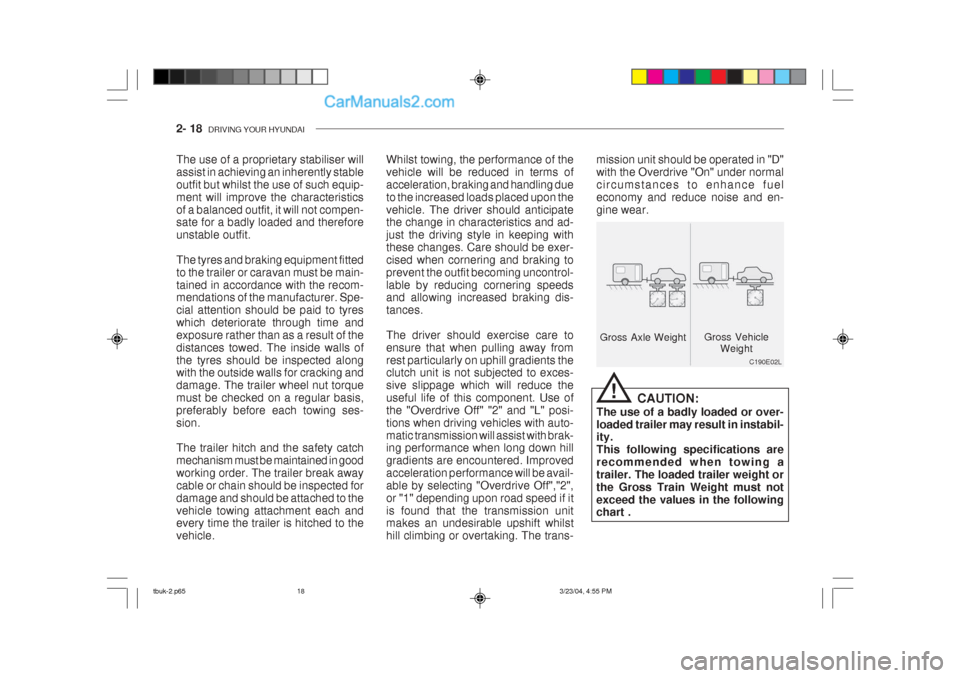
Gross Axle Weight
Gross Vehicle
Weight
The use of a proprietary stabiliser will assist in achieving an inherently stableoutfit but whilst the use of such equip-ment will improve the characteristicsof a balanced outfit, it will not compen- sate for a badly loaded and therefore unstable outfit. The tyres and braking equipment fitted to the trailer or caravan must be main-tained in accordance with the recom- mendations of the manufacturer. Spe- cial attention should be paid to tyreswhich deteriorate through time andexposure rather than as a result of thedistances towed. The inside walls ofthe tyres should be inspected along with the outside walls for cracking and damage. The trailer wheel nut torquemust be checked on a regular basis,preferably before each towing ses-sion. The trailer hitch and the safety catch mechanism must be maintained in goodworking order. The trailer break awaycable or chain should be inspected fordamage and should be attached to thevehicle towing attachment each and every time the trailer is hitched to the vehicle. Whilst towing, the performance of thevehicle will be reduced in terms ofacceleration, braking and handling dueto the increased loads placed upon thevehicle. The driver should anticipate the change in characteristics and ad- just the driving style in keeping withthese changes. Care should be exer-cised when cornering and braking toprevent the outfit becoming uncontrol-lable by reducing cornering speeds and allowing increased braking dis- tances. The driver should exercise care to ensure that when pulling away fromrest particularly on uphill gradients the clutch unit is not subjected to exces- sive slippage which will reduce theuseful life of this component. Use ofthe "Overdrive Off" "2" and "L" posi-tions when driving vehicles with auto-matic transmission will assist with brak- ing performance when long down hill gradients are encountered. Improvedacceleration performance will be avail-able by selecting "Overdrive Off","2",or "1" depending upon road speed if itis found that the transmission unit makes an undesirable upshift whilst hill climbing or overtaking. The trans- mission unit should be operated in "D"with the Overdrive "On" under normalcircumstances to enhance fueleconomy and reduce noise and en-gine wear.
CAUTION:
The use of a badly loaded or over-loaded trailer may result in instabil- ity. This following specifications arerecommended when towing atrailer. The loaded trailer weight orthe Gross Train Weight must notexceed the values in the following chart .
!
tbuk-2.p65 3/23/04, 4:55 PM
18
Page 362 of 445

DRIVING YOUR HYUNDAI 2- 19
Coupling point
Nose
weight
97
(44)
Without Brake Type Trailer
1,543 (700)
2,204 (1,000) 2,425 (1,100) 2,425(1,100)
1,984 (900)
2,425 (1,100)
992(450)
MANUAL
TRANSAXLE
AUTO
TRANSAXLE
1.1L 1.3L 1.6L
Diesel 1.3L 1.6L
With
Brake Type Lbs (kg.)
Maximum Towable
Weight
Type
NOTE:
o The total gross vehicle weight with trailer must not exceed the Gross Vehicle Weight Rating(GVWR) shown on the vehicleidentification plate (see page 8- 2). The total gross vehicle weight is the combined weight of thevehicle, driver, all passengersand their luggage, cargo, towbarhitch, trailer nose weight andother optional equipment. o The front or rear axle weight must
not exceed the Gross Axle Weight Rating (GAWR) shown on the ve- hicle identification plate (seepage 8-2). it is possible that yourtowing package does not exceedthe GVWR but exceeds theGAWR. Improper trailer loading and/or too much luggage in the trunk can overload the rear axle.Redistribute the load and checkthe axle weight again.
o The maximum permissible static vertical load on the coupling de- vice : 44kg
o The maximum permissible over-
hang of the coupling point : 690 mm. YC200E3-E Trailer or Vehicle Towing Tips
1. Before towing, check towbar hitch
and safety cable connections as well as proper operation of the trailerrunning lights, brake lights, and turnsignals.
2. Always drive your vehicle at a mod-
erate speed (Less than 60 mph(max.))
3. Trailer towing requires more fuel than normal conditions.
4. To maintain engine braking effi- ciency and electrical charging per-formance, do not use fifth gear(manual transaxle) or overdrive (au-tomatic transaxle).
5. Always secure items in the trailer to
prevent load shift while driving.
6. Check the condition and air pres-
sure of all tyres on the trailer andyour car. Low tyre pressure canseriously affect the handling. Alsocheck the spare tyre.
7. The vehicle/trailer combination is more affected by crosswind andbuffeting.
HTB312
tbuk-2.p65 3/23/04, 4:55 PM
19