2004 Hyundai Getz height
[x] Cancel search: heightPage 244 of 445

INDEX 10- 3
D Defrosting / Defogging .............................................. 1-80
Door Door locks ................................................................ 1-7
Locking, unlocking front doors with a key ............... 1-7
Drink Holder .............................................................. 1-59
Drive Belts ................................................................ 6-25
Driving
Economical driving ................................................. 2-14
Smooth cornering ................................................... 2-15
Winter driving ......................................................... 2-15
EEmission Control Syst em ........................................... 7-2
Engine Before starting the engine ....................................... 2-3
Compartment ........................................................... 6-2
Coolant ................................................................... 6-13
Coolant temperature gauge ................................... 1-49
If the engine overheats ............................................ 3-4
Number .................................................................... 8-2
Oil ............................................................................. 6-7
Starting ..................................................................... 2-3
Engine Exhaust Can Be Dangerous ........................... 2-2F Fog Light
Front ....................................................................... 1-57
Rear ....................................................................... 1-57
Front Seats Adjustable front seats ............................................ 1-13
Adjustable headrest s .............................................. 1-14
Adjusting seat forward and rear ward..................... 1-13
Adjusting seatback angle .......................................1-13
Lumbar support control .................. ........................ 1-14
Seat cushion height adjustment............................ 1-15
Seat warmer ........................................................... 1-19
Fuel Capacity ................................................................... 9-2
Gauge .................................................................... 1-48
recommendations ..................................................... 1-2
Fuel Filler Lid Remote release ...................................................... 1-68
Fuses ........................................................................ 6-26
Fuse Panel description ............................................. 6-38
G General Checks .......................................................... 6-6
Glove Box ................................................................. 1-63
Page 246 of 445

INDEX 10- 5
P Parking Brake ........................................................... 1-67
Power Steering Fluid Level ............................. ..........6-30
Power Windows ........................................................ 1-12
R Rear Seat .................................................................. 1-15
Rear Window Defroster Switch ................................ 1-56
SSeat Front ....................................................................... 1-13
Seatback Holder ....................................................... 1-70
Seat Pocket .............................................................. 1-70
Seat Warmer ............................................................. 1-19
Seat Belts
3-Point system ....................................................... 1-22
Adjustable height .................................................... 1-22
Adjusting your seat be lt .........................................1-23
Care of seat belts .................................................. 1-21
Precautions ............................................................ 1-20
Spark Plugs ............................................................... 6-15
Spectacle Case ......................................................... 1-63
Speedometer ............................................................. 1-49
Starting ........................................................................ 2-5
Steering Wheel Freeplay .................. ........................ 6-24
Steering Wheel Tilt Lever .............. ...........................1-74
Stereo Radio Operation (K210/K220, K240, H280, HMP280)
................................................. 1-86, 1-91, 1-96, 1-105Stereo Sound System
............................................... 1-84
Sun Visor .................................................................. 1-73
Sunroof ...................................................................... 1-60
T Tachometer ............................................................... 1-49
Tail gate .................................................................... 1-69
Theft-Alarm system ..................................................... 1-9
Tires Balancing .................................................................. 8-5
Chains ...................................................................... 8-4
If you have a flat tire ............................................... 3-6
Information ............................................................... 8-3
Pressure ................................................................... 8-3
Replacement ............................................................ 8-7
Rotation .................................................................... 8-5
Snow tires ................................................................ 8-4
Spare tire ................................................................. 3-5
Traction .................................................................... 8-5
Towing
A trailer (or vehicle) ............................................... 2-18
Emergency ............................................................. 3-13
If your car must be towed .....................................3-11
Trailer or Vehicle towing ........................................... 2-18
Transaxle Automatic ................................................................. 2-9
Automatic transaxle fluid checking ........................6-19
Manual ..................................................................... 2-7
Manual transaxle Oil checking............................... 6-18
Trip Computer ........................................................... 1-51
Trip Odometer ........................................................... 1-50
Page 271 of 445

FEATURES OF YOUR HYUNDAI 1- 13
HTB025-D
SB070F1-F
Seat Cushion Height Adjustment
(Not all models) (Driver's seat
only)
To raise or lower the front part of the
seat cushion, turn the front knob for-
ward or rearward.
To raise or lower the rear part of the seat
cushion, turn the rear knob forward or
rearward.HTB027-D
SB070E1-E
Lumbar Support Adjustment
(Not all models) (Driver's seat
only)
Some models are fitted with adjustable
driver seat lumbar support which may
be used to increase the amount of
lumbar support offered by the seat back.
Adjustment is performed by moving the
handle at the side of the backrest in a
forward direction to increase the sup-
port.
!WARNING:
o For maximum effectiveness in case of an accident, the headrest should
be adjusted so the top of the head-
rest is at the same height as the
top of the occupant's ears. The
use of a cushion that holds the
body away from the seatback is
not recommended.
o Do not operate the vehicle with the headrests removed as severe in-
jury to an occupant may occur in
the event of an accident. Head-
rests may provide protection
against severe neck injuries when
properly adjusted.
tbuk-1a.p65 3/23/04, 2:21 PM
13
Page 273 of 445

FEATURES OF YOUR HYUNDAI 1- 15
HTB294
B099A02F-EAT
BEFORE FOLDING THE REAR
SEATS
Outboard Rear Seat Belt
HTB300
!
Rear Seat Centre's 3 Point Type Seat
Belt. In order to prevent the shoulder belt
from being damaged while folding the
rear seat, the shoulder belt must be
passed through the hanger to keep it
out of the way.
CAUTION:
Seat belts must be removed from the
hanger when in use.
!WARNING:
o For maximum effectiveness in case of an accident, the headrest should
be adjusted so the top of the head-
rest is at the same height as the
top of the occupant's ears. The
use of a cushion that holds the
body away from the seatback is
not recommended.
o Do not operate vehicle with the headrests removed as severe in-
jury to an occupant may occur in
the event of an accident. Head-
rests may provide protection
against severe neck injuries when
properly adjusted.
tbuk-1a.p65 3/23/04, 2:21 PM
15
Page 277 of 445
FEATURES OF YOUR HYUNDAI 1- 19
!
B170A01L
SB090K1-E
Replacement of Seat Belts
The entire seat belt assembly or as-
semblies should be replaced if the ve-
hicle has been involved in an accident
even if no damage is evident. Addi-
tional questions concerning seat belt
operation should be directed to a Hyundai
Dealer.
B170A04A-EAT
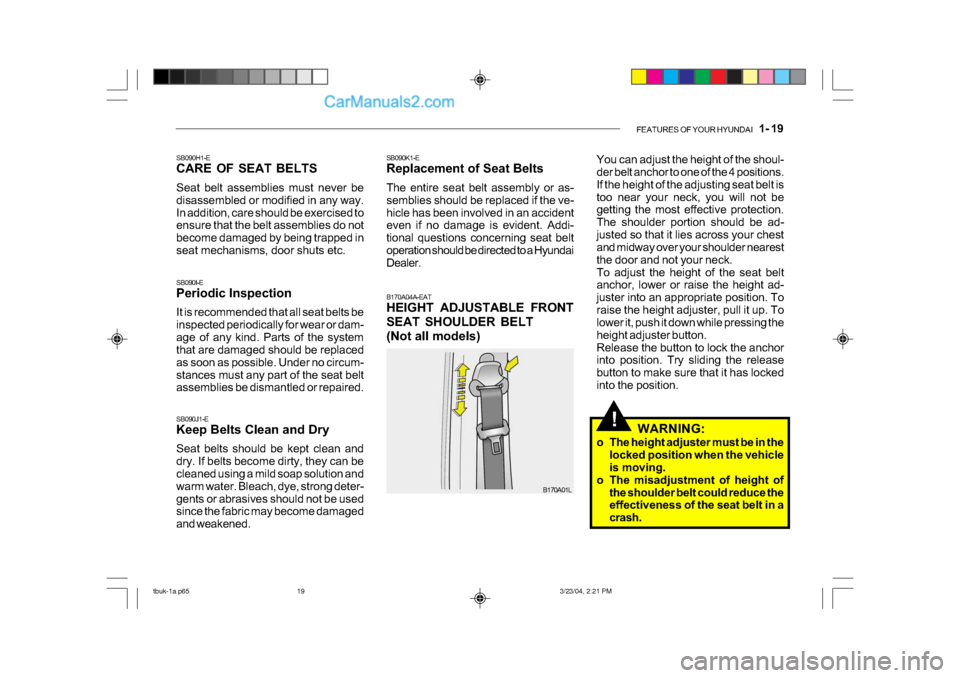
HEIGHT ADJUSTABLE FRONT
SEAT SHOULDER BELT
(Not all models)
You can adjust the height of the shoul-
der belt anchor to one of the 4 positions.
If the height of the adjusting seat belt is
too near your neck, you will not be
getting the most effective protection.
The shoulder portion should be ad-
justed so that it lies across your chest
and midway over your shoulder nearest
the door and not your neck.
To adjust the height of the seat belt
anchor, lower or raise the height ad-
juster into an appropriate position. To
raise the height adjuster, pull it up. To
lower it, push it down while pressing the
height adjuster button.
Release the button to lock the anchor
into position. Try sliding the release
button to make sure that it has locked
into the position.
WARNING:
o The height adjuster must be in the locked position when the vehicle
is moving.
o The misadjustment of height of the shoulder belt could reduce the
effectiveness of the seat belt in a
crash.
SB090H1-E
CARE OF SEAT BELTS
Seat belt assemblies must never be
disassembled or modified in any way.
In addition, care should be exercised to
ensure that the belt assemblies do not
become damaged by being trapped in
seat mechanisms, door shuts etc.
SB090I-E
Periodic Inspection
It is recommended that all seat belts be
inspected periodically for wear or dam-
age of any kind. Parts of the system
that are damaged should be replaced
as soon as possible. Under no circum-
stances must any part of the seat belt
assemblies be dismantled or repaired.
SB090J1-E
Keep Belts Clean and Dry
Seat belts should be kept clean and
dry. If belts become dirty, they can be
cleaned using a mild soap solution and
warm water. Bleach, dye, strong deter-
gents or abrasives should not be used
since the fabric may become damaged
and weakened.
tbuk-1a.p65
3/23/04, 2:21 PM
19
Page 281 of 445

FEATURES OF YOUR HYUNDAI 1- 23
Never allow children to ride in the
front passenger seat.
o Always make sure that the shoul-
der belt portion of the outboard
lap/shoulder belt is positioned
midway over the shoulder, never
across the neck or behind the
back. Moving the child closer to
the centre of the vehicle may help
provide a good shoulder belt fit.
The lap belt portion of the lap/
shoulder belt or the centre seat lap
belt must always be positioned as
low as possible on the child's hips
and as snug as possible.
o If the seat belt will not properly fit the child, Hyundai recommends
the use of an approved booster
seat in the rear seat in order to
raise the child's seating height so
that the seat belt will properly fit
the child.
o Never allow a child to stand up or kneel on the seat. o Never use an infant carrier or child
safety seat that "hooks" over a
seatback; it may not provide ad-
equate security in an accident.
o Never allow a child to be held in a person's arms while they are in a
moving vehicle, as this could re-
sult in serious injury to the child
in the event of an accident or a
sudden stop. Holding a child in a
moving vehicle does not provide
the child with any means of pro-
tection during an accident, even if
the person holding the child is
wearing a seat belt.
o If the child restraint seat is not
anchored properly, the risk of a
child being seriously injured or
killed in a collision greatly in-
creases.
WARNING:
o A child restraint system must be placed in the rear seat. Never in-
stall a child or infant seat on the
front passenger's seat.
Should an accident occur and
cause the passenger side airbag
to deploy, it could severely injure
or kill an infant or child seated in
an infant or child seat. Thus, only
use a child restraint in the rear
seat of your vehicle.
o Since a safety belt or child re-
straint system can become very
hot if it is left in a closed vehicle,
be sure to check the seat cover
and buckles before placing a child
there.
o When the child restraint system is
not in use, store it in the trunk or
fasten it with a safety belt so that it
will not be thrown forward in the
case of a sudden stop or an acci-
dent.
o Children who are too large to be in
a child restraint should sit in the
rear seat and be restrained with
the available lap/shoulder belts.!
tbuk-1a.p65 3/23/04, 2:21 PM
23
Page 343 of 445
FEATURES OF YOUR HYUNDAI 1- 85
CAUTION:
o Be sure to remove the antenna before washing the car in an au-
tomatic car wash or it may be
damaged.
o Before entering a place with a low height clearance, be sure to
adjust the roof antenna low.
o When reinstalling your antenna, it is important that it is fully tight-
ened to ensure proper reception.!
tbuk-1b.p65 3/23/04, 2:24 PM
85
Page 357 of 445

2- 14 DRIVING YOUR HYUNDAI
!WARNING:
ABS will not prevent accidents due to improper or dangerous drivingmaneuvers. Even though vehicle control is improved during emer- gency braking, always maintain asafe distance between you and ob-jects ahead. Vehicle speeds shouldalways be reduced during extremeroad conditions. The braking distance for cars equipped with an anti-lock brakingsystem may be longer than for thosewithout it in the following road con-ditions.
o Driving on rough, gravel or snow- covered roads.
o Driving with tyre chains installed.
o Driving on roads where the road
surface is pitted or has differentsurface height. These roads should be driven at reduced speeds. The safety features of an ABS equipped vehicle shouldnot be tested by high speed drivingor cornering. This could endangerthe safety of yourself or others. SC150A1-F DRIVING FOR ECONOMY You can save fuel and get more miles from your car if you follow these sug-gestions:
o Drive smoothly. Accelerate at a
moderate rate. Don't make "jack- rabbit" starts or full-throttle shiftsand maintain a steady cruisingspeed. Don't race between stop-lights. Try to adjust your speed tothat of the other traffic so you don't have to change speeds unneces- sarily.Avoid heavy traffic whenever pos-sible. Al-ways maintain a safe dis-tance from other vehicles so youcan avoid unnecessary braking. This also reduces brake wear. o Drive at a moderate speed. The
faster you drive, the more fuel your car uses. Driving at a moderatespeed, especially on the highway, isone of the most effective ways to reduce fuel consumption.
o Don't "ride" the brake or clutch pedal. This can increase fuel consumption and also increase wear on thesecomponents. In addition, driving withyour foot resting on the brake pedal may cause the brakes to overheat, which reduces their effectivenessand may lead to more serious con-sequences.
o Take care of your tyres. Keep them inflated to the recommended pres- sure. Incorrect infla-tion, either too much or too little, results in unnec-essary tyre wear. Check the tyrepres-sures at least once a month.
o Be sure that the wheels are aligned correctly. Improper alignment can result from hitting curbs or driving too fast over irregular surfaces. Pooralignment causes faster tyre wearand may also result in other prob-lems as well as greater fuel con-sumption.
tbuk-2.p65 3/23/04, 4:55 PM
14