2004 HONDA ODYSSEY spare tire
[x] Cancel search: spare tirePage 195 of 296

Your Honda is equipped with a
Traction Control System (TCS) to
assist you in maintaining traction
while driving slowly on loose or
slippery surf aces. The TCS assists
only in low-speed, low-traction
conditions; up to approximately 18
mph (30 km/h).
TCS monitors the speed of all f our
wheels. When it senses a f ront wheel
losing traction, it applies braking to
that wheel. The TCS indicator
f lashes when this occurs.
Driving with TCS requires no special
skills or technique. The TCS does
not control your vehicle’s whole
braking system and cannot prevent
skidding if you enter a corner too
f ast. It is still your responsibility to
drive at reasonable speeds and to
leave a sufficient margin of safety.You should still install winter tires on
your vehicle during the winter. Make
sure to use the same size originally
supplied with vehicle. Exercise the
samecautioninwinterdrivingasyou
would if your vehicle was not
equipped with TCS.
Driving with the compact spare tire
installed (see page ) may
activate the TCS. You should turn of f
the system.
When starting out or driving at low
speeds on a loose or slippery road
surface, you may notice that the
vehicle does not respond to the
accelerator in the same way it does
at other times. This is a sign TCS is
activating. You will see the TCS
indicator f lash. If the brakes overheat while TCS is
activating, the TCS indicator will
stop flashing and stay on temporarily.
This indicates that TCS has turned
off. After the brakes have cooled
down (usually f or about 10 minutes),
TCSwillturnbackonandthe
indicator will turn of f .238
Driving
Traction Control System (TCS)
192
TRACTION CONTROL
SYSTEM INDICATOR
Page 201 of 296

When towing a trailer, you should
carry a f ull-size wheel and tire as a
spare in case you have a flat. If you
use the compact spare tire that came
with the vehicle, it may adversely
af f ect vehicle handling. See pagef or inf ormation on proper tire
size, and page f or inf ormation on
how to store a f ull-size tire. When
storing a f ull-size spare tire in the
trailer, f ollow the trailer maker’s
instructions.
Many states and Canadian provinces
require special outside mirrors when
towing a trailer. Even if they don’t,
you should install special mirrors if
you cannot clearly see behind you, or
if the trailer creates a blind spot.
Askyourtrailersalesorrental
agency if any other items are
recommended or required f or your
towing situation. When preparing to tow, and bef ore
driving away, be sure to check the
f ollowing:
You may want to fill the fuel tank
with premium f uel. Premium f uel
provides improved perf ormance. Your vehicle tires and spare are
properly inf lated (see page ),
and the trailer tires and spare are
inflated as recommended by the
trailer maker. The lights and brakes on your
vehicle and the trailer are working
properly. Allitemsonandinthetrailerare
properly secured and cannot shif t
while you drive.
Thehitch,safetychains,andany
other attachments are secure. All weights and loads are within
limits (see pages and ). The trailer has been properly
serviced and is in good condition. If you tow f requently, f ollow the
Severe Conditions maintenance
schedule. The vehicle has been properly
serviced, and the tires, brakes,
suspension, and cooling system
are in good operating condition.
244
233
194231
195
Towing a Trailer
Driving
Spare Vehicle T ire
Additional Trailer EquipmentPre-T ow Checklist
198
Page 233 of 296
To saf ely operate your vehicle, your
tires must be the proper type and
size, in good condition with adequate
tread, and correctly inf lated.
The f ollowing pages give more
detailed inf ormation on how to take
care of your tires and what to do
when they need to be replaced.Keeping the tires properly inf lated
provides the best combination of
handling, tread lif e, and riding
comf ort.
We recommend that you visually
check your tires every day. If you
think a tire might be low, check it
immediately with a tire gauge.Use a gauge to measure the air
pressure at least once a month. Even
tires that are in good condition may
lose one to two psi (10 to 20 kPa, 0.1
to 0.2 kgf /cm ) per month.
Remember to check the spare tire at
thesametime.
Check the pressure in the tires when
they are cold. This means the vehicle
has been parked f or at least three
hours, or driven less than 1 mile (1.6
km).
Underinf lated tires wear unevenly,
adversely affect handling and fuel
economy, and are more likely to
fail from being overheated.
Overinf lated tires can make your
vehicleridemoreharshly,are
more prone to damage f rom road
hazards, and wear unevenly. Add or release air, if needed, to
match the recommended cold tire
pressures on page .231
Tires
Maint enance
Inf lation
230
Using tires that are excessively
worn or improperly inflated can
cause a crash in which you can
be seriously hurt or killed.
Follow all instructions in this
owner’s manual regarding tire
inflation and maintenance.
Page 234 of 296
![HONDA ODYSSEY 2004 RB1-RB2 / 3.G Owners Manual If you check the pressure when the
tires are hot [driven f or several miles
(kilometers)], you will see readings 4
to6psi(30to40kPa,0.3to0.4
kgf /cm ) higher than the cold
reading. This is normal; do](/manual-img/13/5968/w960_5968-233.png "HONDA ODYSSEY 2004 RB1-RB2 / 3.G Owners Manual If you check the pressure when the
tires are hot [driven f or several miles
(kilometers)], you will see readings 4
to6psi(30to40kPa,0.3to0.4
kgf /cm ) higher than the cold
reading. This is normal; do")
If you check the pressure when the
tires are hot [driven f or several miles
(kilometers)], you will see readings 4
to6psi(30to40kPa,0.3to0.4
kgf /cm ) higher than the cold
reading. This is normal; do not
release air to match the cold
pressure.Thecompactsparetirepressureis:
For convenience, the recommended
tire sizes and cold air pressures are
on a label on the driver’s doorjamb.
For additional technical inf ormation,
see page .
Tire pressure f or high speed driving
is the same as f or normal driving.Every time you check inf lation, you
should also examine the tires for
damage, f oreign objects, and wear.
Youshouldlookfor:
Bumps or bulges in the tread or
side of the tire. Replace the tire if
youfindeitherortheseconditions.
Cuts, splits, or cracks in the side
of the tire. Replace the tire if you
can see f abric or cord.
Excessive tread wear.
Tubeless tires have some ability to
self -seal if they are punctured. You
should look closely f or punctures if a
tire starts losing pressure.
Youshouldgetyourowntire
pressure gauge and use it whenever
you check your tire pressures. This
will make it easier f or you to tell if a
pressure loss is due to a tire problem
and not due to a variation between
gauges. 270
CONT INUED
Tire Size Cold Tire Pressure
for Normal Driving
Tires
Maint enance
Tire Inspection
231
60 psi (420 kPa , 4.2 kgf/cm)
225/60R16 98T 36 psi (250 kPa , 2.5 kgf/cm
)
Page 240 of 296

This section covers the more
common problems that motorists
experience with their vehicles. It
gives you inf ormation about how to
safely evaluate the problem and what
to do to correct it. If the problem has
stranded you on the side of the road,
you may be able to get going again.
If not, you will also f ind instructions
on getting your vehicle towed.......................
Compact Spare Tire .238
....................
Changing a Flat Tire .239
.............
If the Engine Won’t Start . 247
................................
Jump Starting .248
..............
If the Engine Overheats . 250
.........
Low Oil Pressure Indicator . 252
..........
Charging System Indicator . 252
.......
Malf unction Indicator Lamp . 253
...............
Brake System Indicator . 254
......................
Emergency Towing .255
..............................................
Fuses .257
..............................
Fuse Locations .260
Taking Care of the Unexpected
T aking Care of t he Unexpect ed237
Page 241 of 296

Use the compact spare tire as a
temporary replacement only. Get
your regular tire repaired or replaced
and put it back on your vehicle as
soon as you can.
Check the inf lation pressure of the
compact spare tire every time you
check the other tires. It should be
inf lated to:
Follow these precautions:Never exceed 50 mph (80 km/h)
under any circumstances.
This tire gives a harsher ride and
less traction on some road sur-
f aces. Use greater caution while
driving. Do not mount snow chains on it.
Do not use the compact spare tire
if you are towing a trailer.
Do not use your compact spare
tire on another vehicle unless it is
thesamemakeandmodel.
Turn off the Traction Control
System (see page ). Driving
withthecompactsparetiremay
activate the TCS.
Replace the tire when you can see
the tread wear indicator bars. The
replacement should be the same size
and design tire, mounted on the
same wheel. The spare tire is not
designed to be mounted on a regular
wheel, and the spare wheel is not
designed f or mounting a regular tire.
193
Compact Spare Tire
T aking Care of t he Unexpect ed238
INDICATOR LOCATION MARK
TREAD WEAR INDICATOR BAR
60 psi (420 kPa , 4.2 kgf/cm)
Page 242 of 296
CONT INUED
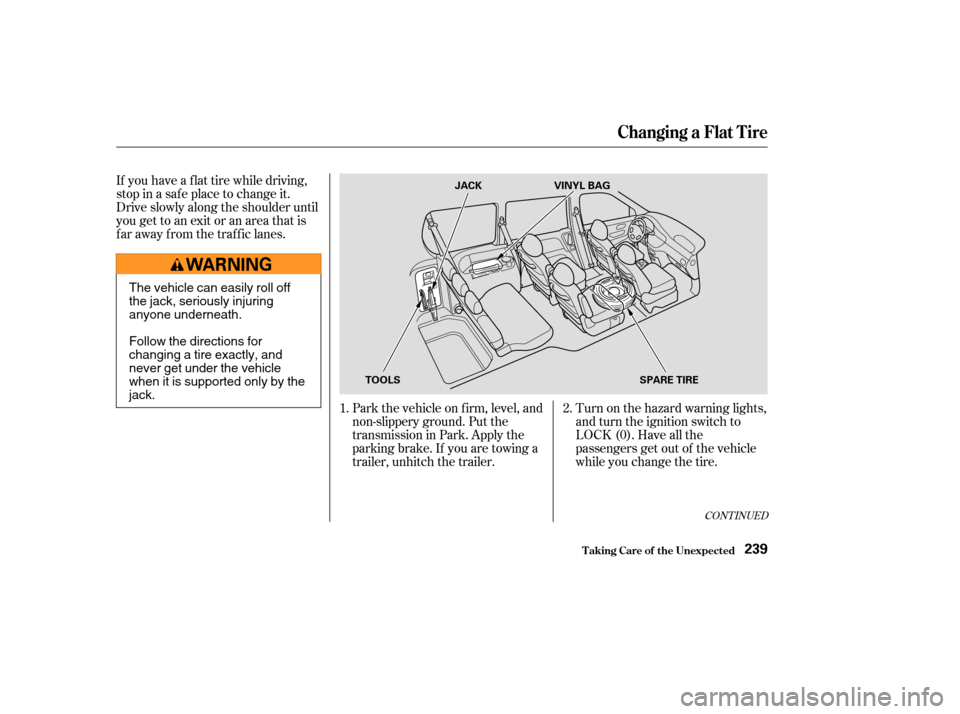
If you have a f lat tire while driving,
stop in a saf e place to change it.
Drive slowly along the shoulder until
you get to an exit or an area that is
far away from the traffic lanes.Park the vehicle on f irm, level, and
non-slippery ground. Put the
transmission in Park. Apply the
parking brake. If you are towing a
trailer, unhitch the trailer.Turn on the hazard warning lights,
and turn the ignition switch to
LOCK (0). Have all the
passengers get out of the vehicle
while you change the tire.
2.
1.
Changing a Flat T ire
T aking Care of t he Unexpect ed239
JACK VINYL BAG
SPARE TIRE
TOOLS
The vehicle can easily roll off
the jack, seriously injuring
anyone underneath.
Follow the directions for
changing a tire exactly, and
never get under the vehicle
when it is supported only by the
jack.
Page 243 of 296
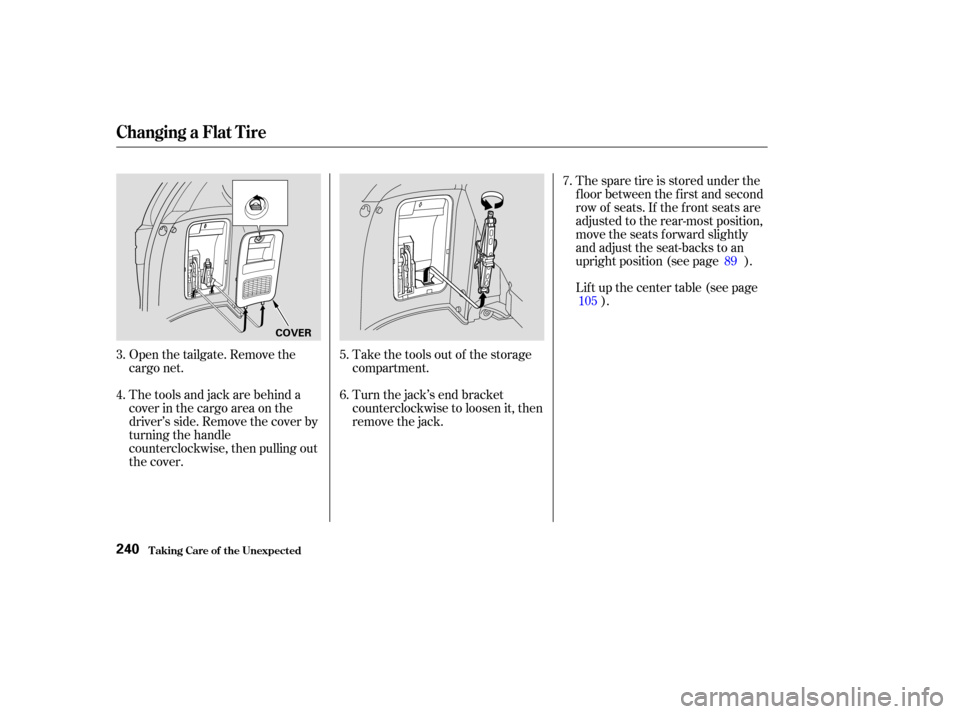
Thetoolsandjackarebehinda
cover in the cargo area on the
driver’s side. Remove the cover by
turning the handle
counterclockwise, then pulling out
the cover.Take the tools out of the storage
compartment.
Turn the jack’s end bracket
counterclockwise to loosen it, then
remove the jack.The spare tire is stored under the
f loor between the f irst and second
row of seats. If the f ront seats are
adjusted to the rear-most position,
move the seats forward slightly
and adjust the seat-backs to an
upright position (see page ).
Lift up the center table (see page
).
Open the tailgate. Remove the
cargo net.
3.
4. 5.
6.7.
105 89
Changing a Flat T ire
T aking Care of t he Unexpect ed240
COVER