2004 HONDA ODYSSEY ECO
[x] Cancel search: ECOPage 2 of 296

T his Owner’s Manual should be considered
a permanent part of the vehicle, and should
remain with the vehicle when it is sold.
T his Owner’s Manual covers all models of
the Odyssey. You may f ind descriptions of
equipment and f eatures that are not on your
particular model.
T he inf ormation and specif ications included
in this publication were in ef f ect at the time
of approval f or printing. Honda Motor Co.,
Ltd. reserves the right, however, to
discontinue or change specif ications or
design at any time without notice and
without incurring any obligation whatsoever.
Owner’s Identif ication
POUR CLIENTS CANADIEN
A VIS IMPORT A NT : Si vous avez
besoin d’un Manuel du Conduct eur
en f rançais, veuillez demander à
votreconcessionnairede
commander le numéro de pièce
38S0X650
OWNER
ADDRESS
V. I. N.
DELIVERY DATE
DEALER NAMEDEALER NO.
ADDRESS
OWNER’S SIGNATURE
DEALER’S SIGNATURE
STREET
CITY STATE/PROVINCE ZIP CODE/
POSTAL CODE
(Date sold to original retail purchaser)
STREET
CITY STATE/PROVINCE ZIP CODE/
POSTAL CODE
Page 9 of 296

You’ll f ind many saf ety
recommendations throughout this
section, and throughout this manual.
Therecommendationsonthispage
are the ones we consider to be the
most important.
A seat belt is your best protection in
all types of collisions. Airbags
supplement seat belts, but airbags
are designed to inf late only in a
moderate to severe frontal or side
collision. So even though your
vehicle is equipped with airbags,
make sure you and your passengers
always wear your seat belts, and
wear them properly (see page ).
Children age 12 and under should
ride properly restrained in a back
seat. Infants and small children
should be restrained in a child seat.
Larger children should use a booster
and a lap/shoulder belt until theycanusethebeltproperlywithouta
booster (see page ).
While airbags can save lives, they
can cause serious or fatal injuries to
occupants who sit too close to them,
or are not properly restrained.
Inf ants, young children, and short
adults are at the greatest risk. Be
sure to f ollow all instructions and
warnings in this manual.
Alcohol and driving don’t mix. Even
one drink can reduce your ability to
respond to changing conditions, and
your reaction time gets worse with
every additional drink. So don’t drink
and drive, and don’t let your f riends
drink and drive, either.
Excessive speed is a major f actor in
crash injuries and deaths. Generally,
the higher the speed the greater the
risk, but serious injuries can also
occur at lower speeds. Never drive
f aster than is saf e f or current
conditions, regardless of the
maximum speed posted.
Having a tire blowout or a
mechanical f ailure can be extremely
hazardous. To reduce the possibility
of such problems, check your tire
pressures and condition f requently,
and perform all regularly scheduled
maintenance (see page ).
14 35
205
Important Saf ety Precautions
Driver and Passenger Saf ety
Always Wear Your Seat Belt
Restrain All ChildrenBe Aware of Airbag Hazards
Control Your Speed
K eep Your Vehicle in Saf e
Condition
Don’t Drink and Drive
6
Page 15 of 296
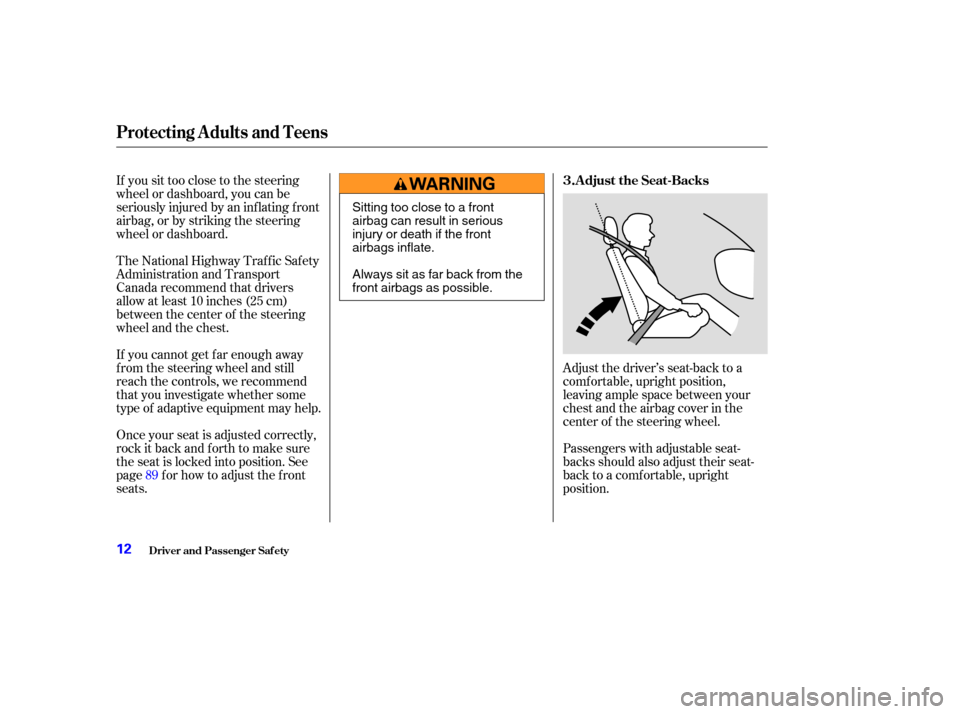
If you sit too close to the steering
wheel or dashboard, you can be
seriously injured by an inf lating f ront
airbag, or by striking the steering
wheel or dashboard.
The National Highway Traffic Safety
Administration and Transport
Canada recommend that drivers
allow at least 10 inches (25 cm)
between the center of the steering
wheel and the chest.
If you cannot get f ar enough away
f rom the steering wheel and still
reach the controls, we recommend
that you investigate whether some
type of adaptive equipment may help.
Once your seat is adjusted correctly,
rock it back and f orth to make sure
the seat is locked into position. See
page f or how to adjust the f ront
seats.Adjust the driver’s seat-back to a
comf ortable, upright position,
leaving ample space between your
chest and the airbag cover in the
center of the steering wheel.
Passengers with adjustable seat-
backs should also adjust their seat-
back to a comf ortable, upright
position.
89
Protecting A dults and Teens
Driver and Passenger Saf ety
Adjust the Seat-Backs
3.
12
Sitting too close to a front
airbag can result in serious
injury or death if the front
airbags inflate.
Always sit as far back from the
front airbags as possible.
Page 18 of 296
CONT INUED
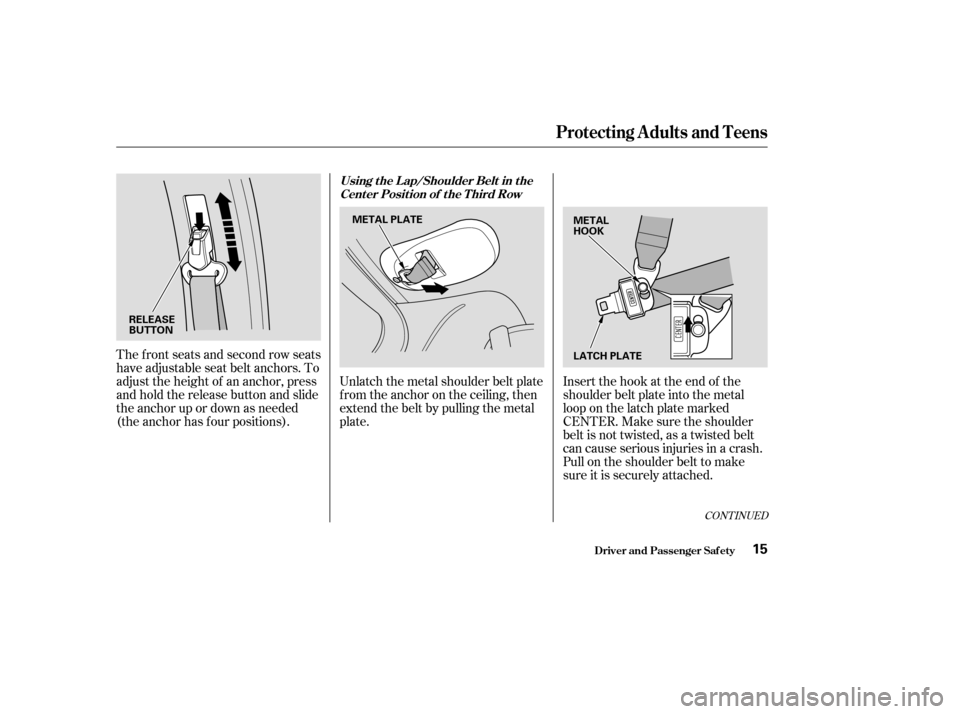
Insert the hook at the end of the
shoulder belt plate into the metal
loop on the latch plate marked
CENTER.Makesuretheshoulder
belt is not twisted, as a twisted belt
can cause serious injuries in a crash.
Pull on the shoulder belt to make
sure it is securely attached.
Unlatch the metal shoulder belt plate
f rom the anchor on the ceiling, then
extend the belt by pulling the metal
plate.
The f ront seats and second row seats
have adjustable seat belt anchors. To
adjust the height of an anchor, press
andholdthereleasebuttonandslide
the anchor up or down as needed
(the anchor has f our positions).
Protecting A dults and Teens
Driver and Passenger Saf ety
Using t he L ap/Shoulder Belt in t he
Cent er Posit ion of t he T hird Row
15
METAL
HOOK
LATCH PLATE
RELEASE
BUTTON METAL PLATE
Page 23 of 296

Your seat belt system includes lap/
shoulder belts in all seven seating
positions. The f ront seat belts are
also equipped with automatic seat
belt tensioners.Most seat belts are a one-piece lap/
shoulder belt. This seat belt goes
over your shoulder, across your
chest and across your hips.
To fasten the belt, insert the latch
plate into the buckle, then tug on the
belt to make sure the buckle is
latched (see page f or how to
properly position the belt).
To unlock the belt, push the red
PRESSbuttononthebuckle.Guide
the belt across your body so that it
retracts completely. Af ter exiting the
vehicle, be sure the belt is out of the
way and will not get closed in the
door.The seat belts in all positions except
the driver’s and the center seat in
the third row have an additional
locking mechanism that must be
activated to secure a child seat (see
page ).
If the shoulder part of the belt is
pulled all the way out, the locking
mechanism will activate. The belt
will retract, but it will not allow the
passenger to move f reely.
To deactivate the locking
mechanism, unlatch the buckle, and
let the seat belt f ully retract. To
ref asten the belt, pull it out only as
f ar as needed.
The seat belt system
includes an indicator on the
instrument panel to remind you and
your passengers to f asten your seat
belts.
If the driver’s seat belt is not
fastened before the ignition is turned
to ON (II), the indicator will come on
and a beeper will also sound. The
beeper will stop af ter a f ew seconds,
but the indicator will stay on until the
driver’s seat belt is f astened. 46
14
Additional Inf ormation About Your Seat Belts
Driver and Passenger Saf ety
Seat Belt System Components L ap/Shoulder Belt
(Except cent er posit ion of t hird row)
20
Page 28 of 296

CONT INUED
A sophisticated electronic system
that continually monitors and
records inf ormation about the
sensors, the control unit, the
airbag activators, and driver and
frontpassengerseatbeltusewhen
the ignition is in the ON (II)
position.
Weight sensors that monitor the
weight on the f ront passenger’s
seat. These prevent the passenger’s
f ront airbag f rom inf lating if the
weight is less than about 65 lbs
(30 kg) (see page ).
An indicator on the instrument
panel that alerts you to a possible
problem with your airbags (see
page ).An indicator on the instrument
panel that alerts you that the f ront
passenger’s side airbag has been
turned of f (see page ).
An indicator on the dashboard that
alerts you that the passenger’s
f ront airbag has been turned of f
(see page ).
Emergency backup power in case
your vehicle’s electrical system is
disconnected in a crash.
A driver’s seat position sensor that
monitors the seat position. If the
seat is too far forward, the airbag
will inf late with less f orce (see
page ).
If you ever have a moderate to
severe f rontal collision, sensors will
detect the vehicle’s rapid
deceleration. If the rate of
deceleration is high enough, the
control unit will instantly inf late the
driver’s and f ront passenger’s f ront
airbags, at the appropriate time and
with the f orce needed.
28
30 31
32
28
Additional Inf ormation About Your Airbags
Driver and Passenger Saf ety
How Your Front Airbags Work
25
Page 29 of 296
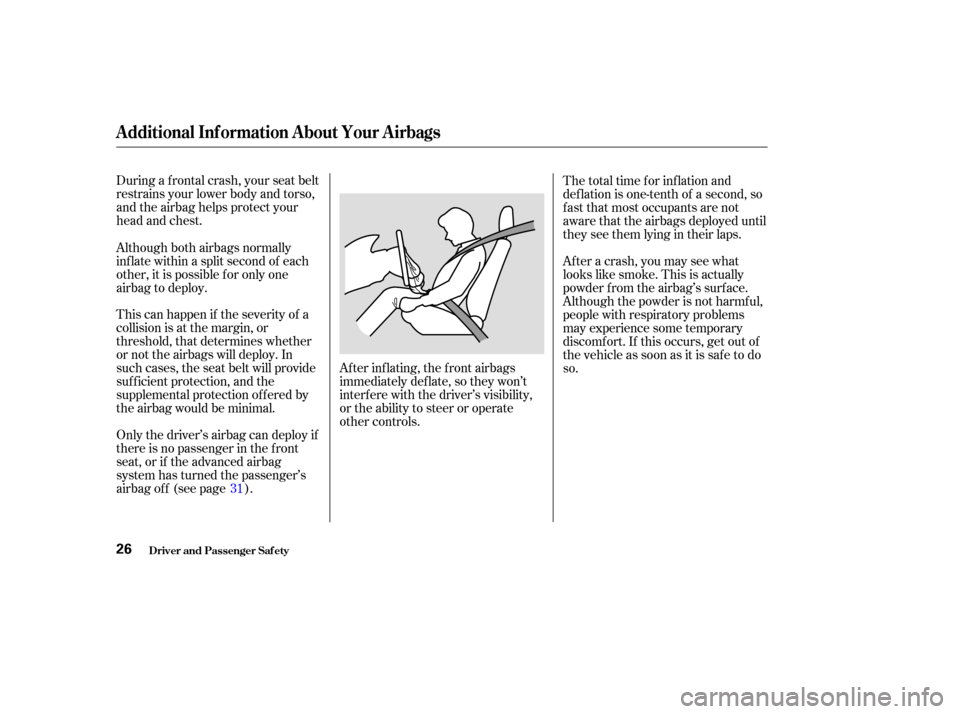
During a f rontal crash, your seat belt
restrains your lower body and torso,
and the airbag helps protect your
head and chest.
This can happen if the severity of a
collision is at the margin, or
threshold, that determines whether
or not the airbags will deploy. In
such cases, the seat belt will provide
suf f icient protection, and the
supplemental protection of f ered by
the airbag would be minimal.Af ter inf lating, the f ront airbags
immediately def late, so they won’t
interf ere with the driver’s visibility,
or the ability to steer or operate
other controls.The total time for inflation and
def lation is one-tenth of a second, so
f ast that most occupants are not
aware that the airbags deployed until
they see them lying in their laps.
After a crash, you may see what
looks like smoke. This is actually
powder f rom the airbag’s surf ace.
Although the powder is not harmf ul,
people with respiratory problems
mayexperiencesometemporary
discomf ort. If this occurs, get out of
the vehicle as soon as it is saf e to do
so.
Only the driver’s airbag can deploy if
there is no passenger in the f ront
seat, or if the advanced airbag
system has turned the passenger’s
airbag off (see page ). Although both airbags normally
inf late within a split second of each
other, it is possible f or only one
airbag to deploy.
31
Additional Inf ormation About Your Airbags
Driver and Passenger Saf ety26
Page 30 of 296

CONT INUED
Your f ront airbags are dual-stage
airbags. This means they have two
inf lation stages that can be ignited
sequentially or simultaneously,
depending on crash severity.
In acrash, both stages
will ignite simultaneously to provide
the quickest and greatest protection.
In a crash, one stage will
ignite first, then the second stage
will ignite a split second later. This
provides longer airbag inf lation time
with a little less force. Your f ront airbags are also dual-
threshold airbags. Airbags with this
f eature have two deployment
thresholds that depend on whether
or not the occupant is wearing a seat
belt.
If the occupant’s belt is
,
the airbag will deploy at the same
threshold as a conventional airbag,
because the occupant would need
extra protection.
It the occupant’s belt is , the
airbag will inf late at a slightly higher
threshold, when the airbag would be
needed to supplement the protection
provided by the seat belt. Your f ront airbags are also advanced
airbags. The main purpose of this
feature is to prevent airbag-caused
injuries to short drivers and children
who ride in f ront.
In addition, do not spill any liquids,
cover the sensors, or put any cargo
or metal objects under the f ront
seats. Ask second row passengers to
not put their f eet under the f ront
seats. Any of these actions could
damage the sensors or prevent them
f rom working properly. For the advanced airbags to work
properly, occupants must sit upright
and wear their seat belts properly. If
a child seat is installed in the f ront, it
must be properly secured.
Additional Inf ormation About Your Airbags
Driver and Passenger Saf ety
Dual-Stage A irbags
more severeless severe Dual-T hreshold A irbags
not lat chedlatchedAdvanced Airbags
27