Page 43 of 296

Only a rear-f acing child seat provides
proper support f or a baby’s head,
neck, and back.
An inf ant must be properly
restrained in a rear-f acing, reclining
child seat until the child reaches the
seat maker’s weight or height limit
for the seat and the child is at least
one year old.Two types of seats may be used: a
seat designed exclusively f or inf ants,
or a convertible seat used in the rear-
f acing, reclining mode.
If placed
f acing f orward, an inf ant could be
very seriously injured during a
f rontal collision. We strongly recommend installing a
rear-facing child seat in a back seat.
In either of these situations, we
strongly recommend that you install
the child seat in a dif f erent back
seating position or get a smaller rear-
f acing child seat.
If an inf ant must ride in the f ront,
make sure the ‘‘Passenger Airbag
Of f ’’ indicator comes on and stays on
while driving. If it goes of f , the child
could be killed or seriously injured if
the front airbag inflates. When properly installed, a rear-
f acing child seat may prevent the
driver or a f ront passenger f rom
moving the seat as far back as
recommended, or f rom locking the
seat-back in the desired position.
Protecting Inf ants and Small Children
Driver and Passenger Saf ety
Protecting Inf ants
Child Seat T ype
Do not put a rear-f acing child seat ina f orward-f acing position. Child Seat Placement
40
Placing a rear-facing child seat
in the front seat can result in
serious injury or death during a
collision.
Always place a rear-facing child
seat in the back seat, not the
front.
Page 44 of 296
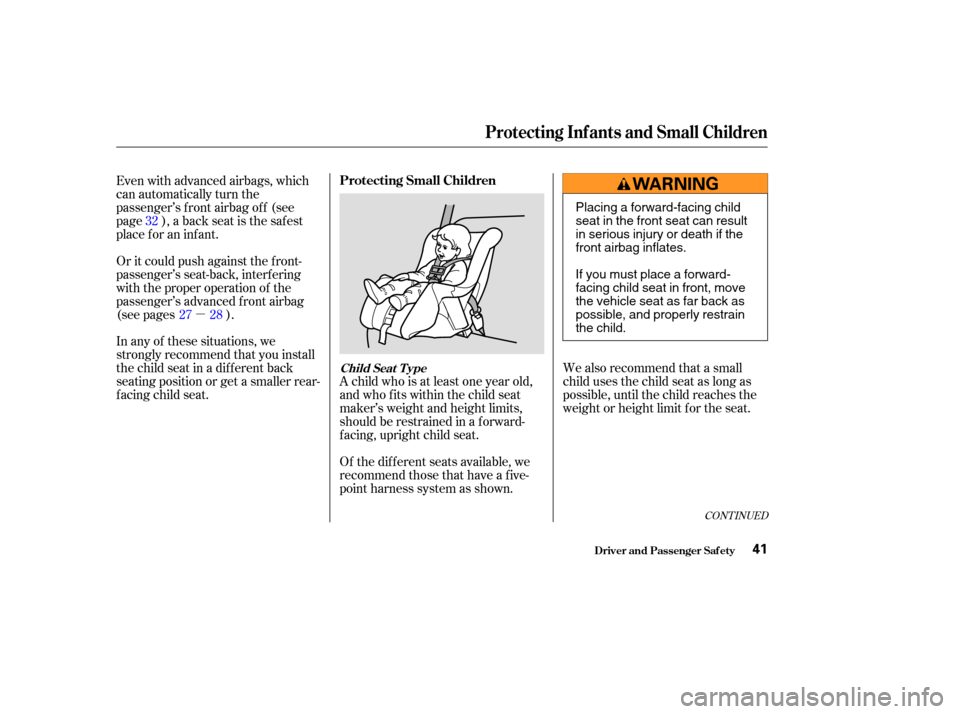
�µA child who is at least one year old,
and who fits within the child seat
maker’s weight and height limits,
should be restrained in a f orward-
f acing, upright child seat.
Of the different seats available, we
recommend those that have a f ive-
point harness system as shown. We also recommend that a small
child uses the child seat as long as
possible, until the child reaches the
weight or height limit f or the seat.
Even with advanced airbags, which
can automatically turn the
passenger’s f ront airbag of f (see
page ), a back seat is the saf est
place f or an inf ant.
In any of these situations, we
strongly recommend that you install
the child seat in a dif f erent back
seating position or get a smaller rear-
f acing child seat. Or it could push against the f ront-
passenger’s seat-back, interf ering
with the proper operation of the
passenger’s advanced front airbag
(see pages ).
32
2827
CONT INUED
Protecting Inf ants and Small Children
Driver and Passenger Saf ety
Protecting Small Children
Child Seat T ype
41
Placing a forward-facing child
seat in the front seat can result
in serious injury or death if the
front airbag inflates.
Ifyoumustplaceaforward-
facing child seat in front, move
the vehicle seat as far back as
possible, and properly restrain
the child.
Page 50 of 296
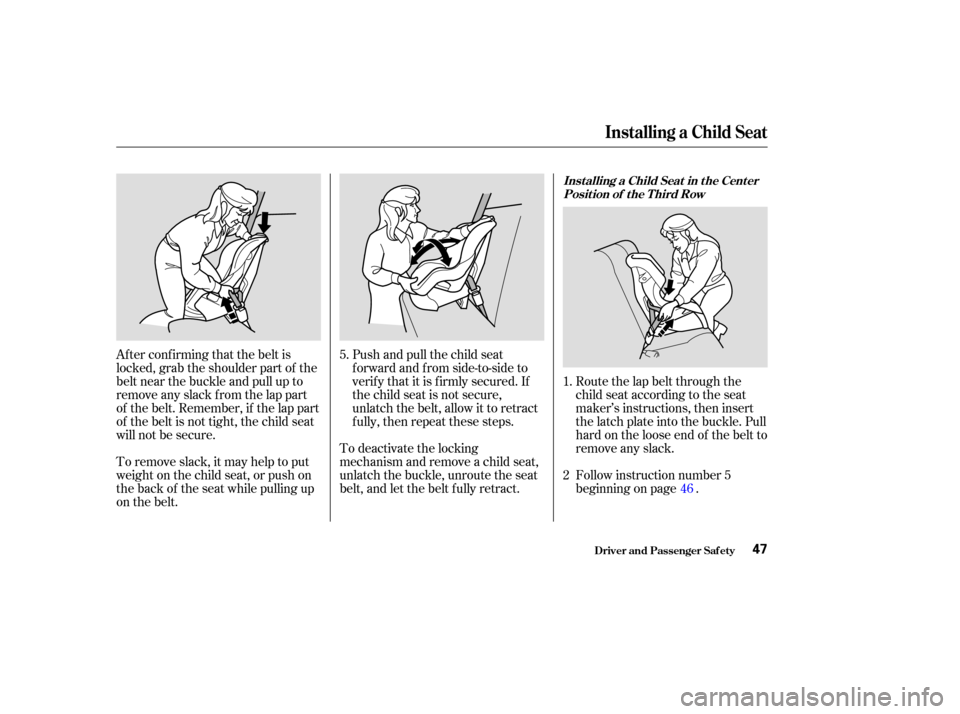
To remove slack, it may help to put
weight on the child seat, or push on
the back of the seat while pulling up
on the belt.Follow instruction number 5
beginning on page . Route the lap belt through the
child seat according to the seat
maker’s instructions, then insert
the latch plate into the buckle. Pull
hard on the loose end of the belt to
remove any slack.
Af ter conf irming that the belt is
locked, grab the shoulder part of the
belt near the buckle and pull up to
remove any slack from the lap part
of the belt. Remember, if the lap part
of the belt is not tight, the child seat
will not be secure.
Push and pull the child seat
f orward and f rom side-to-side to
verif y that it is f irmly secured. If
the child seat is not secure,
unlatch the belt, allow it to retract
f ully, then repeat these steps.
To deactivate the locking
mechanism and remove a child seat,
unlatch the buckle, unroute the seat
belt, and let the belt f ully retract. 5.
46
1.
2
Installing a Child Seat
Driver and Passenger Saf ety
Inst alling a Child Seat in t he Cent er
Position of the T hird Row
47
Page 53 of 296
When a child reaches the
recommended weight or height limit
for a forward-facing child seat, the
child should sit in a back seat on a
booster and wear a lap/shoulder belt.
The f ollowing pages give
instructions on how to check proper
seat belt f it, what kind of booster
seat to use if one is needed, and
important precautions f or a child
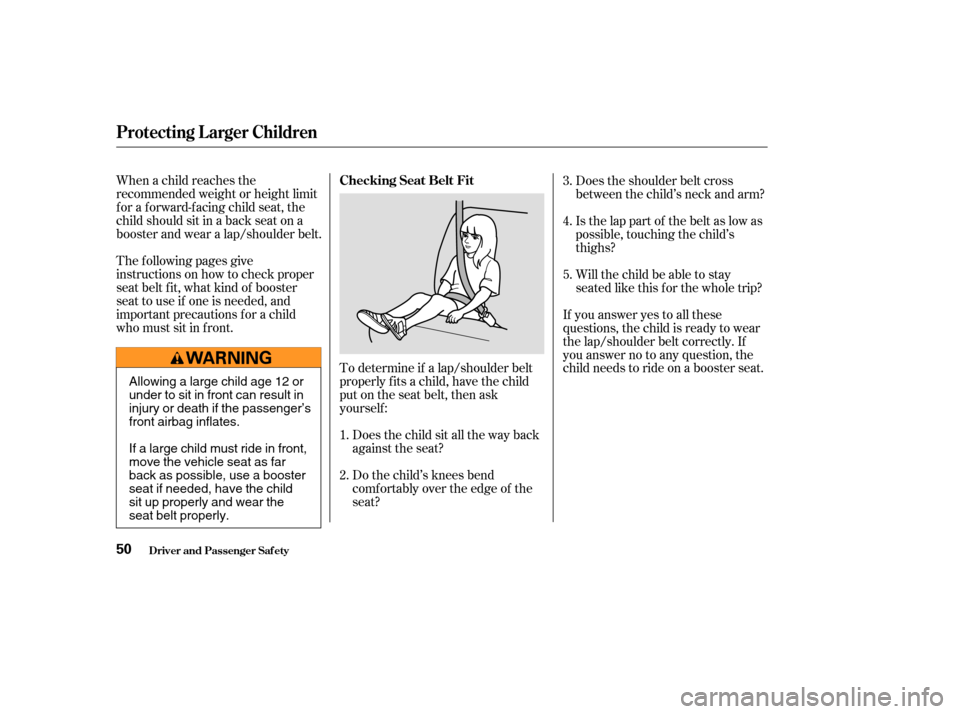
who must sit in f ront.To determine if a lap/shoulder belt
properly f its a child, have the child
put on the seat belt, then ask
yourself :Does the child sit all the way back
against the seat?
Do the child’s knees bend
comf ortably over the edge of the
seat? Does the shoulder belt cross
between the child’s neck and arm?
Is the lap part of the belt as low as
possible, touching the child’s
thighs?
Will the child be able to stay
seated like this f or the whole trip?
If you answer yes to all these
questions, the child is ready to wear
the lap/shoulder belt correctly. If
you answer no to any question, the
child needs to ride on a booster seat.
1.
2. 3.
4.
5.
Protecting L arger Children
Driver and Passenger Saf ety
Checking Seat Belt Fit
50
Allowing a large child age 12 or
under to sit in front can result in
injury or death if the passenger’s
front airbag inflates.
If a large child must ride in front,
move the vehicle seat as far
back as possible, use a booster
seat if needed, have the child
sit up properly and wear the
seat belt properly.
Page 54 of 296
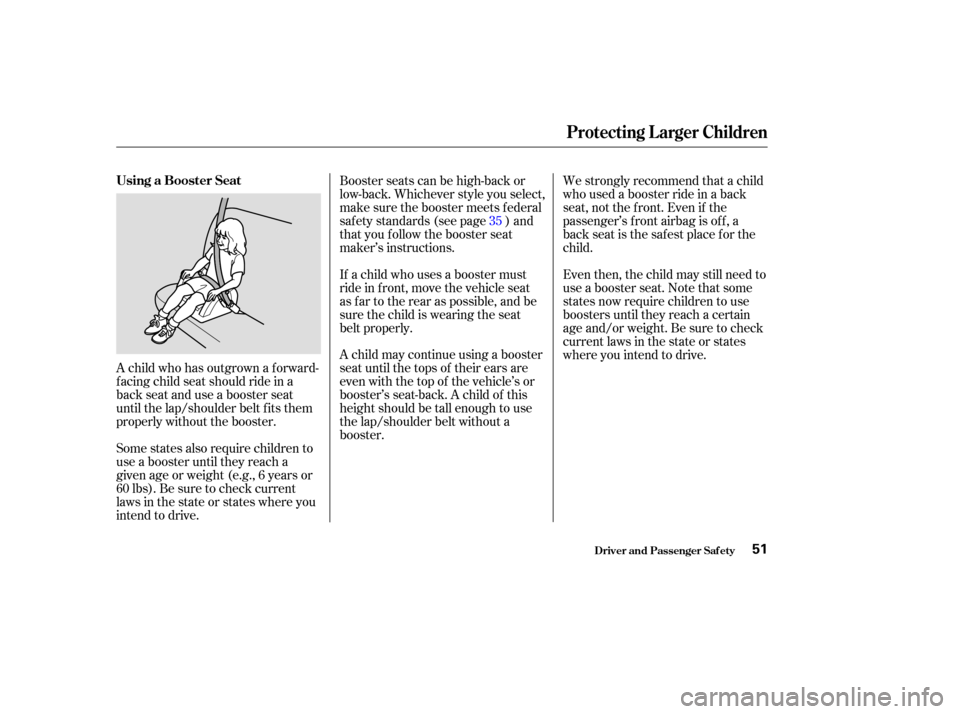
A child who has outgrown a forward-
f acing child seat should ride in a
back seat and use a booster seat
until the lap/shoulder belt f its them
properly without the booster.
Some states also require children to
use a booster until they reach a
given age or weight (e.g., 6 years or
60lbs).Besuretocheckcurrent
laws in the state or states where you
intend to drive.Booster seats can be high-back or
low-back. Whichever style you select,
make sure the booster meets f ederal
saf ety standards (see page ) and
that you f ollow the booster seat
maker’s instructions.
If a child who uses a booster must
ride in f ront, move the vehicle seat
as far to the rear as possible, and be
sure the child is wearing the seat
belt properly.
A child may continue using a booster
seat until the tops of their ears are
even with the top of the vehicle’s or
booster’s seat-back. A child of this
height should be tall enough to use
the lap/shoulder belt without a
booster.
We strongly recommend that a child
whousedaboosterrideinaback
seat,notthefront.Evenif the
passenger’s f ront airbag is of f , a
back seat is the safest place for the
child.
Even then, the child may still need to
use a booster seat. Note that some
states now require children to use
boosters until they reach a certain
ageand/orweight.Besuretocheck
current laws in the state or states
where you intend to drive.
35
Protecting L arger Children
Driver and Passenger Saf ety
Using a Booster Seat
51
Page 64 of 296

This indicator comes on when you
turn the ignition switch to ON (II). If
it comes on at any other time, it
indicates a potential problem with
your f ront airbags or automatic seat
belt tensioners. This indicator will
also alert you to a potential problem
with your side airbags, passenger’s
side airbag automatic cutoff system,
driver’s seat position sensor, or f ront
passenger’s weight sensors. For
more inf ormation, see page .This indicator comes on when you
turn the ignition switch to ON (II). If
it comes on at any other time, it
indicates that the passenger’s side
airbag has automatically shut off.
For more inf ormation, see page .
This indicator normally comes on f or
a f ew seconds when you turn the
ignition switch to ON (II), and when
the ignition switch is turned to
START (III). If it comes on at any
other time, there is a problem in the
ABS. If this happens, have your
vehicle checked by your Honda
dealer. With this indicator on, your
vehicle still has normal braking
ability but no anti-lock. For more
inf ormation, see page .
30 31
190
Instrument Panel Indicators
Inst rument s and Cont rols
Supplemental Restraint
System Indicator Side Airbag Of f Indicator
Anti-lock Brake System (ABS)
Indicator
61
Canada
U.S.
Page 176 of 296
Always maintain your vehicle
according to the maintenance
schedule. See(see page
).
an underinf lated tire
causes more ‘‘rolling resistance,’’
which uses f uel.
The build-up of snow or mud on
your vehicle’s underside adds
weight and rolling resistance.
Frequent cleaning helps your f uel
mileage and reduces the chance of
corrosion.
Drive moderately. Rapid
acceleration, abrupt cornering,
and hard braking use more f uel.
Always drive in the highest gear
possible. Try to maintain a constant speed.
Everytimeyouslowdownand
speed up, your vehicle uses extra
fuel.Usethecruisecontrolwhen
appropriate.
Combine several short trips into
one.
The air conditioning puts an extra
load on the engine which makes it
usemorefuel.Usethefresh-air
ventilation when possible.
204
For example,
Fuel Economy
Bef ore Driving
Improving Fuel Economy
Owner’s
Maintenance Checks
173
Page 180 of 296
�·�µ
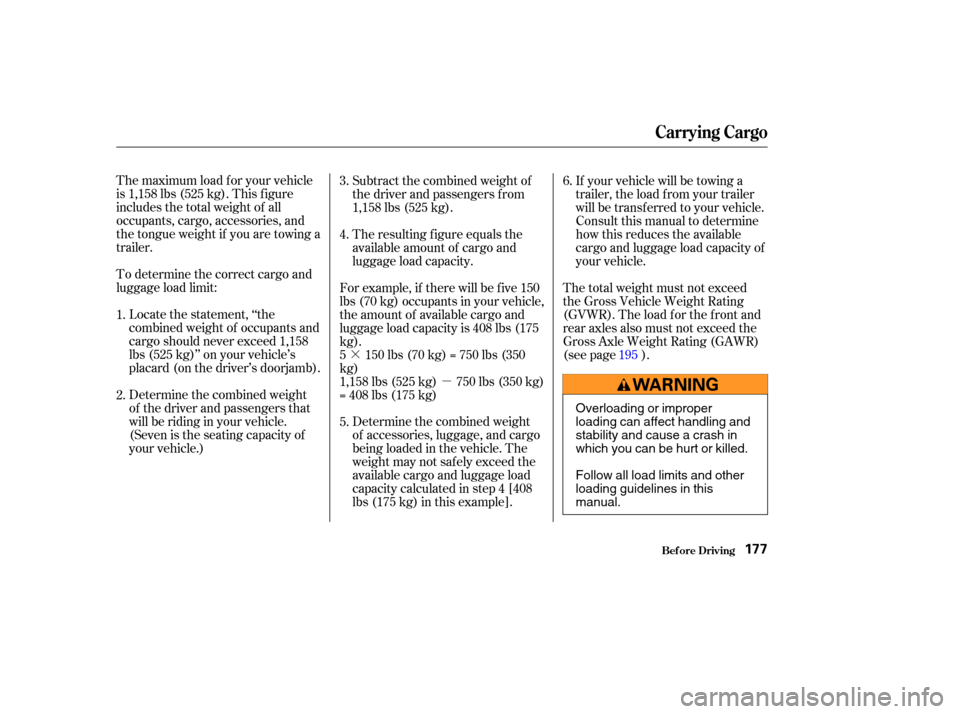
The maximum load f or your vehicle
is 1,158 lbs (525 kg). This f igure
includes the total weight of all
occupants, cargo, accessories, and
the tongue weight if you are towing a
trailer.
To determine the correct cargo and
luggage load limit:
Locate the statement, ‘‘the
combined weight of occupants and
cargo should never exceed 1,158
lbs (525 kg)’’ on your vehicle’s
placard (on the driver’s doorjamb).
Determine the combined weight
of the driver and passengers that
will be riding in your vehicle.
(Seven is the seating capacity of
your vehicle.) Subtract the combined weight of
the driver and passengers f rom
1,158 lbs (525 kg).
The resulting f igure equals the
available amount of cargo and
luggage load capacity.
For example, if there will be f ive 150
lbs (70 kg) occupants in your vehicle,
the amount of available cargo and
luggage load capacity is 408 lbs (175
kg).
5 150 lbs (70 kg) = 750 lbs (350
kg)
1,158 lbs (525 kg) 750 lbs (350 kg)
= 408 lbs (175 kg) Determine the combined weight
of accessories, luggage, and cargo
beingloadedinthevehicle.The
weight may not saf ely exceed the
available cargo and luggage load
capacity calculated in step 4 [408
lbs(175kg)inthisexample]. If your vehicle will be towing a
trailer, the load f rom your trailer
will be transf erred to your vehicle.
Consult this manual to determine
how this reduces the available
cargo and luggage load capacity of
your vehicle.
The total weight must not exceed
theGrossVehicleWeightRating
(GVWR). The load f or the f ront and
rear axles also must not exceed the
Gross Axle Weight Rating (GAWR)
(see page ).
1.
2. 3.
4.
5.6.
195
Carrying Cargo
Bef ore Driving177
Overloading or improper
loading can affect handling and
stability and cause a crash in
which you can be hurt or killed.
Follow all load limits and other
loading guidelines in this
manual.