Page 112 of 218

CONT INUED
The Shif t Up or Shif t Down indicator
will come on at the best time to shif t
toahigherorlowergearforthebest
f uel economy. You can achieve the
best f uel economy by accelerating
and decelerating slowly, and shif ting
up when prompted.
The Shift Down indicator prompts
you to shif t to a lower gear when you
are climbing a hill f aster than 12 mph
(19km/h),losingspeed,andpressing on the accelerator pedal.
Road and traffic conditions may
require you to shif t at times other
than those indicated.
If you exceed the maximum speed
f or the gear you are in, the engine
speed will enter into the tachometer’s
red zone. If this occurs, you may f eel
the engine cut in and out. This is
caused by a limiter in the engine’s
computer controls. The engine will
run normally when you reduce the
RPM below the red zone.
Bef ore downshif ting, make sure the
engine will not go into the
tachometer’s red zone.
To maximize f uel economy, under
certain conditions, the engine will
shut of f when you come to a stop.
Those conditions are:
The A/C is of f , or in ECON mode,
and the outside temperature is
above 41°F (5°C) (see page ). The engine coolant is nearly up to
normal operating temperature.
The vehicle’s speed is below 19
mph (30 km/h) and you are
pressing on the brake pedal to
come to a stop.
You depress the clutch pedal.
You are not pressing on the
accelerator pedal.
The IMA battery is suf f iciently
charged (at least 1/3 on the
battery level gauge). 73
5-speed Manual T ransmission
Driving
Shif t Up/Shif t Down Indicators
Engine Speed L imiterAuto Idle Stop
109
SHIFT UP INDICATOR
SHIFT DOWN INDICATOR
Page 114 of 218
Honda’s Continuously Variable
Transmission’s unique design
provides a smooth, constant f low of
power. It is electronically controlled
f or more precise operation and
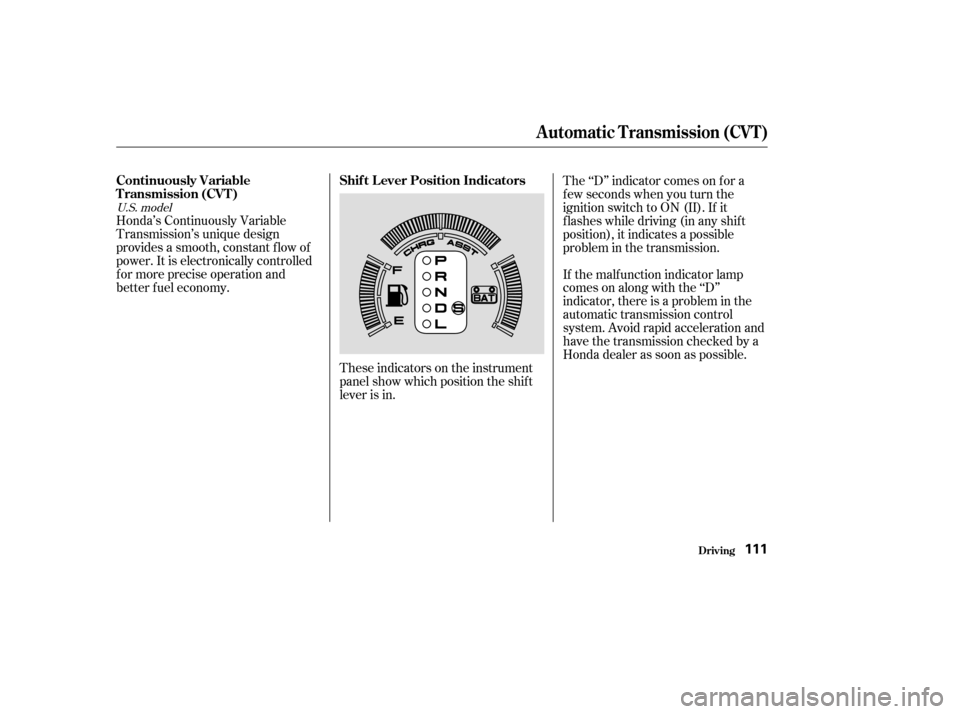
better f uel economy.These indicators on the instrument
panel show which position the shif t
lever is in.The ‘‘D’’ indicator comes on f or a
f ew seconds when you turn the
ignition switch to ON (II). If it
f lashes while driving (in any shif t
position), it indicates a possible
problem in the transmission.
If the malf unction indicator lamp
comes on along with the ‘‘D’’
indicator, there is a problem in the
automatic transmission control
system. Avoid rapid acceleration and
havethetransmissioncheckedbya
Honda dealer as soon as possible.
U.S. model
Automatic Transmission (CVT)
Continuously Variable
T ransmission (CVT )
Shif t L ever Position Indicators
Driving111
Page 116 of 218
�µ�µ
�µ
CONT INUED
Use this position f or
normal driving. The drive position
has two modes, Drive (D) and
Second (S). You can select the
desired mode with the two select
buttons on the steering wheel. The
‘‘D’’ indicator remains lit in either
mode. Usethismodefor
everyday driving. The transmission
automatically adjusts to keep the
engine at the best speed f or driving
conditions. To help the engine warm
up f aster, the transmission will select
ratios that allow the engine to run at
higher speeds when it is cold.
In this mode, the
transmission selects a wider range of
ratios to give better acceleration.
Usethismodefordrivingupor
downhill. Along with the ‘‘D’’
indicator, the ‘‘S’’ indicator comes on
as a reminder.
Automatic Transmission (CVT)
Driving
Drive (D)
Drive Mode
Second (S) Mode
113
DRIVE MODE BUTTON
SECOND MODE BUTTON
‘‘D’’ INDICATOR
‘‘S’’ INDICATOR
Page 117 of 218

�µ
You can switch into and out of
Second mode with the ignition
switch ON (II) and the shif t lever in
D position. If you turn the ignition
switch to ACCESSORY (I) in Second
mode, the mode is switched to Drive.
The ‘‘S’’ indicator also comes on f or a
f ew seconds when you turn the
ignition switch to ON(II). To shif t to Low, press
the release button on the side of the
shif t lever. Use Low to get more
power when climbing, and f or
maximum engine braking when
going down steep hills.
ForfasteraccelerationwheninDor
L, the transmission will automatically
‘‘kick down’’ to a lower range of
ratios when you push the accelerator
pedal to the f loor. If you exceed the maximum speed
f or the gear you are in, the engine
speed will enter into the tachometer’s
red zone. If this occurs, you may f eel
the engine cut in and out. This is
caused by a limiter in the engine’s
computer controls. The engine will
run normally when you reduce the
RPM below the red zone.
Automatic Transmission (CVT)
Driving
Low (L)
Engine Speed Limiter
114
Page 119 of 218

To maximize f uel economy, your
Insight has an Auto Idle Stop
f unction. Under certain conditions,
the engine will shut of f when you
come to a stop. Those conditions are:The engine coolant is nearly up to
normal operating temperature.
The shift lever is in D or N.
You are not pressing on the
accelerator pedal.
The IMA battery is sufficiently
charged (at least 1/3 on the
Battery Level Gauge).
The A/C is of f , or in ECON mode,
and the outside temperature is
above 41°F (5°C) (see page ). There is adequate vacuum reserve
f or the power brakes.
When these conditions are met, the
engine will shut of f as you are
braking to a stop and the vehicle
speed goes below 5 mph (8 km/h).
The engine will start again when you
release the brake pedal. It will also
restart, even if you are still pressing
the brake pedal, under these
conditions: You move the shif t lever f rom D
orNtoR,L,orP.
You press the accelerator pedal.
You are on an incline, and the
vehicle begins rolling. During Auto Idle Stop, the IMA
charge and power brake vacuum
reserve is monitored by the system.
If the vacuum reserve drops below
an optimal level, the engine will
restart to replenish the vacuum
supply. If the IMA charge drops
below an optimal level and the shif t
lever is in Neutral or Park (P), the
engine will restart to recharge the
IMA battery.
73
Automatic Transmission (CVT)
Driving
Auto Idle Stop
116
Page 143 of 218

Park the vehicle on level ground.
With the A/C of f , let the engine
run until the radiator cooling f an
cycles on and of f twice. Then turn
of f the engine.
NOTE: For accurate results, wait at
least 60 seconds, and no more than
90 seconds, af ter turning of f the
engine to check the f luid level. Remove the dipstick (yellow loop)
f rom the transmission, and wipe it
with a clean cloth.
Insert the dipstick all the way back
into the transmission securely as
shown in the illustration.
Remove the dipstick and check
the f luid level. It should be
between the upper and lower
marks within the HOT range.
If the level is below the lower
mark, add f luid into the f iller hole
to bring it to the upper mark.
Pour the f luid slowly and caref ully
so you do not spill. Clean up any
spills immediately; it could damage
components in the engine
compartment.
Always use Honda ATF-Z1
(Automatic Transmission Fluid). If
it’s not available, you may use a
DEXRON
III automatic
transmission f luid as a temporary
replacement. However, continued
use can af f ect the shif t quality.
Have the transmission flushed and
ref illed with Honda ATF-Z1 as
soon as it is convenient.
1. 2.
3.
4.5.
U.S. model
T ransmission Fluid
Maint enance
Automatic Transmission (CVT)
140
DIP STICK
UPPER MARK
LOWER MARK HOT
Page 145 of 218

Always use Honda Heavy Duty
Brake Fluid DOT 3. If it is not
available, you should use only DOT 3
or DOT 4 f luid, f rom a sealed
container, as a temporary
replacement.
Using any non-Honda brake f luid can
cause corrosion and decrease the lif e
of the system. Have the brake
system f lushed and ref illed with
Honda Heavy Duty Brake Fluid
DOT 3 as soon as possible.
Pour the f luid slowly and caref ully so
you do not spill. Clean up any spills
immediately; it could damage
components in the engine
compartment.
Brake f luid marked DOT 5 is not
compatible with your vehicle’s
braking system and can cause
extensive damage.
Check the f luid level in the
reservoirs monthly. There are up to
two reservoirs, depending on the
model. They are:
Brake f luid reservoir (all models)
Clutch f luid reservoir
(manual transmission only)
Replace the brake f luid according to
the recommendation in the
maintenance schedule.
If Honda MTF is not available, you
may use an SAE 10W-30 or 10W-40
viscosity motor oil with the API
Certif ication seal that says ‘‘FOR
GASOLINE ENGINES’’ as a
temporary replacement. However,
motor oil does not contain the proper
additives, and continued use can
cause stiffer shifting. Replace as
soon as it is convenient.
The transmission should be drained
and ref illed with new f luid according
to the time and distance recommen-
dations in the maintenance schedule.
If you are not sure how to check and
add f luid, contact your Honda dealer.
Transmission Fluid, Brake and Clutch Fluid
Maint enance
Brake and Clutch Fluid
142
Page:
< prev 1-8 9-16 17-24