Page 77 of 218

The f low-through ventilation system
draws in outside air, circulates it
through the interior, then exhausts it
through vents near the rear window.Turn the temperature control dial
all the way to the lef t.
Select and Fresh Air mode.
Set the f an to the desired speed.
On vehicles with automatic
transmission (CVT), make sure the
display shows A/C OFF.
The heater uses engine coolant to
warm the air. If the engine is cold, it
will be several minutes bef ore you
f eel warm air coming through the
system. Select and Fresh Air mode.
Set the f an to the desired speed.
Adjust the warmth of the air with
the temperature control dial.
Airf low is divided between
the vents in the dashboard and the
f loor vents.
Airf low is divided between
the f loor vents and the def roster
vents at the base of the windshield.
Air f lows f rom the def roster
vents at the base of the windshield.
When you select or ,
the system automatically switches to
Fresh Air mode and turns on the
A/C (on CVT model only).
When mode is selected, the
auto idle stop f unction will not
activate. you can
cool it down more rapidly by partially
opening the windows, turning on the
AUTO, and setting the fan to
maximum speed in Fresh Air mode. Turn on the A/C by pressing the
ECON button. The display shows
A/CONwhenafanspeedis
selected.
Make sure the temperature
control dial is all the way to the left.
Select .
If the outside air is humid, select
Recirculation mode. If the outside
air is dry, select Fresh Air mode.
Set the f an to the desired speed.
Air conditioning places an extra load
on the engine. Watch the engine
coolant temperature gauge (see page
). If it moves near the red zone,
turn of f the A/C until the gauge
reads normally.
Air f lows f rom the f loor
vents.
1.
2.
3.
4.
5.
1.
2.
3. 1.
2.
3. 47
If the interior is very warm,
On vehicles with automatic
transmission (CVT)
Vents, Heating, and A/C
Comf ort and Convenience Feat ures
Ventilation
Using the Heater Using the A /C in ECON Mode
74
Page 79 of 218

The Automatic Climate Control
system can adjust the f an speed and
airflow levels to maintain the interior
temperature you select.Press the Auto button.
Set the desired temperature by
turning the Temperature Control
dial. You will see AUTO in the
system’s display.
When the system is in f ully
automatic mode, the auto idle stop
f unction will not be activated.
The system automatically selects the
proper mix of conditioned and/or
heated air to raise or lower the
interior temperature to the
temperature you selected. If you set the temperature to its
lower limit or its highest limit, the
system runs at f ull cooling or heating
only. It does not regulate the interior
temperature.
In cold weather, the f an will not
come on automatically until the
heater starts to develop warm air.
You can manually select various
f unctions of the Climate Control
System when it is in AUTO. All other
f eatures remain automatically
controlled.
Manual selections will cause the
word AUTO in the display to go out.
To shut of f the system completely,
turn off the fan and turn the
temperature control dial all the way
to left.
If you press OFF, the Climate
Control system shuts of f completely.
Keep the system completely of f
f or short periods only.
To keep stale air and mustiness
f rom collecting, you should have
the f an running at all times.
1.
2.
On vehicles with manual transmission
On vehicles with automatic
transmission (CVT)
On vehicles with automatictransmission (CVT) On vehicles with automatictransmission (CVT) On vehicles with automatic
transmission (CVT)
Vents, Heating, and A/C
T o Cool or Heat A utomatically
Using A utomatic Climate Control
Manual OperationTo Turn Everything Of f
Comf ort and Convenience Feat ures76
Page 100 of 218

CONT INUED
Always maintain your vehicle
according to the maintenance
schedule. Seeon page
. Drive moderately. Rapid
acceleration, abrupt cornering,
and hard braking use more f uel.
Always drive in the highest gear
possible.
Try to maintain a constant speed.
Everytimeyouslowdownand
speed up, your vehicle uses extra
f uel.
Shif t Up and Shif t Down indicators
(5-speed manual transmission
only) on the instrument panel
show when to shif t to a higher or
lower gear, so you will keep the
engine operating in its most
economical range. Wind resistance causes vehicles to
usemorefuelathigherspeeds.
Driving at moderate speeds on the
highway also reduces wind
resistance and conserves f uel.
The current f uel mileage display is
available to drive appropriately and
save the fuel.
Driving in ECON mode, the A/C
of f , and using the Auto Idle Stop
function is the most effective way
to get the best f uel economy.
Combine several short trips into
one.
an underinf lated tire
causes more ‘‘rolling resistance,’’
which uses f uel.
The build-up of snow or mud on
your vehicle’s underside adds
weight and rolling resistance.
Frequent cleaning helps your f uel
mileage and reduces the chance of
corrosion.
The f uel ef f icient, low-viscosity
0W- 20oil recommended f or your
Insightisformulatedtohelpthe
engine use less f uel. This oil is
available at your Honda dealer. 126
For example,
Fuel Economy
Bef ore Driving
Improving Fuel Economy
Owner’s
Maintenance Checks
97
Page 108 of 218
This section gives you tips on
starting the engine under various
conditions, and how to operate the
manual and automatic transmissions.
It also includes important
information on parking your vehicle,
and the braking system.........................
Preparing to Drive .106
.......................
Starting the Engine .107
....
5-speed Manual Transmission . 108
............................
Auto Idle Stop .109
..............
Automatic Transmission . 111
Continuously Variable ............
Transmission (CVT) . 111
............................
Auto Idle Stop .116
..................................
Parking Tips .118
.............................
Braking System .119
...............
Anti-lock Brakes (ABS) . 120
...........................
Towing a Trailer .121
Driving
Driving105
Page 110 of 218

Apply the parking brake.
In cold weather, turn of f all
electrical accessories to reduce
the drain on the battery.
Push the clutch pedal down all the
way. START (III) does not
f unction unless the clutch pedal is
pressed.
Make sure the shif t lever is in
Park. Press on the brake pedal.
Without touching the accelerator
pedal, turn the ignition key to the
START (III) position. Do not hold
the key in START for more than
15 seconds at a time. If the engine
does not start right away, pause
f or at least 10 seconds bef ore
trying again.If the engine does not start within
15 seconds, or starts but stalls
right away, repeat step 4 with the
accelerator pedal pressed halfway
down. If the engine starts, release
pressure on the accelerator pedal
so the engine does not race.
If the engine fails to start, press
the accelerator pedal all the way
downandholdittherewhile
starting to clear flooding. If the
engine still does not start, return
to step 5.
1.
2.
3.
4. 5.
6.
Manual Transmission:
Automatic Transmission (CVT):
Starting the Engine
Driving107
NOTICE: The engine is harder to start
in cold weather. Also, the thinner air
f ound at altitudes above 8,000 f eet
(2,400 meters) adds to this problem.
Page 111 of 218

The manual transmission is syn-
chronizedinallforwardgearsfor
smooth operation. It has a lockout so
you cannot shift directly from Fifth
to Reverse. When shif ting up or
down,makesureyoupushtheclutch
pedal down all the way, shift to the
next gear, and let the pedal up
gradually. When you are not shif ting,
do not rest your f oot on the clutch
pedal. This can cause your clutch to
wear out faster.Come to a full stop before you shift
into Reverse. You can damage the
transmission by trying to shif t into
Reverse with the vehicle moving.
Push down the clutch pedal, and
pause f or a f ew seconds bef ore
shif ting into Reverse, or shif t into
one of the f orward gears f or a
moment. This stops the gears so
they won’t ‘‘grind.’’
When slowing down, you can get
extra braking f rom the engine by
shifting to a lower gear. This extra
braking can help you maintain a safe
speed and prevent your brakes f rom
overheating while going down a
steep hill. Bef ore downshif ting,
make sure the vehicle speed is low
enough that you will not activate the
engine speed limiter in the lower
gear. Make sure the engine speed
will not go into the tachometer’s red
zone in the lower gear bef ore
downshif ting.
5-speed Manual T ransmission
Driving108
Rapid slowing or speeding-up
can cause loss of control on
slippery surfaces. If you crash,
you can be injured.
Use extra care when driving on
slippery surfaces.
Page 113 of 218

There is adequate vacuum reserve
f or the power brakes.
The engine will start again
automatically when you shift to first
gear. There is no need to start the
engine with the ignition switch.
It is recommended that you shif t to
Neutral and release the clutch pedal
while stopped. Sitting with the clutch
pedal depressed and the shif t lever
in gear will cause the engine to
continue running, def eating the f uel
economy benef its of the Auto Idle
Stop f unction.
During Auto Idle Stop, the IMA
charge and power brake vacuum
reserve is monitored by the system.
If either drops below a desired level,
and the shif t lever is in Neutral, the
engine will restart so it can recharge
the IMA battery or replenish the
vacuum supply. Auto Idle Stop is not active.
Auto Idle Stop is active.
The clutch pedal is depressed.
The transmission is not in gear.Auto Idle Stop is active.
The clutch is not depressed.
You cannot restart the engine.
You will hear a chime if the door is
open.
When the indicator is of f :
When the indicator is on: When the indicator is blinking:
5-speed Manual T ransmission
Driving
A uto Idle Stop Indicator
110
AUTO IDEL STOP INDICATOR
Page 114 of 218
Honda’s Continuously Variable
Transmission’s unique design
provides a smooth, constant f low of
power. It is electronically controlled
f or more precise operation and
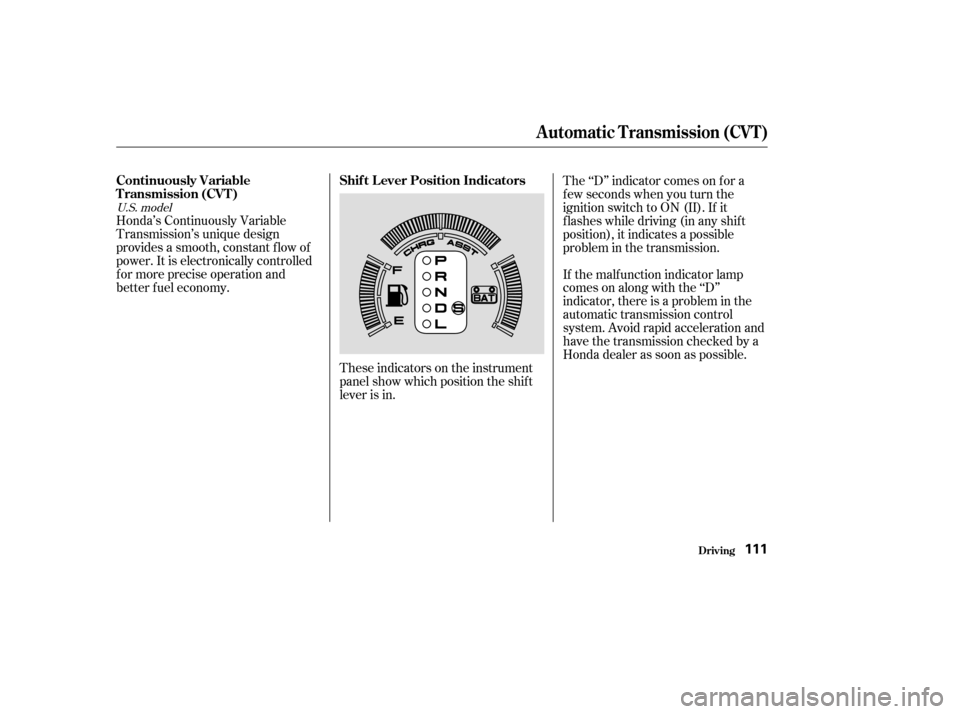
better f uel economy.These indicators on the instrument
panel show which position the shif t
lever is in.The ‘‘D’’ indicator comes on f or a
f ew seconds when you turn the
ignition switch to ON (II). If it
f lashes while driving (in any shif t
position), it indicates a possible
problem in the transmission.
If the malf unction indicator lamp
comes on along with the ‘‘D’’
indicator, there is a problem in the
automatic transmission control
system. Avoid rapid acceleration and
havethetransmissioncheckedbya
Honda dealer as soon as possible.
U.S. model
Automatic Transmission (CVT)
Continuously Variable
T ransmission (CVT )
Shif t L ever Position Indicators
Driving111