Page 158 of 256
When preparing to tow, and bef ore
driving away, be sure to check the
f ollowing:The vehicle has been properly
serviced, and the tires, brakes,
suspension, and cooling system
are in good operating condition.
If you tow f requently, f ollow the
Severe Conditions maintenance
schedule.
The trailer has been properly
serviced and is in good condition.
Thehitch,safetychains,andany
other attachments are secure.
Allitemsonandinthetrailerare
properly secured and cannot shif t
while you drive. The lights and brakes on your
vehicle and the trailer are working
properly.
Your vehicle tires and spare are
properly inf lated (see page ),
and the trailer tires and spare are
inflated as recommended by the
trailer maker.
All weights and loads are within
limits (see page ). 151 190
Towing a Trailer
Driving
Pre-T ow Checklist
154
Page 159 of 256

CONT INUED
The added weight, length, and
height of a trailer will af f ect your
vehicle’s handling and perf ormance,
so driving with a trailer requires
some special driving skills and
techniques.Make turns more slowly and wider
than normal. The trailer tracks a
smaller arc than your vehicle, and it
canhitorrunoversomethingthe
vehicle misses. Allow more time and
distance f or braking. Do not brake or
turn suddenly as this could cause the
trailer to jackknif e or turn over.When climbing hills, closely watch
your temperature gauge. If it nears
the red mark, turn the air
conditioning of f , reduce speed and, if
necessary, pull to the side of the
road to let the engine cool.
If the automatic transmission shif ts
f requently between 3rd and 4th
gears while going up a hill, turn of f
the Over drive (O/D) mode (see
page ).
If youmuststopwhenfacinguphill,
use the f oot brake or parking brake.
Do not try to hold the vehicle in
placebypressingontheaccelerator,
as this can cause the automatic
transmission to overheat.
Foryoursafetyandthesafetyof
others,taketimetopracticedriving
maneuvers bef ore heading f or the
open road, and f ollow the guidelines
discussed below. Drive slower than normal in all
driving situations, and obey posted
speed limits f or vehicles with trailers.
If you have an automatic
transmission, use over drive (O/D)
when towing a trailer on level roads.
Turn of f the over drive (O/D) mode
when towing a trailer in hilly terrain.
(see ‘‘
’’ in the next
column f or additional gear
inf ormation.) 143
Trailer Driving Tips
Driving
Driving Saf ely With a T railerT owing Speeds and Gears
Making T urns and Braking Driving on Hills
Driving on Hills
155
Page 160 of 256

Always drive slowly and have
someone guide you when backing up.
Grip the of the steering
wheel; then turn the wheel to the lef t
to get the trailer to move to the lef t,
andturnthewheelrighttomovethe
trailer to the right.
Crosswinds and air turbulence
caused by passing trucks can disrupt
your steering and cause trailer
swaying. When being passed by a
large vehicle, keep a constant speed
and steer straight ahead. Do not try
to make quick steering or braking
corrections.Follow all normal precautions when
parking, including f irmly setting the
parking brake and putting the
transmission in Park (automatic) or
in 1st or Reverse (manual). Also,
place wheel chocks at each of the
trailer’s tires.
When driving down hills, reduce
your speed and shif t down to 3rd
gear on the manual transmission,
and turn off the Over drive (O/D)
mode on the automatic transmission.
Do not ‘‘ride’’ the brakes.
bottom
Trailer Driving Tips
Driving
Backing Up
Handling Crosswinds and Buf f et ing Parking
Remember: It will take longer to
slow down and stop when towing
atrailer.
156
Page 161 of 256

Your Honda can be towed behind a
motorhome at legal highway speeds
up to 65 mph(100 km/h). Do not
exceed 65 mph(100km/h).
Otherwise, severe transmission
damage will occur. To avoid damage
to the 4WD system, it must be towed
with all f our wheels on the ground
(f lat towing).
When purchasing a tow bar, make
sure you select a reputable
manuf acturer and installer. Follow
the manufacturer’s attachment
instructions caref ully.Perf orm the f ollowing procedure
everyday immediately bef ore you
begin towing. Otherwise severe
automatic transmission damage will
occur.
Check the transmission f luid level
(see page ).
Start the engine.
Press on the brake pedal. Move
the shif t lever through all its
positions.
ShifttoD,thentoN.Letthe
engine run f or three minutes, then
turn it off.
Leave the ignition switch in
ACCESSORY (I) so the steering
wheel does not lock. Make sure
the radio and any items plugged
into the accessory power sockets
are turned of f so you do not run
down the battery. If you tow more than 8 hours in one
day, you should repeat the above
procedure at least every 8 hours
(when you stop f or f uel, etc.)
Release the parking brake. 179
Do not overf ill.
Driving
Towing Your Vehicle Behind a Motorhome
Ext ended T owing
157
NOTICE:
NOTICE:T he steering system can be
damaged if the steering wheel is locked.
Leave the ignition switch in Accessory
(I), and make sure the steering wheel
turns f reely bef ore you begin towing.
Failure to f ollow the above
instructions exactly will result in severe
automatic transmission damage. If you
cannot shif t the transmission or start
the engine, your vehicle must be
transported on a f lat-bed truck or
trailer.
Page 170 of 256

�µ�Ì
Trailer towing, driving with a roof
top carrier, or driving in
mountainous conditions.
Driving on muddy, dusty, or de-
iced roads.
Follow the
Maintenance Schedule f or Severe
Conditions. Your authorized Honda dealer
knows your vehicle best and can
provide competent, ef f icient service.
However, service at a dealer is not
mandatory to keep your warranties
in effect. Maintenance may be done
by any qualif ied service f acility or
skilled person to keep all the receipts
as proof of completion, and have the
person who does the work f ill out the
Maintenance Record. Check your
warranty booklet f or more
inf ormation.
We recommend the use of Honda
parts and f luids whenever you have
maintenance done.
If you only OCCASIONALLY
drive under ‘‘severe’’ conditions, you
should f ollow the Maintenance
Schedule f or Normal Conditions. According to state and federal
regulations, f ailure to perf orm
maintenance on the items marked
with will not void your emissions
warranties. However, Honda
recommends that all maintenance
services be perf ormed at the
recommended time or mileage
period to ensure long-term reliability. U.S. Vehicles:
Maintenance Schedule
Maint enance
Canadian OwnersServicing Your Vehicle
Maintenance, replacement, or
repair of emissions control
devices and systems may be done
by any automotive repair
establishment or individual using
parts that are ‘‘certif ied’’ to EPA
standards.
166
NOTE:
Page 187 of 256
Theheadlightswereproperlyaimed
when your vehicle was new. If you
regularly carry heavy items in the
cargo area or pull a trailer, a
readjustment may be required.
Adjustments should be perf ormed by
a Honda dealer or other qualif ied
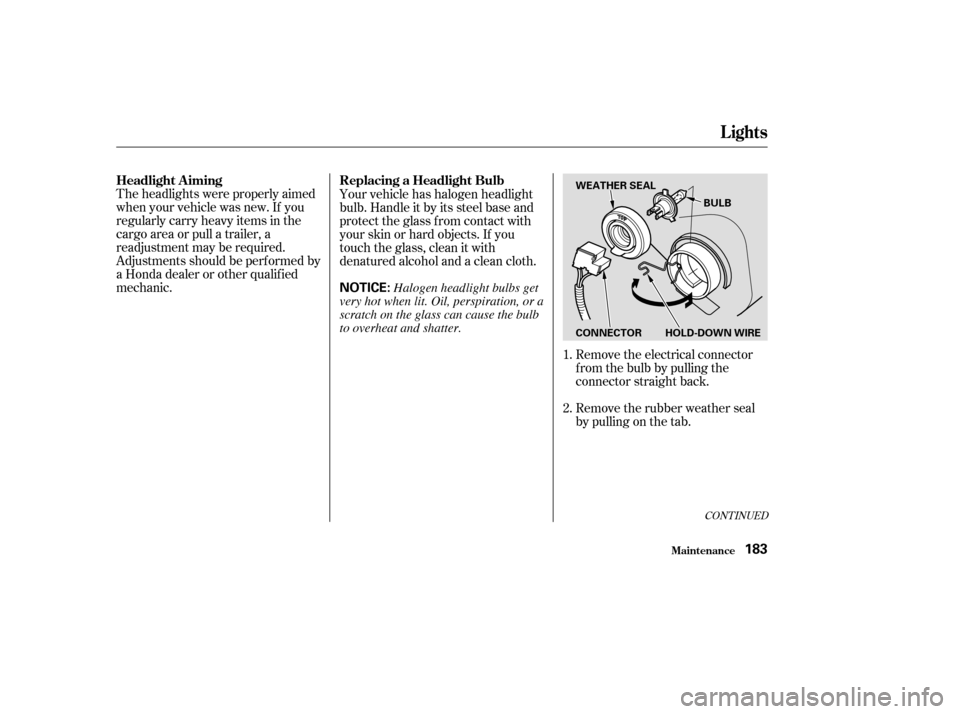
mechanic.Your vehicle has halogen headlight
bulb. Handle it by its steel base and
protect the glass f rom contact with
your skin or hard objects. If you
touch the glass, clean it with
denaturedalcoholandacleancloth.
Remove the electrical connector
f rom the bulb by pulling the
connector straight back.
Remove the rubber weather seal
by pulling on the tab.
1.
2.
CONT INUED
Headlight A iming
Replacing a Headlight Bulb
Lights
Maint enance183
NOTICE:
WEATHER SEAL
CONNECTOR HOLD-DOWN WIREBULB
Halogen headlight bulbs get
very hot when lit. Oil, perspiration, or a
scratch on the glass can cause the bulb
to overheat and shatter.
Page 204 of 256
If you have a f lat tire while driving,
stop in a saf e place to change it.
Drive slowly along the shoulder until
you get to an exit or an area to stop
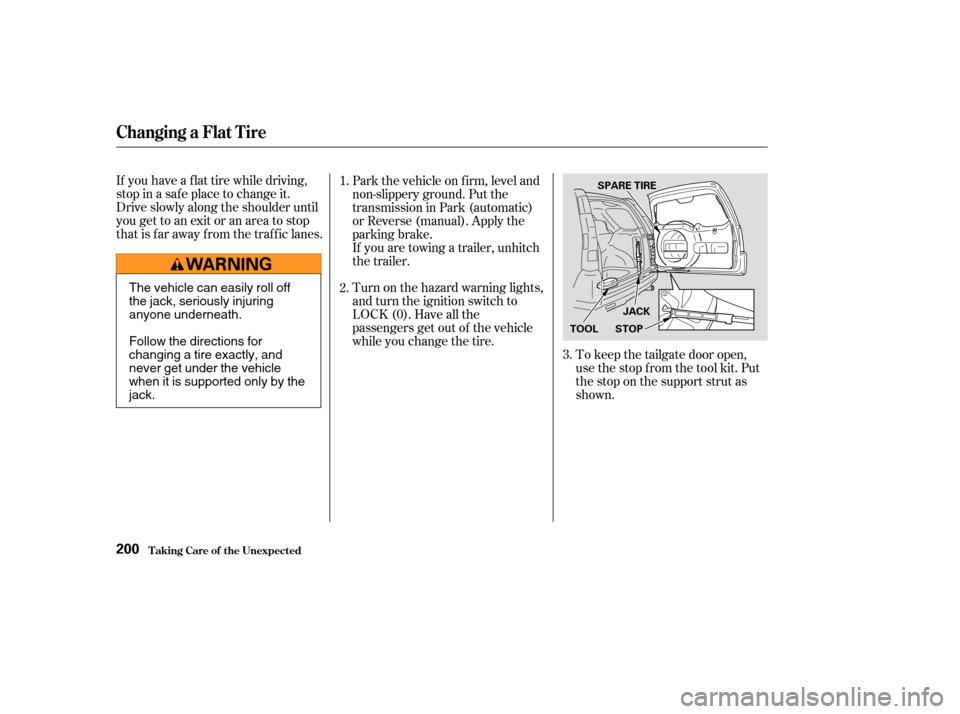
that is far away from the traffic lanes.To keep the tailgate door open,
use the stop f rom the tool kit. Put
the stop on the support strut as
shown.
Park the vehicle on f irm, level and
non-slippery ground. Put the
transmission in Park (automatic)
or Reverse (manual). Apply the
parking brake.
If you are towing a trailer, unhitch
the trailer.
Turn on the hazard warning lights,
and turn the ignition switch to
LOCK (0). Have all the
passengers get out of the vehicle
while you change the tire.
1.
2.
3.
Changing a Flat T ire
T aking Care of t he Unexpect ed200
JACK
STOP
SPARE TIRE
TOOL
The vehicle can easily roll off
the jack, seriously injuring
anyone underneath.
Follow the directions for
changing a tire exactly, and
never get under the vehicle
when it is supported only by the
jack.
Page 220 of 256
If your vehicle needs to be towed,
call a prof essional towing service or
an organization. Never tow your
vehicle with just a rope or chain. It is
very dangerous.The operator will load
your vehicle on the back of a truck.
Any other method of towing will
damage the drive system. When you
contact the towing agency, inf orm
them a f lat-bed is required. Refer to
on page
for non-emergency towing
inf ormation. 157
The only way you can saf ely tow
your vehicle is with f lat-bed
equipment. Towing Your Vehicle
Behind a Motorhome
Emergency T owing
T aking Care of t he Unexpect ed216
NOTICE: Towing with only two tires
on the ground will damage parts of the
4WD system. It should be transported
on a f lat-bed truck or trailer.