Page 128 of 256

Help assure your vehicle’s f uture
reliability and perf ormance by paying
extra attention to how you drive
during the f irst 600 miles (1,000 km).Avoid full throttle starts and rapid
acceleration.
Do not change the oil until the
scheduled maintenance time.
Avoidhardbrakingforthefirst
200 miles (300 km).
During this period:
Your Honda is designed to operate
on unleaded gasoline with a pump
octane number of 86 or higher. Use
of a lower octane gasoline can cause
a persistent, heavy, metallic rapping
noise in the engine that can lead to
mechanical f ailure.
We recommend using a gasoline
containing detergent additives that
help prevent f uel system and engine
deposits.
In addition, in order to maintain good
perf ormance, f uel economy, and
emissions control, we strongly
recommend, in areas where it is
available, the use of gasoline that
does NOT contain manganese-based
f uel additives such as MMT.
Use of gasoline with these additives
may adversely af f ect perf ormance,
and cause the Malfunction Indicator
Lamp on your instrument panel to
come on. If this happens, contactyour authorized Honda dealer f or
service.
For f urther important f uel-related
inf ormation, please ref er to your
Quick Start Guide.
You should also f ollow these re-
commendations with an overhauled
or exchanged engine, or when the
brakes are replaced. Do not tow a trailer. Some gasoline today is blended with
oxygenates such as ethanol or
MTBE. Your vehicle is designed to
operate on oxygenated gasoline
containing up to 10 percent ethanol
by volume and up to 15 percent
MTBE by volume. Do not use
gasoline containing methanol.
Bef ore Driving
Break-in Period
Gasoline Type
Break-in Period, Gasoline T ype
124
Page 132 of 256
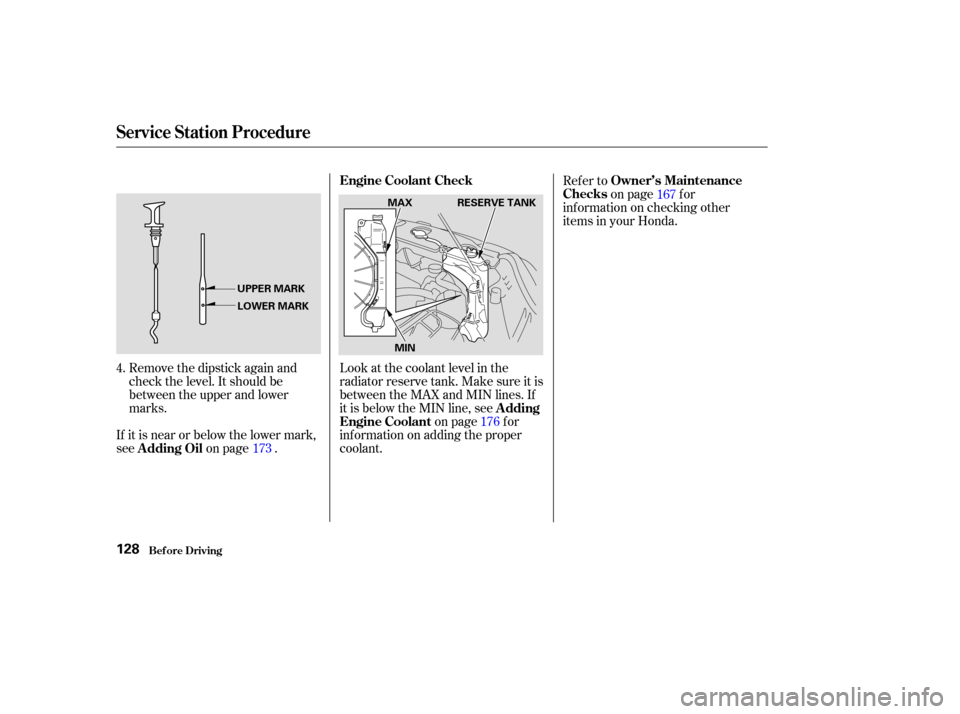
Remove the dipstick again and
check the level. It should be
between the upper and lower
marks.
If it is near or below the lower mark,
see on page . Look at the coolant level in the
radiator reserve tank. Make sure it is
between the MAX and MIN lines. If
it is below the MIN line, see
on page f or
inf ormation on adding the proper
coolant. Refer to
on page f or
inf ormation on checking other
items in your Honda.
4. 173 176167
Service Station Procedure
Bef ore Driving
A dding Oil Engine Coolant Check
A dding
Engine Coolant Owner’s Maintenance
Checks
128
UPPER MARK
LOWER MARK MAX RESERVE TANK
MIN
Page 133 of 256
Always maintain your vehicle
according to the maintenance
schedule. See(see page
).
an underinf lated tire
causes more ‘‘rolling resistance,’’
which uses f uel.
The build-up of snow or mud on
your vehicle’s underside adds
weight and rolling resistance.
Frequent cleaning helps your f uel
mileage and reduces the chance of
corrosion.
Drive moderately. Rapid
acceleration, abrupt cornering and
hard braking use more f uel.
Always drive in the highest gear
possible. The air conditioning puts an extra
load on the engine which makes it
usemorefuel.Usethefresh-air
ventilation when possible. Combine several short trips into
one. Try to maintain a constant speed.
Everytimeyouslowdownand
speed up, your vehicle uses extra
fuel.Usethecruisecontrolwhen
appropriate.
167
For example,
Fuel Economy
Bef ore Driving
Improving Fuel Economy
Owner’s
Maintenance Checks
129
Page 158 of 256
When preparing to tow, and bef ore
driving away, be sure to check the
f ollowing:The vehicle has been properly
serviced, and the tires, brakes,
suspension, and cooling system
are in good operating condition.
If you tow f requently, f ollow the
Severe Conditions maintenance
schedule.
The trailer has been properly
serviced and is in good condition.
Thehitch,safetychains,andany
other attachments are secure.
Allitemsonandinthetrailerare
properly secured and cannot shif t
while you drive. The lights and brakes on your
vehicle and the trailer are working
properly.
Your vehicle tires and spare are
properly inf lated (see page ),
and the trailer tires and spare are
inflated as recommended by the
trailer maker.
All weights and loads are within
limits (see page ). 151 190
Towing a Trailer
Driving
Pre-T ow Checklist
154
Page 164 of 256

Before you leave the pavement, be
sure to do all scheduled maintenance
and service and that you inspect your
vehicle. Pay special attention to the
condition of the tires and check the
tire pressure.
After you return to the pavement,
caref ully inspect your vehicle to
make sure there is no damage that
could make driving it unsaf e.
Recheck the condition of the tires
and the tire pressure.
The route presents limits (too steep
or bumpy roads). You have limits
(driving skill and comf ort). And your
vehicle has limits (traction, stability,
and power).
Driving of f -highway can be
hazardous if you f ail to recognize
limits and take the proper
precautions.Forbettertractiononallsurfaces,
accelerate slowly and gradually build
up speed. If you try to start too fast
on wet soil, mud, snow, or ice, you
might not have enough traction to
get underway and you may dig
yourself a hole. Starting with the
shif t lever in second gear (2) will
help you have a smoother start on
snow and ice.
Keep in mind that you will usually
need more time and distance to
brake to a stop on unpaved surf aces.
Avoid hard braking. Do not pump
the brakes; let the anti-lock braking
system pump them f or you.
Debris in the road can damage your
suspension or other components.
Because your vehicle has a high
center of gravity, driving over a large
obstacle, or allowing a wheel to drop
into a deep hole can cause yourvehicle to tip or roll over.
If you can’t clearly see all road
conditions or obstacles, walk the
slope bef ore you drive on it. If you
have any doubt whether or not you
can saf ely drive on the slope, don’t
do it. Find another route.
If you are driving up a hill and f ind
that you cannot continue,
. Your vehicle could roll
over. Slowly back down the hill,
f ollowing the same route you took up
the hill.
do not try to
turn around
Of f -Highway Driving Guidelines
Driving
Check Out Your Vehicle
Remember: Accelerating and Braking
Avoiding ObstaclesDriving on Slopes
160
Page 167 of 256

This section explains why it is
important to keep your vehicle well
maintained and how to f ollow basic
maintenance saf ety precautions.
This section also includes
Maintenance Schedules f or normal
driving and severe driving conditions,
a Maintenance Record, and instruc-
tions f or simple maintenance tasks
you may want to take care of
yourself .
If you have the skills and tools to per-
f orm more complex maintenance
tasks on your Honda, you may want
to purchase the Service Manual. See
page f or inf ormation on how to
obtain a copy, or see your Honda
dealer.......................
Maintenance Saf ety .164
.................
Maintenance Schedule . 165
....................
Maintenance Record .170
..............................
Fluid Locations .172
........................
Adding Engine Oil .173
.........
Changing the Oil and Filter . 174
..............................
Engine Coolant .176
....................
Windshield Washers .178
.......................
Transmission Fluid .179
................
Brake and Clutch Fluid . 181
....................
Power Steering Fluid . 182
....................................
Hood Latch .182
.............................................
Lights .183
.......................................
Seat Belts .187
.....................................
Floor Mats .188
..................
Dust and Pollen Filter . 188
.................................
Wiper Blades .189
...............................................
Tires .190
...................
Checking the Battery . 196
.............................
Vehicle Storage .197
243
Maintenance
Maint enance163
Page 168 of 256
All service items not detailed in this
section should be perf ormed by a
Honda technician or other qualif ied
mechanic.
To eliminate potential hazards, read
the instructions bef ore you begin,
and make sure you have the tools
and skills required.Make sure your vehicle is parked
on level ground, the parking brake
is set, and the engine is of f .
To clean parts, use a commercially
available degreaser or parts
cleaner, not gasoline.
To reduce the possibility of f ire or
explosion, keep cigarettes, sparks,
and f lames away f rom the battery
and all f uel-related parts. Let the
engine and exhaust system cool
bef ore touching any parts.
Do
not run the engine unless
instructed to do so. Be sure there is
adequate ventilation whenever you
operate the engine.
Wear eye protection and
protective clothing when working
with the battery or compressed air.
Maintenance Saf ety
Maint enance
Important Saf ety Precautions Potential Vehicle Hazards
Burns f rom hot parts.
Injury f rom moving parts. Carbon Monoxide poison f rom
engine exhaust.
164
Improperly maintaining this
vehicle or failing to correct a
problem before driving can
cause a crash in which you can
be seriously hurt or killed.
Always follow the inspection
and maintenance
recommendations, and
schedules in this owner’s
manual.
Page 169 of 256
�µ
Some of the most important saf ety
precautions are given here. However,
we cannot warn you of every
conceivable hazard that can arise in
perf orming maintenance. Only you
can decide whether or not you
should perf orm a given task. Service your vehicle according to the
time and mileage periods on one of
the Maintenance Schedules on the
f ollowing pages.
Follow the
Maintenance Schedule f or Severe
Conditions if you drive your vehicle
MAINLY under one or more of the
f ollowing conditions.
Driving less than 5 miles (8 km)
per trip or, in f reezing
temperatures, driving less than 10
miles (16 km) per trip.
Driving in extremely hot [over
90°F (32°C)] conditions.
Used primarily as a delivery
vehicle or taxi that is driven
mostly in stop-and-go traf f ic and/
or parked with the engine idling.
The maintenance schedule assumes
you will use your vehicle as normal
transportation for passengers and
their possessions. You should also
f ollow these recommendations:
Avoid exceeding your vehicle’s
load limit. This puts excess stress
on the engine, brakes, and many
other parts of you vehicle. The
load limit is shown on the tire
inf ormation label on the driver’s
doorjamb.
Operate your vehicle on
reasonable roads within the legal
speed limit.
Drive your vehicle regularly over a
distance of several miles
(kilometers).
Always use unleaded gasoline with
theproperoctanerating(seepage ).
124
Maintenance Saf ety, Maintenance Schedule
Maint enance
Maintenance Schedule
U.S. Owners Which Schedule to Follow:
165
Failure to properly follow
maintenance instructions and
precautions can cause you to
be seriously hurt or killed.
Always follow the procedures
and precautions in this owner’s
manual.