Page 167 of 221

Fill the f uel tank.
Change the engine oil and f ilter.Block the rear wheels.
If the vehicle is to be stored f or a
longer period, it should be
supported on jackstands so the
tires are of f the ground.
Wash and dry the exterior
completely.
Cleantheinterior.Makesurethe
carpeting, floor mats, etc. are
completely dry.
Leave the parking brake off. Put
the transmission in Reverse
(5-speed manual) or Park
(automatic).
If you need to park your vehicle f or
an extended period (more than one
month), there are several things you
should do to prepare it f or storage.
Proper preparation helps prevent
deterioration and makes it easier to
get your vehicle back on the road. If
possible, store your vehicle indoors. Leave one window open slightly (if
the vehicle is being stored
indoors).Cover the vehicle with a
‘‘breathable’’ cover, one made
f rom a porous material such as
cotton. Nonporous materials, such
as plastic sheeting, trap moisture,
which can damage the paint.
To minimize sticking, apply a
silicone spray lubricant to all door
and trunk seals. Also, apply a
vehiclebodywaxtothepainted
surfaces that mate with the door
and trunk seals.
Support the f ront wiper blade
arms with a f olded towel or rag so
they do not touch the windshield.
Disconnect the battery.
If you store your vehicle f or 12
months or longer, have your Honda
dealer perf orm the inspections called
f or in the 24 months/30,000 miles
maintenance schedule (Normal
Conditions) as soon as you take it
out of storage (see page ). The
replacements called f or in the
maintenance schedule are not
needed unless the vehicle has
actually reached that time or mileage.If possible, run the engine
periodically until it reaches f ull
operating temperature (the
cooling f an cycles on and of f
twice) pref erably once a month.
139
Maint enance
Vehicle Storage
168
�����—�����—�����y�
������
��
���y���
�(�����������y���
���
�y
Page 169 of 221
Check the inf lation pressure of the
compact spare tire every time you
check the other tires. It should be
inf lated to:Follow these precautions:
Never exceed 50 mph (80 km/h).
This tire gives a harsher ride and
less traction on some road sur-
f aces. Use greater caution while
driving.
Do not mount snow chains on it.
Use the compact spare tire as a
temporary replacement only. Get
your regular tire repaired or replaced
and put it back on your vehicle as
soon as you can.
Do not use your compact spare
tire on another vehicle unless it is
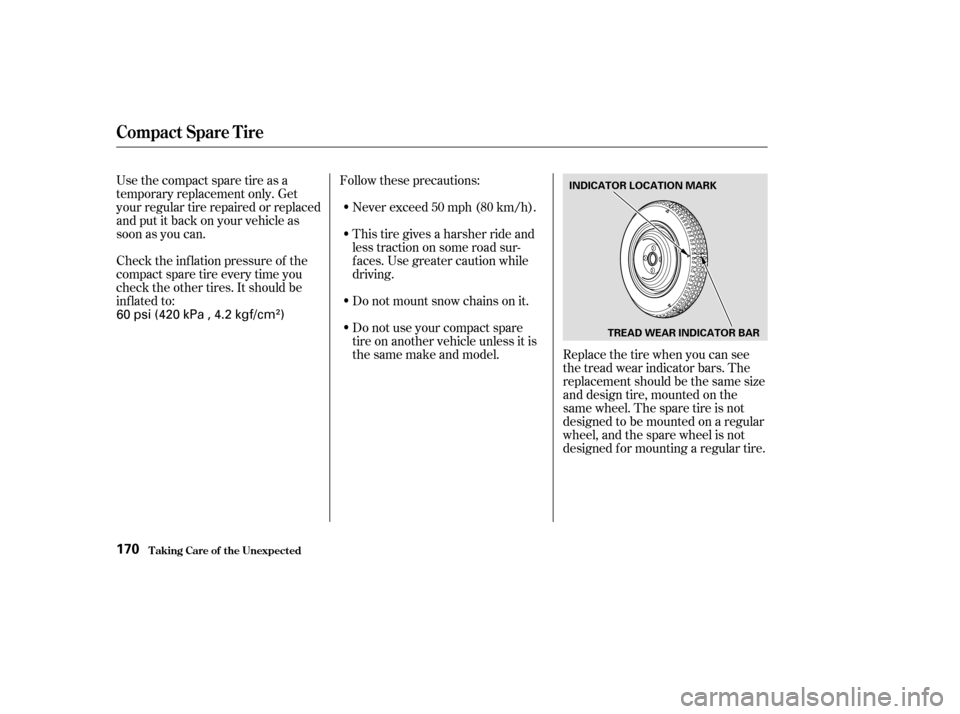
thesamemakeandmodel. Replacethetirewhenyoucanseethe tread wear indicator bars. The
replacement should be the same size
and design tire, mounted on the
same wheel. The spare tire is not
designed to be mounted on a regular
wheel, and the spare wheel is not
designed f or mounting a regular tire.
Compact Spare Tire
T aking Care of t he Unexpect ed170
INDICATOR LOCATION MARK
TREAD WEAR INDICATOR BAR
60 psi (420 kPa , 4.2 kgf/cm)
�����—�����—�����y�
������
������y���
�(�����������y���
�����y
Page 171 of 221
Turn the jack’s end
counterclockwise to loosen it, then
remove the jack.Loosen each wheel nut 1/2 turn
with the wheel wrench.
Placethejackunderthejacking
point. Turn the end bracket
clockwise until the top of the jack
contacts the jacking point. Make
sure the jacking point tab is
restinginthejacknotch.
6.
7.8.
Changing a Flat T ire
T aking Care of t he Unexpect ed172
JACK
WHEEL WRENCHJACKING POINTS
�����—�����—�����y�
������
������y���
�(�����������y���
�����y
Page 172 of 221
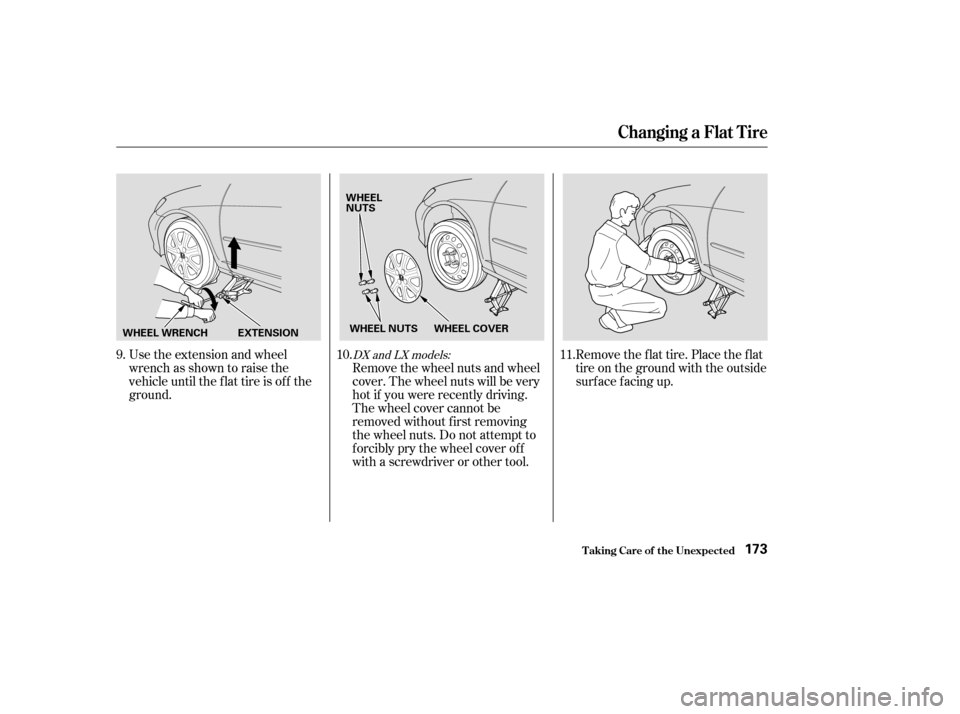
Remove the flat tire. Place the flat
tire on the ground with the outside
surface facing up.
Use the extension and wheel
wrench as shown to raise the
vehicle until the f lat tire is of f the
ground. Remove the wheel nuts and wheel
cover. The wheel nuts will be very
hot if you were recently driving.
The wheel cover cannot be
removed without f irst removing
the wheel nuts. Do not attempt to
f orcibly pry the wheel cover of f
with a screwdriver or other tool.
9.
11.
10.DX and LX models:
Changing a Flat T ire
T aking Care of t he Unexpect ed173
WHEEL WRENCH WHEEL
NUTS
WHEEL NUTS WHEEL COVER
EXTENSION
�����—�����—�����y�
������
������y���
�(�����������y���
�����y
Page 173 of 221
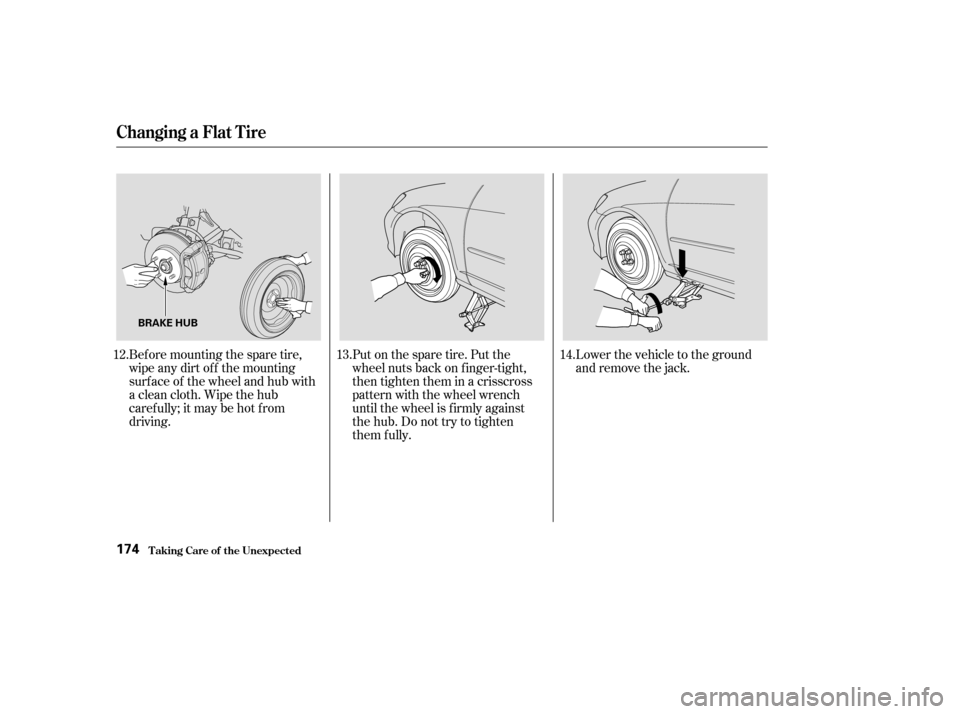
Bef ore mounting the spare tire,
wipeanydirtoff themounting
surface of the wheel and hub with
a clean cloth. Wipe the hub
carefully;itmaybehotfrom
driving.Put on the spare tire. Put the
wheel nuts back on f inger-tight,
then tighten them in a crisscross
pattern with the wheel wrench
until the wheel is f irmly against
the hub. Do not try to tighten
them f ully.Lower the vehicle to the ground
and remove the jack.
12. 13.
14.
Changing a Flat T ire
T aking Care of t he Unexpect ed174
BRAKE HUB
�����—�����—�����y�
�������������y���
�(�����������y���
�����y
Page 174 of 221
Tighten the wheel nuts securely in
the same crisscross pattern. Have
the wheel nut torque checked at
the nearest automotive service
f acility.
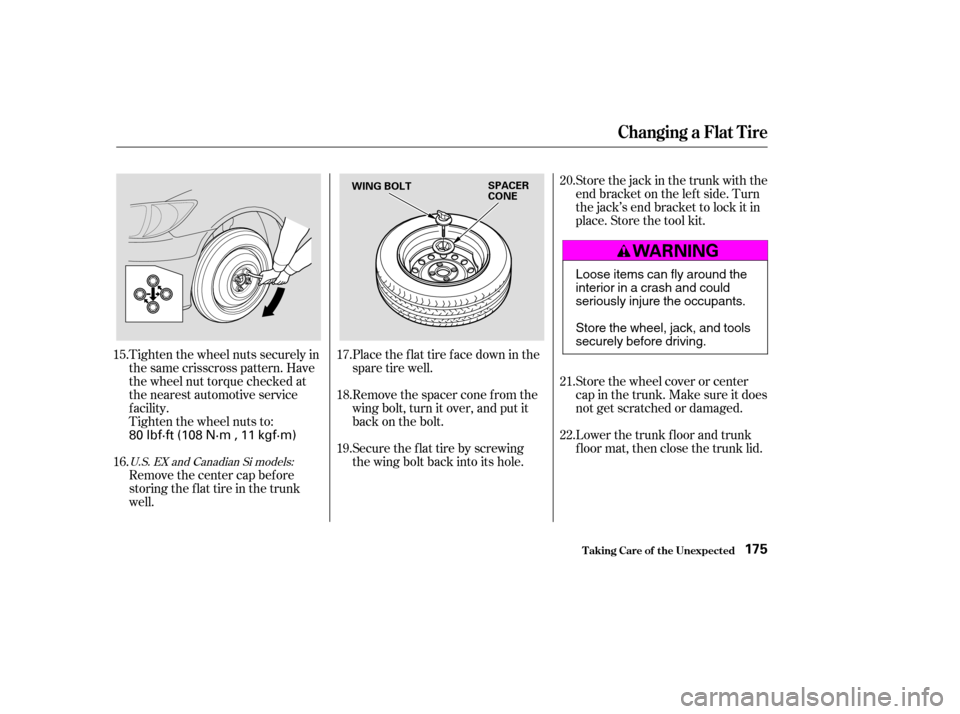
Tighten the wheel nuts to:Place the flat tire face down in the
spare tire well.
Remove the spacer cone f rom the
wing bolt, turn it over, and put it
back on the bolt.
Securetheflattirebyscrewing
the wing bolt back into its hole.Store the jack in the trunk with the
end bracket on the lef t side. Turn
the jack’s end bracket to lock it in
place. Store the tool kit.
Store the wheel cover or center
cap in the trunk. Make sure it does
not get scratched or damaged.
Lower the trunk f loor and trunk
floor mat, then close the trunk lid.
Remove the center cap before
storing the f lat tire in the trunk
well.
15.
22.
21.
20.
17. 18. 19.
16.
U.S.EXandCanadianSimodels:
Changing a Flat T ire
T aking Care of t he Unexpect ed175
WING BOLT SPACER CONE
80 lbf·ft (108 N·m , 11 kgf·m) Loose items can fly around the
interiorinacrashandcould
seriously injure the occupants.
Store the wheel, jack, and tools
securely before driving.
�����—�����—�����y�
���������
���y���
�(�����������y���
�����y
Page 183 of 221

However, if the brake pedal does not
f eel normal, you should take
immediate action. A problem in one
part of the system’s dual circuit
design will still give you braking at
two wheels. You will f eel the brake
pedal go down much f arther bef ore
the vehicle begins to slow down and
you will have to press harder on the
pedal.
Slow down by shif ting to a lower
gear, and pull to the side of the road
when it is saf e. Because of the long
distance needed to stop, it is
hazardous to drive the vehicle. You
should have it towed and repaired as
soon as possible (seeon page ).
If you must drive the vehicle a short
distance in this condition, drive
slowly and caref ully.
The brake system indicator
normally comes on when
you turns the ignition
switch ON (II) and as a
reminder to check the
parking brake. It will stay lit
if you do not f ully release
the parking brake.
If the brake system indicator comes
on while drivinig, the brake f luid
level is probably low. Press lightly on
the brake pedal to see if it f eels
normal. If it does, check the brake
f luid level the next time you stop at a
service station (see page ).
If the f luid level is low, take the
vehicle to your dealer and have the
brake system inspected f or leaks or
worn brake pads. 190
151
Brake System Indicator
Emergency
Towing
T aking Care of t he Unexpect ed184
Canada U.S.
�����—�����—�����y�
�������������y���
�(�����������y���
�����y
Page 189 of 221

�µ
�µ �µ
There are three popular types of
prof essional towing equipment.
The tow
truck uses two pivoting arms that go
under the tires (f ront or rear) and lif t
them of f the ground. The other two
tires remain on the ground. Release the parking brake.
Shif t the transmission to Neutral.
Release the parking brake.
Start the engine.
ShifttoD,thentoN.
Turn of f the engine.
If your vehicle needs to be towed,
call a prof essional towing service or,
organization. Never tow your vehicle
behind another vehicle with just a
rope or chain. It is very dangerous.
The operator
loads your vehicle on the back of a
truck. The tow
truck uses metal cables with hooks
on the ends. These hooks go around
parts of the f rame or suspension and
the cables lif t that end of the vehicle
of f the ground. Your vehicle’s sus-
pension and body can be seriously
damaged.
If your Honda cannot be transported
by f lat-bed, it should be towed by
wheel-lif t equipment with the f ront
wheels of f the ground. If , due to
damage, your vehicle must be towed
with the f ront wheels on the ground,
do the f ollowing:
5-speed Manual Transmission:
Automatic Transmission:
Emergency T owing
T aking Care of t he Unexpect ed
Wheel-lif t Equipment
Flat -bed Equipment Sling-t ype Equipment
T his is
an acceptable way to tow your
Honda. This is the best way to trans-
port your Honda. T his method of towing
is unacceptable.
190
NOTICE: Improper towing preparation
will damage the transmission. Follow
the above procedure exactly. If you
cannot shif t the transmission or start
the engine (automatic transmission),
your vehicle must be transported with
the f ront wheels of f the ground.
�����—�����—�����y�
�������������y���
�(�����������y���
�����y