Page 21 of 215

Two SRS (Supplemental Restraint
System) f ront airbags. The driver’s
airbag is stored in the center of
the steering wheel; the f ront
passenger’sairbagisstoredinthe
dashboard. Both are marked ‘‘SRS
AIRBAG.’’If you ever have a moderate to
severe f rontal collision, sensors will
detect the vehicle’s rapid
deceleration. If the rate of
deceleration is high enough, the
control unit will instantly inf late the
driver’s and f ront passenger’s f ront
airbags, at the time and with the
f orce needed.
Sensors that can detect a
moderate to severe frontal impact
or side impact in models equipped
with side airbags.
Automatic seat belt tensioners
(see page ).
one f or the driver and one f or a
f ront passenger. The airbags are
stored in the outer edges of the
seat-backs. Both are marked
‘‘SIDE AIRBAG’’ (see page ).
Your Airbag System includes:
A sophisticated electronic system
that continually monitors and
records inf ormation about the
sensors, the control unit, the
airbag activators, and driver and
passenger seat belt use when the
ignition is ON (II).
An indicator on the instrument
panel that alerts you to a possible
problem with your airbags (see
page ).
an indicator on the dashboard that
alerts you that the passenger’s
side airbag has been turned of f
(see page ).
Emergency backup power in case
your vehicle’s electrical system is
disconnected in a crash.
20 25 26
27
On models equipped with side airbags, On models equipped with side airbags,
Additional Inf ormation About Your Airbags
Driver and Passenger Saf ety
Airbag System Components
How Your Front Airbags Work
22
�����—�����—�����y�
�������������y���
�(���)�������y���������y
Page 48 of 215

This section gives inf ormation about
the controls and displays that
contribute to the daily operation of
your Honda. All the essential
controls are within easy reach............................
Control Locations . 50
..........
Instrument Panel Indicators . 51
.............................................
Gauges . 57
...............
Odometer/Trip Meter . 57
..................................
Fuel Gauge . 57
...................
Temperature Gauge . 58
Controls Near the Steering ...........................................
Wheel . 59
.
Windshield Wipers and Washers . 60
...........
Turn Signal and Headlights . 61
........
Instrument Panel Brightness . 62
.................
Hazard Warning Button . 62
.................
Rear Window Def ogger . 62
..........
Steering Wheel Adjustment . 63
...............................
Keys and Locks . 64
........................
Immobilizer System . 65
................................
Ignition Switch . 66
......................................
Door Locks . 67
......................
Power Door Locks . 67
............................................
Hatch . 68
.......................
Remote Transmitter . 69
.................................................
Seats . 71
...........................
Cargo Area Cover . 75
..............................
Power Windows . 76
.........................................
Moonroof . 78
.............................................
Mirrors . 79 .................................
Parking Brake . 80
.................................
Interior Lights . 81
...........
Interior Convenience Items . 82
.......................
Beverage Holders . 83
....................................
Glove Box . 83
..........
Accessory Power Sockets . 83
...............
Console Compartment . 83
Instruments and Controls
Inst rument s and Cont rols 49
�����—�����—�����y�
������
������y���
�(���)�������y���������y
Page 50 of 215
The U.S. instrument panel is shown. Dif f erences f or the Canadian models are noted in thetext.
Inst rument s and Cont rols
Instrument Panel Indicators
51
PARKING BRAKE AND
BRAKE SYSTEM INDICATOR
HATCH-OPEN INDICATOR
CHARGING SYSTEM INDICATOR
LOW OIL PRESSURE
INDICATOR
MALFUNCTION
INDICATOR LAMP
IMMOBILIZER SYSTEM INDICATOR CRUISE CONTROL
INDICATOR
HIGH BEAM INDICATOR
ANTI-LOCK BRAKE SYSTEM INDICATOR ELECTRIC POWER
STEERING INDICATOR
LOW FUEL
INDICATOR
SUPPLEMENTAL
RESTRAINT SYSTEM
INDICATOR
MAINTENANCE
REQUIRED
INDICATOR
(P. 53) (P. 54)
(P. 56) (P. 53)
(P. 54)
(P. 55)
(P. 54)
(P. 52)
(P. 52)
(P. 55)
(P. 53, 179)
(P. 52, 177)
(P. 52, 177)
(P. 53, 178) SIDE AIRBAG OFF
INDICATOR
SEAT BELT REMINDER INDICATOR
(P. 52)
�����—�����—�����y�
������
������y���
�(���)�������y���������y
Page 54 of 215

This indicator normally comes on
when you turn the ignition to ON (II)
and goes off after the engine starts.
If it comes on at any other time,
there is a problem in the Electric
Power Steering system. If this
happens, stop the vehicle in a saf e
place and turn of f the engine. Reset
the system by restarting the engine.
The indicator will not turn of f
immediately. If it does not go of f
after driving a short distance, or
comes back on again while driving,
take the vehicle to your dealer to
have it checked. With the indicator
on, the EPS may be turned of f ,
making the vehicle harder to steer.
If the power steering system
overheats while driving, the assisting
power is reduced and steering may
f eel slightly harder.This indicator comes on f or a f ew
seconds when you turn the ignition
switch to ON (II). It will go of f if you
have inserted a properly-coded
ignition key. If it is not a properly-
coded key, the indicator will blink
and the engine will not start (see
page ).
This indicator also blinks several
times when you turn the ignition
switch f rom ON (II) to ACCESSORY
(I) or LOCK (0).
65
Inst rument s and Cont rols
Electric Power Steering
(EPS) Indicator
Immobilizer System
Indicator
Instrument Panel Indicators
55
�����—�����—�����y�
�������������y���
�(���)�������y���������y
Page 58 of 215
�Î
�Î To use the horn, press the pad around the ‘‘H’’ logo.
Inst rument s and Cont rols
Controls Near the Steering Wheel
59
REAR WINDOW DEFOGGER
MIRROR CONTROLS TILT ADJUSTMENTHORN
HEADLIGHTS/TURN SIGNALS
WINDSHIELD WIPERS/WASHERS
(P. 61) (P. 60)
(P. 62)
CRUISE CONTROL
SWITCHES
(P. 105)
(P. 79) (P. 63)
(P. 62)
CRUISE CONTROL
MASTER SWITCH
(P. 105)
HAZARD WARNING BUTTON
�����—�����—�����y�
�������������y���
�(���)�������y���������y
Page 62 of 215

Make sure the rear window is clear
and you have good visibility bef ore
starting to drive.
Thedefoggerwiresontheinsideof
the rear window can be accidentally
damaged. When cleaning the glass,
always wipe side-to-side.Make any steering wheel adjustment
bef ore you start driving.
To adjust the steering wheel upward
or downward:
Push the lever under the steering
column all the way down. Move the steering wheel so it
points to your chest, not toward
yourface.Makesureyoucansee
the instrument panel gauges and
indicators.
Push the lever up to lock the
steering wheel in that position.
Make sure you have securely
locked the steering wheel in place
by trying to move it up and down.
1.
4.
3.
2.
See page f or important saf ety
inf ormation about how to properlyposition the steering wheel. 16
Rear Window Def ogger, Steering Wheel A djustment
Inst rument s and Cont rols
Steering Wheel A djustment
63
Adjusting the steering wheel
position while driving may
cause you to lose control of the
vehicle and be seriously injured
inacrash.
Adjust the steering wheel only
when the vehicle is stopped.
�����—�����—�����y�
���������
�
�y���
�(���)�������y���������y
Page 65 of 215
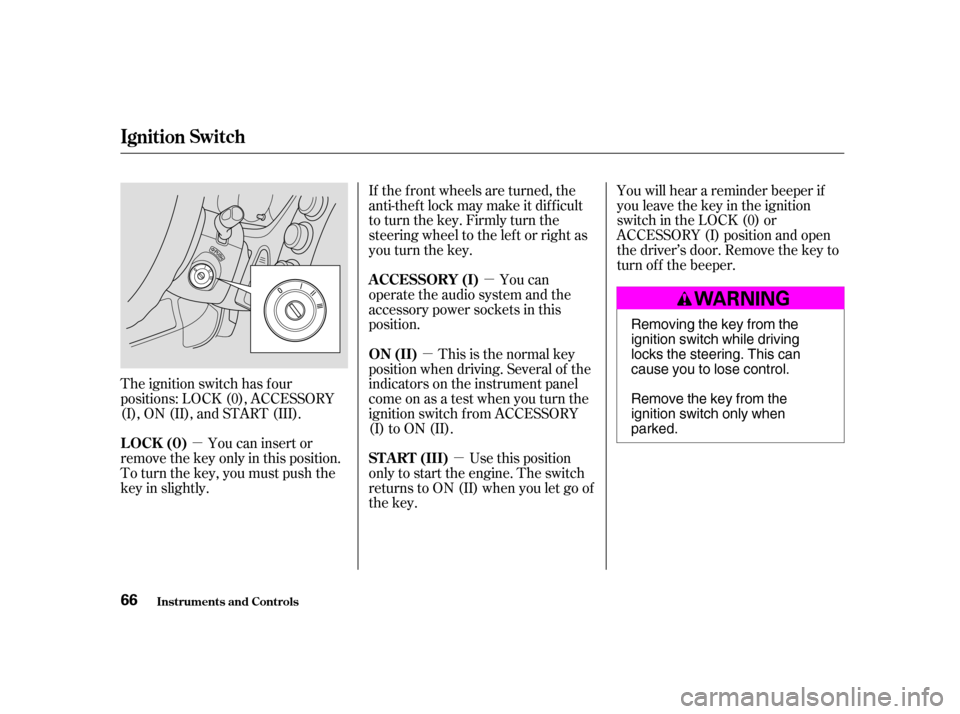
�µ
�µ
�µ �µ
The ignition switch has f our
positions: LOCK (0), ACCESSORY
(I), ON (II), and START (III). If the f ront wheels are turned, the
anti-thef t lock may make it dif f icult
to turn the key. Firmly turn the
steering wheel to the lef t or right as
you turn the key.
You can
operate the audio system and the
accessory power sockets in this
position.
Use this position
only to start the engine. The switch
returns to ON (II) when you let go of
the key. You will hear a reminder beeper if
you leave the key in the ignition
switch in the LOCK (0) or
ACCESSORY (I) position and open
thedriver’sdoor.Removethekeyto
turn of f the beeper.
You can insert or
remove the key only in this position.
To turn the key, you must push the
key in slightly. This is the normal key
position when driving. Several of the
indicators on the instrument panel
come on as a test when you turn the
ignition switch f rom ACCESSORY
(I) to ON (II).
A CCESSORY (I)
ST A RT (III)
LOCK (0) ON (II)
Ignition Switch
Inst rument s and Cont rols
66 Removing the key from the
ignition switch while driving
locks the steering. This can
cause you to lose control.
Remove the key from the
ignition switch only whenparked.
�����—�����—�����y�
�������������y���
�(���)�������y���������y
Page 104 of 215
Cruise control allows you to maintain
asetspeedabove25mph(40km/h)
without keeping your f oot on the
accelerator pedal. It should be used
f or cruising on straight, open
highways. It is not recommended f or
city driving, winding roads, slippery
roads, heavy rain, or bad weather.Push in the Cruise Control Master
Switch. The indicator in the switch
will light.
Accelerate to the desired cruising
speedabove25mph(40km/h).Press and release the SET/decel
buttononthesteeringwheel.The
CRUISE CONTROL indicator on
the instrument panel comes on to
show the system is now activated.
1. 2. 3.
CONT INUED
Cruise Control
Comf ort and Convenience Feat ures
Using t he Cruise Cont rol
105
RESUME/ accel
BUTTON
SET/decel
BUTTON
CANCEL BUTTON
Improper use of the cruise
control can lead to a crash.
Use the cruise control only
when traveling on open
highways in good weather.
�����—�����—�����y�
�������������y���
�(���)�������y���
�����y


