Page 161 of 301

Toerasethecodesstoredinallthree
buttons, press and hold the two
outside buttons until the red light
begins to f lash, then release the
buttons.
Youshoulderaseallthreecodes
bef ore selling the vehicle.
Totrainanalreadyprogrammed
transceiver button with a new device,
you do not have to erase all the
memory. Train the selected button
over the existing memory code
f ollowing the steps under. If you have problems with training
the HomeLink Wireless Control
System, or would like inf ormation on
home products that can be operated
by the transmitter, call (800) 355-
3515. On the Internet, go to www.
homelink.com.
As required by the FCC:
This device complies with Part 15 of theFCC rules. Operation is subject to thef ollowing two conditions: (1) This devicemay not cause harmf ul interf erence, and(2) this device must accept anyinterf erence received, including
interf erence that may cause undesiredoperation.
Changes or modif ications not expresslyapproved by the party responsible f or
compliance could void the user’sauthority to operate the equipment.
This device complies with IndustryCanada Standard RSS-210.Operation is subject to the f ollowing twoconditions: (1) this device may not cause
interf erence, and (2) this device mustaccept any interf erence that may causeundesired operation of the device.Erasing Codes
Retraining a Button
T raining
HomeL ink Customer Assistance
HomeL ink Universal T ransceiver
Features162
�����—�����—�����y�
�
����
������y���
�(�������
���y���
�����y
Page 165 of 301
To Open the Hood:Park the vehicle, and set the
parking brake. Pull the hood
release handle located under the
lower lef t corner of the dashboard.
The hood will pop up slightly.
Screw the fuel fill cap back on
until it clicks at least three times.
If you do not properly tighten the
cap, the Malf unction Indicator
Lampmaycomeon(seepage
).
Push the f uel f ill door closed until
it latches.
Put your f ingers under the f ront
edge of the hood to the right of
the center. Slide your hand to the
lef t until you f eel the hood latch
handle. Push this handle up to
release it. Lift up the hood.
If the hood latch handle moves stif f ly,
or if you can open the hood without
lifting the handle, the mechanism
should be cleaned and lubricated.
1.
2.
5. 6.
260
Service Station Procedure
Bef ore Driving
Opening and Closing the Hood
166
HOOD RELEASE HANDLE
LATCH
�����—�����—�����y�
�
�����������y���
�(�������
���y���
�����y
Page 166 of 301
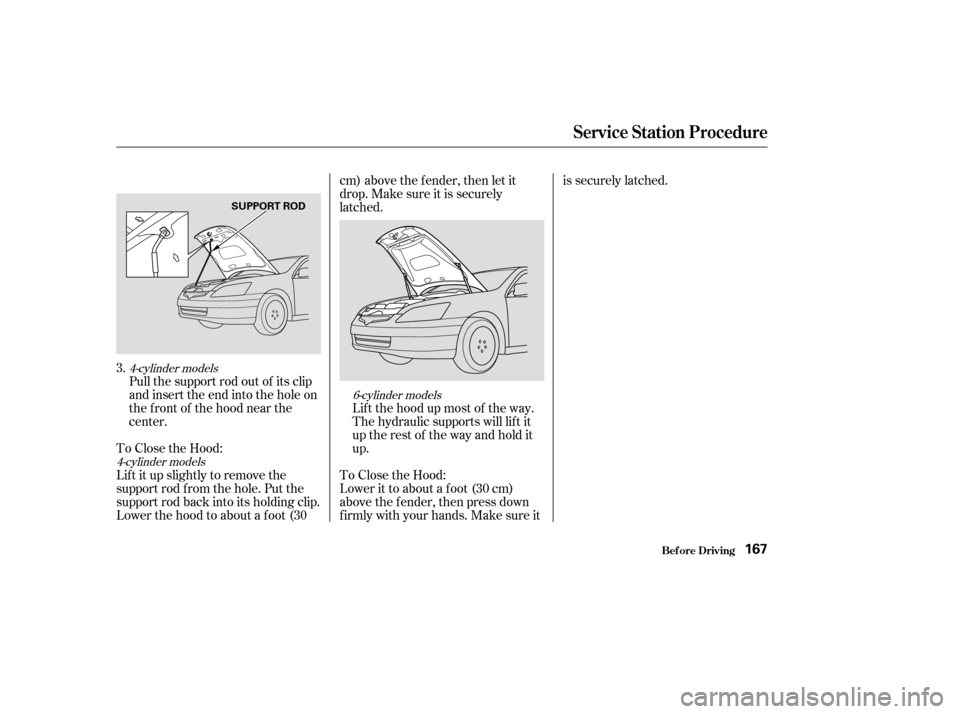
Pull the support rod out of its clip
and insert the end into the hole on
the front of the hood near the
center.
To Close the Hood:
Lif t it up slightly to remove the
support rod f rom the hole. Put the
support rod back into its holding clip.
Lower the hood to about a f oot (30 cm) above the f ender, then let it
drop. Make sure it is securely
latched.
Lif t the hood up most of the way.
The hydraulic supports will lif t it
uptherestof thewayandholditup.
Lower it to about a f oot (30 cm)
above the f ender, then press down
f irmly with your hands. Make sure it is securely latched.
To Close the Hood:
3.
4-cylinder models
4-cylinder models 6-cylinder models
Service Station Procedure
Bef ore Driving167
SUPPORT ROD
�����—�����—�����y�
�
�����������y���
�(�������
���y���
�����y
Page 170 of 301

Bef ore installing any accessory:Make sure the accessory does not
obscure any lights, or interf ere
with proper vehicle operation or
perf ormance.
Be sure electronic accessories do
not overload electrical circuits
(see page ) or interf ere with
proper operation.
Have the installer contact your
Honda dealer f or assistance bef ore
installing any electronic accessory.
When properly installed, cellular
phones, alarms, two-way radios, and
low-powered audio systems should
not interf ere with your vehicle’s
computer controlled systems, such
as the SRS and anti-lock brake
system.
Modif ying your vehicle, or installing
some non-Honda accessories, can
make your vehicle unsaf e. Bef ore
you make any modif ications or add
anyaccessories,besuretoreadthe
f ollowing inf ormation.
Your dealer has Honda accessories
that allow you to personalize your
vehicle. These accessories have
been designed and approved f or your
vehicle, and are covered by warranty.
Although aftermarket accessories
may f it on your vehicle, they may not
meet f actory specif ications, and
could adversely af f ect your vehicle’s
handling and stability (see
‘‘Modif ications’’ on page f or
additional information).
172 265
A ccessories
Bef ore Driving
A ccessories
171
Improper accessories or
modifications can affect your
vehicle’s handling, stability, and
performance, and cause a
crash in which you can be hurt
or killed.
Follow all instructions in this
owner’s manual regarding
accessories and modifications.
�����—�����—�����y�
�
�������
���y���
�(�������
���y���
�����y
Page 177 of 301
Youshoulddothefollowingchecks
and adjustments bef ore you drive
your vehicle.Make sure all windows, mirrors,
and outside lights are clean and
unobstructed. Remove f rost, snow,
or ice.
Visually check the tires. If a tire
looks low, use a gauge to check its
pressure.
Check that any items you may be
carrying are stored properly or
f astened down securely. Check the adjustment of the
inside and outside mirrors (see
page ).
Make sure the doors are securely
closed and locked.
Fasten your seat belt. Check that
your passengers have f astened
their seat belts (see page ).When you start the engine, check
the gauges and indicator lights in
the instrument panel (see page
).
Check the steering wheel
adjustment (see page ).
Check the seat adjustment (see
pages and ).
3. 2.
1.
4. 5. 6. 7.8.
159.
61
98 92 93
78
Preparing to Drive
Driving178
�����—�����—�����y�
�
�����������y���
�(�������
���y���
���
�y
Page 186 of 301

Always use the parking brake when
you park your vehicle. Make sure
the parking brake is set f irmly or
your vehicle may roll if it is parked
on an incline.
If your vehicle has an automatic
transmission, set the parking brake
bef ore you put the transmission in
Park. This keeps the vehicle f rom
moving and putting pressure on the
parking mechanism in the
transmission.Make sure the moonroof (if
equipped) and the windows are
closed.
Turn of f the lights.
Place any packages, valuables, etc.,
in the trunk or take them with you.
Lockthedoorswiththekeyorthe
remote transmitter.
Check the indicator on the
instrument panel to verif y that the
security system is set.
Never park over dry leaves, tall
grass, or other f lammable
materials. The hot three way
catalytic converter could cause
these materials to catch on fire.
If your vehicle has a manual
transmission, put it in f irst gear.
Make sure the parking brake is
f ully released bef ore driving away.
Driving with the parking brake
partially set can overheat or
damage the rear brakes.
If the vehicle is f acing uphill, turn
the f ront wheels away f rom the
curb. If your vehicle has a manual
transmission, put it in f irst gear.
If the vehicle is f acing downhill,
turn the front wheels toward the
curb. If your vehicle has a manual
transmission, put it in reverse gear.
On EX, LX-V6, and Canadian LX-G
models
Driving
Parking T ips
Parking
187
�����—�����—�����y�
�
�����������y���
�(�������
���y���
�����y
Page 187 of 301

Your Honda is equipped with disc
brakes. The brakes on the rear
wheels may be disc or drum,
depending on the model. A power
assist helps reduce the ef f ort needed
on the brake pedal. The ABS helps
you retain steering control when
braking very hard.Check the brakes after driving
through deep water. Apply the
brakes moderately to see if they f eel
normal. If not, apply them gently and
f requently until they do. Be extra
cautious in your driving.
The hydraulic system that operates
the brakes has two separate circuits.
Each circuit works diagonally across
the vehicle (the lef t-f ront brake is
connected with the right-rear brake,
etc.). If one circuit should develop a
problem, you will still have braking
at two wheels.
If the brake pads need replacing, you
will hear a distinctive, metallic
screeching sound when you apply
the brake pedal. If you do not have
the brake pads replaced, they will
screech all the time. It is normal f or
the brakes to occasionally squeal or
squeak when you apply them.
Resting your f oot on the pedal keeps
the brakes applied lightly, builds up
heat, and reduces their ef f ectiveness.
It also keeps your brake lights on all
the time, conf using drivers behind
you.
Constant application of the brakes
when going down a long hill builds
up heat and reduces their ef f ective-
ness. Use the engine to assist the
brakes by taking your f oot of f the
accelerator and downshif ting to a
lower gear.
Braking System
Driving
Braking System Design
Brake Wear Indicators
188
Front
�����—�����—�����y�
�
�����������y���
�(�������
���y���
���
�y
Page 190 of 301
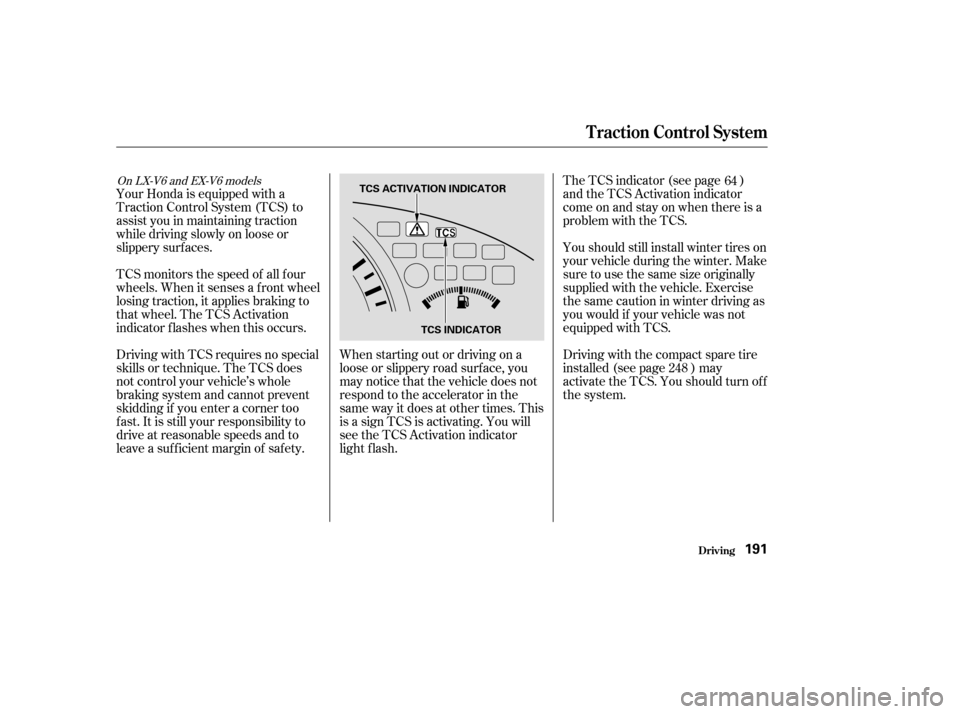
Your Honda is equipped with a
Traction Control System (TCS) to
assist you in maintaining traction
while driving slowly on loose or
slippery surf aces.
TCS monitors the speed of all f our
wheels. When it senses a f ront wheel
losing traction, it applies braking to
that wheel. The TCS Activation
indicator f lashes when this occurs.
Driving with TCS requires no special
skills or technique. The TCS does
not control your vehicle’s whole
braking system and cannot prevent
skidding if you enter a corner too
f ast. It is still your responsibility to
drive at reasonable speeds and to
leave a sufficient margin of safety.When starting out or driving on a
loose or slippery road surf ace, you
may notice that the vehicle does not
respond to the accelerator in the
samewayitdoesatothertimes.This
is a sign TCS is activating. You will
seetheTCSActivationindicator
light f lash.TheTCSindicator(seepage )
andtheTCSActivationindicator
comeonandstayonwhenthereisa
problem with the TCS.
You should still install winter tires on
your vehicle during the winter. Make
sure to use the same size originally
supplied with the vehicle. Exercise
the same caution in winter driving as
you would if your vehicle was not
equipped with TCS.
Driving with the compact spare tire
installed (see page ) may
activate the TCS. You should turn of f
the system.
64
248
On LX-V6 and EX-V6 models
Traction Control System
Driving191
TCS ACTIVATION INDICATOR TCS INDICATOR
�����—�����—�����y�
�
�����������y���
�(�������
���y���
�����y