Page 32 of 301

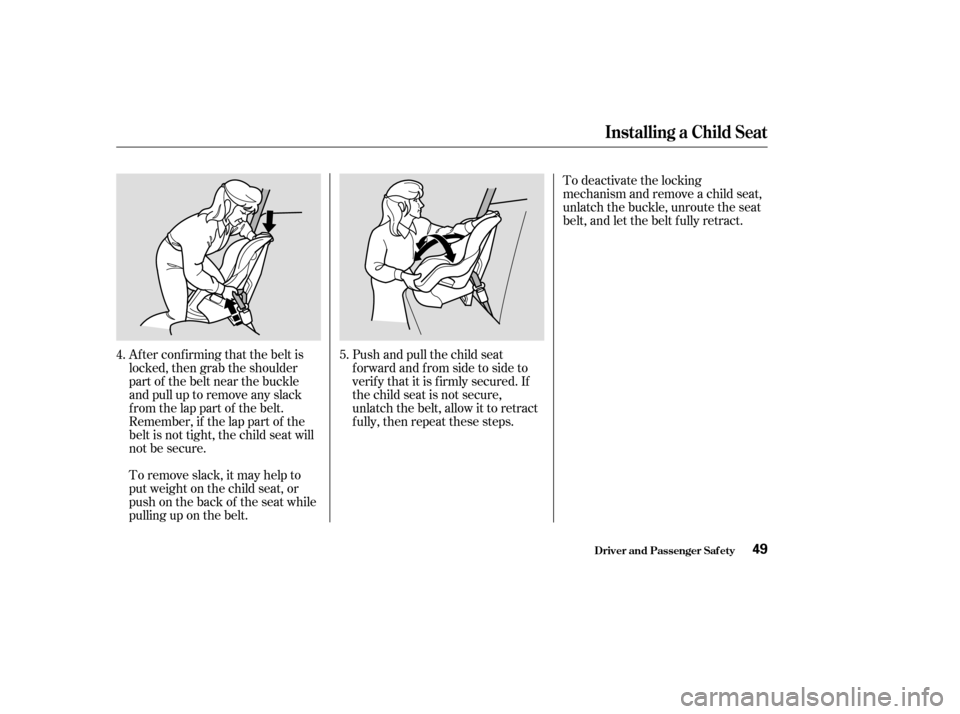
Together, airbags and
seat belts provide the best
protection.
Tampering could cause
the airbags to deploy, possibly
causing very serious injury.
If water or another liquid
soaks into a seat-back, it can
prevent the side airbag cutof f
system f rom working properly. This could make the
driver’s seat position sensor or the
f ront passenger’s weight sensors
inef f ective. If it is necessary to
remove or modif y a f ront seat to
accommodate a person with
disabilities, f irst contact American
Honda at 800-999-1009.
This could make the
driver’s seat position sensor and
the f ront passenger’s weight
sensors inef f ective. This could make the front
passenger’s weight sensors
inef f ective. Make sure the right
rear f loor mat is hooked over the
f loor mat anchor (see page ).
Improperly
replacing or covering f ront seat-
back covers can prevent your side
airbags f rom inf lating during a
side impact.
Pushing or
pulling on the back of the seat,
placing heavy items in the back
seat pocket, pushing cargo against
the seat, or hanging heavy items
on the seat back can interf ere with
the proper operation of the
passenger’s advanced front airbag. 235
Additional Inf ormation About Your Airbags
Driver and Passenger Saf ety
Additional Saf ety Precautions
Donotattempttodeactivateyour
airbags.
Do not t amper wit h airbagcomponent s or wiring f or any
reason.
Do not expose t he f ront seat -backsto liquid. Do not remove or modif y a f ront
seat wit hout consult ing a Hondadealer.
Do not place any it ems under t he front seats. Do not place t he right rear f loor
mat under t he f ront passenger’sseat .
Do not cover or replace f ront seat -back covers wit hout consult ing aHonda dealer.
Do not do anyt hing t hat wouldincrease or decrease weight on t hef ront passenger’s seat .
33
�����—�����—�����y�
�
�����������y���
�(�������
���y���������y
Page 34 of 301

�µ�µ
�µ
�µ
(see pages ).
Children who ride in back are less
likely to be injured by striking
interior vehicle parts during a
collision or hard braking. Also,
children cannot be injured by an
inf lating airbag when they ride in the
back. (see pages ).
According to accident statistics,
children of all ages and sizes are
saf er when they are restrained in the
back seat. The National Highway
Traffic Safety Administration and
Transport Canada recommend that
all children age 12 and under be
properly restrained in the back seat. Front airbags have been designed to
help protect adults in a moderate to
severe f rontal collision. To do this
the passenger’s f ront airbag is quite
large and it can inf late with enough
f orce to cause very serious injuries.
To help prevent airbag-caused
injuries to children, this vehicle has
an advanced airbag system.
With this system, the front
passenger’s airbag is turned of f if
sensors detect a total weight of less
thanabout65lbs(30kg)ontheseat
(see pages f or additional
inf ormation about how the f ront
passenger’s advanced airbag works).Even if the passenger’s f ront airbag
is turned of f , we strongly
recommend that children age 12 and
under ride properly restrained in a
back seat where they will be saf er.
40 50
55
51
25 26
CONT INUED
Inf ant s and small children must berest rained in an approved child seatt hat is properly secured t o t hevehicleLarger children must be restrained wit h a lap/shoulder belt and ride ona boost er unt il t he seat belt f it s t hem
properly
All Children Should Sit in the
Back Seat The Passenger’s Front Airbag
Can Pose Serious Risks
Driver and Passenger Saf ety
Protecting Children General Guidelines
35
�����—�����—�����y�
�
�����������y���
�(�������
���y���������y
Page 39 of 301
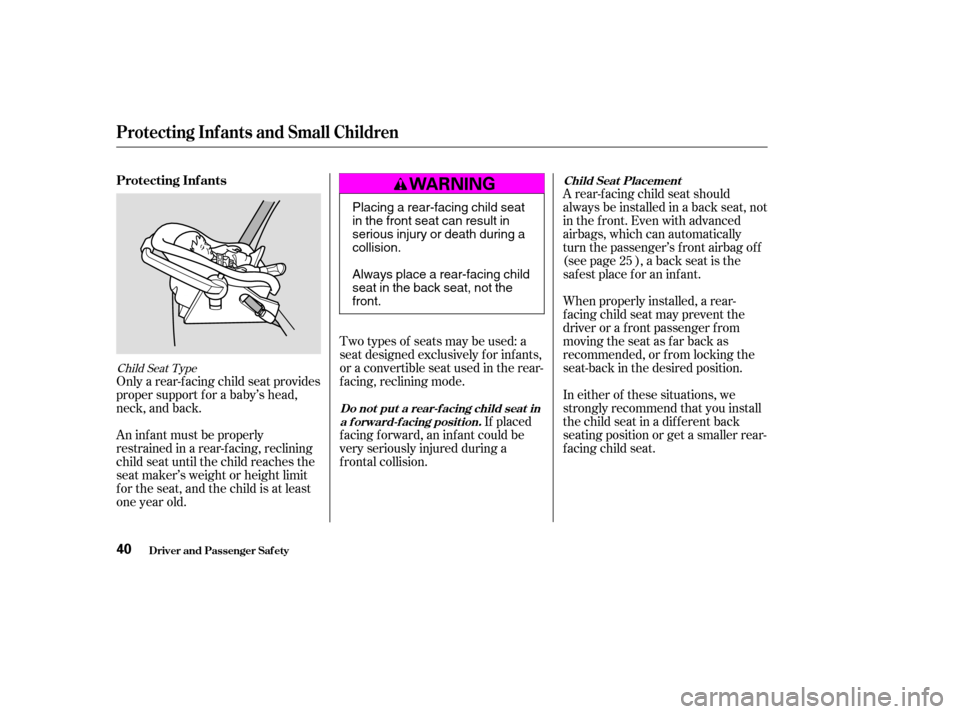
Two types of seats may be used: a
seat designed exclusively f or inf ants,
or a convertible seat used in the rear-
f acing, reclining mode.If placed
f acing f orward, an inf ant could be
very seriously injured during a
f rontal collision.
An inf ant must be properly
restrained in a rear-f acing, reclining
child seat until the child reaches the
seat maker’s weight or height limit
f or the seat, and the child is at least
one year old.
Only a rear-f acing child seat provides
proper support f or a baby’s head,
neck, and back. A rear-f acing child seat should
always be installed in a back seat, not
in the front. Even with advanced
airbags, which can automatically
turn the passenger’s f ront airbag of f
(see page ), a back seat is the
saf est place f or an inf ant.
When properly installed, a rear-
f acing child seat may prevent the
driver or a f ront passenger f rom
moving the seat as far back as
recommended, or f rom locking the
seat-back in the desired position.
In either of these situations, we
strongly recommend that you install
the child seat in a dif f erent back
seating position or get a smaller rear-
f acing child seat.
25
Child Seat Type
Do not put a rear-f acing child seat ina f orward-f acing position. Child Seat Placement
Protecting Inf ants and Small Children
Protecting Inf ants
Driver and Passenger Saf ety40
Placing a rear-facing child seat
in the front seat can result in
serious injury or death during acollision.
Always place a rear-facing child
seat in the back seat, not thefront.
�����—�����—�����y�
�
�����������y���
�(�������
���y���������y
Page 41 of 301
We also recommend that a small
child stay in the child seat as long as
possible, until the child reaches the
weight or height limit f or the seat.We strongly recommend placing a
forward-facing child seat in a back
seat,notthefront.Evenwith
advanced airbags, which can
automatically turn the passenger’s
front airbag off (see page ), a
back seat is the safest place for a
small child.
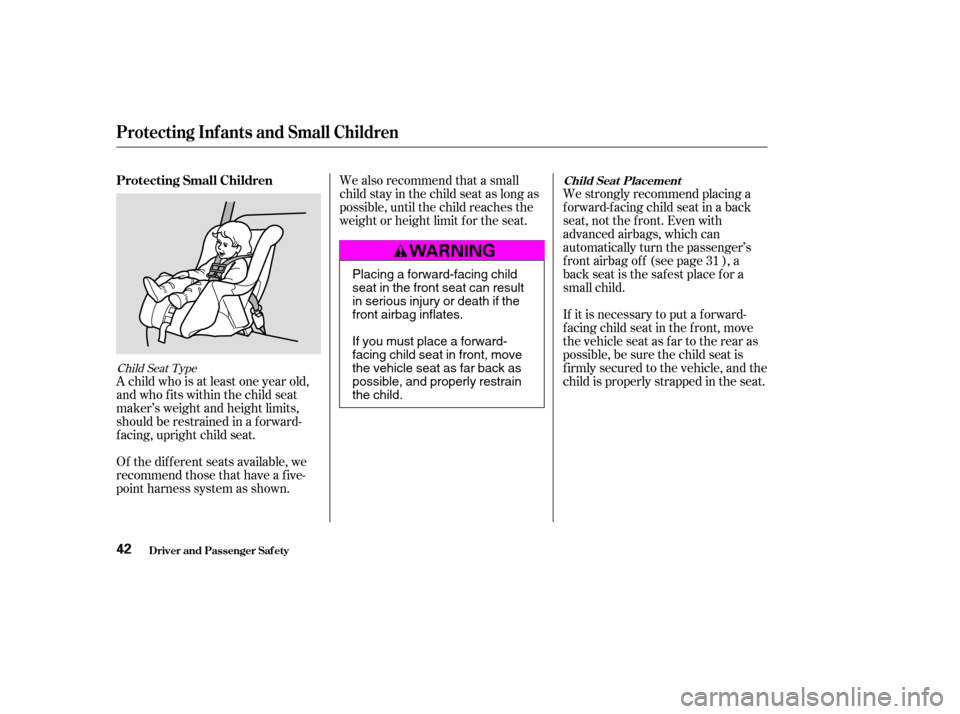
Of the different seats available, we
recommend those that have a f ive-
point harness system as shown.
A child who is at least one year old,
and who fits within the child seat
maker’s weight and height limits,
should be restrained in a f orward-
f acing, upright child seat. If it is necessary to put a f orward-
f acing child seat in the f ront, move
the vehicle seat as far to the rear as
possible, be sure the child seat is
f irmly secured to the vehicle, and the
child is properly strapped in the seat.31
Child Seat Type
Driver and Passenger Saf ety
Child Seat Placement
Protecting Inf ants and Small Children
Protecting Small Children
42
Placing a forward-facing child
seat in the front seat can result
in serious injury or death if the
front airbag inflates.
Ifyoumustplaceaforward-
facing child seat in front, move
the vehicle seat as far back as
possible, and properly restrain
the child.
�����—�����—�����y�
�
����
��
���y���
�(�������
���y���������y
Page 48 of 301
Af ter conf irming that the belt is
locked,thengrabtheshoulder
part of the belt near the buckle
andpulluptoremoveanyslack
f rom the lap part of the belt.
Remember, if the lap part of the
belt is not tight, the child seat will
not be secure.
To remove slack, it may help to
putweightonthechildseat,or
push on the back of the seat while
pulling up on the belt.To deactivate the locking
mechanism and remove a child seat,
unlatch the buckle, unroute the seat
belt, and let the belt f ully retract.
Push and pull the child seat
f orward and f rom side to side to
verif y that it is f irmly secured. If
the child seat is not secure,
unlatch the belt, allow it to retract
f ully, then repeat these steps.
4.
5.
Installing a Child Seat
Driver and Passenger Saf ety49
�����—�����—�����y�
�
�������
�
�y���
�(�������
���y���������y
Page 50 of 301
To determine if a lap/shoulder belt
properly f its a child, have the child
put on the seat belt, then ask
yourself :
When a child reaches the
recommended weight or height limit
for a forward-facing child seat, the
child should sit in a back seat on a
booster and wear a lap/shoulder belt.
The f ollowing pages give
instructions on how to check proper
seat belt f it, what kind of booster
seat to use if one is needed, and
important precautions f or a child
who must sit in f ront.
CONT INUED
Checking Seat Belt Fit
Protecting L arger Children
Driver and Passenger Saf ety51
Allowing a child age 12 or under
to sit in front can result in injury
or death if the passenger’s front
airbag inflates.
If a larger child must ride in front,
move the vehicle seat as far
back as possible, use a booster
seat if needed, have the child
sit up properly and wear the
seat belt properly.
�����—�����—�����y�
�
�����������y���
�(�������
���y���������y
Page 51 of 301
Is the lap part of the belt as low as
possible, touching the child’s
thighs?
Will the child be able to stay
seated like this f or the whole trip?
If you answer yes to all these
questions, the child is ready to wear
the lap/shoulder belt correctly. If
you answer no to any question, the
child needs to ride on a booster seat.
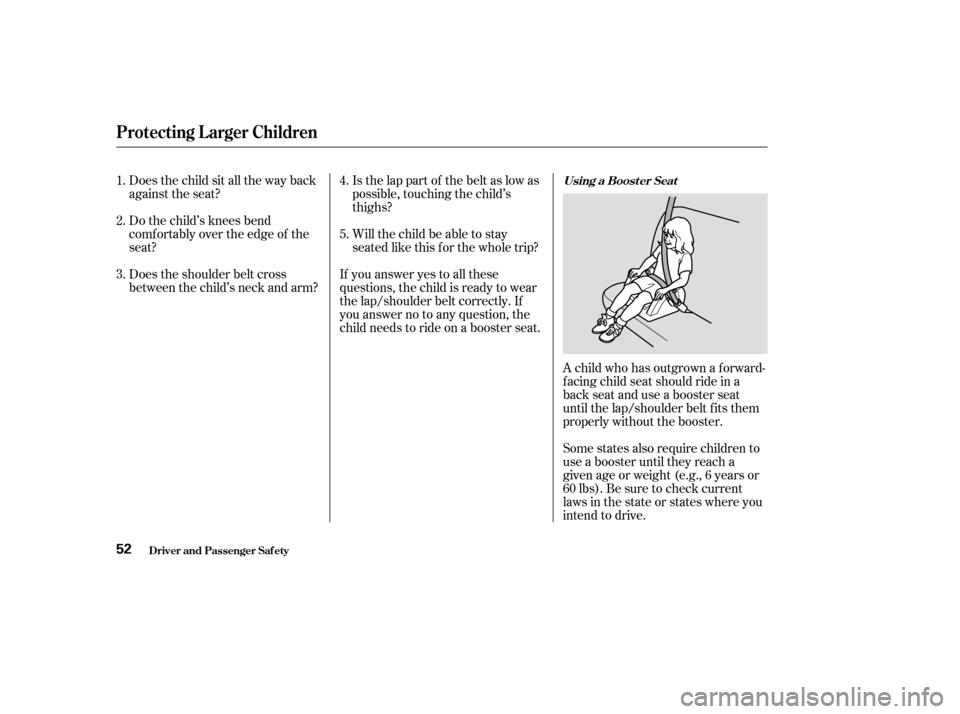
A child who has outgrown a forward-
f acing child seat should ride in a
back seat and use a booster seat
until the lap/shoulder belt f its them
properly without the booster.
Does the child sit all the way back
against the seat?
Do the child’s knees bend
comf ortably over the edge of the
seat?
Does the shoulder belt cross
between the child’s neck and arm?
Some states also require children to
use a booster until they reach a
given age or weight (e.g., 6 years or
60lbs).Besuretocheckcurrent
laws in the state or states where you
intend to drive.
4. 5.
1. 2. 3.Using a Boost er Seat
Protecting L arger Children
Driver and Passenger Saf ety52
�����—�����—�����y�
�
�����������y���
�(�������
���y���������y
Page 62 of 301

On all V6 models
Only on models equipped with side airbags
This indicator lights brief ly when
you turn the ignition switch to ON
(II). If it comes on at any other time,
it indicates a potential problem with
your f ront airbags. This indicator will
also alert you to a potential problem
with your side airbags, passenger’s
side airbag automatic cutoff system,
side curtain airbags, automatic seat
belt tensioners, driver’s seat position
sensor, or f ront passenger’s weight
sensors. For more inf ormation, see
page . This indicator normally comes on f or
a f ew seconds when you turn the
ignition switch to ON (II), and when
the ignition switch is turned to
START (III). If it comes on at any
other time, there is a problem in the
ABS. If this happens, have your
vehicle checked by your Honda
dealer. With the indicator on, your
vehicle still has normal braking
ability but no anti-lock. For complete
inf ormation, see page .
This indicator lights when you turn
the ignition switch to ON (II). If it
comes on at any other time, it
indicates that the passenger’s side
airbag has automatically shut off.
For complete inf ormation, see page
.
28 29
190
Instrument Panel L ights
Inst rument s and Cont rols
Supplemental Restraint
System Indicator T CS A ctivation Indicator
Anti-lock Brake System (ABS)
Indicator
Side Airbag Of f Indicator
63
�����—�����—�����y�
�
�����������y���
�(�������
���y���������y