Page 172 of 301
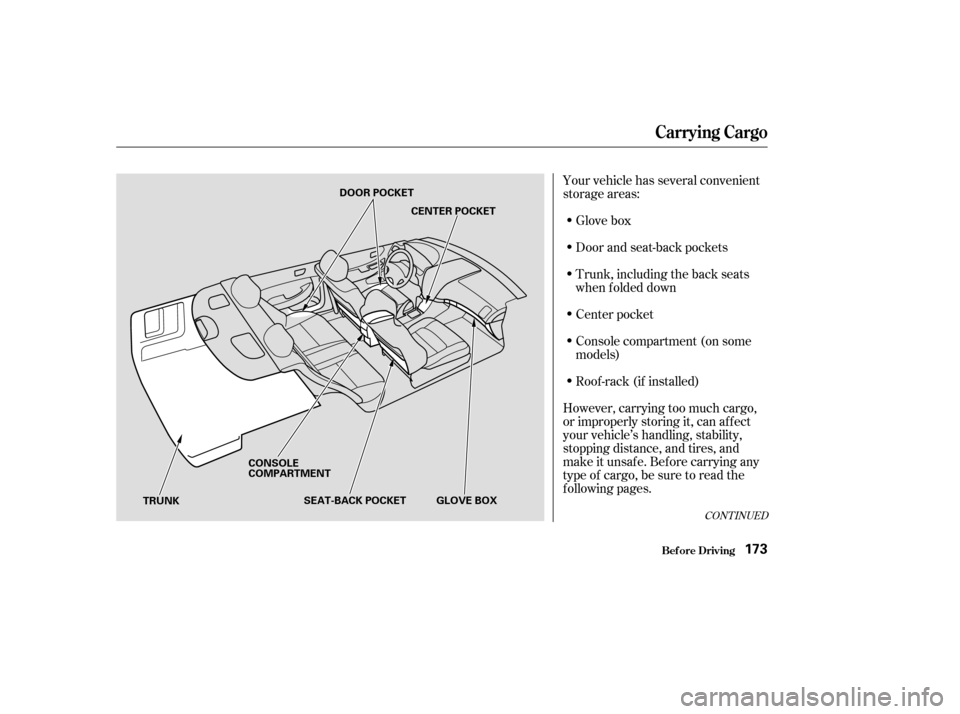
Your vehicle has several convenient
storage areas:Glove box
Door and seat-back pockets
Trunk, including the back seats
when f olded down
Center pocket
Console compartment (on some
models)
Roof -rack (if installed)
However, carrying too much cargo,
or improperly storing it, can af f ect
your vehicle’s handling, stability,
stopping distance, and tires, and
make it unsaf e. Bef ore carrying any
type of cargo, be sure to read the
f ollowing pages.
CONT INUED
Carrying Cargo
Bef ore Driving173
GLOVE BOX
SEAT-BACK POCKET CENTER POCKET
DOOR POCKET
CONSOLE
COMPARTMENT
TRUNK
�����—�����—�����y�
�
�����������y���
�(�������
���y���
�����y
Page 174 of 301

The total weight must not exceed
theGrossVehicleWeightRating
(GVWR). The load f or the f ront and
rear axles also must not exceed the
Gross Axle Weight Rating (GAWR)
(see page ).Store or secure all items that could
be thrown around and hurt
someone during a crash.
Be sure items placed on the f loor
behind the f ront seats cannot roll
under the seats and interf ere with
the pedals or seat operation.
Keep the glove box closed while
driving. If it is open, a passenger
could injure their knees during a
crash or sudden stop.
If you carry large items that
prevent you f rom closing the trunk
lid, exhaust gas can enter the
passenger area. To avoid the
possibility of
, f ollow the instructions
on page .
If you carry any items on a roof
rack,besurethetotalweightof
the rack and the items does not
exceed 165 lbs (75 kg).
If you use an accessory roof rack,
the roof rack weight limit may be
lower. Ref er to the inf ormation that
came with your roof rack.
Distribute cargo evenly on the
f loor of the trunk, placing the
heaviest items on the bottom and
as far forward as possible.
If youfolddownthebackseat,tie
down items that could be thrown
about the vehicle during a crash or
sudden stop. 56
195
Carrying Cargo
Bef ore Driving
Carrying Items in the Passenger
Compartment
Carrying Cargo in the Trunk carbon monoxide
poisoning
175
�����—�����—�����y�
�
���������
�y���
�(�������
���y���
�����y
Page 186 of 301

Always use the parking brake when
you park your vehicle. Make sure
the parking brake is set f irmly or
your vehicle may roll if it is parked
on an incline.
If your vehicle has an automatic
transmission, set the parking brake
bef ore you put the transmission in
Park. This keeps the vehicle f rom
moving and putting pressure on the
parking mechanism in the
transmission.Make sure the moonroof (if
equipped) and the windows are
closed.
Turn of f the lights.
Place any packages, valuables, etc.,
in the trunk or take them with you.
Lockthedoorswiththekeyorthe
remote transmitter.
Check the indicator on the
instrument panel to verif y that the
security system is set.
Never park over dry leaves, tall
grass, or other f lammable
materials. The hot three way
catalytic converter could cause
these materials to catch on fire.
If your vehicle has a manual
transmission, put it in f irst gear.
Make sure the parking brake is
f ully released bef ore driving away.
Driving with the parking brake
partially set can overheat or
damage the rear brakes.
If the vehicle is f acing uphill, turn
the f ront wheels away f rom the
curb. If your vehicle has a manual
transmission, put it in f irst gear.
If the vehicle is f acing downhill,
turn the front wheels toward the
curb. If your vehicle has a manual
transmission, put it in reverse gear.
On EX, LX-V6, and Canadian LX-G
models
Driving
Parking T ips
Parking
187
�����—�����—�����y�
�
�����������y���
�(�������
���y���
�����y
Page 200 of 301

�µ�µ
Follow the
Maintenance Schedule f or Severe
Conditions if you drive your vehicle
MAINLY under one or more of the
f ollowing conditions.
Driving less than 5 miles (8 km)
per trip or, in f reezing
temperatures, driving less than 10
miles (16 km) per trip.
Driving in extremely hot [over
90°F (32°C)] conditions.
Used primarily as a delivery
vehicle or taxi that is driven
mostly in stop-and-go traf f ic and/
or parked with the engine idling. Trailer towing, driving with a roof
top carrier, or driving in
mountainous conditions.
Driving on muddy, dusty, or de-
iced roads.
If you only
drive under a ‘‘severe’’ condition, you
should f ollow the Normal Conditions
Maintenance Schedule.
The maintenance schedule assumes
you will use your vehicle as normal
transportation for passengers and
their possessions. You should also
f ollow these recommendations:
Service your vehicle according to the
time and mileage periods on one of
the Maintenance Schedules on the
f ollowing pages.
Follow the
Maintenance Schedule f or Severe
Conditions.
Avoid exceeding your vehicle’s
load limit. This puts excess stress
on the engine, brakes, and many
other vehicle parts. The load limit
is shown on the tire inf ormation
label on the driver’s doorjamb.
Operate your vehicle on
reasonable roads within the legal
speed limit.
Drive your vehicle regularly over a
distance of several miles
(kilometers).
Always use unleaded gasoline with
theproperoctanerating(seepage
).
164
OCCASIONALLY
Maintenance Schedule
Maint enance
Which Schedule to Follow
U.S. Owners
Canadian Owners
201
NOTE:
�����—�����—�����y�
�
�����������y���
�(�������
���y���������y
Page 201 of 301

�Ì
Your authorized Honda dealer
knows your vehicle best and can
provide competent, ef f icient service.
However, service at a dealer is not
mandatory to keep your warranties
in effect. Maintenance may be done
by any qualif ied service f acility or
skilled person to keep your
warranties in ef f ect. Keep all the
receipts as proof of completion, and
have the person who does the work
f ill out the Maintenance Record.
Check your warranty booklet f or
more inf ormation. We recommend the use of Honda
parts and f luids whenever you have
maintenance done.
Maintenance,
replacement, or repair of emissions
control devices and systems may be
done by any automotive repair
establishment or individual using
parts that are ‘‘certif ied’’ to EPA
standards. According to state and federal
regulations, f ailure to perf orm
maintenance on the items marked
with will not void your emissions
warranties. However, Honda
recommends that all maintenance
services be perf ormed at the
recommended time or mileage
period to ensure long-term reliability.
Maintenance Schedule
Maint enance
Servicing Your Vehicle
U.S. Vehicles:
202
�����—�����—�����y�
�
���������
�y���
�(�������
���y���������y
Page 246 of 301

This section covers the more
common problems that motorists
experience with their vehicles. It
gives you inf ormation about how to
safely evaluate the problem and what
to do to correct it. If the problem has
stranded you on the side of the road,
you may be able to get going again.
If not, you will also f ind instructions
on getting your vehicle towed.......................
Compact Spare Tire . 248
....................
Changing a Flat Tire . 249
..........
If Your Engine Won’t Start . 253
Nothing Happens or theStarter Motor Operates ............................
Very Slowly . 253
The Starter Operates ................................
Normally . 254
................................
Jump Starting . 255
............
If Your Engine Overheats . 257
.........
Low Oil Pressure Indicator . 259
..........
Charging System Indicator . 260
.......
Malf unction Indicator Lamp . 260
.......................
Readiness Codes . 261
...............
Brake System Indicator . 262
..................
Closing the Moonroof . 263
......................
Emergency Towing . 264
..............................................
Fuses . 265
..........
Checking and Replacing . 265
T aking Care of t he Unexpect ed
Taking Care of the Unexpected
247
�����—�����—�����y�
���������
���y���
�(�������
���y���������y
Page 262 of 301
If the electric motor will not close
the moonroof , do the f ollowing:Try closing the moonroof . If the
new f use blows immediately or the
moonroof motor still does not
operate, you can close the
moonroof manually.
Check the f use f or the moonroof
motor (see page ). If the f use
is blown, replace it with one of the
same or lower rating.
Get the moonroof wrench out of
the tool kit in the trunk.
Use a screwdriver or coin to
remove the round plug in the
center of the headliner.
Insert the moonroof wrench into
the socket behind this plug. Turn
the wrench until the moonroof is
f ully closed.
Remove the wrench. Reinstall the
round plug.
5. 6.
4.
3.
1. 2.
265
On all EX and EX-V6 models
Closing t he Moonroof
T aking Care of t he Unexpect ed263
ROUND PLUG
SOCKET
�����—�����—�����y�
����
��������y���
�(�������
���y���������y
Page 268 of 301
�µ�µ �µ
�Î�Î
�Π�ΠNo.No.
Amps. Amps.Amps.
Circuits Protected Circuits Protected
No. Circuits Protected 1 : 6-cylinder models
2 : On Canadian models
789
101112 131415161718 192021222324252627282930313233
(15 A)
15 A
(10 A)
15 A
10 A
7.5 A 10 A
20 A
15 A
7.5 A 30 A (20 A)
(20 A)
(20 A)
(20 A)
(20 A)
15 A
15 A
7.5 A
7.5 A 10 A
7.5 A 20 A
20 A
20 A
20 A
(20 A)
7.5 A
7.5 A
7.5 A
Back-Up Lights
Door Lock
Front Accessory Sockets
IG OPDS
IG Wiper
Not Used Driver’s Power Seat Slide
Heated Seat
Driver’s Power Seat Recline
IG ACG
IG Fuel Pump
IG Washer
IG Meter
IG SRS
IGP (PGM-FI ECU)
Lef t Rear Power Window
Right Rear Power Window
Right Front Power Window
Driver’s Power Window
Moonroof
Not Used
IG HAC
Not Used
ACC
HAC OP
123456 DrivebyWire
Ignition Coil
Day Light
Laf Heater
Radio
Interior Light
Passenger’s Power Seat Recline
Passenger’s Power Seat Slide
1 2
Fuses
T aking Care of t he Unexpect ed269
INTERIOR FUSE BOX
�����—�����—�����y�
����
�
������y���
�(�������
���y���������y