Page 226 of 313

Remove the dipstick and check
the f luid level. It should be
between the upper and lower
marks.
If the level is below the lower
mark, remove the f ill plug and add
f luid to bring it to the upper mark.
Pour the f luid slowly and caref ully
so you do not spill. Clean up any
spills immediately; it could damage
components in the engine
compartment.
Always use Honda ATF-Z1
(Automatic Transmission Fluid). If
it’s not available, you may use a
DEXRON
III automatic
transmission f luid as a temporary
replacement. However, continued
use can affect the shift quality.
Have the transmission f lushed and
ref illed with Honda ATF-Z1 as
soon as it is convenient. To thoroughly f lush the transmission,
the technician should drain and ref ill
it with Honda ATF-Z1, then drive the
vehicle f or a short distance. Do this
three times. Then drain and ref ill the
transmission a f inal time.
Make sure the rubber cap f its in
the dipstick guide and the dipstick
is down all the way.
Insert the dipstick all the way back
into the transmission securely as
shown in the illustration.
The transmission should be drained
and ref illed with new f luid according
to the time and distance recommen-
dations in the maintenance schedule.
If you are not sure how to add f luid,
contact your Honda dealer.
5.
6.
4.
T ransmission Fluid
Maint enance227
�����—�����—�����y�
������
������y���
�(���%���
���y���������y
Page 227 of 313

On 4-cylinder modelsOn EX-V6 model
Check the f luid level with the
transmission at normal operating
temperature and the vehicle sitting
on level ground. Remove the
transmission f iller bolt, and caref ully
f eel inside the bolt hole with your
f inger. The f luid level should be up
to the edge of the bolt hole. If it is
not, add Honda Manual
Transmission Fluid (MTF) until it
starts to run out of the hole. Reinstallthe f iller bolt, and tighten it securely.
If Honda MTF is not available, you
may use an SAE 10W-30 or 10W-40
viscosity motor oil with the API
Certif ication seal that says ‘‘FOR
GASOLINE ENGINES’’ as a
temporary replacement. However,
motor oil does not contain the proper
additives, and continued use can
cause stiffer shifting. Replace as
soon as it is convenient.
The transmission should be drained
and ref illed with new f luid according
to the time and distance recommen-
dations in the maintenance schedule.
If you are not sure how to check and
add f luid, contact your Honda dealer.
Check the f luid level with the
transmission at normal operating
temperature and the vehicle sitting
on level ground.
Remove the check bolt and look for
transmission f luid coming out of the
bolt hole. If a small amount of f luid
drips out of the bolt hole, reinstall
the check bolt.
T ransmission Fluid
Maint enance
5-speed Manual Transmission
6-speed Manual Transmission
228
FILLER BOLT
Correct level CHECK BOLT
WASHER
DRAIN BOLT
�����—�����—�����y�
�������������y���
�(���%���
���y�������
�y
Page 228 of 313

The transmission should be drained
and ref illed with new f luid according
to the time and distance recommen-
dations in the maintenance schedule.
If you are not sure how to check and
add f luid, contact your Honda dealer.
Pour the f luid to the f iller hole slowly
and caref ully so you do not spill.
Clean up any spills immediately; it
could damage components in the
engine compartment.
If Honda MTF is not available, you
may use an SAE 10W-30 or 10W-40
viscosity motor oil with the API
Certif ication seal that says ‘‘FOR
GASOLINE ENGINES’’ as a
temporary replacement. However,
motor oil does not contain the proper
additives, and continued use can
cause stiffer shifting. Replace as
soon as it is convenient.
If no f luid comes out, remove the
f iller bolt. Slowly add Honda Manual
Transmission Fluid (MTF) until it
starts to run out of the check bolt
hole. Let the f luid run out until it
stops, then reinstall the check bolt
and the f iller bolt.
T ransmission Fluid
Maint enance229
FILLER BOLT
WASHER
�����—�����—�����y�
���������
���y���
�(���%���
���y���������y
Page 230 of 313
The f luid level should be between
theMINandMAXmarksontheside
of the reservoir. If it is not, add
brake f luid to bring it up to that level.
Use the same fluid specified for the
brake system.
Low f luid level can indicate a leak in
the clutch system. Have this system
inspected as soon as possible.Check the level on the side of the
reservoir when the engine is cold.
The f luid should be between the
UPPER LEVEL and LOWER LEVEL.
If not, add power steering f luid to the
UPPER LEVEL mark.
CONT INUED
Brake and Clutch Fluid, Power Steering Fluid
Maint enance
Power Steering Fluid
Clutch System
231
6-cylider models UPPER LEVEL
LOWER LEVEL
4-cylider models LOWER LEVEL UPPER LEVEL
MAX
MIN
�����—�����—�����y�
�������������y���
�(���%���
���y���������y
Page 234 of 313
Turn on the headlights to test the
new bulb.
(Passenger’s side)
Reinstall the air intake cover.
Reinstall the two fasteners and
secure them by pushing on the
heads until they lock.To change the passenger’s side
bulb, start the engine, turn the
steering wheel all the way to the
lef t, and turn of f the engine. To
change the driver’s side bulb, turn
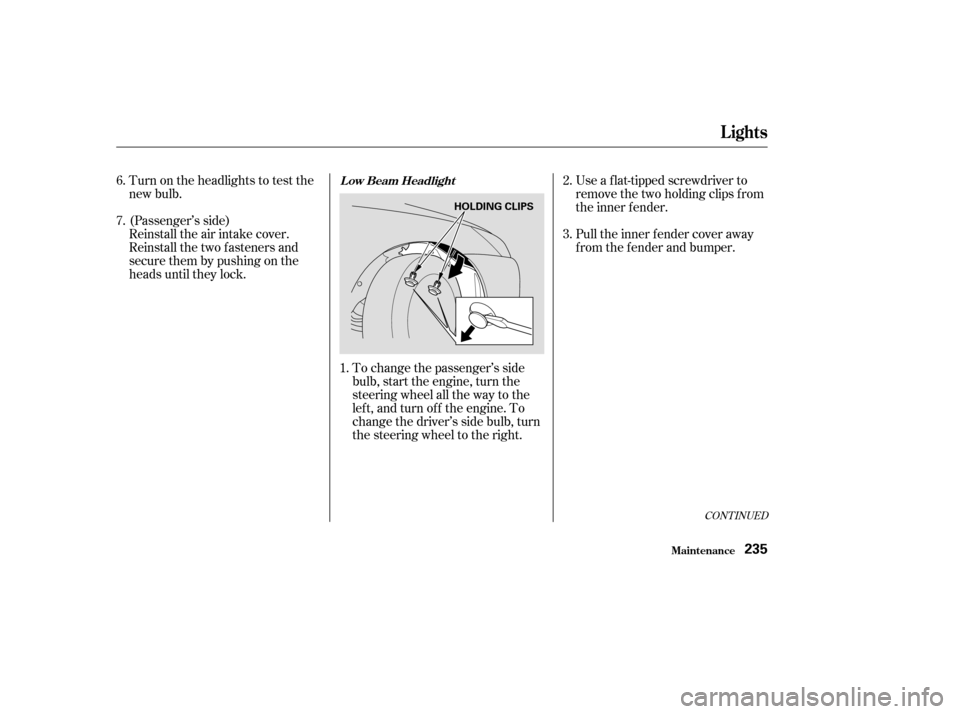
the steering wheel to the right.Use a f lat-tipped screwdriver to
remove the two holding clips f rom
the inner f ender.
Pull the inner f ender cover away
f rom the f ender and bumper.
3.
1. 2.
6. 7.
CONT INUED
Lights
Maint enance
L ow Beam Headlight
235
HOLDING CLIPS
�����—�����—�����y�
�������������y���
�(���%���
���y���������y
Page 236 of 313
To change the passenger’s side
bulb, start the engine, turn the
steering wheel all the way to the
lef t, and turn of f the engine. To
change the driver’s side bulb, turn
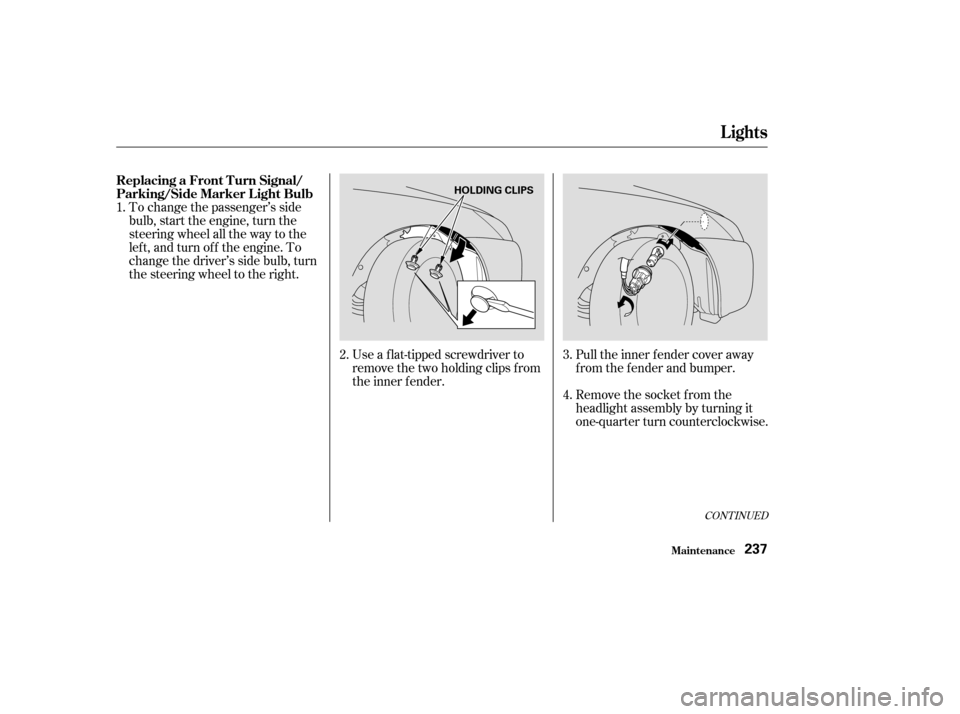
the steering wheel to the right.Use a f lat-tipped screwdriver to
remove the two holding clips f rom
the inner f ender.Pull the inner f ender cover away
f rom the f ender and bumper.
Remove the socket from the
headlight assembly by turning it
one-quarter turn counterclockwise.
1.
3.
2.
4.
CONT INUED
Lights
Maint enance
Replacing a Front T urn Signal/
Parking/Side Marker Light Bulb
237
HOLDING CLIPS
�����—�����—�����y�
�������������y���
�(���%���
���y���������y
Page 253 of 313

If you need to park your vehicle f or
an extended period (more than one
month), there are several things you
should do to prepare it f or storage.
Proper preparation helps prevent
deterioration and makes it easier to
get your vehicle back on the road. If
possible, store your vehicle indoors.Fill the f uel tank.
Change the engine oil and f ilter.
Wash and dry the exterior
completely.
Cleantheinterior.Makesurethe
carpeting, floor mats, etc. are
completely dry.
Leave the parking brake off. Put
the transmission in Reverse
(manual) or Park (automatic).
Block the rear wheels. If the vehicle is to be stored f or a
longer period, it should be
supported on jackstands so the
tires are of f the ground.
Leave one window open slightly (if
the vehicle is being stored
indoors).
Disconnect the battery.
Support the f ront wiper blade
arms with a f olded towel or rag so
they do not touch the windshield.
To minimize sticking, apply a
silicone spray lubricant to all door
and trunk seals. Also, apply a
vehiclebodywaxtothepainted
surfaces that mate with the door
and trunk seals.
Cover the vehicle with a
‘‘breathable’’ cover, one made
f rom a porous material such as
cotton. Non-porous materials, suchas plastic sheeting, trap moisture,
which can damage the paint.
If possible, periodically run the
engine until it reaches f ull
operating temperature (the
cooling f ans cycle on and of f
twice). Pref erably, do this once a
month.
If you store your vehicle f or 1 year or
longer, have your Honda dealer
perf orm the inspections as soon as
youtakeitoutof storage(seepages and ). The 6-cylinder model
needs the inspections called f or in
the 2 years/30,000 miles (48,000 km)
maintenance schedule (Normal
Conditions) and the 4-cylinder model
needs the inspections called f or in
the 2 years/40,000 miles (64,000 km)
maintenance schedule (Normal
Conditions). The replacements
called f or in the maintenance
schedule are not needed unless the
vehicle has actually reached that
time or mileage. 205 210
Vehicle Storage
Maint enance254
�����—�����—�����y�
�������������y���
�(���%���
���y���������y
Page 254 of 313

This section covers the more
common problems that motorists
experience with their vehicles. It
gives you inf ormation about how to
safely evaluate the problem and what
to do to correct it. If the problem has
stranded you on the side of the road,
you may be able to get going again.
If not, you will also f ind instructions
on getting your vehicle towed.......................
Compact Spare Tire . 256
....................
Changing a Flat Tire . 257
.............
If the Engine Won’t Start . 262
................................
Jump Starting . 264
..............
If the Engine Overheats . 266
.........
Low Oil Pressure Indicator . 268
..........
Charging System Indicator . 269
.......
Malf unction Indicator Lamp . 269
...............
Brake System Indicator . 271
......................
Emergency Towing . 272
..................
Closing the Moonroof . 274
..............................................
Fuses . 275
..............................
Fuse Locations . 278
Taking Care of the Unexpected
T aking Care of t he Unexpect ed255
�����—�����—�����y�
�������������y���
�(���%���
���y���������y