Page 54 of 468
Child Restraints
Older Children
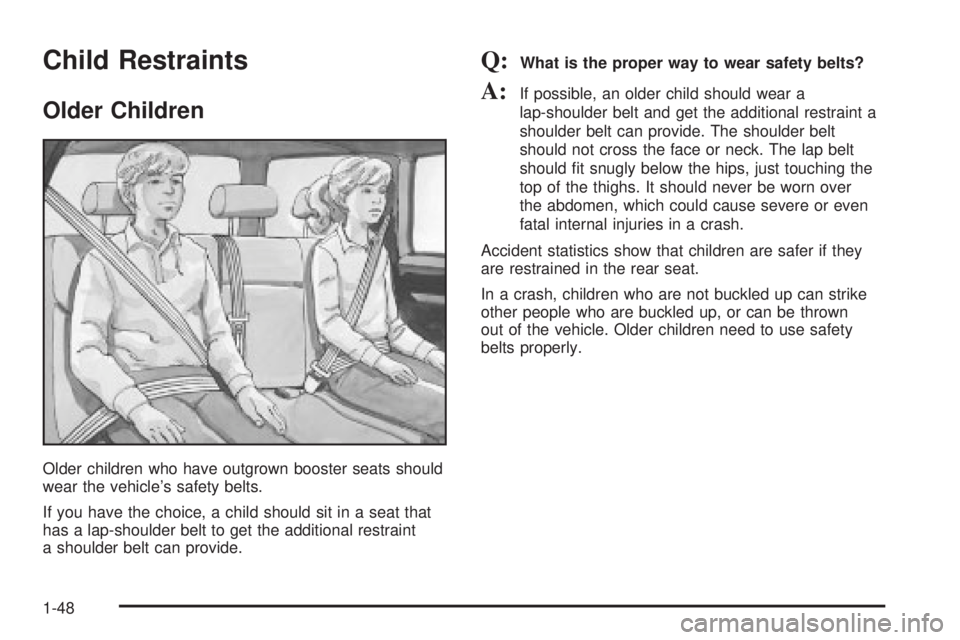
Older children who have outgrown booster seats should
wear the vehicle's safety belts.
If you have the choice, a child should sit in a seat that
has a lap-shoulder belt to get the additional restraint
a shoulder belt can provide.
Q:What is the proper way to wear safety belts?
A:If possible, an older child should wear a
lap-shoulder belt and get the additional restraint a
shoulder belt can provide. The shoulder belt
should not cross the face or neck. The lap belt
should ®t snugly below the hips, just touching the
top of the thighs. It should never be worn over
the abdomen, which could cause severe or even
fatal internal injuries in a crash.
Accident statistics show that children are safer if they
are restrained in the rear seat.
In a crash, children who are not buckled up can strike
other people who are buckled up, or can be thrown
out of the vehicle. Older children need to use safety
belts properly.
1-48
Page 61 of 468
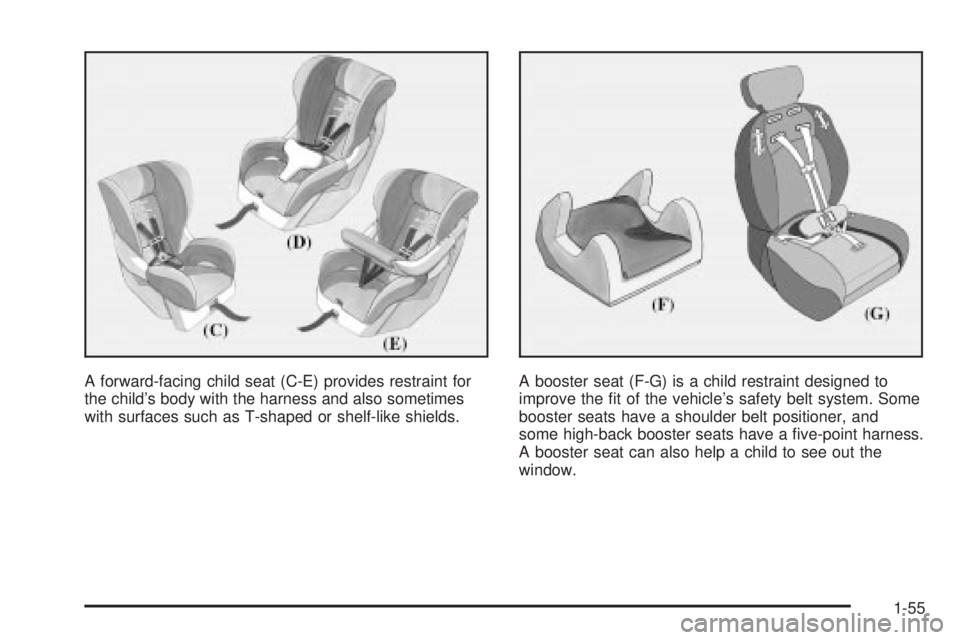
A forward-facing child seat (C-E) provides restraint for
the child's body with the harness and also sometimes
with surfaces such as T-shaped or shelf-like shields.A booster seat (F-G) is a child restraint designed to
improve the ®t of the vehicle's safety belt system. Some
booster seats have a shoulder belt positioner, and
some high-back booster seats have a ®ve-point harness.
A booster seat can also help a child to see out the
window.
1-55
Page 65 of 468
Top Strap Anchor Location
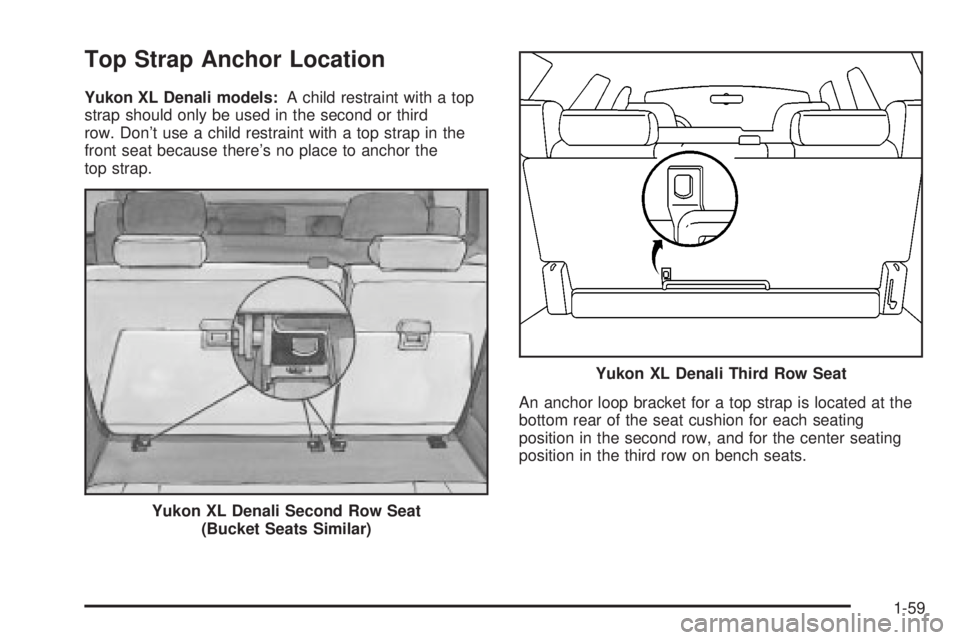
Yukon XL Denali models:A child restraint with a top
strap should only be used in the second or third
row. Don't use a child restraint with a top strap in the
front seat because there's no place to anchor the
top strap.
An anchor loop bracket for a top strap is located at the
bottom rear of the seat cushion for each seating
position in the second row, and for the center seating
position in the third row on bench seats.
Yukon XL Denali Second Row Seat
(Bucket Seats Similar)
Yukon XL Denali Third Row Seat
1-59
Page 66 of 468
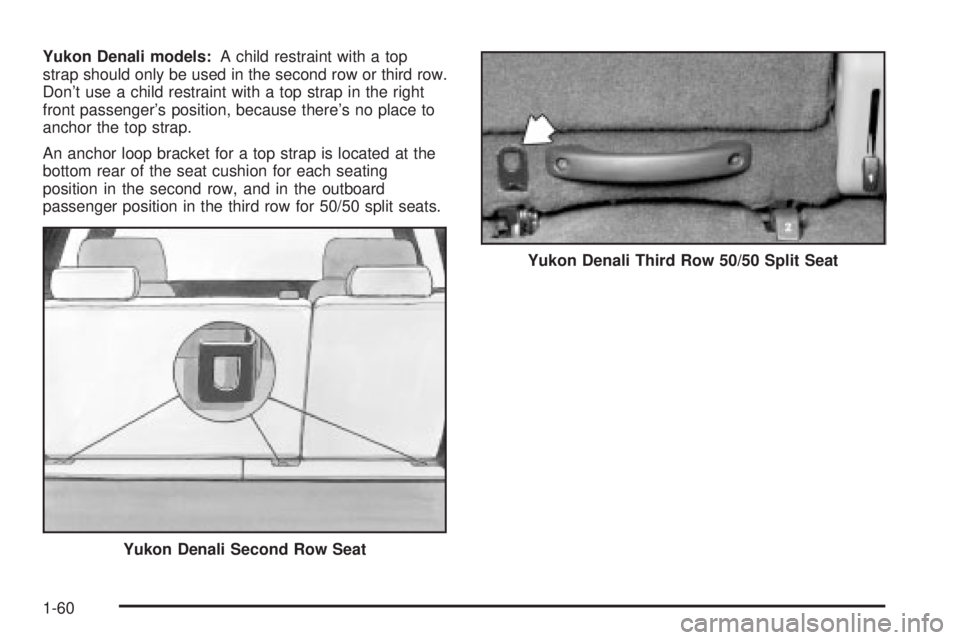
Yukon Denali models:A child restraint with a top
strap should only be used in the second row or third row.
Don't use a child restraint with a top strap in the right
front passenger's position, because there's no place to
anchor the top strap.
An anchor loop bracket for a top strap is located at the
bottom rear of the seat cushion for each seating
position in the second row, and in the outboard
passenger position in the third row for 50/50 split seats.
Yukon Denali Second Row Seat
Yukon Denali Third Row 50/50 Split Seat
1-60
Page 67 of 468
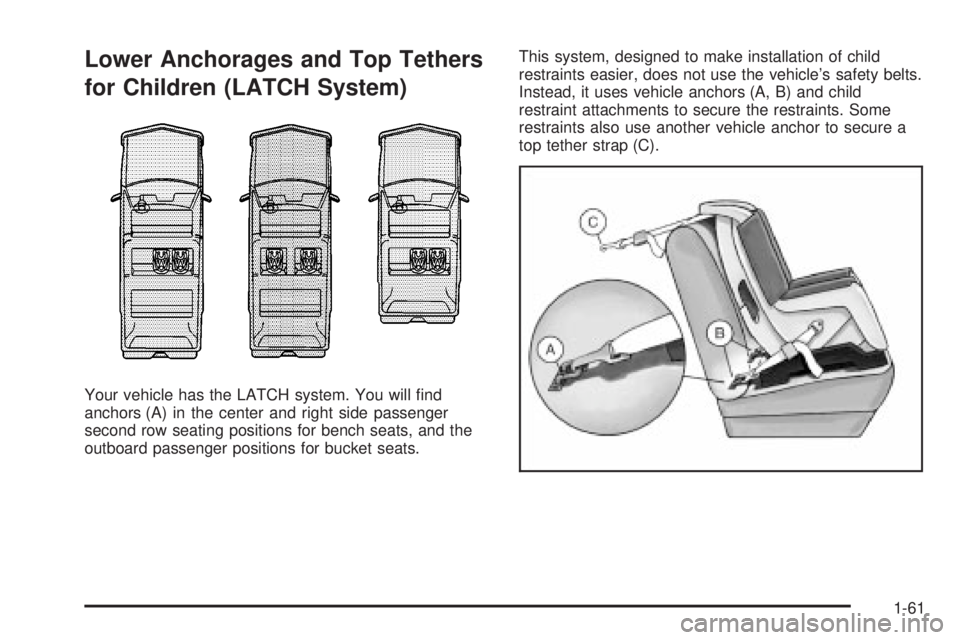
Lower Anchorages and Top Tethers
for Children (LATCH System)
Your vehicle has the LATCH system. You will ®nd
anchors (A) in the center and right side passenger
second row seating positions for bench seats, and the
outboard passenger positions for bucket seats.This system, designed to make installation of child
restraints easier, does not use the vehicle's safety belts.
Instead, it uses vehicle anchors (A, B) and child
restraint attachments to secure the restraints. Some
restraints also use another vehicle anchor to secure a
top tether strap (C).
1-61
Page 75 of 468
{CAUTION:
A child in a rear-facing child restraint can be
seriously injured or killed if the right front
passenger's air bag in¯ates. This is because
the back of the rear-facing child restraint
would be very close to the in¯ating air bag.
Even though the passenger sensing system is
designed to turn off the passenger's frontal air
bag if the system detects a rear-facing child
restraint, no system is fail-safe, and no one
can guarantee that an air bag will not deploy
under some unusual circumstance, even
though it is turned off. General Motors
recommends that rear-facing child restraints
be secured in the rear seat, even if the air bag
is off.
If you need to secure a forward-facing child restraint in
the right front seat position, move the seat as far
back as it will go before securing the forward-facing
child restraint. See
Power Seats on page 1-3.
If your child restraint is equipped with the LATCH
system, see
Lower Anchorages and Top Tethers for
Children (LATCH System) on page 1-61.You will be using the lap-shoulder belt to secure the
child restraint in this position. See
Top Strap on
page 1-57if your child restraint has one. Be sure to
follow the instructions that came with the child restraint.
Secure the child in the child restraint when and as
the instructions say.
1. Your vehicle has a right front passenger's frontal air
bag. See
Passenger Sensing System on page 1-81.
General Motors recommends that rear-facing
child restraints be secured in a rear seat, even if
the air bag is off. If your child restraint is
forward-facing, move the seat as far back as it will
go before securing the child restraint in this
seat. See
Power Seats on page 1-3.
When the passenger sensing system has turned off
the right front passenger's frontal air bag, the off
indicator in the passenger air bag status indicator
should light and stay lit when you turn the ignition to
RUN or START. See
Passenger Air Bag Status
Indicator on page 3-34.
2. Put the child restraint on the seat.
3. Pick up the latch plate, and run the lap and shoulder
portions of the vehicle's safety belt through or
around the restraint. The child restraint instructions
will show you how.
1-69
Page 83 of 468

When Should an Air Bag In¯ate?
Frontal Air Bags
The driver's and right front passenger's frontal air bags
are designed to in¯ate in moderate to severe frontal
or near-frontal crashes. But they are designed to in¯ate
only if the impact speed is above the system's
designed ªthreshold level.º
In addition, your vehicle has ªdual stageº frontal air
bags, which adjust the amount of restraint according to
crash severity. For moderate frontal impacts, these
air bags in¯ate at a level less than full deployment. For
more severe frontal impacts, full deployment occurs.
If the front of your vehicle goes straight into a wall that
doesn't move or deform, the threshold level for the
reduced deployment is about 10 to 16 mph
(16 to 25 km/h), and the threshold level for a full
deployment is about 20 to 25 mph (32 to 40 km/h).
The threshold level can vary, however, with speci®c
vehicle design, so that it can be somewhat above
or below this range.
If your vehicle strikes something that will move or
deform, such as a parked car, the threshold level will be
higher. The driver's and right front passenger's frontal
air bags are not designed to in¯ate in rollovers, rear
impacts, or in many side impacts because in¯ation
would not help the occupant.
Seat Position Sensors
Vehicles with dual stage air bags are also equipped with
special sensors which enable the sensing system to
monitor the position of both the driver and passenger
front seats. The seat position sensor provides
information which is used to determine if the air bags
should deploy at a reduced level or at full depoyment.
Side Impact Air Bags
Your vehicle may or may not have a side impact air
bag. SeeAir Bag Systems on page 1-72. Side impact air
bags are designed to in¯ate in moderate to severe
side crashes. A side impact air bag will in¯ate if
the crash severity is above the system's designed
ªthreshold level.º The threshold level can vary with
speci®c vehicle design. Side impact air bags are
not designed to in¯ate in frontal or near-frontal impacts,
rollovers or rear impacts, because in¯ation would not
help the occupant. A side impact air bag will only deploy
on the side of the vehicle that is struck.
Air Bag Systems
In any particular crash, no one can say whether an air
bag should have in¯ated simply because of the damage
to a vehicle or because of what the repair costs were.
For frontal air bags, in¯ation is determined by the angle
of the impact and how quickly the vehicle slows down
1-77
Page 92 of 468
Q:Because I have a disability, I have to get my
vehicle modi®ed. How can I ®nd out whether
this will affect my advanced air bag system?
A:Changing or moving any parts of the front seats,
safety belts, the air bag sensing and diagnostic
module (located under the driver's seat), or
the inside rearview mirror can affect the operation
of the advanced air bag system. If you have
questions, call Customer Assistance. The phone
numbers and addresses for Customer Assistance
are in Step Two of the Customer Satisfaction
Procedure in this manual. See
Customer
Satisfaction Procedure on page 7-2
.
Restraint System Check
Checking Your Restraint Systems
Now and then, make sure the safety belt reminder light
and all your belts, buckles, latch plates, retractors
and anchorages are working properly. Look for any other
loose or damaged safety belt system parts. If you see
anything that might keep a safety belt system from doing
its job, have it repaired.
Torn or frayed safety belts may not protect you in a
crash. They can rip apart under impact forces. If a belt
is torn or frayed, get a new one right away.
Also look for any opened or broken air bag covers, and
have them repaired or replaced. (The air bag system
does not need regular maintenance.)
1-86