2004 GMC SIERRA towing
[x] Cancel search: towingPage 438 of 588
If No Steam Is Coming From Your
Engine
An overheat warning, along with a low coolant condition,
can indicate a serious problem. For more information,
see
Driver Information Center (DIC) on page 3-55.
If you get an engine overheat warning and don't have a
low coolant condition, but see or hear no steam, the
problem may not be too serious. Sometimes the engine
can get a little too hot when you:
·Climb a long hill on a hot day.
·Stop after high speed driving.
·Idle for long periods in traffic.
·Tow a trailer. See ªDriving on Gradesº under
Towing a Trailer on page 4-70.
If you get the overheat warning with no sign of steam,
try this for a minute or so:
1. If you have an air conditioner and it's on, turn it off.
2. Turn on your heater to full hot at the highest fan
speed and open the window as necessary.
3. If you're in a traffic jam, shift to NEUTRAL (N);
otherwise, shift to the highest gear while
driving ± AUTOMATIC OVERDRIVE
Xor
DRIVE (D) for automatic transmissions.If you no longer have the overheat warning, you can
drive. Just to be safe, drive slower for about 10 minutes.
If the warning doesn't come back on, you can drive
normally.
If the warning continues, pull over, stop, and park your
vehicle right away.
If there's still no sign of steam, push down the
accelerator until the engine speed is about twice as fast
as normal idle speed for at least three minutes while
you're parked. If you still have the warning,
turn off the
engine and get everyone out of the vehicleuntil it
cools down. Also, see ªOverheated Engine Protection
Operating Modeº listed previously in this section.
You may decide not to lift the hood but to get service
help right away.
5-38
Page 444 of 588
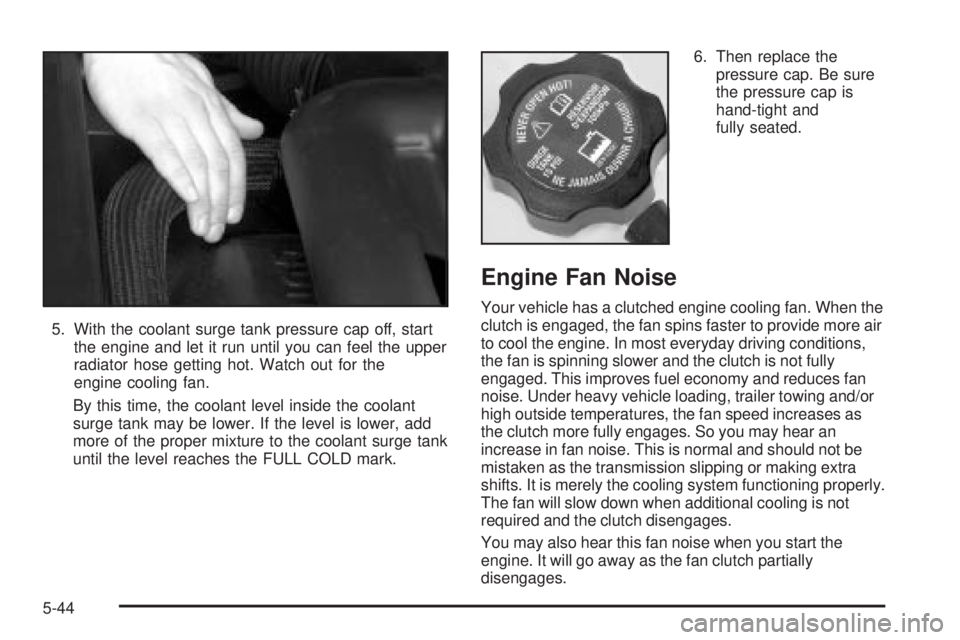
5. With the coolant surge tank pressure cap off, start
the engine and let it run until you can feel the upper
radiator hose getting hot. Watch out for the
engine cooling fan.
By this time, the coolant level inside the coolant
surge tank may be lower. If the level is lower, add
more of the proper mixture to the coolant surge tank
until the level reaches the FULL COLD mark.6. Then replace the
pressure cap. Be sure
the pressure cap is
hand-tight and
fully seated.
Engine Fan Noise
Your vehicle has a clutched engine cooling fan. When the
clutch is engaged, the fan spins faster to provide more air
to cool the engine. In most everyday driving conditions,
the fan is spinning slower and the clutch is not fully
engaged. This improves fuel economy and reduces fan
noise. Under heavy vehicle loading, trailer towing and/or
high outside temperatures, the fan speed increases as
the clutch more fully engages. So you may hear an
increase in fan noise. This is normal and should not be
mistaken as the transmission slipping or making extra
shifts. It is merely the cooling system functioning properly.
The fan will slow down when additional cooling is not
required and the clutch disengages.
You may also hear this fan noise when you start the
engine. It will go away as the fan clutch partially
disengages.
5-44
Page 545 of 588

(b)Visually inspect front and rear suspension and
steering system for damaged, loose or missing parts,
signs of wear or lack of lubrication. Inspect power
steering lines and hoses for proper hook-up, binding,
leaks, cracks, cha®ng, etc. Visually check constant
velocity joints, rubber boots and axle seals for leaks.
(c)Visually inspect hoses and have them replaced if they
are cracked, swollen or deteriorated. Inspect all pipes,
®ttings and clamps; replace with genuine GM parts as
needed. To help ensure proper operation, a pressure test
of the cooling system and pressure cap and cleaning the
outside of the radiator and air conditioning condenser is
recommended at least once a year.
(d)Visually inspect wiper blades for wear or cracking.
Replace blade inserts that appear worn or damaged
or that streak or miss areas of the windshield.
(e)Make sure the safety belt reminder light and all your
belts, buckles, latch plates, retractors and anchorages
are working properly. Look for any other loose or
damaged safety belt system parts. If you see anything
that might keep a safety belt system from doing its
job, have it repaired. Have any torn or frayed safety belts
replaced. Also look for any opened or broken air bag
coverings, and have them repaired or replaced. (The air
bag system does not need regular maintenance.)
(f)Lubricate all key lock cylinders, body door hinges,
hood latch assembly, secondary latch, pivots, spring
anchor, release pawl, tailgate hinges, tailgatelinkage,
tailgate handle pivot points, latch bolt, fuel door
hinge, locks and folding seat hardware. More frequent
lubrication may be required when exposed to a corrosive
environment. Applying silicone grease on weatherstrips
with a clean cloth will make them last longer, seal
better and not stick or squeak.
(g)Add ¯uid as needed. A ¯uid loss could indicate a
problem; repair as needed. Check vent hose at transfer
case for kinks and proper installation.
(h)Change automatic transmission ¯uid and ®lter if the
vehicle GVWR is over 8600 lbs. or if the vehicle is
mainly driven under one or more of these conditions:
þIn heavy city traffic where the outside temperature
regularly reaches 90ÉF (32ÉC) or higher.
þIn hilly or mountainous terrain.
þWhen doing frequent trailer towing.
þUses such as found in taxi, police or delivery
service.
(i)Drain, ¯ush and re®ll cooling system. See Engine
Coolant on page 5-33for what to use. Inspect hoses.
Clean radiator, condenser, pressure cap and ®ller neck.
Pressure test the cooling system and pressure cap.
6-9
Page 546 of 588
(j)A ¯uid loss in any vehicle system could indicate a
problem. Have the system inspected and repaired and
the ¯uid level checked. Add ¯uid if needed.
(k)Inspect system. Check all fuel and vapor lines and
hoses for proper hook-up, routing and condition.
Check that the purge valve works properly (if equipped).
Replace as needed.
(l)Change ®lter only at the ®rst maintenance service
performed on the vehicle.
(m)Change automatic transmission ¯uid and ®lter if the
vehicle is mainly driven under one or more of these
conditions:
þIn heavy city traffic where the outside temperature
regularly reaches 90ÉF (32ÉC) or higher.
þIn hilly or mountainous terrain.
þWhen doing frequent trailer towing.
þUses such as found in taxi, police or delivery
service.
(n)Change clutch ¯uid (or every 24 months, whichever
occurs ®rst).
Owner Checks and Services
These owner checks and services should be performed
at the intervals speci®ed to help ensure the safety,
dependability and emission control performance of your
vehicle. Your GM Goodwrench dealer can assist you
with these checks and services.
Be sure any necessary repairs are completed at once.
Whenever any ¯uids or lubricants are added to your
vehicle, make sure they are the proper ones, as shown
in
Recommended Fluids and Lubricants on page 6-14.
6-10
Page 575 of 588
D
Daytime Running Lamps..................................3-16
Defensive Driving............................................. 4-2
Defogging and Defrosting.........................3-24, 3-31
Delayed Locking.............................................2-10
Dinghy Towing................................................4-54
Doing Your Own Service Work........................... 5-3
Dolly Towing..................................................4-56
Dome Lamps.................................................3-20
Door
Delayed Locking..........................................2-10
Locks.......................................................... 2-8
Power Door Locks......................................... 2-9
Programmable Automatic Door Locks.............2-10
Rear Door Security Locks.............................2-12
Rear Doors.................................................2-13
Driver
Position, Safety Belt.....................................1-16
DRIVER DOOR AJAR.....................................3-68
Driver Information Center (DIC).........................3-55
DIC Operation and Displays..........................3-55
DIC Warnings and Messages........................3-66
Driving
At Night.....................................................4-37
City...........................................................4-42
Defensive..................................................... 4-2
Drunken....................................................... 4-2
Freeway.....................................................4-43
Hill and Mountain Roads..............................4-45Driving (cont.)
In Rain and on Wet Roads...........................4-39
Winter........................................................4-47
Driving Across an Incline..................................4-32
Driving Downhill..............................................4-31
Driving in Mud, Sand, Snow or Ice....................4-35
Driving in Water..............................................4-36
Driving On Grades..........................................4-93
Driving on Off-Road Hills.................................4-26
Driving on Snow or Ice....................................4-47
Driving Through Deep Standing Water...............4-40
Driving Through Flowing Water.........................4-41
Driving Uphill..................................................4-28
Driving with a Trailer.......................................4-91
Dual Automatic Climate Control System.............3-26
Dual Climate Control System............................3-22
Dual Stage Air Bags........................................1-74
Dual Tire Operation.........................................5-85
DVD
Cleaning the Video Screen..........................3-131
Distortion..................................................3-129
Rear Seat Entertainment System..................3-115
DVD Player..................................................3-116
E
Easy Exit Seat...............................................2-70
Electrical System
Add-On Equipment.....................................5-125
5
Page 580 of 588
M
Maintenance Schedule
Additional Required Services........................... 6-6
At Each Fuel Fill.........................................6-11
At Least Once a Month................................6-11
At Least Once a Year..................................6-12
At the First 100, 1,000 and 6,000 Miles
(160, 1 600 and 10 000km).......................6-11
Introduction.................................................. 6-2
Maintenance Footnotes.................................. 6-8
Maintenance Record....................................6-19
Maintenance Requirements............................. 6-2
Normal Maintenance Replacement Parts.........6-17
Owner Checks and Services.........................6-10
Recommended Fluids and Lubricants.............6-14
Scheduled Maintenance................................. 6-4
Using Your................................................... 6-3
Your Vehicle and the Environment................... 6-2
Maintenance When Trailer Towing.....................4-95
Making Turns.................................................4-92
Malfunction Indicator Light................................3-49
Manual Seats................................................... 1-3
Manual Selectable Ride...................................4-11
Manual Transfer Case.....................................2-36
Manual Transmission.......................................2-24
Fluid..........................................................5-31
Operation...................................................2-30Manual Transmission (cont.)
Manual Windows............................................2-16
Matching Transmitter(s) to Your Vehicle............... 2-6
Memory Seat.................................................2-69
Message
DIC Warnings and Messages........................3-66
Mexico, Central America and Caribbean Islands/
Countries (Except Puerto Rico and U.S. Virgin
Islands)....................................................... 7-5
Mirrors
Automatic Dimming Rearview with Compass
and Temperature Display...........................2-57
Automatic Dimming Rearview with OnStar
ž,
Compass and Temperature Display.............2-55
Manual Rearview Mirror................................2-54
Outside Automatic Dimming Mirror.................2-63
Outside Camper-Type Mirrors........................2-60
Outside Convex Mirror.................................2-64
Outside Curb View Assist Mirrors...................2-63
Outside Heated Mirrors................................2-64
Outside Manual Mirrors................................2-60
Outside Power Camper-Type.........................2-62
Outside Power Foldaway Mirrors....................2-62
Outside Power Mirrors..................................2-61
Outside West Coast-Type Mirrors...................2-61
Model Reference................................................ vi
MyGMLink.com................................................ 7-3
10
Page 583 of 588

Rear Seat Entertainment System.....................3-115
Rear Seat Operation......................................... 1-9
Rear Seat Outside Passenger Positions
(Extended Cab and Crew Cab)......................1-27
Rear Seat Passengers, Safety Belts..................1-27
Rear Seat Top Strap Anchors (Extended Cab
Models)......................................................1-46
Rear Seat Top Strap Anchors
(Crew Cab Models)......................................1-47
Rear Window Defogger............................3-24, 3-32
Rearview Mirror, Automatic Dimming with
Compass and Temperature Display................2-57
Rearview Mirror, Automatic Dimming with
OnStar
ž, Compass and Temperature Display . . . 2-55
Rearview Mirrors.............................................2-54
Reclining Seatbacks.......................................... 1-6
Recommended Fluids and Lubricants.................6-14
Recreational Vehicle Towing.............................4-54
REDUCED ENGINE POWER...........................3-70
Regular Cab and Extended Cab Models.............1-76
Remote Alarm.................................................. 2-6
Remote Control.............................................3-119
Remote Keyless Entry System............................ 2-4
Remote Keyless Entry System, Operation............ 2-5
Removing the Flat Tire and Installing the
Spare Tire................................................5-101
Removing the Spare Tire and Tools...................5-97
Replacement Bulbs.........................................5-74
Replacing Brake System Parts..........................5-52
Replacing Restraint System Parts After a Crash.....1-88Reporting Safety Defects
Canadian Government..................................7-11
General Motors...........................................7-11
United States Government............................7-11
Restraint System Check
Checking Your Restraint Systems...................1-87
Replacing Restraint System Parts After a
Crash.....................................................1-88
Restraint Systems
Checking....................................................1-87
Replacing Parts...........................................1-88
Resynchronization............................................. 2-7
Retained Accessory Power (RAP)......................2-23
Right Front Passenger Position, Safety Belts......1-25
Right Front Passenger Position Top Strap Anchor
(Regular and Extended Models).....................1-45
RIGHT REAR DOOR AJAR (Crew Cab).............3-70
Roadside
Assistance Program....................................... 7-6
Rocking Your Vehicle To Get It Out...................4-52
Running Your Engine While You Are Parked.......2-53
S
Safety Belt
Reminder Light............................................3-36
Safety Belts
Care of....................................................5-119
Center Passenger Position............................1-25
13
Page 586 of 588
Tires (cont.)
Wheel Alignment and Tire Balance.................5-91
Wheel Replacement.....................................5-92
When It Is Time for New Tires......................5-88
To Use the Engine Coolant Heater....................2-25
Tonneau Cover...............................................2-67
Top Strap......................................................1-43
Top Strap Anchor Location...............................1-45
Torque Lock (Automatic Transmission)...............2-51
Total Weight on Your Vehicle's Tires..................4-88
Tow/Haul Mode Light.......................................3-53
Tow/Haul Mode, Overdrive Disable....................3-53
Tow/Haul Mode
(Automatic Transmission)..............................2-29
Towing
Power Take-Off (PTO)................................4-101
Recreational Vehicle.....................................4-54
Towing a Trailer..........................................4-70
Your Vehicle...............................................4-53
Traction
Assist System (TAS)...................................... 4-9
Manual Selectable Ride................................4-11
Off Light.....................................................3-45
TRACTION ACTIVE........................................3-72
Trailer
Recommendations.......................................4-70
Trailer Brakes.................................................4-91
Trailer Wiring Harness.....................................4-95
TRANS HOT IDLE ENGINE
(Allison Transmission
žOnly)..........................3-73Transfer Case................................................5-60
Transmission
Fluid, Automatic..................................5-25, 5-28
Fluid, Manual..............................................5-31
Temperature Gage.......................................3-47
Up-Shift Light..............................................3-43
TRANSMISSION HOT.....................................3-72
Transmission Operation, Automatic....................2-26
Transmission Operation, Manual........................2-30
Transmission, Transaxle, Transfer Case Unit
Repair Manual............................................7-12
Transportation Options...................................... 7-8
Traveling to Remote Areas...............................4-24
Trip Information Button....................................3-56
Trip Odometer................................................3-35
Truck-Camper Loading Information....................4-68
Turn and Lane Change Signals.......................... 3-8
TURN SIGNAL ON.........................................3-73
Turn Signal/Multifunction Lever........................... 3-7
Turn Signals When Towing a Trailer..................4-93
Two-Tiered Loading.........................................4-63
U
Underhood Fuse Block...................................5-129
Understanding Radio Reception.......................3-129
Uniform Tire Quality Grading............................5-90
United States................................................... 7-4
Up-Shift Light.................................................3-43
16