2004 GMC SIERRA coolant temperature
[x] Cancel search: coolant temperaturePage 389 of 588

Turn Signals When Towing a Trailer
The arrows on your instrument panel will ¯ash whenever
you signal a turn or lane change. Properly hooked up,
the trailer lamps will also ¯ash, telling other drivers
you're about to turn, change lanes or stop.
When towing a trailer, the arrows on your instrument
panel will ¯ash for turns even if the bulbs on the trailer
are burned out. Thus, you may think drivers behind
you are seeing your signal when they are not. It's
important to check occasionally to be sure the trailer
bulbs are still working.
Driving On Grades
Reduce speed and shift to a lower gearbeforeyou start
down a long or steep downgrade. If you don't shift
down, you might have to use your brakes so much that
they would get hot and no longer work well.
If you have an automatic transmission, you can tow in
DRIVE (D). You may want to shift the transmission
to lower gear selection if the transmission shifts too often
(e.g., under heavy loads and/or hilly conditions).
You may also want to activate the tow/haul mode if the
transmission shifts too often. See
Tow/Haul Mode
Light on page 3-53.If you have a 5-speed manual transmission and you are
towing a trailer, it's better not to use FIFTH (5) gear.
Just drive in FOURTH (4) gear (or, as you need
to, a lower gear).
If you have a 6-speed manual transmission and you are
towing a trailer, it's better not to use SIXTH (6) gear.
Drive in FIFTH (5) gear (or, as you need to, a lower gear).
When towing at high altitude on steep uphill grades,
consider the following: Engine coolant will boil at a lower
temperature than at normal altitudes. If you turn your
engine off immediately after towing at high altitude
on steep uphill grades, your vehicle may show signs
similar to engine overheating. To avoid this, let the
engine run while parked, preferably on level ground, with
the automatic transmission in PARK (P) for a few
minutes before turning the engine off. For manual
transmissions, let the engine run while parked,
preferably on level ground, with the transmission out of
gear and the parking brake applied, for a few minutes
before turning the engine off. If you do get the overheat
warning, see
Engine Overheating on page 5-36.
4-93
Page 433 of 588

How to Check and Add Fluid
The proper ¯uid should be added if the level does not
reach the bottom of the diaphragm when it's in place in
the reservoir. See the instructions on the reservoir cap.
Engine Coolant
The cooling system in your vehicle is ®lled with
DEX-COOLžengine coolant. This coolant is designed
to remain in your vehicle for 5 years or 150,000 miles
(240 000 km), whichever occurs ®rst, if you add only
DEX-COOL
žextended life coolant.
The following explains your cooling system and how to
add coolant when it is low. If you have a problem
with engine overheating, see
Engine Overheating on
page 5-36.A 50/50 mixture of clean, drinkable water and
DEX-COOL
žcoolant will:
·Give freezing protection down to-34ÉF (-37ÉC).
·Give boiling protection up to 265ÉF (129ÉC).
·Protect against rust and corrosion.
·Help keep the proper engine temperature.
·Let the warning lights and gages work as they
should.
Notice:Using coolant other than DEX-COOLžmay
cause premature engine, heater core or radiator
corrosion. In addition, the engine coolant may
require changing sooner, at 30,000 miles (50 000 km)
or 24 months, whichever occurs ®rst. Any repairs
would not be covered by your warranty. Always use
DEX-COOL
ž(silicate-free) coolant in your vehicle.
5-33
Page 436 of 588
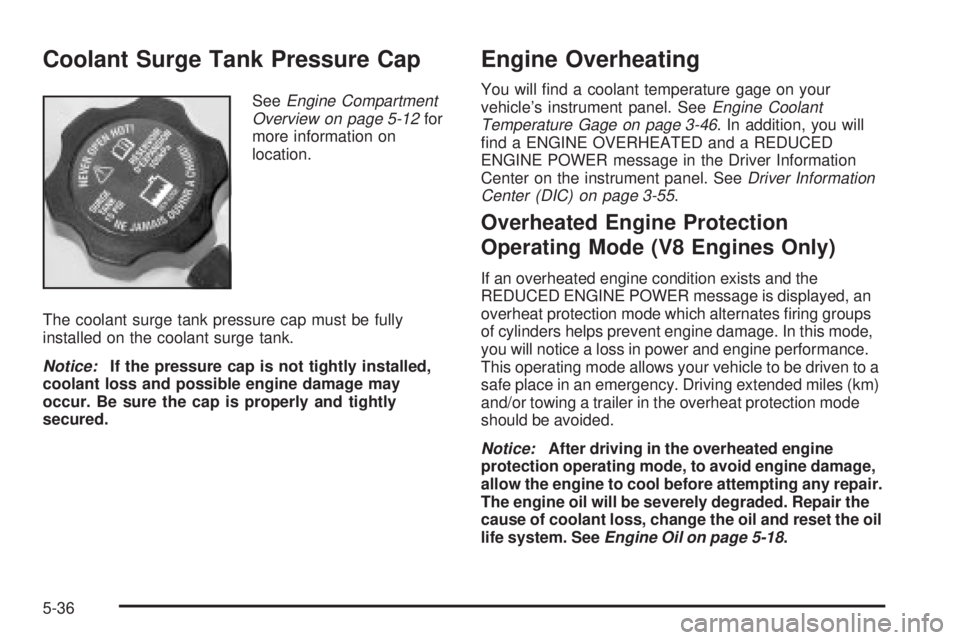
Coolant Surge Tank Pressure Cap
SeeEngine Compartment
Overview on page 5-12for
more information on
location.
The coolant surge tank pressure cap must be fully
installed on the coolant surge tank.
Notice:If the pressure cap is not tightly installed,
coolant loss and possible engine damage may
occur. Be sure the cap is properly and tightly
secured.
Engine Overheating
You will ®nd a coolant temperature gage on your
vehicle's instrument panel. SeeEngine Coolant
Temperature Gage on page 3-46. In addition, you will
®nd a ENGINE OVERHEATED and a REDUCED
ENGINE POWER message in the Driver Information
Center on the instrument panel. See
Driver Information
Center (DIC) on page 3-55.
Overheated Engine Protection
Operating Mode (V8 Engines Only)
If an overheated engine condition exists and the
REDUCED ENGINE POWER message is displayed, an
overheat protection mode which alternates ®ring groups
of cylinders helps prevent engine damage. In this mode,
you will notice a loss in power and engine performance.
This operating mode allows your vehicle to be driven to a
safe place in an emergency. Driving extended miles (km)
and/or towing a trailer in the overheat protection mode
should be avoided.
Notice:After driving in the overheated engine
protection operating mode, to avoid engine damage,
allow the engine to cool before attempting any repair.
The engine oil will be severely degraded. Repair the
cause of coolant loss, change the oil and reset the oil
life system. See
Engine Oil on page 5-18.
5-36
Page 444 of 588
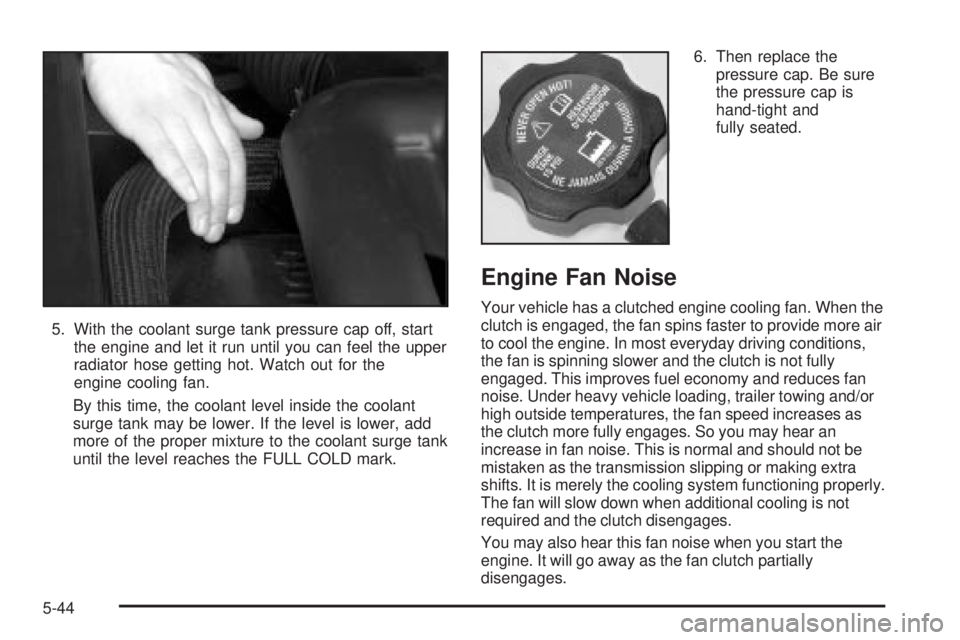
5. With the coolant surge tank pressure cap off, start
the engine and let it run until you can feel the upper
radiator hose getting hot. Watch out for the
engine cooling fan.
By this time, the coolant level inside the coolant
surge tank may be lower. If the level is lower, add
more of the proper mixture to the coolant surge tank
until the level reaches the FULL COLD mark.6. Then replace the
pressure cap. Be sure
the pressure cap is
hand-tight and
fully seated.
Engine Fan Noise
Your vehicle has a clutched engine cooling fan. When the
clutch is engaged, the fan spins faster to provide more air
to cool the engine. In most everyday driving conditions,
the fan is spinning slower and the clutch is not fully
engaged. This improves fuel economy and reduces fan
noise. Under heavy vehicle loading, trailer towing and/or
high outside temperatures, the fan speed increases as
the clutch more fully engages. So you may hear an
increase in fan noise. This is normal and should not be
mistaken as the transmission slipping or making extra
shifts. It is merely the cooling system functioning properly.
The fan will slow down when additional cooling is not
required and the clutch disengages.
You may also hear this fan noise when you start the
engine. It will go away as the fan clutch partially
disengages.
5-44
Page 545 of 588

(b)Visually inspect front and rear suspension and
steering system for damaged, loose or missing parts,
signs of wear or lack of lubrication. Inspect power
steering lines and hoses for proper hook-up, binding,
leaks, cracks, cha®ng, etc. Visually check constant
velocity joints, rubber boots and axle seals for leaks.
(c)Visually inspect hoses and have them replaced if they
are cracked, swollen or deteriorated. Inspect all pipes,
®ttings and clamps; replace with genuine GM parts as
needed. To help ensure proper operation, a pressure test
of the cooling system and pressure cap and cleaning the
outside of the radiator and air conditioning condenser is
recommended at least once a year.
(d)Visually inspect wiper blades for wear or cracking.
Replace blade inserts that appear worn or damaged
or that streak or miss areas of the windshield.
(e)Make sure the safety belt reminder light and all your
belts, buckles, latch plates, retractors and anchorages
are working properly. Look for any other loose or
damaged safety belt system parts. If you see anything
that might keep a safety belt system from doing its
job, have it repaired. Have any torn or frayed safety belts
replaced. Also look for any opened or broken air bag
coverings, and have them repaired or replaced. (The air
bag system does not need regular maintenance.)
(f)Lubricate all key lock cylinders, body door hinges,
hood latch assembly, secondary latch, pivots, spring
anchor, release pawl, tailgate hinges, tailgatelinkage,
tailgate handle pivot points, latch bolt, fuel door
hinge, locks and folding seat hardware. More frequent
lubrication may be required when exposed to a corrosive
environment. Applying silicone grease on weatherstrips
with a clean cloth will make them last longer, seal
better and not stick or squeak.
(g)Add ¯uid as needed. A ¯uid loss could indicate a
problem; repair as needed. Check vent hose at transfer
case for kinks and proper installation.
(h)Change automatic transmission ¯uid and ®lter if the
vehicle GVWR is over 8600 lbs. or if the vehicle is
mainly driven under one or more of these conditions:
þIn heavy city traffic where the outside temperature
regularly reaches 90ÉF (32ÉC) or higher.
þIn hilly or mountainous terrain.
þWhen doing frequent trailer towing.
þUses such as found in taxi, police or delivery
service.
(i)Drain, ¯ush and re®ll cooling system. See Engine
Coolant on page 5-33for what to use. Inspect hoses.
Clean radiator, condenser, pressure cap and ®ller neck.
Pressure test the cooling system and pressure cap.
6-9
Page 574 of 588
Child Restraints (cont.)
Top Strap Anchor Location............................1-45
Where to Put the Restraint...........................1-42
Chime Level Adjustment.................................3-131
Cigarette Lighter.............................................3-21
Cleaning
Inside of Your Vehicle.................................5-117
Outside of Your Vehicle..............................5-120
Underbody Maintenance.............................5-123
Video Screen............................................3-131
Weatherstrips............................................5-119
Cleaning Aluminum or Chrome-Plated Wheels . . . 5-122
Cleaning Exterior Lamps/Lenses......................5-120
Cleaning Fabric/Carpet...................................5-117
Cleaning Glass Surfaces................................5-119
Cleaning Interior Plastic Components...............5-119
Cleaning Leather...........................................5-118
Cleaning the Mirror.................................2-57, 2-60
Cleaning the Top of the Instrument Panel.........5-119
Cleaning the Windshield and Wiper Blades.......5-121
Cleaning Tires..............................................5-122
Cleaning Vinyl..............................................5-118
Climate Control System...................................3-21
Dual..........................................................3-22
Dual Automatic............................................3-26
Clutch, Hydraulic.............................................5-32
Compass Calibration...............................2-57, 2-58
Compass Operation.........................................2-58Compass Variance..................................2-56, 2-59
Content Theft-Deferrent....................................2-19
Control of a Vehicle.......................................... 4-5
Coolant
Engine Temperature Gage............................3-46
Heater, Engine............................................2-25
Surge Tank Pressure Cap.............................5-36
Cooling System..............................................5-39
Crew Cab......................................................1-58
Cruise Control................................................3-11
Cruise Control Light........................................3-53
Cupholder(s)..................................................2-66
Current and Past Model Order Forms................7-13
Customer Assistance Information
Courtesy Transportation.................................. 7-7
Customer Assistance for Text Telephone (TTY)
Users....................................................... 7-4
Customer Assistance Offices........................... 7-4
Customer Satisfaction Procedure..................... 7-2
GM Mobility Program for Persons with
Disabilities................................................ 7-5
Reporting Safety Defects to General Motors....7-11
Reporting Safety Defects to the Canadian
Government............................................7-11
Reporting Safety Defects to the United States
Government............................................7-11
Roadside Assistance Program......................... 7-6
Service Publications Ordering Information........7-12
4
Page 576 of 588

Electrical System (cont.)
Fuses and Circuit Breakers.........................5-126
Power Windows and Other Power Options....5-126
Windshield Wiper Fuses.............................5-126
Electronic Transfer Case..................................2-44
Emissions Inspection and Maintenance
Programs...................................................3-51
Engine
Air Cleaner/Filter.........................................5-23
Battery.......................................................5-52
Check and Service Engine Soon Light............3-49
Coolant......................................................5-33
Coolant Heater............................................2-25
Coolant Temperature Gage...........................3-46
Engine Compartment Overview......................5-12
Exhaust.....................................................2-53
Fan Noise..................................................5-44
Oil .............................................................5-18
Overheating................................................5-36
Starting......................................................2-23
ENGINE COOLANT HOT.................................3-68
Engine Hour Meter Display...............................3-35
Engine Oil Additives........................................5-21
ENGINE OVERHEATED..................................3-68
Entertainment System
Cleaning the Video Screen..........................3-131
DVD Distortion..........................................3-129
Entry Lighting.................................................3-19
Environmental Concerns..................................4-24
Event Data Records (EDR)..............................7-10Exit Lighting...................................................3-19
Express Down Windows..................................2-17
Extended Cab................................................1-58
Extended Cab and Crew Cab...........................1-55
Extender, Safety Belt.......................................1-32
Exterior Lamps...............................................3-14
F
Fifth Wheel and Gooseneck Trailering................4-90
Filter
Engine Air Cleaner......................................5-23
Finding a Program Type (PTY) Station
(RDS and XMŸ).......................3-80, 3-92, 3-105
Finding a Station..................3-75, 3-78, 3-90, 3-103
Finish Care..................................................5-120
Finish Damage.............................................5-122
Five-Speed (VORTECŸ 4300 V6 and
4800 V8 Engines)........................................2-31
Five-Speed (VORTECŸ 6000 V8 Engine)...........2-30
Fixed Mast Antenna.......................................3-131
Flash-to-Pass................................................... 3-9
Flat Tire........................................................5-95
Flat Tire, Changing.........................................5-96
Fluid
Automatic Transmission........................5-25, 5-28
Manual Transmission....................................5-31
Power Steering...........................................5-45
6
Page 577 of 588

Fluid (cont.)
Windshield Washer......................................5-46
FM Stereo....................................................3-129
Fog Lamps....................................................3-17
Folding the Rear Seat....................................... 1-9
Following Distance..........................................4-92
Four-Wheel Drive....................................2-35, 5-60
Four-Wheel-Drive Light....................................3-53
Front Axle......................................................5-61
Front Axle Locking Feature...............................2-35
Front Reading Lamps......................................3-19
Front Storage Area.........................................2-67
Fuel............................................................... 5-4
Additives...................................................... 5-6
California Fuel.............................................. 5-5
Filling a Portable Fuel Container..................... 5-9
Filling Your Tank........................................... 5-7
Fuels in Foreign Countries.............................. 5-6
Gage.........................................................3-54
Gasoline Octane........................................... 5-4
Gasoline Speci®cations.................................. 5-5
Low Warning Light.......................................3-54
Fuel Information Button....................................3-58
FUEL LEVEL LOW.........................................3-68
Fuses
Fuses and Circuit Breakers.........................5-126
Windshield Wiper.......................................5-126G
Gage
Engine Coolant Temperature.........................3-46
Fuel..........................................................3-54
Oil Pressure...............................................3-52
Speedometer..............................................3-35
Tachometer.................................................3-35
Transmission Temperature.............................3-47
Voltmeter Gage...........................................3-42
Gasoline
Octane........................................................ 5-4
Speci®cations............................................... 5-5
Getting Familiar with Off-Road Driving................4-24
Glove Box.....................................................2-66
GM Mobility Program for Persons with
Disabilities.................................................... 7-5
H
Hazard Warning Flashers................................... 3-6
Head Restraints............................................... 1-8
Headlamp High/Low-Beam Changer.................... 3-9
Headlamps....................................................5-64
Bulb Replacement.......................................5-64
7