Page 499 of 588
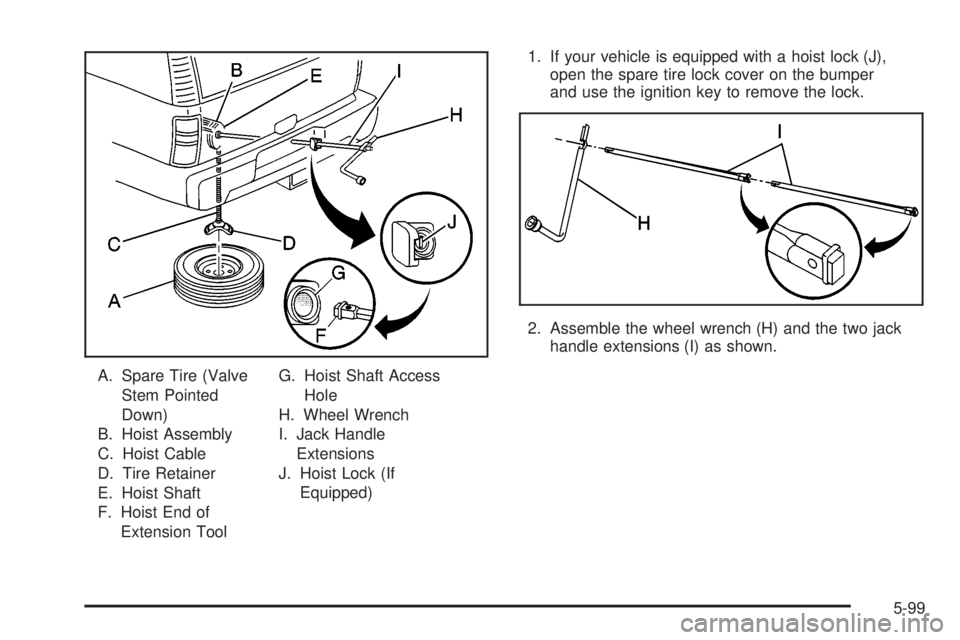
A. Spare Tire (Valve
Stem Pointed
Down)
B. Hoist Assembly
C. Hoist Cable
D. Tire Retainer
E. Hoist Shaft
F. Hoist End of
Extension ToolG. Hoist Shaft Access
Hole
H. Wheel Wrench
I. Jack Handle
Extensions
J. Hoist Lock (If
Equipped)1. If your vehicle is equipped with a hoist lock (J),
open the spare tire lock cover on the bumper
and use the ignition key to remove the lock.
2. Assemble the wheel wrench (H) and the two jack
handle extensions (I) as shown.
5-99
Page 500 of 588
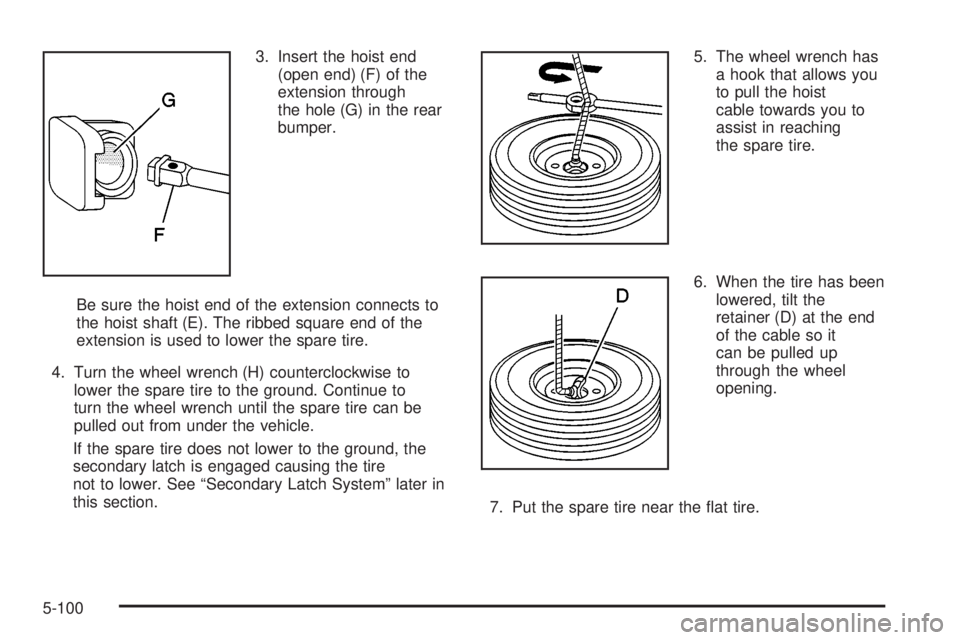
3. Insert the hoist end
(open end) (F) of the
extension through
the hole (G) in the rear
bumper.
Be sure the hoist end of the extension connects to
the hoist shaft (E). The ribbed square end of the
extension is used to lower the spare tire.
4. Turn the wheel wrench (H) counterclockwise to
lower the spare tire to the ground. Continue to
turn the wheel wrench until the spare tire can be
pulled out from under the vehicle.
If the spare tire does not lower to the ground, the
secondary latch is engaged causing the tire
not to lower. See ªSecondary Latch Systemº later in
this section.5. The wheel wrench has
a hook that allows you
to pull the hoist
cable towards you to
assist in reaching
the spare tire.
6. When the tire has been
lowered, tilt the
retainer (D) at the end
of the cable so it
can be pulled up
through the wheel
opening.
7. Put the spare tire near the ¯at tire.
5-100
Page 501 of 588
Removing the Flat Tire and Installing
the Spare Tire
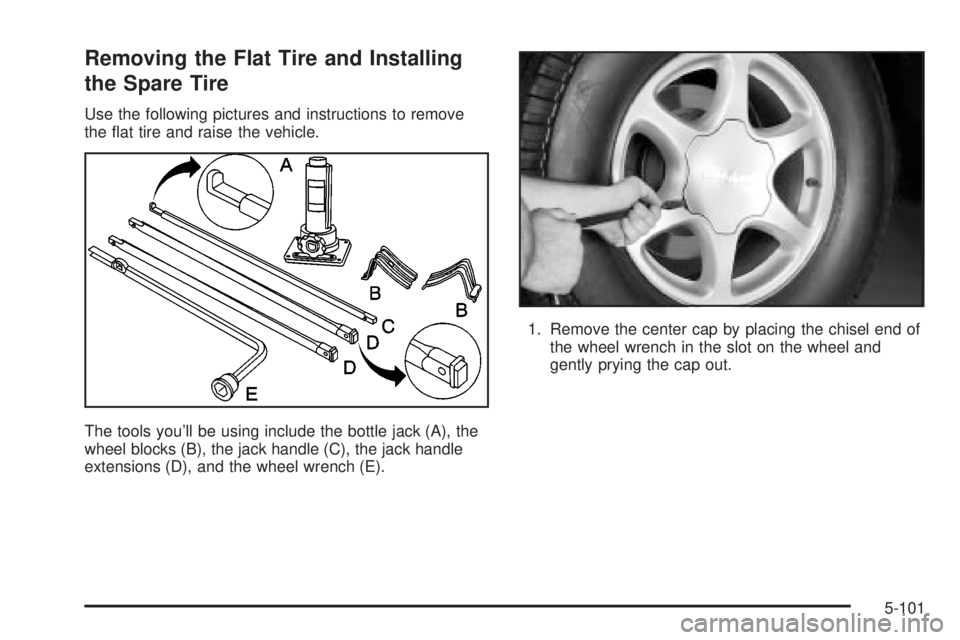
Use the following pictures and instructions to remove
the ¯at tire and raise the vehicle.
The tools you'll be using include the bottle jack (A), the
wheel blocks (B), the jack handle (C), the jack handle
extensions (D), and the wheel wrench (E).1. Remove the center cap by placing the chisel end of
the wheel wrench in the slot on the wheel and
gently prying the cap out.
5-101
Page 502 of 588
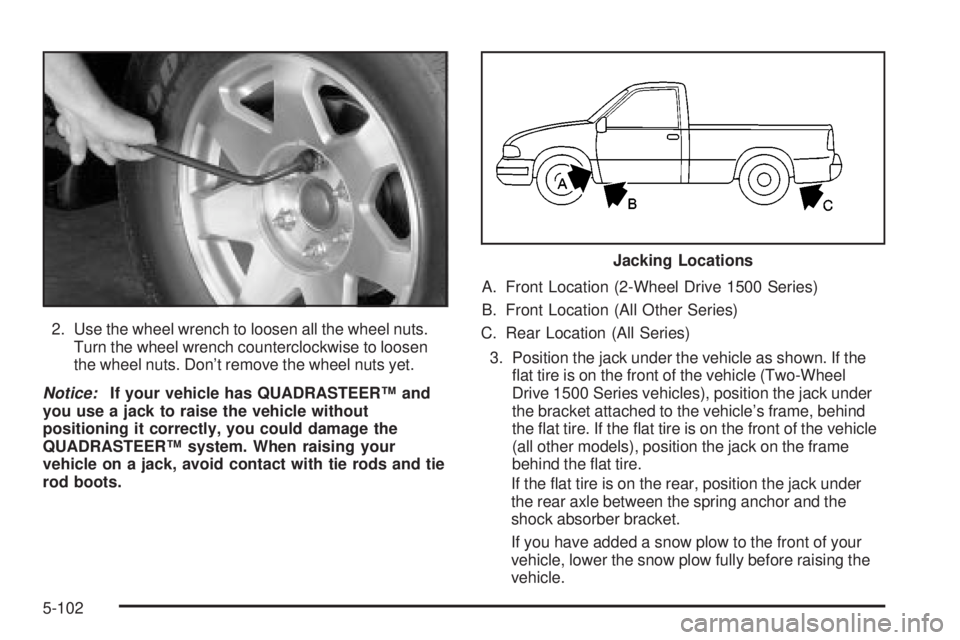
2. Use the wheel wrench to loosen all the wheel nuts.
Turn the wheel wrench counterclockwise to loosen
the wheel nuts. Don't remove the wheel nuts yet.
Notice:If your vehicle has QUADRASTEERŸ and
you use a jack to raise the vehicle without
positioning it correctly, you could damage the
QUADRASTEERŸ system. When raising your
vehicle on a jack, avoid contact with tie rods and tie
rod boots.A. Front Location (2-Wheel Drive 1500 Series)
B. Front Location (All Other Series)
C. Rear Location (All Series)
3. Position the jack under the vehicle as shown. If the
¯at tire is on the front of the vehicle (Two-Wheel
Drive 1500 Series vehicles), position the jack under
the bracket attached to the vehicle's frame, behind
the ¯at tire. If the ¯at tire is on the front of the vehicle
(all other models), position the jack on the frame
behind the ¯at tire.
If the ¯at tire is on the rear, position the jack under
the rear axle between the spring anchor and the
shock absorber bracket.
If you have added a snow plow to the front of your
vehicle, lower the snow plow fully before raising the
vehicle.
Jacking Locations
5-102
Page 504 of 588
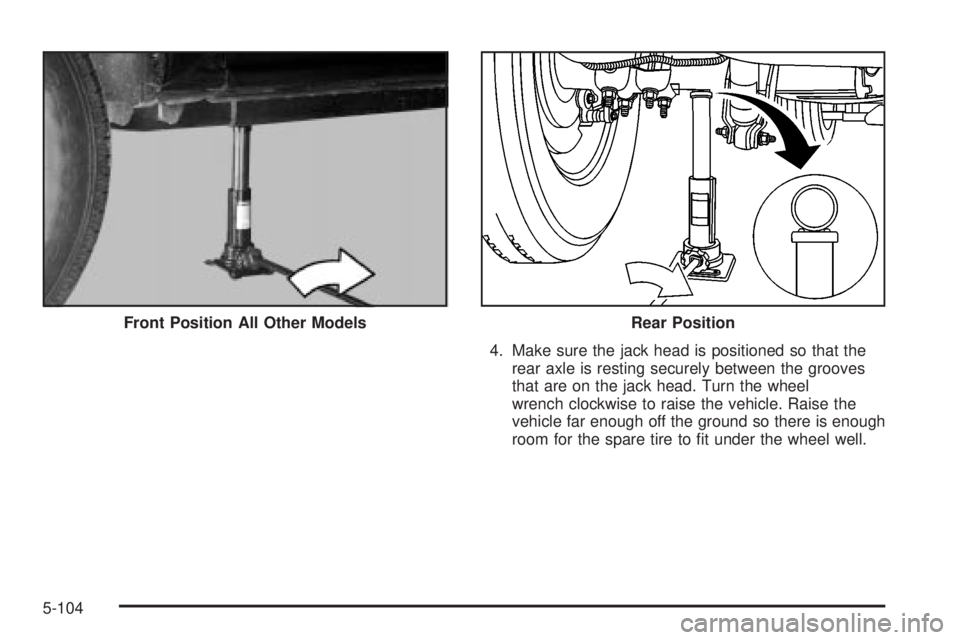
4. Make sure the jack head is positioned so that the
rear axle is resting securely between the grooves
that are on the jack head. Turn the wheel
wrench clockwise to raise the vehicle. Raise the
vehicle far enough off the ground so there is enough
room for the spare tire to ®t under the wheel well. Front Position All Other Models
Rear Position
5-104
Page 505 of 588
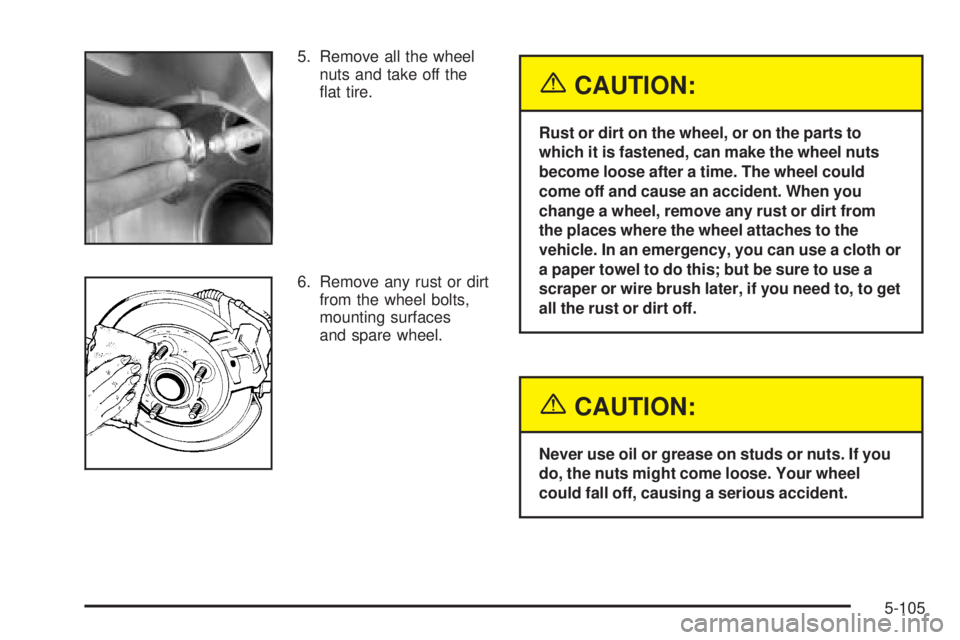
5. Remove all the wheel
nuts and take off the
¯at tire.
6. Remove any rust or dirt
from the wheel bolts,
mounting surfaces
and spare wheel.
{CAUTION:
Rust or dirt on the wheel, or on the parts to
which it is fastened, can make the wheel nuts
become loose after a time. The wheel could
come off and cause an accident. When you
change a wheel, remove any rust or dirt from
the places where the wheel attaches to the
vehicle. In an emergency, you can use a cloth or
a paper towel to do this; but be sure to use a
scraper or wire brush later, if you need to, to get
all the rust or dirt off.
{CAUTION:
Never use oil or grease on studs or nuts. If you
do, the nuts might come loose. Your wheel
could fall off, causing a serious accident.
5-105
Page 506 of 588
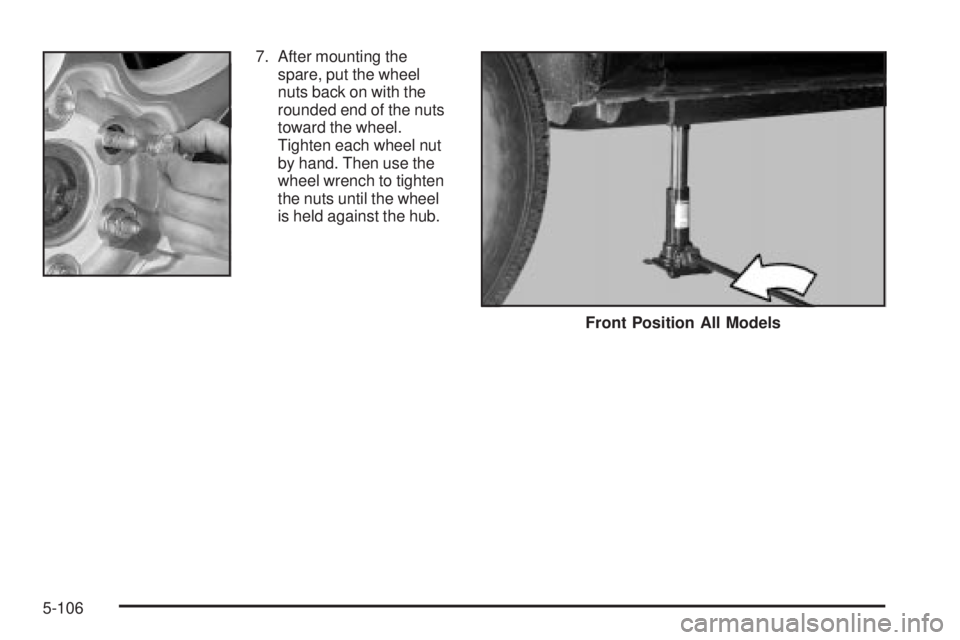
7. After mounting the
spare, put the wheel
nuts back on with the
rounded end of the nuts
toward the wheel.
Tighten each wheel nut
by hand. Then use the
wheel wrench to tighten
the nuts until the wheel
is held against the hub.
Front Position All Models
5-106
Page 508 of 588
8. Turn the wheel wrench counterclockwise to lower
the vehicle. Lower the jack completely.
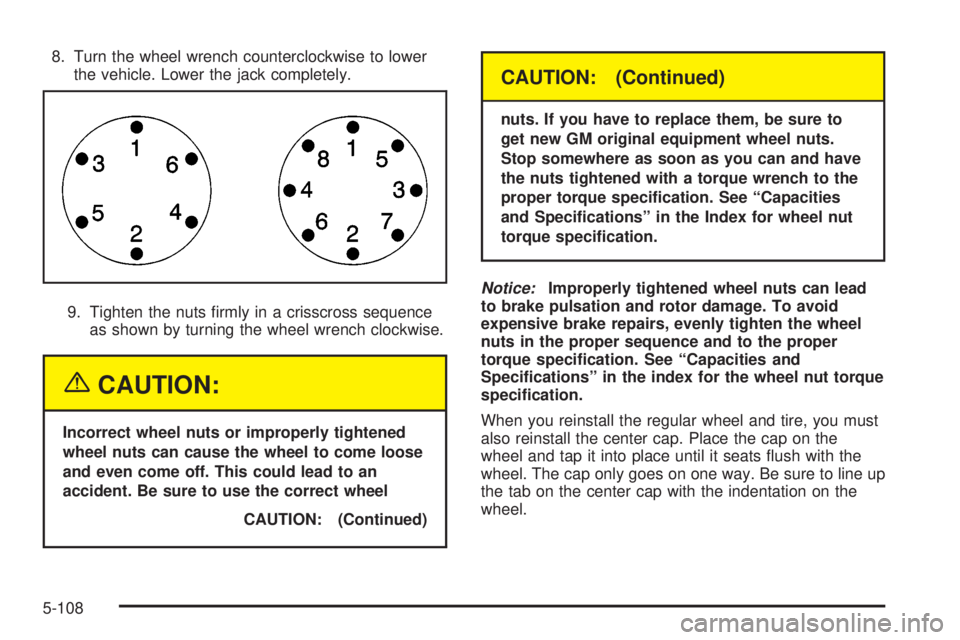
9. Tighten the nuts ®rmly in a crisscross sequence
as shown by turning the wheel wrench clockwise.
{CAUTION:
Incorrect wheel nuts or improperly tightened
wheel nuts can cause the wheel to come loose
and even come off. This could lead to an
accident. Be sure to use the correct wheel
CAUTION: (Continued)
CAUTION: (Continued)
nuts. If you have to replace them, be sure to
get new GM original equipment wheel nuts.
Stop somewhere as soon as you can and have
the nuts tightened with a torque wrench to the
proper torque speci®cation. See ªCapacities
and Speci®cationsº in the Index for wheel nut
torque speci®cation.
Notice:Improperly tightened wheel nuts can lead
to brake pulsation and rotor damage. To avoid
expensive brake repairs, evenly tighten the wheel
nuts in the proper sequence and to the proper
torque speci®cation. See ªCapacities and
Speci®cationsº in the index for the wheel nut torque
speci®cation.
When you reinstall the regular wheel and tire, you must
also reinstall the center cap. Place the cap on the
wheel and tap it into place until it seats ¯ush with the
wheel. The cap only goes on one way. Be sure to line up
the tab on the center cap with the indentation on the
wheel.
5-108