2004 GMC SAVANA mirror
[x] Cancel search: mirrorPage 213 of 398

Here are some tips on night driving.
Drive defensively.
Do not drink and drive.
Adjust your inside rearview mirror to reduce the
glare from headlamps behind you.
Since you can not see as well, you may need to
slow down and keep more space between you
and other vehicles.
Slow down, especially on higher speed roads. Your
headlamps can light up only so much road ahead.
In remote areas, watch for animals.
If you are tired, pull off the road in a safe place
and rest.
No one can see as well at night as in the daytime. But
as we get older these differences increase. A
50-year-old driver may require at least twice as much
light to see the same thing at night as a 20-year-old.
What you do in the daytime can also affect your
night vision. For example, if you spend the day in bright
sunshine you are wise to wear sunglasses. Your
eyes will have less trouble adjusting to night. But if you
are driving, do not wear sunglasses at night. They
may cut down on glare from headlamps, but they also
make a lot of things invisible.You can be temporarily blinded by approaching
headlamps. It can take a second or two, or even several
seconds, for your eyes to re-adjust to the dark. When
you are faced with severe glare (as from a driver
who does not lower the high beams, or a vehicle with
misaimed headlamps), slow down a little. Avoid
staring directly into the approaching headlamps.
Keep your windshield and all the glass on your vehicle
clean — inside and out. Glare at night is made much
worse by dirt on the glass. Even the inside of the glass
can build up a lm caused by dust. Dirty glass makes
lights dazzle and ash more than clean glass would,
making the pupils of your eyes contract repeatedly.
Remember that your headlamps light up far less of a
roadway when you are in a turn or curve. Keep
your eyes moving; that way, it is easier to pick out dimly
lighted objects. Just as your headlamps should be
checked regularly for proper aim, so should your eyes
be examined regularly. Some drivers suffer from
night blindness — the inability to see in dim light — and
are not even aware of it.
4-17
Page 218 of 398
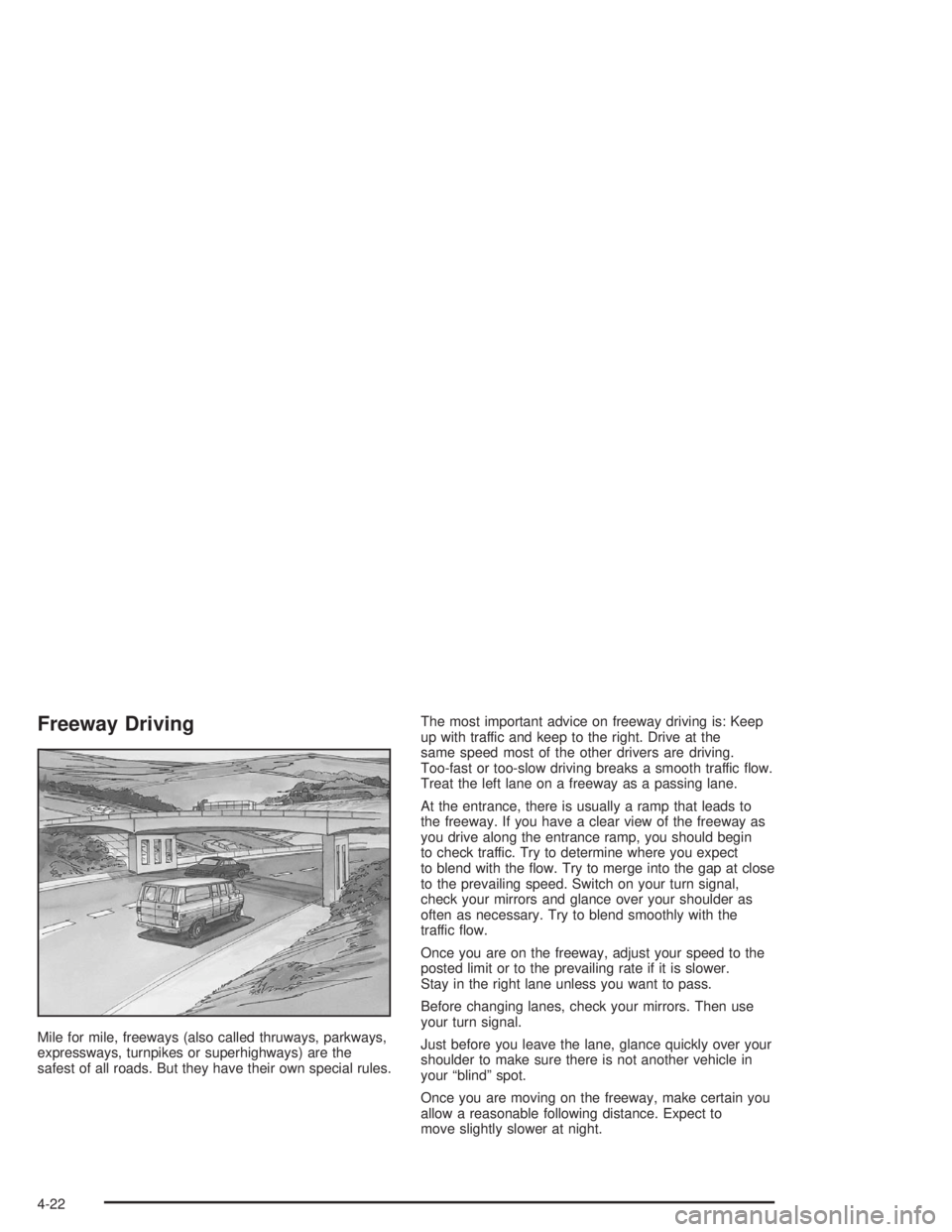
Freeway Driving
Mile for mile, freeways (also called thruways, parkways,
expressways, turnpikes or superhighways) are the
safest of all roads. But they have their own special rules.The most important advice on freeway driving is: Keep
up with traffic and keep to the right. Drive at the
same speed most of the other drivers are driving.
Too-fast or too-slow driving breaks a smooth traffic ow.
Treat the left lane on a freeway as a passing lane.
At the entrance, there is usually a ramp that leads to
the freeway. If you have a clear view of the freeway as
you drive along the entrance ramp, you should begin
to check traffic. Try to determine where you expect
to blend with the ow. Try to merge into the gap at close
to the prevailing speed. Switch on your turn signal,
check your mirrors and glance over your shoulder as
often as necessary. Try to blend smoothly with the
traffic ow.
Once you are on the freeway, adjust your speed to the
posted limit or to the prevailing rate if it is slower.
Stay in the right lane unless you want to pass.
Before changing lanes, check your mirrors. Then use
your turn signal.
Just before you leave the lane, glance quickly over your
shoulder to make sure there is not another vehicle in
your “blind” spot.
Once you are moving on the freeway, make certain you
allow a reasonable following distance. Expect to
move slightly slower at night.
4-22
Page 220 of 398
Highway Hypnosis
Is there actually such a condition as “highway
hypnosis”? Or is it just plain falling asleep at the wheel?
Call it highway hypnosis, lack of awareness, or
whatever.
There is something about an easy stretch of road with
the same scenery, along with the hum of the tires on the
road, the drone of the engine, and the rush of the
wind against the vehicle that can make you sleepy. Do
not let it happen to you! If it does, your vehicle can
leave the road inless than a second,and you could
crash and be injured.
What can you do about highway hypnosis? First, be
aware that it can happen.
Then here are some tips:
Make sure your vehicle is well ventilated, with a
comfortably cool interior.
Keep your eyes moving. Scan the road ahead and
to the sides. Check your mirrors and your
instruments frequently.
If you get sleepy, pull off the road into a rest,
service or parking area and take a nap, get some
exercise, or both. For safety, treat drowsiness
on the highway as an emergency.
Hill and Mountain Roads
Driving on steep hills or mountains is different from
driving in at or rolling terrain.
If you drive regularly in steep country, or if you are
planning to visit there, here are some tips that can make
your trips safer and more enjoyable.
4-24
Page 243 of 398

Driving with a Trailer
{CAUTION:
If you have a rear-most window open and you
pull a trailer with your vehicle, carbon
monoxide (CO) could come into your vehicle.
You can not see or smell CO. It can cause
unconsciousness or death. SeeEngine
Exhaust on page 2-30. To maximize your safety
when towing a trailer:
Have your exhaust system inspected for
leaks, and make necessary repairs before
starting on your trip.
Keep the rear-most windows closed.
If exhaust does come into your vehicle
through a window in the rear or another
opening, drive with your front, main
heating or cooling system on and with the
fan on any speed. This will bring fresh,
outside air into your vehicle. Do not use
the climate control setting for maximum air
because it only recirculates the air inside
your vehicle. SeeClimate Control System
on page 3-19.Towing a trailer requires a certain amount of experience.
Before setting out for the open road, you’ll want to get
to know your rig. Acquaint yourself with the feel of
handling and braking with the added weight of the trailer.
And always keep in mind that the vehicle you are
driving is now a good deal longer and not nearly as
responsive as your vehicle is by itself.
Before you start, check all trailer hitch parts and
attachments, safety chains, electrical connector, lamps,
tires and mirror adjustment. If the trailer has electric
brakes, start your vehicle and trailer moving and then
apply the trailer brake controller by hand to be sure
the brakes are working. This lets you check your
electrical connection at the same time.
During your trip, check occasionally to be sure that the
load is secure, and that the lamps and any trailer
brakes are still working.Following Distance
Stay at least twice as far behind the vehicle ahead as
you would when driving your vehicle without a trailer.
This can help you avoid situations that require
heavy braking and sudden turns.
4-47
Page 348 of 398

Fuses and Circuit Breakers
Floor Console Fuse Block
The oor console fuse block is located under the
driver’s seat.
Fuse Usage
1 Spare
2 Outside Rear View MirrorFuse Usage
3 Courtesy Lamp/SEO
4 Left Rear Stop/Turn Signal
5 Cargo Locks
6 Right Rear Stop/Turn Signal
7 Driver Locks
8Stop/Center High Mounted Stop
Lamp
9 Climate Control 1
10 Climate Control
11 Brakes
12 Heated Mirror/Defogger
13 Right Rear Blower
14 Driver Turn Mirror
15 Door Locks
16 Uptter Park
17 Not Available
18 Left Rear Park Lamp
19 Pass Turn Mirror
20 Right Rear Park Lamp
21 Trailer Park Lamp
Front of Vehicle
5-102
Page 350 of 398

Fuse Usage
4 Right Rear Turn Lamp
5 Backup Lamps Trailer Wiring
6 Ignition 0
7 Stop Lamp
8 Right Rear Defogger/Heated Mirror
9 Right Daytime Running Lamp/Turn Signal
10 Left Daytime Running Lamp/Turn Signal
11 Truck Body Control Module 4
12 Fuel Pump
13 Trailer
14 Flasher
15 Horn
16 Truck Body Control Module 3
17 Trailer Stop/Turn Signal
18 Truck Body Control Module 2
19 Truck Body Control Module
20 Remote Function Actuator
21 Engine 2Fuse Usage
22 Ignition E
23 Engine 1
24 Truck Body Control Module Ignition 1
25 Spare
26 RPA/Inside Rearview Mirror
27 Crankcase
28 Brake Transmission Shift Interlock System
29 Auxiliary Power Outlets
30 Cigarette Lighter
31 Instrument Panel Cluster
32 Air Conditioning
33 Spare
34 Vent
35 Spare
36 Vehicle Back Up
37 Supplemental Inatable Restraint System
38 Powertrain Control Module Ignition 1
39 Oxygen Sensor B
5-104
Page 391 of 398

How to Add Coolant to the Radiator..................5-32
How to Add Fluid............................................5-22
How to Check........................................5-20, 5-66
How to Check Lubricant...................................5-48
How to Check Power Steering Fluid..................5-36
How to Inspect the Engine Air Cleaner/Filter.......5-18
How to Use This Manual...................................... ii
How to Wear Safety Belts Properly...................1-15
Hydroplaning..................................................4-20
I
If No Steam Is Coming From Your Engine..........5-27
If Steam Is Coming From Your Engine...............5-26
If the Light Is Flashing.....................................3-36
If the Light Is On Steady.................................3-36
If You Are Caught in a Blizzard.........................4-28
If You Are Stuck in Sand, Mud, Ice or Snow.......4-30
If You Do Decide To Pull A Trailer.....................4-38
Ignition Positions.............................................2-21
Infants and Young Children, Restraints...............1-36
Ination - Tire Pressure...................................5-65
Inside Day/Night Rearview Mirror......................2-32
Instrument Panel
Cluster.......................................................3-25
Overview..................................................... 3-4
Instrument Panel Brightness Control..................3-16
Interior Lamps................................................3-16
J
Jump Starting.................................................5-42
K
Keyless Entry System....................................... 2-4
Keys............................................................... 2-2
L
Lamps
Exterior......................................................3-14
Interior.......................................................3-16
Lamps On Reminder.......................................3-15
Lap Belt........................................................1-25
Lap-Shoulder Belt...........................................1-15
LATCH System
Child Restraints...........................................1-52
Securing a Child Restraint Designed for
the LATCH System...................................1-54
Leaving Your Vehicle.......................................2-11
Leaving Your Vehicle With the
Engine Running..........................................2-28
Light
Air Bag Off .................................................3-29
Air Bag Readiness.......................................3-28
Anti-Lock Brake System Warning...................3-33
7
Page 393 of 398

Mirrors
Manual Rearview Mirror................................2-32
Outside Camper-Type Mirrors........................2-32
Outside Convex Mirror.................................2-34
Outside Heated Mirrors................................2-34
Outside Manual Mirror..................................2-32
Outside Power Mirrors..................................2-33
Model Reference................................................ vi
MyGMLink.com................................................ 7-3
N
New Vehicle Break-In......................................2-20
Noise Control System, Tampering......................5-50
Normal Maintenance Replacement Parts............6-14
O
Off-Road Recovery..........................................4-13
Oil
Change Engine Oil Light...............................3-38
Engine.......................................................5-13
Pressure Gage............................................3-37
Older Children, Restraints................................1-32
Online Owner Center........................................ 7-3
OnStar
®Personal Calling.................................2-36
OnStar®Services............................................2-35
OnStar®System.............................................2-35OnStar
®Virtual Advisor....................................2-36
Operation Tips................................................3-21
Other Warning Devices...................................... 3-7
Outlet Adjustment............................................3-21
Outside
Camper-Type Mirrors....................................2-32
Convex Mirror.............................................2-34
Heated Mirrors............................................2-34
Manual Mirror.............................................2-32
Power Mirrors.............................................2-33
Owner Checks and Services.............................. 6-9
Owners, Canadian............................................... ii
Owner’s Information........................................7-12
P
Park (P)
Shifting Into................................................2-27
Shifting Out of............................................2-29
Parking
Brake........................................................2-26
Over Things That Burn.................................2-30
Parking on Hills..............................................4-49
Passenger Vans with an Air Bag
Off Switch..................................................1-46
Passenger Vans without an Air Bag
Off Switch..................................................1-45
Passing.................................................4-14, 4-48
Passlock
®......................................................2-20
9