Page 248 of 398

When It Is Time for New Tires.......................5-69
Buying New Tires.........................................5-70
Uniform Tire Quality Grading..........................5-71
Wheel Alignment and Tire Balance..................5-72
Wheel Replacement......................................5-72
Tire Chains..................................................5-73
If a Tire Goes Flat........................................5-74
Changing a Flat Tire.....................................5-75
Appearance Care............................................5-92
Cleaning the Inside of Your Vehicle.................5-92
Care of Safety Belts......................................5-95
Weatherstrips...............................................5-95
Cleaning the Outside of Your Vehicle..............5-95
Sheet Metal Damage.....................................5-97Finish Damage.............................................5-98
Underbody Maintenance................................5-98
Chemical Paint Spotting.................................5-98
Vehicle Care/Appearance Materials..................5-99
Vehicle Identication.....................................5-100
Vehicle Identication Number (VIN)................5-100
Service Parts Identication Label...................5-100
Electrical System..........................................5-101
Add-On Electrical Equipment.........................5-101
Headlamp Wiring........................................5-101
Windshield Wiper Fuses...............................5-101
Fuses and Circuit Breakers..........................5-102
Capacities and Specications........................5-106
Section 5 Service and Appearance Care
5-2
Page 297 of 398

Bulb Replacement
For any bulb changing procedure not listed in this
section, contact your dealer.
For the type of bulbs, seeReplacement Bulbs on
page 5-55.
Halogen Bulbs
{CAUTION:
Halogen bulbs have pressurized gas inside
and can burst if you drop or scratch the bulb.
You or others could be injured. Be sure to read
and follow the instructions on the bulb
package.
Headlamps
1. Remove the two bolts from the headlamp assembly.
2. Remove the two pins on the top of the headlamp
assembly. To remove the pins, turn the outer pin
clockwise and pull it straight up. To remove
the inner pin, turn it counterclockwise and pull it
straight up.
3. Lift the inboard side of the headlamp to release the
inboard tab from the radiator support.
4. Lift the outboard side of the headlamp to release
the outboard tab from the radiator support.
5. Lower the headlamp to allow the vertical adjustor to
clear tie bar.
6. Turn the headlamp forward and upward to remove
it from the grille.
7. Turn the bulb connector counterclockwise and pull it
out of the housing.
5-51
Page 298 of 398
8. Without removing the headlamp assembly itself,
remove the bulb socket from the back of the
headlamp on the driver’s side.
9. Turn the bulb counterclockwise one quarter turn to
remove it from the socket.
10. On the passenger’s side, turn the bulb clockwise
one turn. Do not touch the glass part of the bulb.11. Install the new bulb into the socket and return it to
the headlamp assembly.
12. Put the headlamp assembly back into the vehicle
and reinstall the two pins.
5-52
Page 301 of 398
Center High Mounted
Stoplamp (CHMSL)
It is recommended that this component be replaced as
a unit by your dealer.
Replacement Bulbs
Exterior Lamp Bulb Number
Back-up Lamp 3157
CHMSL 912
Composite High-Beam
Headlamps9005
Composite Low-Beam
Headlamps9006GS
Front Parking and Turn Lamp 3157KX
Front Sidemarker Lamp 194
Sealed Beam Headlamps H6054
Rear Parking, Stop, and
Turn Lamp3157
For any bulb not listed here, contact your dealer.
5-55
Page 319 of 398

{CAUTION:
Using the wrong replacement wheels, wheel
bolts or wheel nuts on your vehicle can be
dangerous. It could affect the braking and
handling of your vehicle, make your tires lose
air and make you lose control. You could have
a collision in which you or others could be
injured. Always use the correct wheel, wheel
bolts and wheel nuts for replacement.
Notice:The wrong wheel can also cause problems
with bearing life, brake cooling, speedometer or
odometer calibration, headlamp aim, bumper height,
vehicle ground clearance and tire or tire chain
clearance to the body and chassis.
Whenever a wheel, wheel bolt or wheel nut is replaced
on a dual wheel setup, check the wheel nut torque
after 100, 1,000 and 6,000 miles (160, 1 600 and
10 000 km) of driving. For proper torque, see “Wheel Nut
Torque” underCapacities and Specications on
page 5-106.
SeeChanging a Flat Tire on page 5-75for more
information.
Used Replacement Wheels
{CAUTION:
Putting a used wheel on your vehicle is
dangerous. You can’t know how it’s been used
or how far it’s been driven. It could fail
suddenly and cause a crash. If you have to
replace a wheel, use a new GM original
equipment wheel.
Tire Chains
{CAUTION:
If your vehicle has dual wheels or P235/75R16
or LT245/75R16 size tires, do not use tire
chains. They can damage your vehicle because
there’s not enough clearance. Tire chains used
on a vehicle without the proper amount of
clearance can cause damage to the brakes,
suspension or other vehicle parts. The area
CAUTION: (Continued)
5-73
Page 347 of 398

Electrical System
Add-On Electrical Equipment
Notice:Don’t add anything electrical to your
vehicle unless you check with your dealer rst.
Some electrical equipment can damage your vehicle
and the damage wouldn’t be covered by your
warranty. Some add-on electrical equipment can
keep other components from working as they
should.
Your vehicle has an air bag system. Before attempting
to add anything electrical to your vehicle, see
Servicing Your Air Bag-Equipped Vehicle on page 1-78.
Headlamp Wiring
The headlamp wiring is protected by a circuit breaker in
the lamp switch. An electrical overload will cause the
lamps to icker on and off, or in some cases to remain
off. If this happens, have your headlamp wiring
checked right away.
Windshield Wiper Fuses
The windshield wiper motor is protected by a circuit
breaker and a fuse. If the motor overheats due to heavy
snow, etc., the wiper will stop until the motor cools.
Although the circuit is protected from electrical overload,
overload due to heavy snow, etc., may cause wiper
linkage damage. Always clear ice and heavy snow from
the windshield before using the windshield wipers. If
the overload is caused by some electrical problem and
not snow, etc., be sure to get it xed.
5-101
Page 351 of 398
Fuse Usage
40 Oxygen Sensor A
41 Windshield Wipers
42 Right Headlamp — Low Beam
43 Left Headlamp — Low Beam
44 Left Headlamp — High Beam
45 Right Headlamp — High Beam
46 Truck Body Control Module-Accessory
47 Front Windshield Wiper
48 Anti-Lock Brakes
49 Ignition A
50 Trailer
51 Climate Control Blower
52 Ignition BFuse Usage
63 Spare
64 Spare
Relay Usage
53 Windshield Wiper
54 Air Conditioning
55 Spare
56 Headlamp —High Beam
57 Fuel Pump
58 Headlamp — Low Beam
59 Horn
61 Starter
62 Spare
Circuit
BreakerUsage
60 Power Seat
5-105
Page 386 of 398
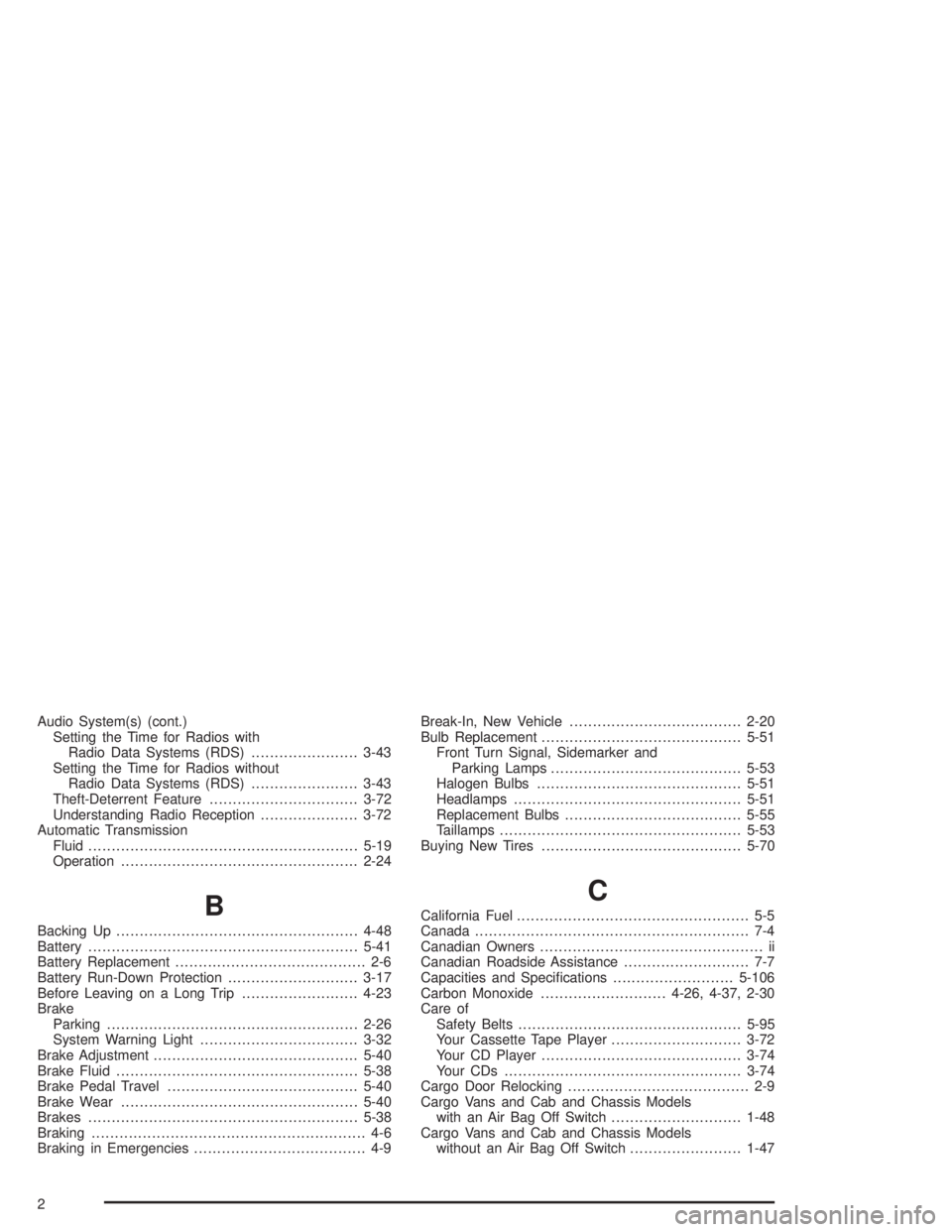
Audio System(s) (cont.)
Setting the Time for Radios with
Radio Data Systems (RDS).......................3-43
Setting the Time for Radios without
Radio Data Systems (RDS).......................3-43
Theft-Deterrent Feature................................3-72
Understanding Radio Reception.....................3-72
Automatic Transmission
Fluid..........................................................5-19
Operation...................................................2-24
B
Backing Up....................................................4-48
Battery..........................................................5-41
Battery Replacement......................................... 2-6
Battery Run-Down Protection............................3-17
Before Leaving on a Long Trip.........................4-23
Brake
Parking......................................................2-26
System Warning Light..................................3-32
Brake Adjustment............................................5-40
Brake Fluid....................................................5-38
Brake Pedal Travel.........................................5-40
Brake Wear...................................................5-40
Brakes..........................................................5-38
Braking........................................................... 4-6
Braking in Emergencies..................................... 4-9Break-In, New Vehicle.....................................2-20
Bulb Replacement...........................................5-51
Front Turn Signal, Sidemarker and
Parking Lamps.........................................5-53
Halogen Bulbs............................................5-51
Headlamps.................................................5-51
Replacement Bulbs......................................5-55
Taillamps....................................................5-53
Buying New Tires...........................................5-70
C
California Fuel.................................................. 5-5
Canada........................................................... 7-4
Canadian Owners................................................ ii
Canadian Roadside Assistance........................... 7-7
Capacities and Specications..........................5-106
Carbon Monoxide...........................4-26, 4-37, 2-30
Care of
Safety Belts................................................5-95
Your Cassette Tape Player............................3-72
Your CD Player...........................................3-74
Your CDs ...................................................3-74
Cargo Door Relocking....................................... 2-9
Cargo Vans and Cab and Chassis Models
with an Air Bag Off Switch............................1-48
Cargo Vans and Cab and Chassis Models
without an Air Bag Off Switch........................1-47
2


