Page 195 of 216

Information on“T ” type tires
T145/80D16 is an example of a tire
size.
Note: The temporary tire size for
your vehicle may be different than
this example.
1. T: Indicates a type of tire,
designated by the Tire and Rim
Association (T&RA), that is
intended for temporary service on
cars, SUVs, minivans and light
trucks.
2. 145: Indicates the nominal width
of the tire in millimeters from
sidewall edge to sidewall edge. In
general, the larger the number, the
wider the tire.
3. 80: Indicates the aspect ratio
which gives the tires ratio of height to width. Numbers of 70 or lower
indicate a short sidewall.
4. D: Indicates a “diagonal ”type tire.
R: Indicates a “radial ”type tire.
5. 16: Indicates the wheel or rim diameter in inches. If you change your
wheel size, you will have to purchase new tires to match the new wheel
diameter.
Location of the tire label
You will find a tire label containing tire inflation pressure by tire size and
other important information located on the B-Pillar or the driver ’s door.
TIRE CARE
Improper or inadequate vehicle maintenance can also cause tires to wear
abnormally. Here are some of the important maintenance items
Tire inflation pressure
Use a tire gauge to check the tire inflation pressure, including the spare,
at least monthly and before long trips. You are strongly urged to buy a
reliable tire pressure gauge, as automatic service station gauges may be
inaccurate.
SPARETIRE
TEMPORARYUSEONLY
INFLATETO60P.S.I.T
T145/80D16105M
2004 Thunderbird (tbr)
Owners Guide (post-2002-fmt)
USA English (fus)
Maintenance and Specifications
195
Page 197 of 216

6. Visually inspect the tires to make sure there are no nails or other
objects embedded that could poke a hole in the tire and cause an air
leak.
7. Check the sidewalls to make sure there are no gouges, cuts, bulges or
other irregularities.
Tire and wheel alignment
A bad jolt from hitting a curb or pothole can cause the front end of your
vehicle to become misaligned or damage to your tires. If your vehicle
seems to pull to one side, vibrate or shake when you’re driving, the
wheels may be out of alignment. Have a qualified technician at a
reputable repair facility check the wheel alignment periodically.
Wheel misalignment in the front or the rear can cause uneven and rapid
treadwear of your tires and should be corrected by a qualified technician
at a reputable repair facility. Front wheel drive (FWD) vehicles, and
those with independent front suspension require alignment of all four
wheels.
The tire should also be balanced periodically. An unbalanced tire and
wheel assembly may result in irregular tire wear.
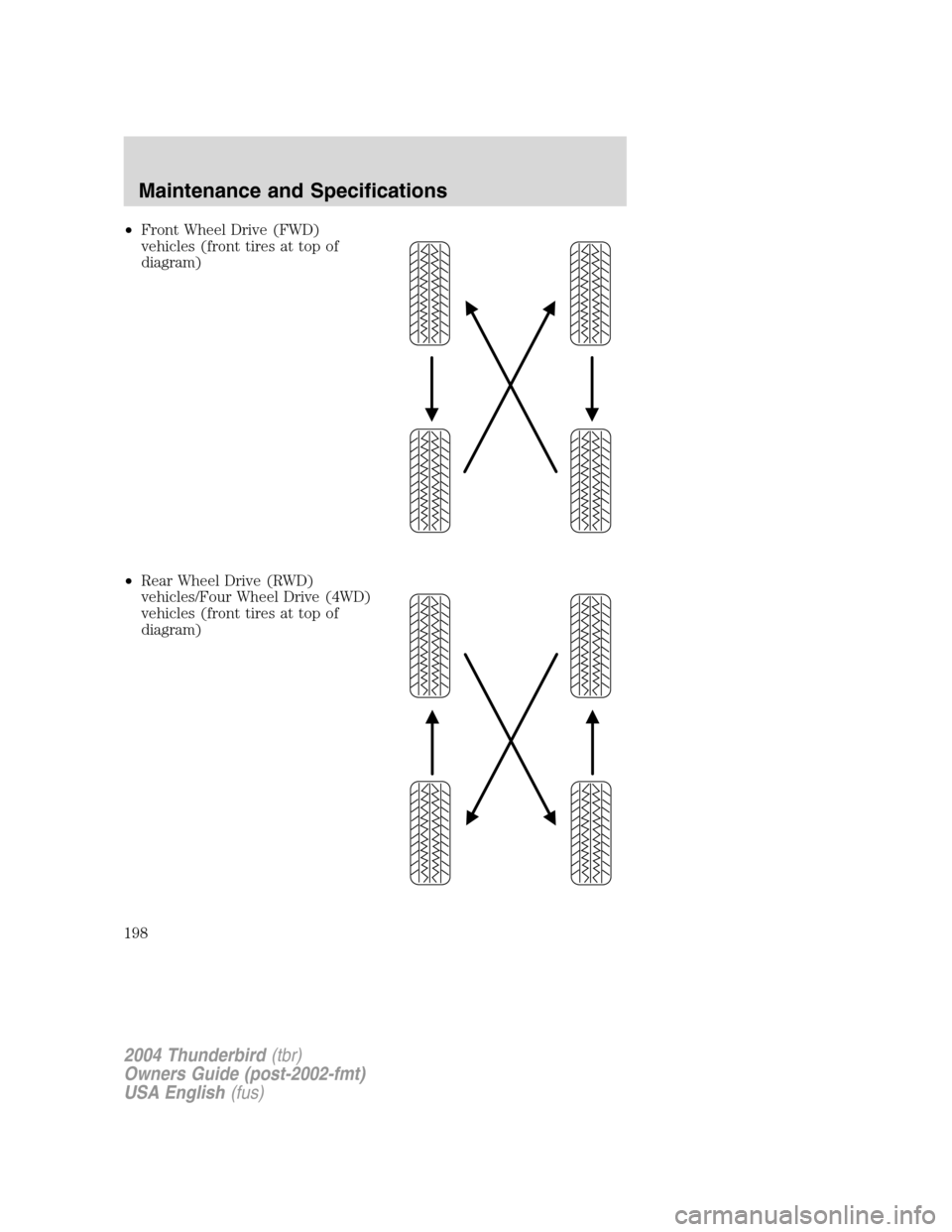
Tire rotation
Rotating your tires at the recommended interval (as indicated in the
Service Maintenance Guide that comes with your vehicle) will help your
tires wear more evenly providing better tire performance and longer tire
life. Unless otherwise specified, rotate the tires approximately every
8,000 km (5,000 miles).
2004 Thunderbird (tbr)
Owners Guide (post-2002-fmt)
USA English (fus)
Maintenance and Specifications
197
Page 198 of 216
•Front Wheel Drive (FWD)
vehicles (front tires at top of
diagram)
• Rear Wheel Drive (RWD)
vehicles/Four Wheel Drive (4WD)
vehicles (front tires at top of
diagram)
2004 Thunderbird (tbr)
Owners Guide (post-2002-fmt)
USA English (fus)
Maintenance and Specifications
198
Page 199 of 216
Sometimes irregular tire wear can be corrected by rotating the tires.
Note:If your tires show uneven wear ask a qualified technician at a
reputable repair facility to check for and correct any wheel misalignment,
tire imbalance or mechanical problem involved before tire rotation.
Tire wear
Measure and inspect the tire tread on all your tires periodically.
Advanced and unusual tire wear can reduce the ability of tread to grip
the road in adverse (wet, snowy, etc.) conditions. Visually check your
tires for uneven wear, looking for high and low areas or unusually
smooth areas. Also check for signs of tire damage.
When the tread is worn down to 4
mm (1/16th of an inch), tires must
be replaced to prevent your vehicle
from skidding and hydroplaning.
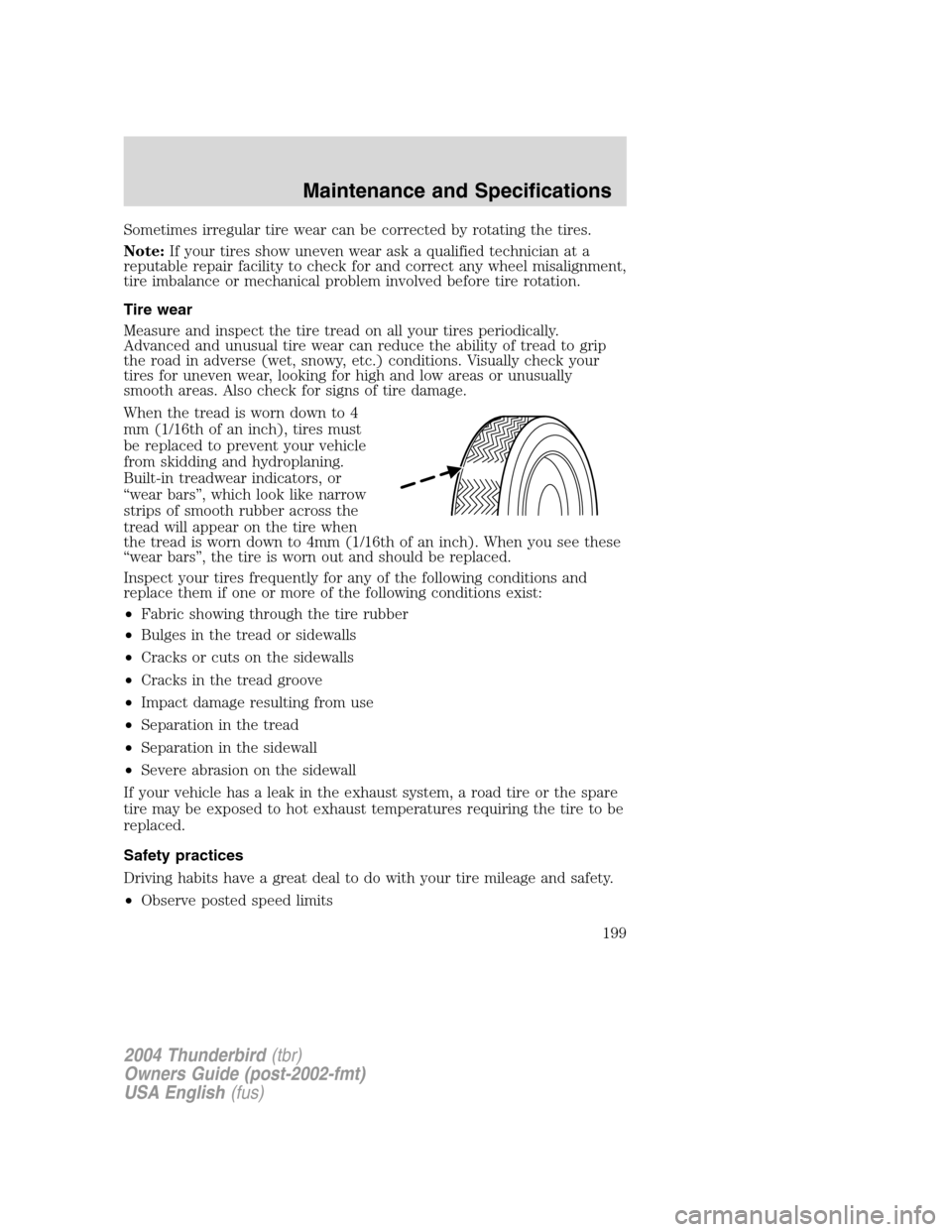
Built-in treadwear indicators, or
“ wear bars ”, which look like narrow
strips of smooth rubber across the
tread will appear on the tire when
the tread is worn down to 4mm (1/16th of an inch). When you see these
“ wear bars ”, the tire is worn out and should be replaced.
Inspect your tires frequently for any of the following conditions and
replace them if one or more of the following conditions exist:
• Fabric showing through the tire rubber
• Bulges in the tread or sidewalls
• Cracks or cuts on the sidewalls
• Cracks in the tread groove
• Impact damage resulting from use
• Separation in the tread
• Separation in the sidewall
• Severe abrasion on the sidewall
If your vehicle has a leak in the exhaust system, a road tire or the spare
tire may be exposed to hot exhaust temperatures requiring the tire to be
replaced.
Safety practices
Driving habits have a great deal to do with your tire mileage and safety.
• Observe posted speed limits
2004 Thunderbird (tbr)
Owners Guide (post-2002-fmt)
USA English (fus)
Maintenance and Specifications
199
Page 200 of 216

•Avoid fast starts, stops and turns
• Avoid potholes and objects on the road
• Do not run over curbs or hit the tire against a curb when parking
If you vehicle is stuck in snow, mud, sand, etc., do notrapidly spin the
tires; spinning the tires can tear the tire and cause an explosion. A tire
can explode in as little as three to five seconds.
Tire explosions can cause death, personal injury or property
damage. Do not allow anyone to stand near, or directly ahead or
behind the spinning tire.
Never spin the tires in excess of the 55 km/h (35 mph) point
indicated on the speedometer.
Highway hazards
No matter how carefully you drive there ’s always the possibility that you
may eventually have a flat tire on the highway. Drive slowly to the
closest safe area out of traffic. This may further damage the flat tire, but
your safety is more important.
If you feel a sudden vibration or ride disturbance while driving or you
suspect your tire or vehicle has been damaged, immediately reduce your
speed. Drive with caution until you can safely pull off the road. Stop and
inspect the tire for damage. If the tire is under-inflated or damaged,
deflate it, remove wheel and replace it with your spare tire and wheel. If
you cannot detect a cause, have the vehicle towed to the nearest repair
facility or tire dealer to have the vehicle inspected.
SNOW TIRES AND CHAINS
Driving too fast for conditions creates the possibility of loss of
vehicle control.
Snow tires must be the same size and grade as the tires you
currently have on your vehicle.
Driving at very high speeds for extended periods of time may result in
damage to vehicle components.
The tires on your vehicle have all-weather treads that provide traction in
rain or snow.
2004 Thunderbird (tbr)
Owners Guide (post-2002-fmt)
USA English (fus)
Maintenance and Specifications
200
Page 205 of 216
ENGINE DATA
Engine 3.9L-4V V8 engine
Displacement 3 949 cc (241 cid)
Required fuel 91 octane
Firing order 1-5-4-2-6-3-7-8
Spark plug gap 0.99-1.09 mm (0.039-0.043 inch)
Ignition system Coil on plug
Compression ratio 10.75:1
VEHICLE DIMENSIONS
Vehicle dimensions mm (in)
(1) Overall length 4732mm (186.3 in)
(2) Overall width 1829mm (72.0 in)
(3) Overall height 1323 mm (52.1 in)
(4) Wheelbase 2722 mm (107.2 in)
(5) Track - Front 1537 mm (60.5 in)
(5) Track - Rear 1529 mm (60.2 in)
4
1
2004 Thunderbird (tbr)
Owners Guide (post-2002-fmt)
USA English (fus)
Maintenance and Specifications
205
Page 209 of 216
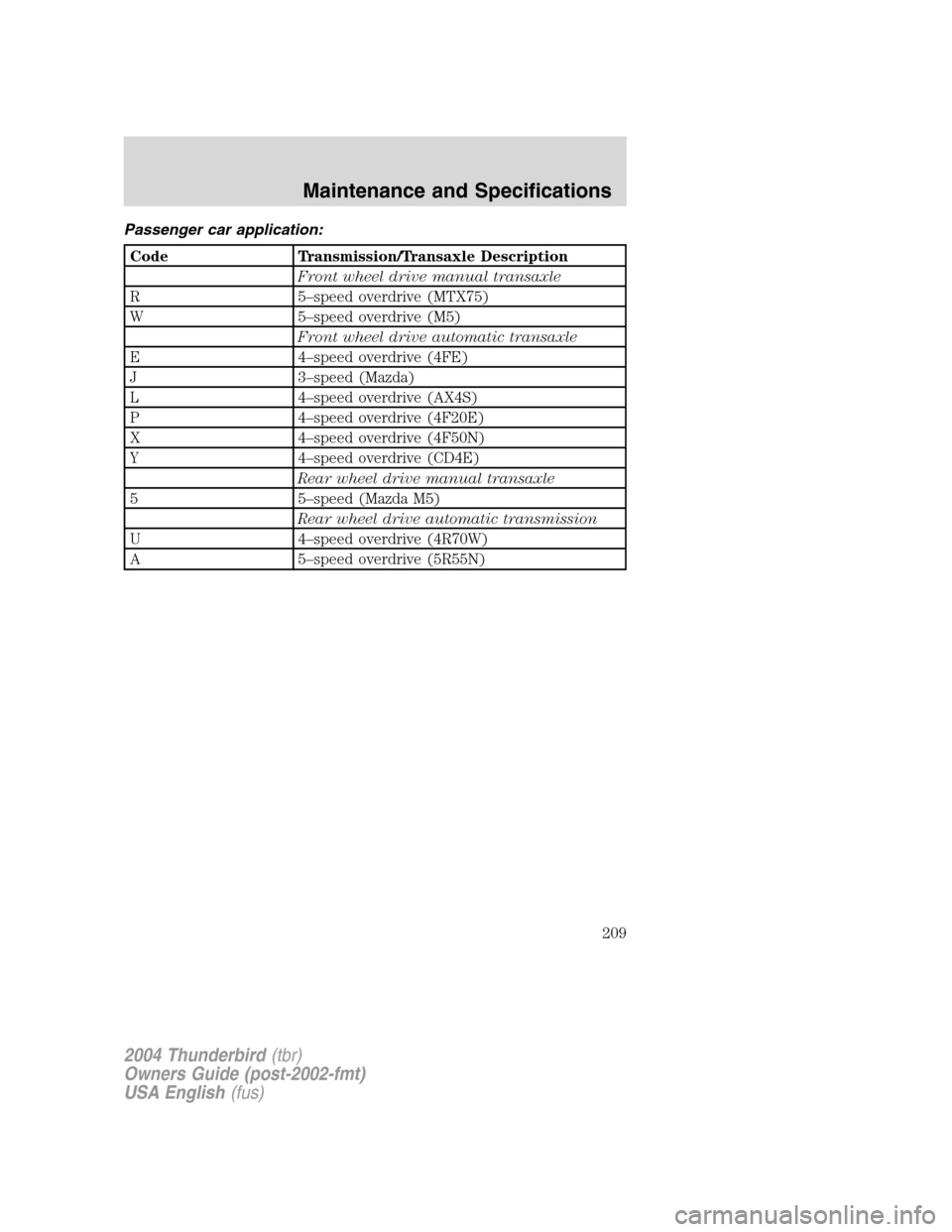
Passenger car application:
Code Transmission/Transaxle DescriptionFront wheel drive manual transaxle
R5 –speed overdrive (MTX75)
W5 –speed overdrive (M5)
Front wheel drive automatic transaxle
E4 –speed overdrive (4FE)
J3 –speed (Mazda)
L4 –speed overdrive (AX4S)
P4 –speed overdrive (4F20E)
X4 –speed overdrive (4F50N)
Y4 –speed overdrive (CD4E)
Rear wheel drive manual transaxle
55 –speed (Mazda M5)
Rear wheel drive automatic transmission
U4 –speed overdrive (4R70W)
A5 –speed overdrive (5R55N)
2004 Thunderbird (tbr)
Owners Guide (post-2002-fmt)
USA English (fus)
Maintenance and Specifications
209
Page 210 of 216

FORD ACCESSORIES FOR YOUR VEHICLE
A wide selection of genuine Ford accessories are available for your
vehicle through your local authorized Ford or Ford of Canada dealer.
These quality accessories have been specifically engineered to fulfill your
automotive needs; they are custom designed to complement the style
and aerodynamic appearance of your vehicle. In addition, each accessory
is made from high quality materials and meets or exceeds Ford’s rigorous
engineering and safety specifications. Ford Motor Company will repair or
replace any properly dealer-installed Ford accessory found to be
defective in factory-supplied materials or workmanship during the
warranty period, as well as any component damaged by the defective
accessory. The accessory will be warranted for whichever provides you
the greatest benefit:
• 12 months or 20,000 km (12,000 miles) (whichever occurs first), or
• the remainder of your new vehicle limited warranty.
This means that genuine Ford accessories purchased along with your new
vehicle and installed by the dealer are covered for the full length of your
New Vehicle ’s Limited Warranty —3 years or 60,000 km (36,000 miles)
(whichever occurs first). Contact your dealer for details and a copy of the
warranty.
Not all accessories are available for all models.
Following is a list of several Ford Genuine Accessory products. Not all
accessories are available for all models. To find out what accessories are
available for your vehicle, please contact your dealer or visit our online
store at: www.fordaccessoriesstore.com.
Exterior style
Bug shields
Deflectors
Exterior trim kits
Front end covers
Grille inserts
Headlamps, fog lights and Daytime Running Lamps (DRLS)
Splash guards
Wheels
Interior style
Cell phone holders
Electrochromatic compass/temperature interior mirrors
2004 Thunderbird (tbr)
Owners Guide (post-2002-fmt)
USA English (fus)
Accessories
Accessories
210