2004 FORD SUPER DUTY engine
[x] Cancel search: enginePage 179 of 304
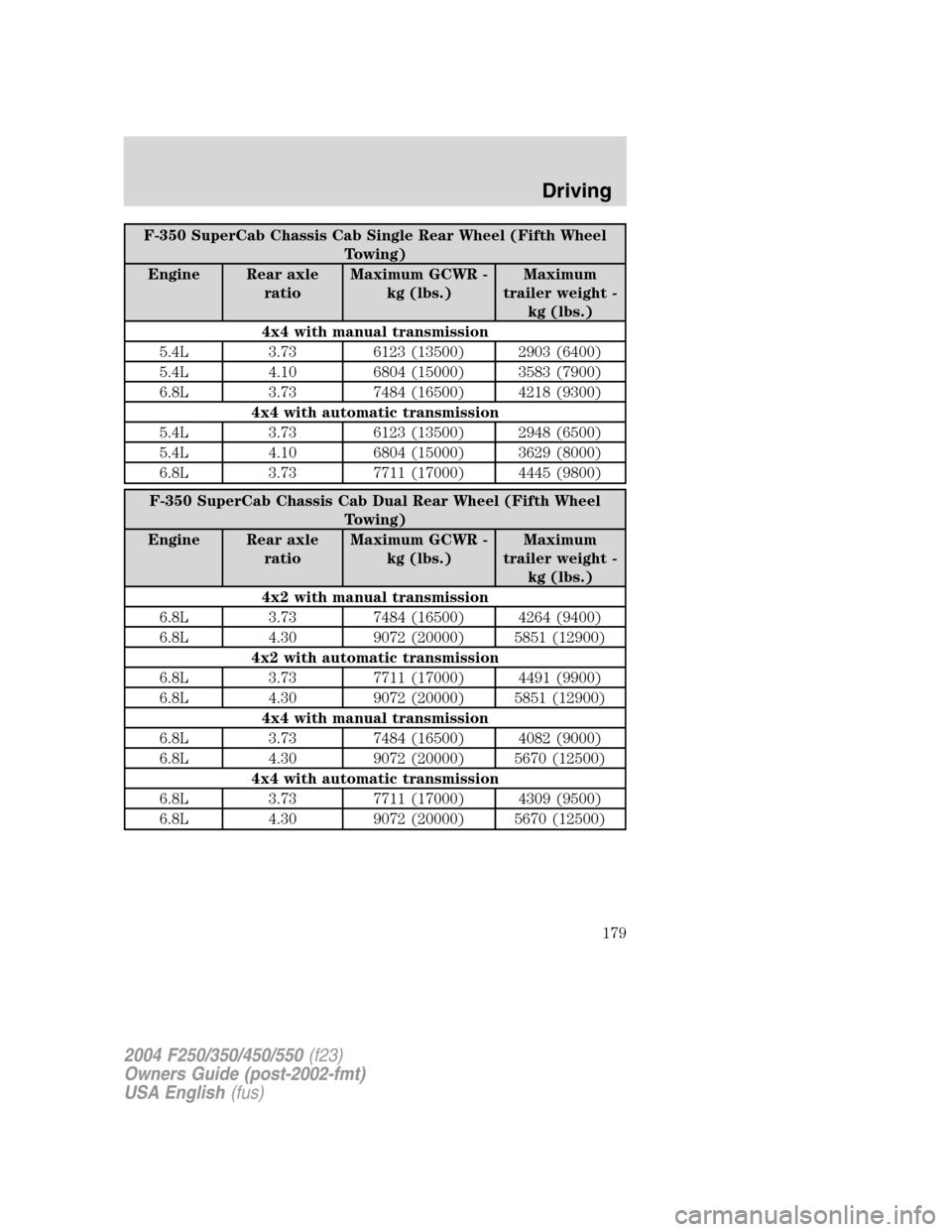
F-350 SuperCab Chassis Cab Single Rear Wheel (Fifth Wheel
Towing)
Engine Rear axle
ratioMaximum GCWR -
kg (lbs.)Maximum
trailer weight -
kg (lbs.)
4x4 with manual transmission
5.4L 3.73 6123 (13500) 2903 (6400)
5.4L 4.10 6804 (15000) 3583 (7900)
6.8L 3.73 7484 (16500) 4218 (9300)
4x4 with automatic transmission
5.4L 3.73 6123 (13500) 2948 (6500)
5.4L 4.10 6804 (15000) 3629 (8000)
6.8L 3.73 7711 (17000) 4445 (9800)
F-350 SuperCab Chassis Cab Dual Rear Wheel (Fifth Wheel
Towing)
Engine Rear axle
ratioMaximum GCWR -
kg (lbs.)Maximum
trailer weight -
kg (lbs.)
4x2 with manual transmission
6.8L 3.73 7484 (16500) 4264 (9400)
6.8L 4.30 9072 (20000) 5851 (12900)
4x2 with automatic transmission
6.8L 3.73 7711 (17000) 4491 (9900)
6.8L 4.30 9072 (20000) 5851 (12900)
4x4 with manual transmission
6.8L 3.73 7484 (16500) 4082 (9000)
6.8L 4.30 9072 (20000) 5670 (12500)
4x4 with automatic transmission
6.8L 3.73 7711 (17000) 4309 (9500)
6.8L 4.30 9072 (20000) 5670 (12500)
2004 F250/350/450/550(f23)
Owners Guide (post-2002-fmt)
USA English(fus)
Driving
179
Page 180 of 304
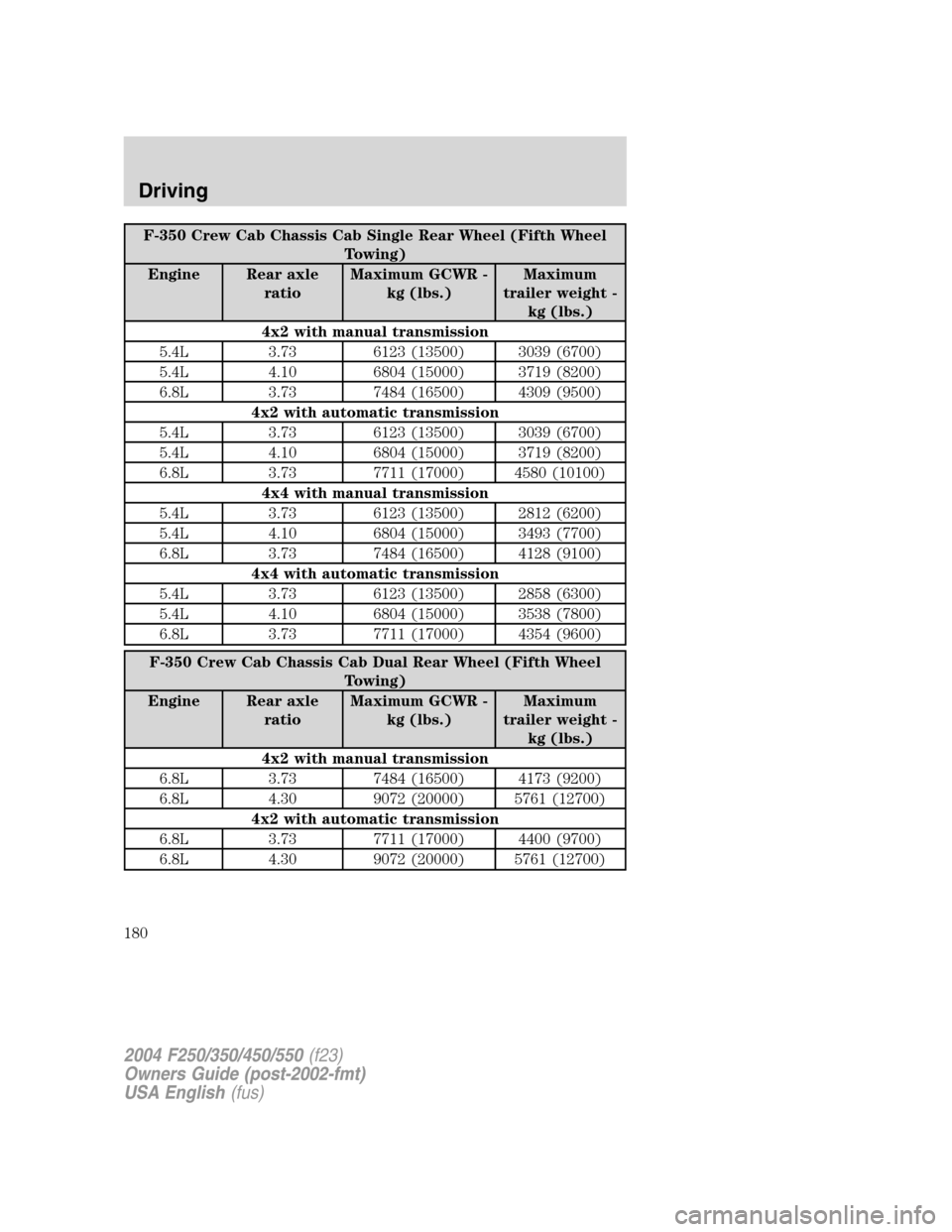
F-350 Crew Cab Chassis Cab Single Rear Wheel (Fifth Wheel
Towing)
Engine Rear axle
ratioMaximum GCWR -
kg (lbs.)Maximum
trailer weight -
kg (lbs.)
4x2 with manual transmission
5.4L 3.73 6123 (13500) 3039 (6700)
5.4L 4.10 6804 (15000) 3719 (8200)
6.8L 3.73 7484 (16500) 4309 (9500)
4x2 with automatic transmission
5.4L 3.73 6123 (13500) 3039 (6700)
5.4L 4.10 6804 (15000) 3719 (8200)
6.8L 3.73 7711 (17000) 4580 (10100)
4x4 with manual transmission
5.4L 3.73 6123 (13500) 2812 (6200)
5.4L 4.10 6804 (15000) 3493 (7700)
6.8L 3.73 7484 (16500) 4128 (9100)
4x4 with automatic transmission
5.4L 3.73 6123 (13500) 2858 (6300)
5.4L 4.10 6804 (15000) 3538 (7800)
6.8L 3.73 7711 (17000) 4354 (9600)
F-350 Crew Cab Chassis Cab Dual Rear Wheel (Fifth Wheel
Towing)
Engine Rear axle
ratioMaximum GCWR -
kg (lbs.)Maximum
trailer weight -
kg (lbs.)
4x2 with manual transmission
6.8L 3.73 7484 (16500) 4173 (9200)
6.8L 4.30 9072 (20000) 5761 (12700)
4x2 with automatic transmission
6.8L 3.73 7711 (17000) 4400 (9700)
6.8L 4.30 9072 (20000) 5761 (12700)
2004 F250/350/450/550(f23)
Owners Guide (post-2002-fmt)
USA English(fus)
Driving
180
Page 181 of 304
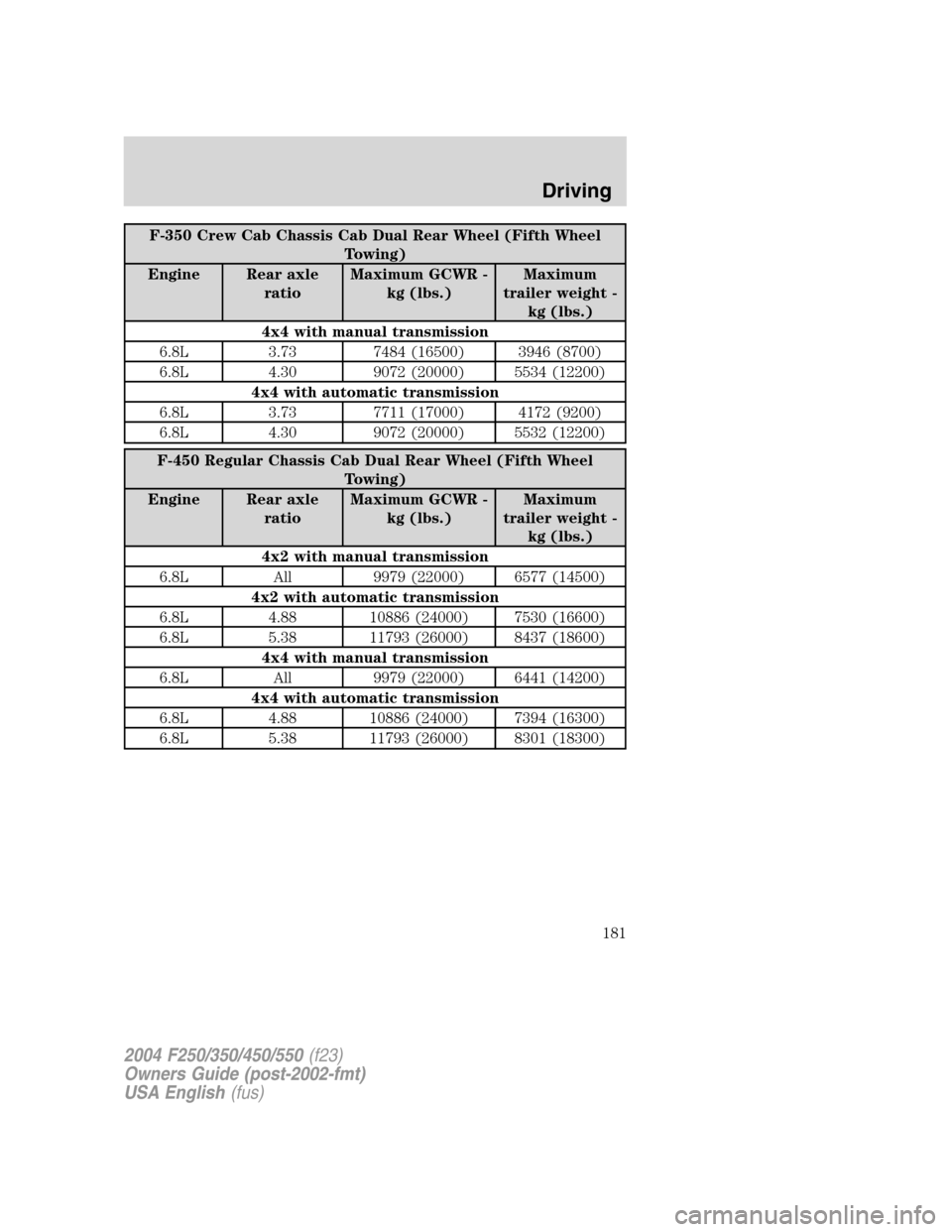
F-350 Crew Cab Chassis Cab Dual Rear Wheel (Fifth Wheel
Towing)
Engine Rear axle
ratioMaximum GCWR -
kg (lbs.)Maximum
trailer weight -
kg (lbs.)
4x4 with manual transmission
6.8L 3.73 7484 (16500) 3946 (8700)
6.8L 4.30 9072 (20000) 5534 (12200)
4x4 with automatic transmission
6.8L 3.73 7711 (17000) 4172 (9200)
6.8L 4.30 9072 (20000) 5532 (12200)
F-450 Regular Chassis Cab Dual Rear Wheel (Fifth Wheel
Towing)
Engine Rear axle
ratioMaximum GCWR -
kg (lbs.)Maximum
trailer weight -
kg (lbs.)
4x2 with manual transmission
6.8L All 9979 (22000) 6577 (14500)
4x2 with automatic transmission
6.8L 4.88 10886 (24000) 7530 (16600)
6.8L 5.38 11793 (26000) 8437 (18600)
4x4 with manual transmission
6.8L All 9979 (22000) 6441 (14200)
4x4 with automatic transmission
6.8L 4.88 10886 (24000) 7394 (16300)
6.8L 5.38 11793 (26000) 8301 (18300)
2004 F250/350/450/550(f23)
Owners Guide (post-2002-fmt)
USA English(fus)
Driving
181
Page 182 of 304
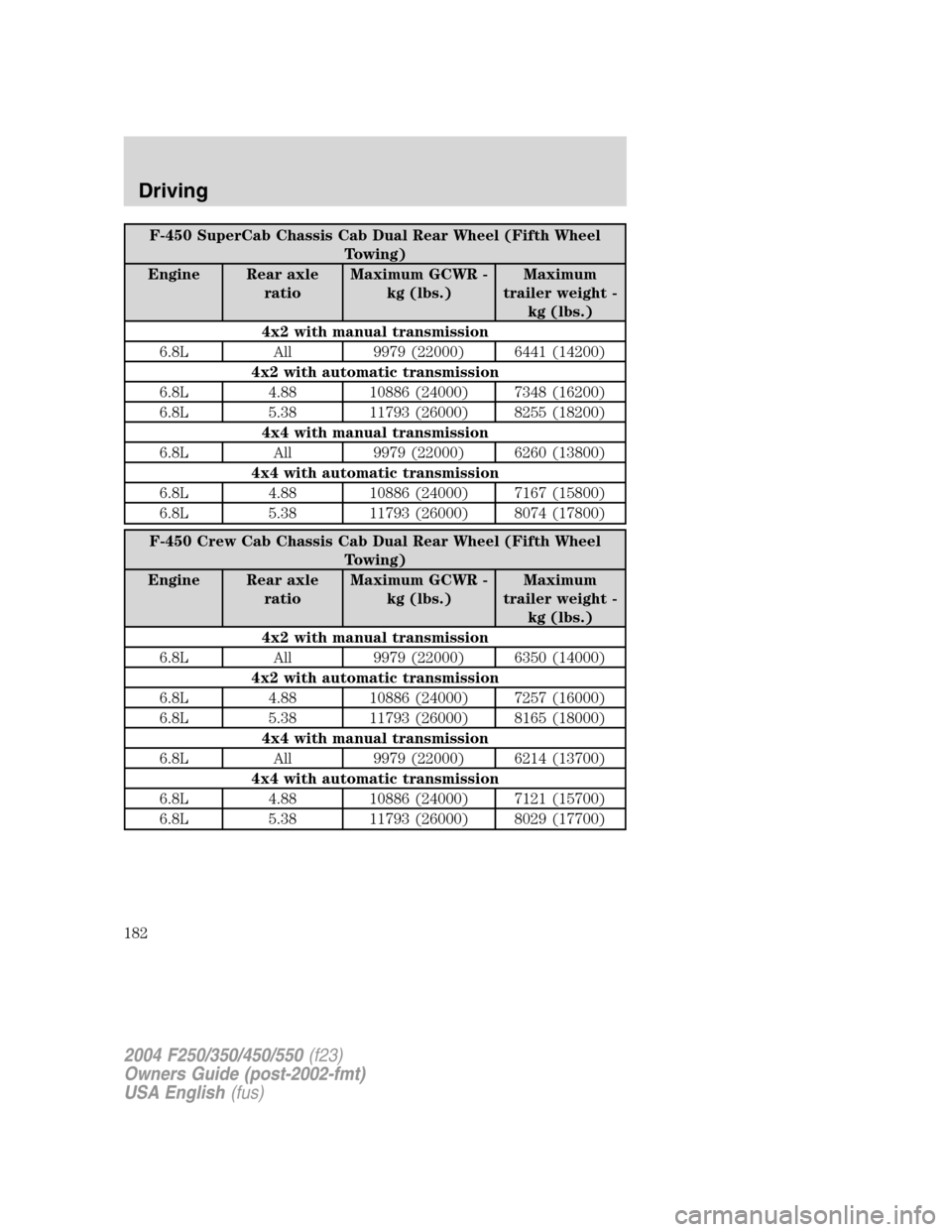
F-450 SuperCab Chassis Cab Dual Rear Wheel (Fifth Wheel
Towing)
Engine Rear axle
ratioMaximum GCWR -
kg (lbs.)Maximum
trailer weight -
kg (lbs.)
4x2 with manual transmission
6.8L All 9979 (22000) 6441 (14200)
4x2 with automatic transmission
6.8L 4.88 10886 (24000) 7348 (16200)
6.8L 5.38 11793 (26000) 8255 (18200)
4x4 with manual transmission
6.8L All 9979 (22000) 6260 (13800)
4x4 with automatic transmission
6.8L 4.88 10886 (24000) 7167 (15800)
6.8L 5.38 11793 (26000) 8074 (17800)
F-450 Crew Cab Chassis Cab Dual Rear Wheel (Fifth Wheel
Towing)
Engine Rear axle
ratioMaximum GCWR -
kg (lbs.)Maximum
trailer weight -
kg (lbs.)
4x2 with manual transmission
6.8L All 9979 (22000) 6350 (14000)
4x2 with automatic transmission
6.8L 4.88 10886 (24000) 7257 (16000)
6.8L 5.38 11793 (26000) 8165 (18000)
4x4 with manual transmission
6.8L All 9979 (22000) 6214 (13700)
4x4 with automatic transmission
6.8L 4.88 10886 (24000) 7121 (15700)
6.8L 5.38 11793 (26000) 8029 (17700)
2004 F250/350/450/550(f23)
Owners Guide (post-2002-fmt)
USA English(fus)
Driving
182
Page 183 of 304
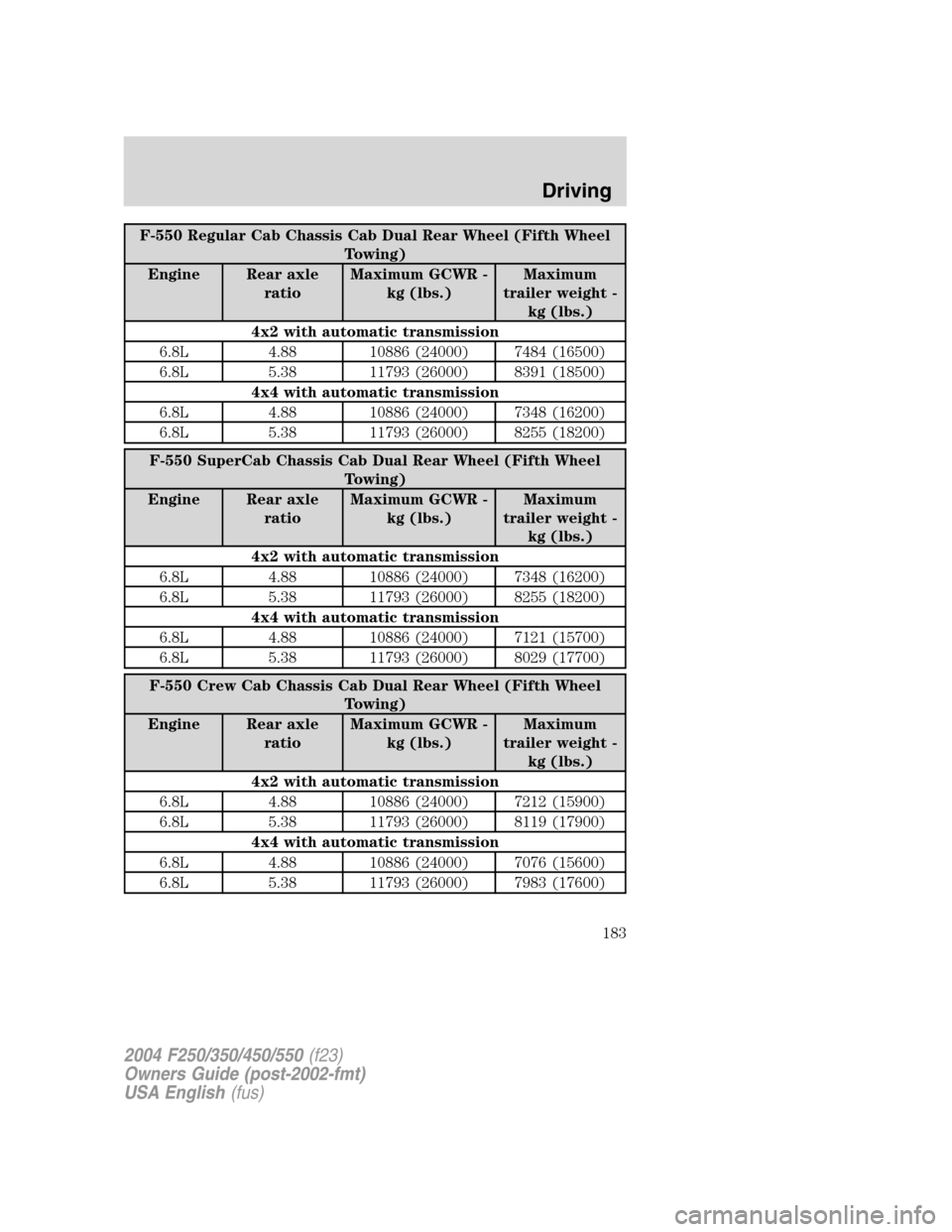
F-550 Regular Cab Chassis Cab Dual Rear Wheel (Fifth Wheel
Towing)
Engine Rear axle
ratioMaximum GCWR -
kg (lbs.)Maximum
trailer weight -
kg (lbs.)
4x2 with automatic transmission
6.8L 4.88 10886 (24000) 7484 (16500)
6.8L 5.38 11793 (26000) 8391 (18500)
4x4 with automatic transmission
6.8L 4.88 10886 (24000) 7348 (16200)
6.8L 5.38 11793 (26000) 8255 (18200)
F-550 SuperCab Chassis Cab Dual Rear Wheel (Fifth Wheel
Towing)
Engine Rear axle
ratioMaximum GCWR -
kg (lbs.)Maximum
trailer weight -
kg (lbs.)
4x2 with automatic transmission
6.8L 4.88 10886 (24000) 7348 (16200)
6.8L 5.38 11793 (26000) 8255 (18200)
4x4 with automatic transmission
6.8L 4.88 10886 (24000) 7121 (15700)
6.8L 5.38 11793 (26000) 8029 (17700)
F-550 Crew Cab Chassis Cab Dual Rear Wheel (Fifth Wheel
Towing)
Engine Rear axle
ratioMaximum GCWR -
kg (lbs.)Maximum
trailer weight -
kg (lbs.)
4x2 with automatic transmission
6.8L 4.88 10886 (24000) 7212 (15900)
6.8L 5.38 11793 (26000) 8119 (17900)
4x4 with automatic transmission
6.8L 4.88 10886 (24000) 7076 (15600)
6.8L 5.38 11793 (26000) 7983 (17600)
2004 F250/350/450/550(f23)
Owners Guide (post-2002-fmt)
USA English(fus)
Driving
183
Page 186 of 304

•Your vehicle may be equipped with a temporary or conventional spare
tire. If the spare tire is different in size (diameter and/or width), tread
type (All-Season or All-Terrain) or is from a different manufacturer
other than the road tires on your vehicle, your spare tire is considered
“temporary”. Consult information on the spare tire label for limitations
when using.
Servicing after towing
If you tow a trailer for long distances, your vehicle will require more
frequent service intervals. Refer to your scheduled maintenance guide for
more information.
Trailer towing tips
•Practice turning, stopping and backing up before starting on a trip to
get the feel of the vehicle trailer combination. When turning, make
wider turns so the trailer wheels will clear curbs and other obstacles.
•Allow more distance for stopping with a trailer attached.
•The trailer tongue weight should be 10–15% of the loaded trailer
weight.
•After you have traveled 80 km (50 miles), thoroughly check your
hitch, electrical connections and trailer wheel lug nuts.
•To aid in engine/transmission cooling and A/C efficiency during hot
weather while stopped in traffic, place the gearshift lever in P (Park)
(automatic transmission) or N (Neutral) (manual transmissions).
•Vehicles with trailers should not be parked on a grade. If you must
park on a grade, place wheel chocks under the trailer’s wheels.
Launching or retrieving a boat
When backing down a ramp during boat launching or retrieval,
•Do not allow the static water level to rise above the bottom edge of
the rear bumper.
•Do not allow waves to break higher than 15 cm (6 inches) above the
bottom edge of the rear bumper.
•Disconnect the trailer tow electrical connector to prevent blown fuses
caused by water entering into your trailer’s electrical wiring.
Exceeding these limits may allow water to enter critical vehicle
components, adversely affecting driveability, emissions and reliability.
Replace front and rear axle lubricants any time the axles have been
submerged in water. Axle lubricant quantities are not to be checked
unless a leak is suspected.
2004 F250/350/450/550(f23)
Owners Guide (post-2002-fmt)
USA English(fus)
Driving
186
Page 188 of 304
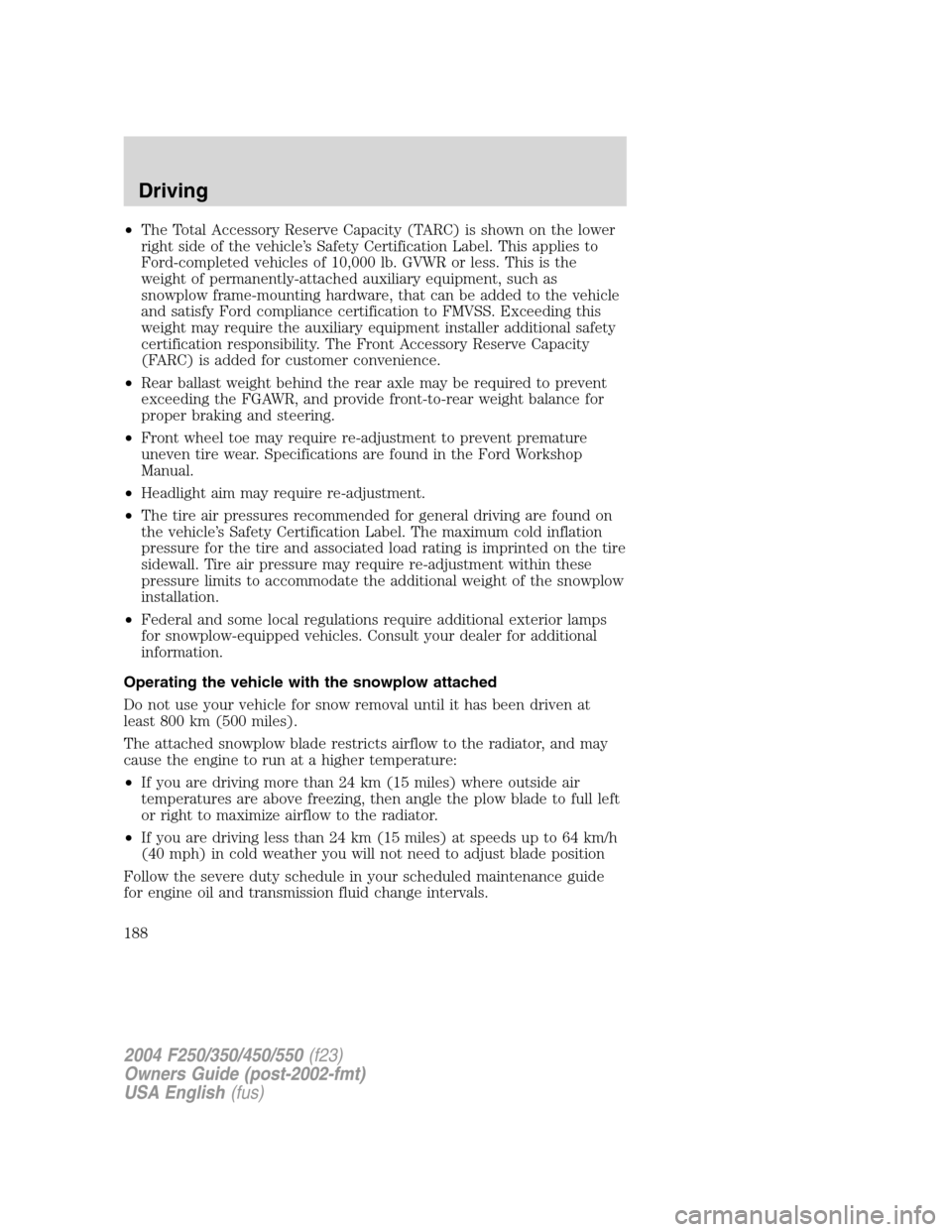
•The Total Accessory Reserve Capacity (TARC) is shown on the lower
right side of the vehicle’s Safety Certification Label. This applies to
Ford-completed vehicles of 10,000 lb. GVWR or less. This is the
weight of permanently-attached auxiliary equipment, such as
snowplow frame-mounting hardware, that can be added to the vehicle
and satisfy Ford compliance certification to FMVSS. Exceeding this
weight may require the auxiliary equipment installer additional safety
certification responsibility. The Front Accessory Reserve Capacity
(FARC) is added for customer convenience.
•Rear ballast weight behind the rear axle may be required to prevent
exceeding the FGAWR, and provide front-to-rear weight balance for
proper braking and steering.
•Front wheel toe may require re-adjustment to prevent premature
uneven tire wear. Specifications are found in the Ford Workshop
Manual.
•Headlight aim may require re-adjustment.
•The tire air pressures recommended for general driving are found on
the vehicle’s Safety Certification Label. The maximum cold inflation
pressure for the tire and associated load rating is imprinted on the tire
sidewall. Tire air pressure may require re-adjustment within these
pressure limits to accommodate the additional weight of the snowplow
installation.
•Federal and some local regulations require additional exterior lamps
for snowplow-equipped vehicles. Consult your dealer for additional
information.
Operating the vehicle with the snowplow attached
Do not use your vehicle for snow removal until it has been driven at
least 800 km (500 miles).
The attached snowplow blade restricts airflow to the radiator, and may
cause the engine to run at a higher temperature:
•If you are driving more than 24 km (15 miles) where outside air
temperatures are above freezing, then angle the plow blade to full left
or right to maximize airflow to the radiator.
•If you are driving less than 24 km (15 miles) at speeds up to 64 km/h
(40 mph) in cold weather you will not need to adjust blade position
Follow the severe duty schedule in your scheduled maintenance guide
for engine oil and transmission fluid change intervals.
2004 F250/350/450/550(f23)
Owners Guide (post-2002-fmt)
USA English(fus)
Driving
188
Page 189 of 304
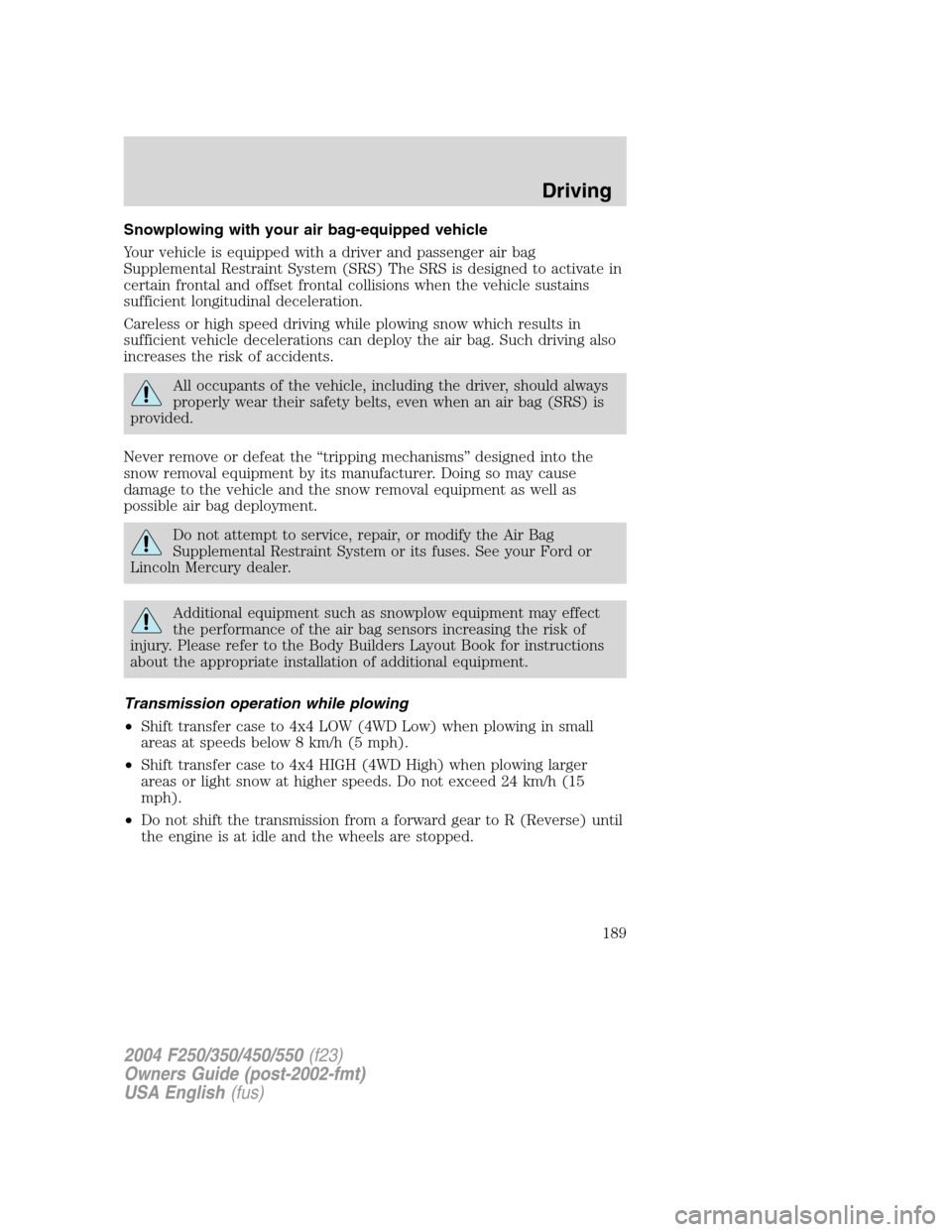
Snowplowing with your air bag-equipped vehicle
Your vehicle is equipped with a driver and passenger air bag
Supplemental Restraint System (SRS) The SRS is designed to activate in
certain frontal and offset frontal collisions when the vehicle sustains
sufficient longitudinal deceleration.
Careless or high speed driving while plowing snow which results in
sufficient vehicle decelerations can deploy the air bag. Such driving also
increases the risk of accidents.
All occupants of the vehicle, including the driver, should always
properly wear their safety belts, even when an air bag (SRS) is
provided.
Never remove or defeat the“tripping mechanisms”designed into the
snow removal equipment by its manufacturer. Doing so may cause
damage to the vehicle and the snow removal equipment as well as
possible air bag deployment.
Do not attempt to service, repair, or modify the Air Bag
Supplemental Restraint System or its fuses. See your Ford or
Lincoln Mercury dealer.
Additional equipment such as snowplow equipment may effect
the performance of the air bag sensors increasing the risk of
injury. Please refer to the Body Builders Layout Book for instructions
about the appropriate installation of additional equipment.
Transmission operation while plowing
•Shift transfer case to 4x4 LOW (4WD Low) when plowing in small
areas at speeds below 8 km/h (5 mph).
•Shift transfer case to 4x4 HIGH (4WD High) when plowing larger
areas or light snow at higher speeds. Do not exceed 24 km/h (15
mph).
•Do not shift the transmission from a forward gear to R (Reverse) until
the engine is at idle and the wheels are stopped.
2004 F250/350/450/550(f23)
Owners Guide (post-2002-fmt)
USA English(fus)
Driving
189