Page 244 of 304
![FORD SUPER DUTY 2004 1.G Owners Manual Fill your engine coolant reservoir as outlined inAdding engine coolant
in this chapter.
Severe climates
If you drive in extremely cold climates (less than–36°C[–34°F]):
•It may be necessary to](/manual-img/11/5261/w960_5261-243.png "FORD SUPER DUTY 2004 1.G Owners Manual Fill your engine coolant reservoir as outlined inAdding engine coolant
in this chapter.
Severe climates
If you drive in extremely cold climates (less than–36°C[–34°F]):
•It may be necessary to")
Fill your engine coolant reservoir as outlined inAdding engine coolant
in this chapter.
Severe climates
If you drive in extremely cold climates (less than–36°C[–34°F]):
•It may be necessary to increase the coolant concentration
above 50%.
•NEVER increase the coolant concentration above 60%.
•Increased engine coolant concentrations above 60% will
decrease the overheat protection characteristics of the engine
coolant and may cause engine damage.
•Refer to the chart on the coolant container to ensure the
coolant concentration in your vehicle will provide adequate
freeze protection at the temperatures in which you drive in the
winter months.
If you drive in extremely hot climates:
•It is still necessary to maintain the coolant concentration
above 40%.
•NEVER decrease the coolant concentration below 40%.
•Decreased engine coolant concentrations below 40% will
decrease the corrosion protection characteristics of the engine
coolant and may cause engine damage.
•Decreased engine coolant concentrations below 40% will
decrease the freeze protection characteristics of the engine
coolant and may cause engine damage.
•Refer to the chart on the coolant container to ensure the
coolant concentration in your vehicle will provide adequate
protection at the temperatures in which you drive.
Vehicles driven year-round in non-extreme climates should use a 50/50
mixture of engine coolant and distilled water for optimum cooling system
and engine protection.
What you should know about fail-safe cooling (if equipped)
If the engine coolant supply is depleted, this feature allows the vehicle to
be driven temporarily before incremental component damage is incurred.
The“fail-safe”distance depends on ambient temperatures, vehicle load
and terrain.
2004 F250/350/450/550(f23)
Owners Guide (post-2002-fmt)
USA English(fus)
Maintenance and Specifications
244
Page 245 of 304

How fail-safe cooling works
If the engine begins to overheat:
•The engine coolant temperature
gauge will move to the red (hot)
area.
•The
andsymbol will
illuminate.
•TheService Engine Soon
indicator light will illuminate.
If the engine reaches a preset
over-temperature condition, the engine will automatically switch to
alternating cylinder operation. Each disabled cylinder acts as an air
pump and cools the engine.
When this occurs the vehicle will still operate. However:
•The engine power will be limited.
•The air conditioning system will be disabled.
Continued operation will increase the engine temperature and the engine
will completely shut down, causing steering and braking effort to
increase.
Once the engine temperature cools, the engine can be re-started. Take
your vehicle to a service facility as soon as possible to minimize engine
damage.
When fail-safe mode is activated
You have limited engine power when in the fail-safe mode, so drive the
vehicle with caution. The vehicle will not be able to maintain high-speed
operation and the engine will run rough. Remember that the engine is
capable of completely shutting down automatically to prevent engine
damage, therefore:
1. Pull off the road as soon as safely possible and turn off the engine.
2. Arrange for the vehicle to be taken to a service facility.
3. If this is not possible, wait a short period for the engine to cool.
4. Check the coolant level and replenish if low.
Never remove the coolant reservoir cap while the engine is
running or hot.
2004 F250/350/450/550(f23)
Owners Guide (post-2002-fmt)
USA English(fus)
Maintenance and Specifications
245
Page 301 of 304
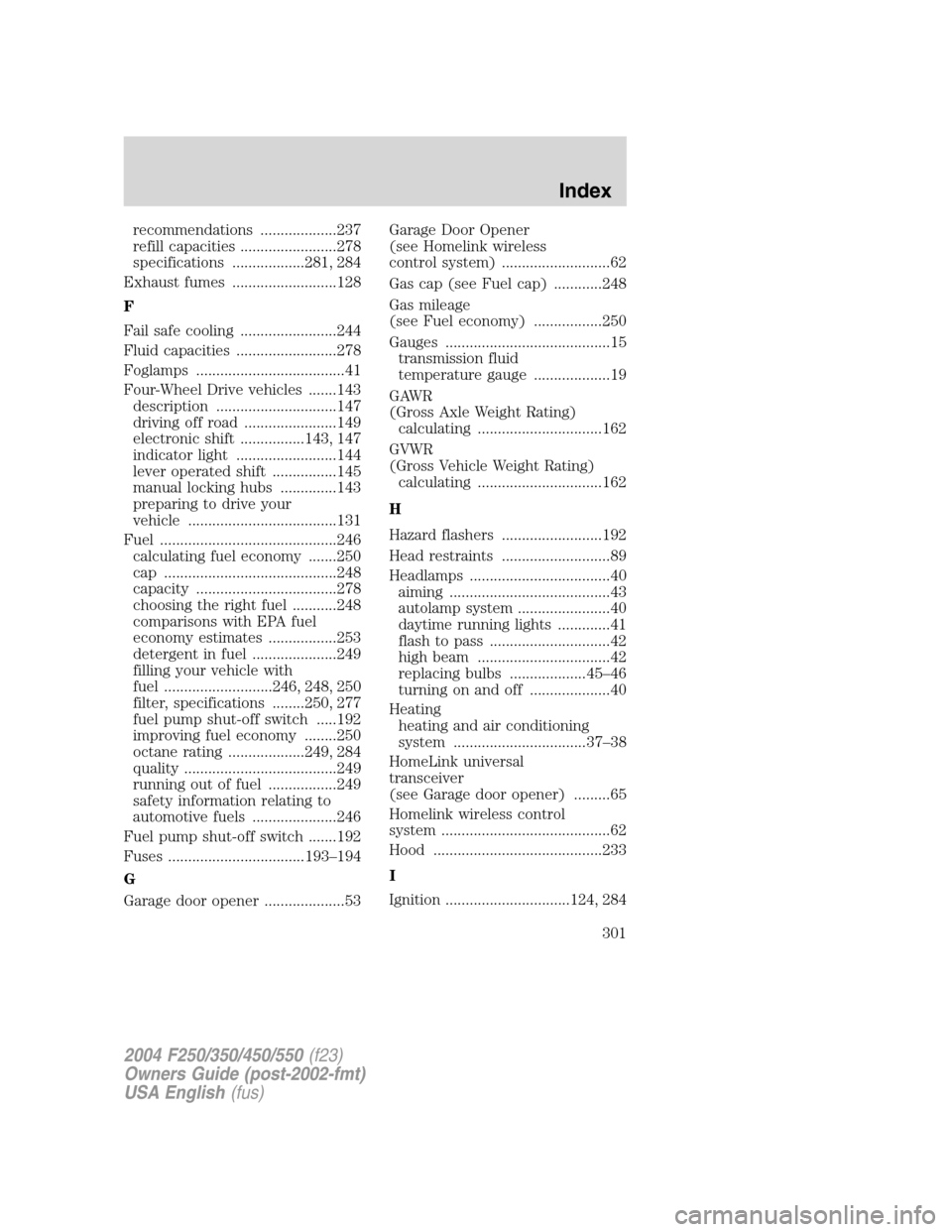
recommendations ...................237
refill capacities ........................278
specifications ..................281, 284
Exhaust fumes ..........................128
F
Fail safe cooling ........................244
Fluid capacities .........................278
Foglamps .....................................41
Four-Wheel Drive vehicles .......143
description ..............................147
driving off road .......................149
electronic shift ................143, 147
indicator light .........................144
lever operated shift ................145
manual locking hubs ..............143
preparing to drive your
vehicle .....................................131
Fuel ............................................246
calculating fuel economy .......250
cap ...........................................248
capacity ...................................278
choosing the right fuel ...........248
comparisons with EPA fuel
economy estimates .................253
detergent in fuel .....................249
filling your vehicle with
fuel ...........................246, 248, 250
filter, specifications ........250, 277
fuel pump shut-off switch .....192
improving fuel economy ........250
octane rating ...................249, 284
quality ......................................249
running out of fuel .................249
safety information relating to
automotive fuels .....................246
Fuel pump shut-off switch .......192
Fuses ..................................193–194
G
Garage door opener ....................53Garage Door Opener
(see Homelink wireless
control system) ...........................62
Gas cap (see Fuel cap) ............248
Gas mileage
(see Fuel economy) .................250
Gauges .........................................15
transmission fluid
temperature gauge ...................19
GAWR
(Gross Axle Weight Rating)
calculating ...............................162
GVWR
(Gross Vehicle Weight Rating)
calculating ...............................162
H
Hazard flashers .........................192
Head restraints ...........................89
Headlamps ...................................40
aiming ........................................43
autolamp system .......................40
daytime running lights .............41
flash to pass ..............................42
high beam .................................42
replacing bulbs ...................45–46
turning on and off ....................40
Heating
heating and air conditioning
system .................................37–38
HomeLink universal
transceiver
(see Garage door opener) .........65
Homelink wireless control
system ..........................................62
Hood ..........................................233
I
Ignition ...............................124, 284
2004 F250/350/450/550(f23)
Owners Guide (post-2002-fmt)
USA English(fus)
Index
301