2004 FORD SUPER DUTY engine oil
[x] Cancel search: engine oilPage 3 of 64

overpressurization and the risk of fuel expulsion and fires. To determine
whether the vehicle is equipped with theFord Ambulance Preparation
Package,inspect the information plate on the driver’s side door pillar.
Contact the manufacturer of your vehicle to determine whether the
ambulance manufacturer’s followed Ford’s recommendations.
WARNINGS
Throughout this guide, you will find warnings identified by the
symbol
. Warnings remind you to be especially careful to reduce the
risk of personal injury.
NEW VEHICLE BREAK-IN
Your vehicle does not need an extensive break-in. Try not to drive
continuously at the same speed for the first 1,600 km (1,000 miles) of
new vehicle operation. Vary your speed to allow parts to adjust
themselves to other parts.
Drive your new vehicle at least 800 km (500 miles) before towing a
trailer.
Do not add friction modifier compounds or special break-in oils during
the first few thousand kilometers (miles) of operation, since these
additives may prevent piston ring seating. SeeEngine oilin the
Maintenance and specificationssection for more information on oil
usage.
DIESEL ENGINE INFORMATION
The Diesel engine fuel system consists of:
•an engine-mounted secondary fuel filter
•frame-mounted Horizontal Fuel Conditioner Module (HFCM)
•a unit injector for each cylinder
The HFCM acts as a primary fuel filter/water separator which removes
both water and impurities from the fuel. The engine-mounted fuel filter
and the HFCM filter should be changed at the recommended service
interval. Refer to theGeneral Owner’s Informationsection of this
supplement for more information.
The HFCM should be drained at
regular intervals or when the
WATER IN FUEL light illuminates in
the instrument cluster.
Introduction
3
Page 4 of 64

The fuel injectors are located in the center of the combustion chambers
in the cylinder head between the rocker arm assemblies. The glow plug
system and fuel injection system are controlled through the Powertrain
Control Module (PCM) and Fuel Injection Control Module (FICM).
Fuel is drawn from the fuel tank by a frame-mounted electric fuel pump.
The fuel pump provides pressurized fuel to the engine and is
electronically controlled by the fuel pump PCM relay. The fuel pump
contains a pressure relief valve for overpressure protection in the event
of restricted flow.
Lubrication system
It is important to change the engine oil at the recommended service
intervals, because oil viscosity is important in maintaining the oil
pressure required to actuate the fuel injectors. Extended oil change
intervals can negatively affect engine performance, fuel economy and
engine life. Refer to the engine oil specification chart located under
Engine oil specificationsin theMaintenance and specifcations
chapter.
Fast start glow plug system
The glow plug system consists of:
•eight glow plugs
•the glow plug control module (GPCM)
•engine oil temperature (EOT) sensor
•barometric pressure (BARO) sensor
The glow plug system is
electronically controlled by the
PCM. The GPCM energizes the glow
plugs immediately after the ignition
is placed in the ON position, then determines how long the glow plugs
will be on according to the EOT and BARO sensors. The required time
for the glow plugs to be energized decreases as the engine oil
temperature and barometric pressure increase.
Engine cooling system
The cooling system contains an engine oil cooler which is mounted in the
center valley of the engine. The cooler’s function is to regulate engine oil
temperature.
Introduction
4
Page 11 of 64
STARTING THE ENGINE
Read all starting instructions carefully before you start your vehicle.
For temperatures below 0°C (32°F), the use of the correct grade engine
oil is essential for proper operation.
If your vehicle is equipped with a manual transmission, make sure the
parking brake is set fully before you turn the key. Depress the clutch
pedal and place the gearshift in the neutral position. The clutch must be
fully depressed in order to operate the starter. Do not press the
accelerator during starting.
If your vehicle is equipped with an automatic transmission, ensure the
gearshift lever is in P (Park) and the parking brake is set before you turn
the key. Do not press the accelerator during starting.
COLD WEATHER STARTING
Do not crank the engine for more than 30 seconds as starter damage
may occur. If the engine fails to start, turn the key to 3 (OFF) and wait
30 seconds before trying again.
Do not use starting fluid, such as ether, in the air intake system
(see air cleaner decal). Such fluid could cause immediate
explosive damage to the engine and possible personal injury.
Note:Do not add gasoline, gasohol or alcohol to Diesel fuel. This
practice creates a serious fire hazard and causes engine performance
problems.
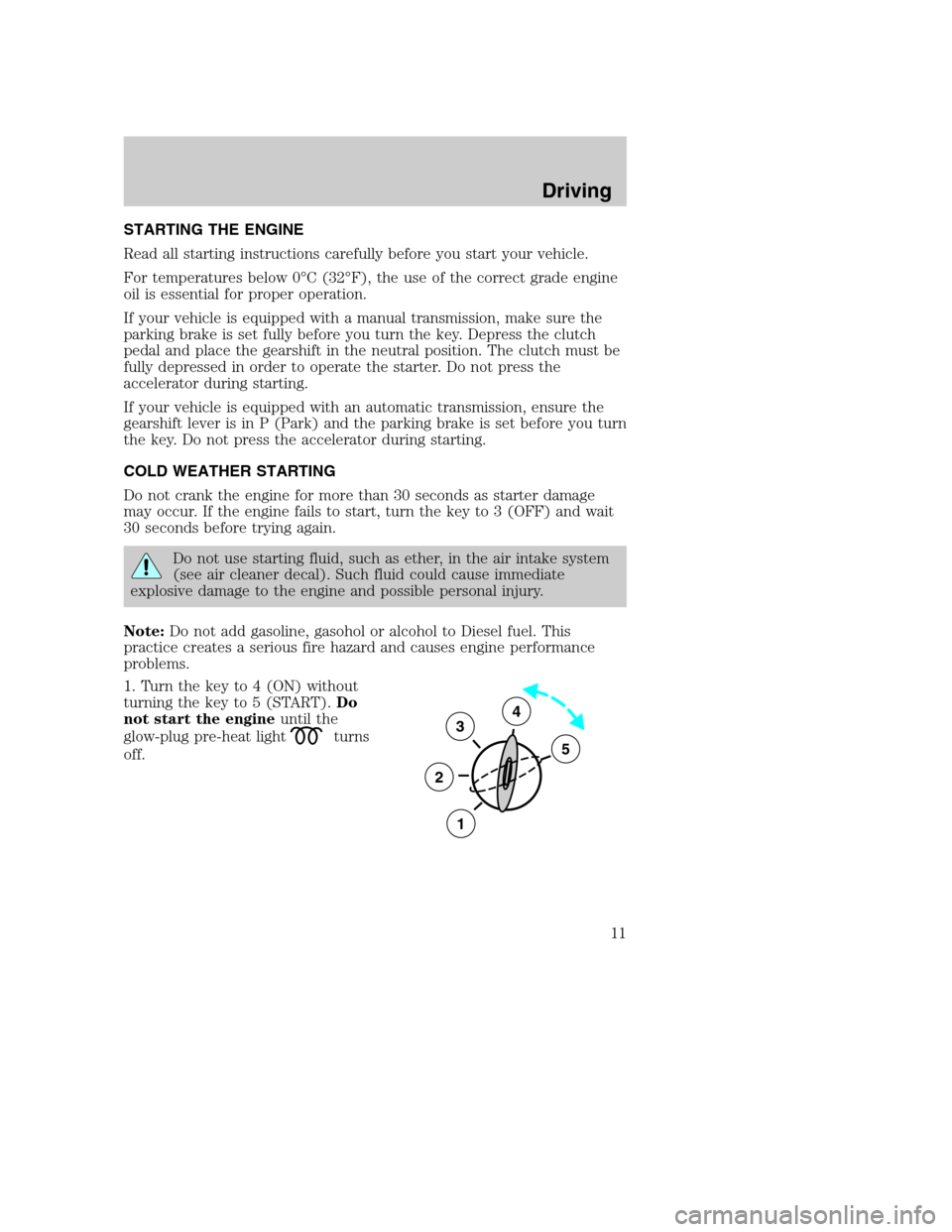
1. Turn the key to 4 (ON) without
turning the key to 5 (START).Do
not start the engineuntil the
glow-plug pre-heat light
turns
off.3
2
1
5
4
Driving
Driving
11
Page 12 of 64
2. When the glow plug pre-heat light
turns off, turn the key to 5
(START), then release the key as
soon as the engine starts. The glow
plugs will continue to be activated for two minutes after the glow plug
pre-heat light
has turned off. If the engine is not started before the
glow plug activation time ends, the glow plugs will need to be reset by
turning the key to 3 (OFF).
3. After the engine starts, allow it to idle for about 15 seconds. Do not
increase engine speed until the oil pressure gauge indicates normal
pressure.
Note:If the engine does not start within five seconds on the first try,
turn the key to 3 (OFF), wait 10 seconds and try again. If the engine still
fails to start, press the accelerator to the floor and try again; this will
allow the engine to crank with the fuel shut off in case the engine is
flooded with fuel.
STOPPING THE ENGINE
Turn the ignition to OFF. To prolong engine life (after extended high
speed or maximum GVW operation), it is recommended that a hot engine
be allowed to operate at low idle for about 7–10 minutes which would
allow sufficient time for the turbocharged engine to cool down.
COLD WEATHER OPERATION
Changing to a lighter grade engine oil also makes starting easier under
these conditions. Refer toEngine oil specificationsin theMaintenance
and specificationschapter.
At temperatures below–7°C (20°F), Number 2–D Diesel fuel may
thicken enough to clog the fuel filter. Your vehicle is equipped with an
HFCM which acts as a fuel filter/heater/water separator to keep the wax
melted which will help prevent fuel filter clogging. However, if the engine
starts but stalls after a short time and will not restart, the fuel filter(s)
may be clogged. For best results in cold weather, use Number 1–D Diesel
fuel or“winterized”Number 2–D Diesel fuel which has an additive to
minimize wax formation.
Your vehicle is also equipped with a bypass relief valve, located on the
fuel control module, which provides fuel flow to the engine if the fuel
pickup should become plugged by ice or wax. To allow this bypass valve
to function and avoid engine fuel starvation, it is recommended that,
during cold weather operation 0°C (32°F) or below, the fuel level in your
Driving
12
Page 23 of 64
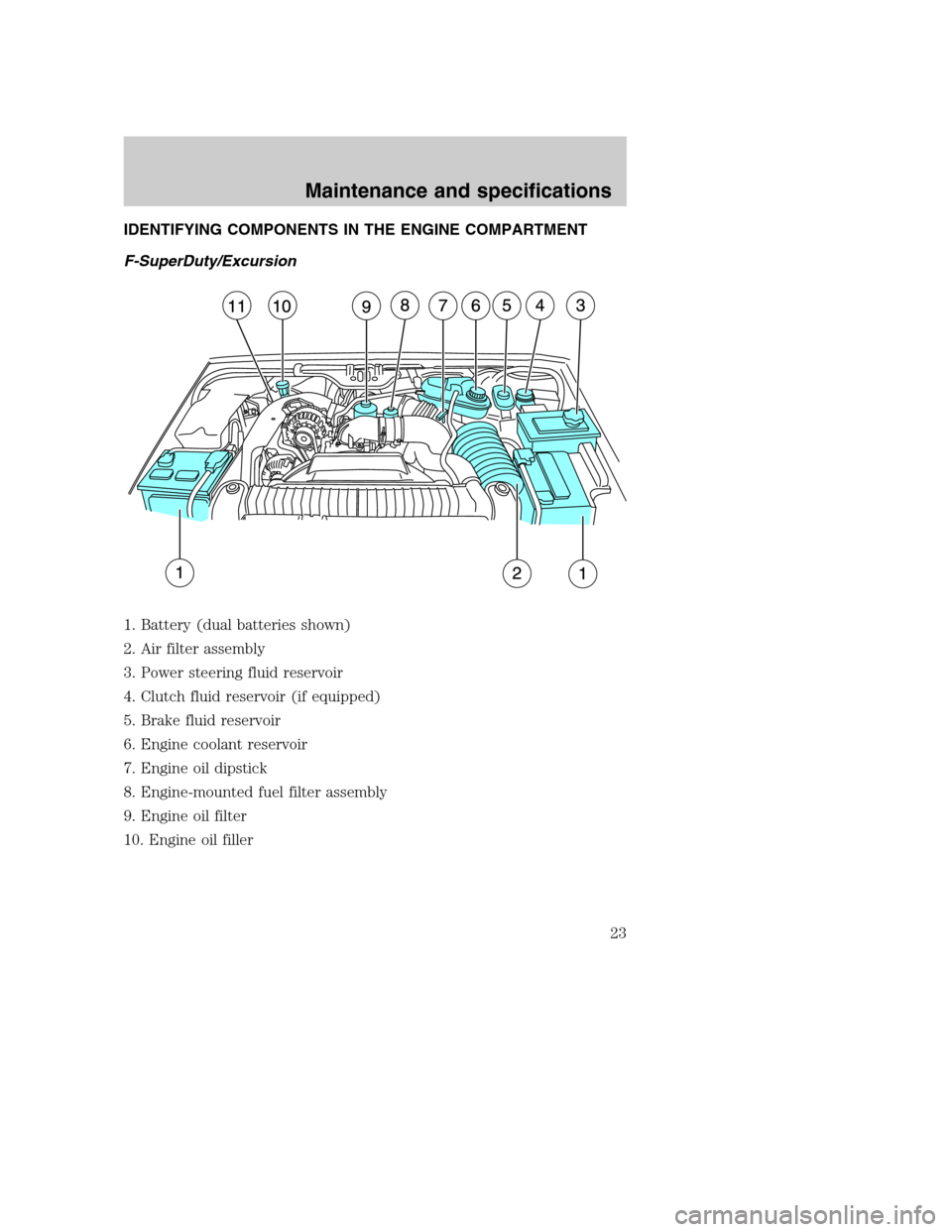
IDENTIFYING COMPONENTS IN THE ENGINE COMPARTMENT
F-SuperDuty/Excursion
1. Battery (dual batteries shown)
2. Air filter assembly
3. Power steering fluid reservoir
4. Clutch fluid reservoir (if equipped)
5. Brake fluid reservoir
6. Engine coolant reservoir
7. Engine oil dipstick
8. Engine-mounted fuel filter assembly
9. Engine oil filter
10. Engine oil filler
Maintenance and specifications
Maintenance and specifications
23
Page 24 of 64
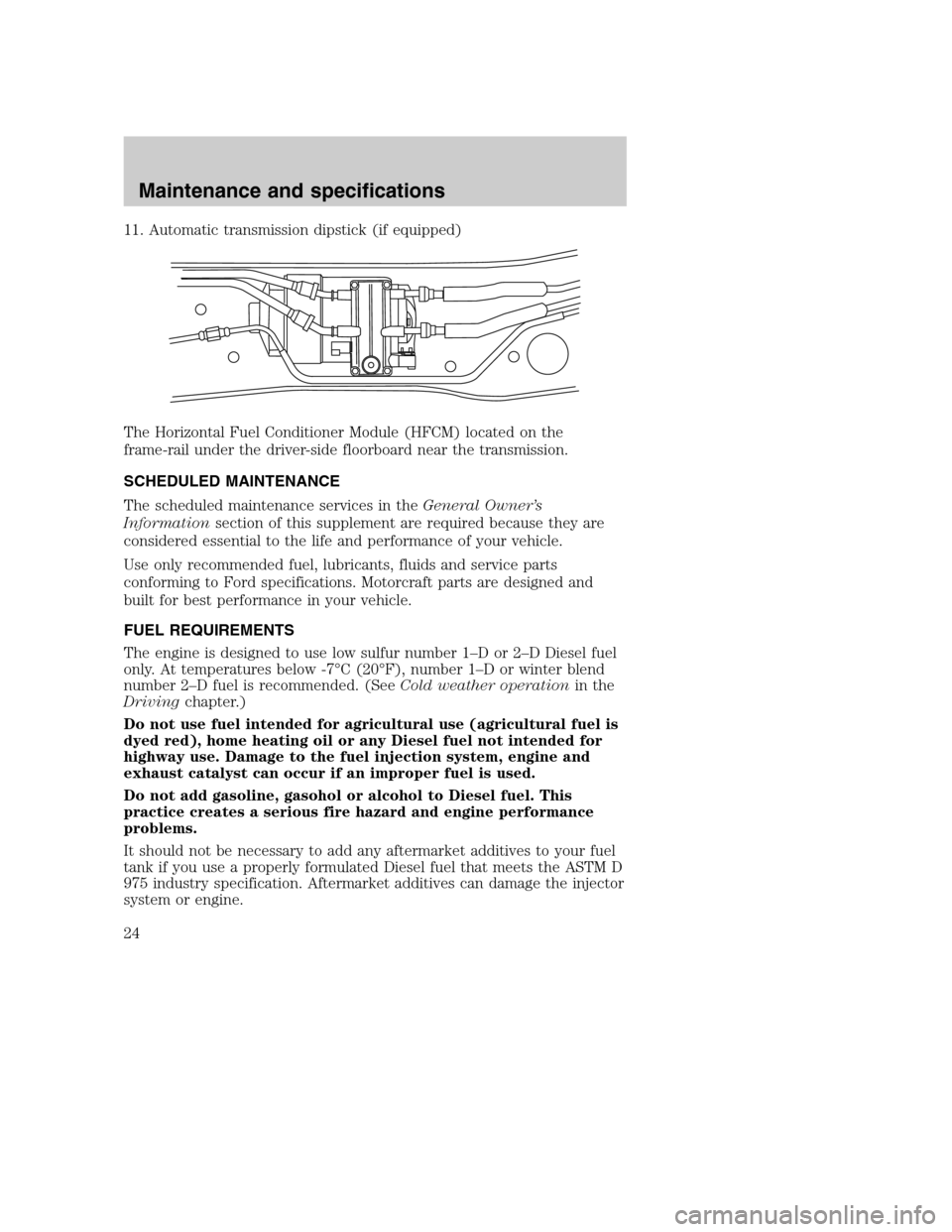
11. Automatic transmission dipstick (if equipped)
The Horizontal Fuel Conditioner Module (HFCM) located on the
frame-rail under the driver-side floorboard near the transmission.
SCHEDULED MAINTENANCE
The scheduled maintenance services in theGeneral Owner’s
Informationsection of this supplement are required because they are
considered essential to the life and performance of your vehicle.
Use only recommended fuel, lubricants, fluids and service parts
conforming to Ford specifications. Motorcraft parts are designed and
built for best performance in your vehicle.
FUEL REQUIREMENTS
The engine is designed to use low sulfur number 1–Dor2–D Diesel fuel
only. At temperatures below -7°C (20°F), number 1–D or winter blend
number 2–D fuel is recommended. (SeeCold weather operationin the
Drivingchapter.)
Do not use fuel intended for agricultural use (agricultural fuel is
dyed red), home heating oil or any Diesel fuel not intended for
highway use. Damage to the fuel injection system, engine and
exhaust catalyst can occur if an improper fuel is used.
Do not add gasoline, gasohol or alcohol to Diesel fuel. This
practice creates a serious fire hazard and engine performance
problems.
It should not be necessary to add any aftermarket additives to your fuel
tank if you use a properly formulated Diesel fuel that meets the ASTM D
975 industry specification. Aftermarket additives can damage the injector
system or engine.
Maintenance and specifications
24
Page 25 of 64

Do not blend used engine oil with Diesel fuel under any
circumstances.Blending used oil with the fuel will significantly increase
your vehicle’s exhaust emissions and reduce engine life due to increased
internal wear.
Do not crank the engine for more than 30 seconds at a time as
damage to the starter motor may result.
If the engine fails to start in 30 seconds, turn the key to the OFF
position and wait 30 seconds before trying again.
Truck stops have pumps and nozzles designed for larger, heavy-duty
trucks. When refueling at truck stops: if the nozzle shuts off repeatedly
when refueling, wait 5–10 seconds; then use a slower rate of flow (don’t
depress the nozzle trigger as far).
If air is allowed to enter the fuel system (during fuel filter change or if
you run out of fuel) the engine will purge the trapped air as it runs. The
engine may run rough and produce white smoke while air is in the
system. This is normal and should correct itself in a short time.
An engine that suddenly becomes noisy or operates poorly after a fuel fill
could be using substandard fuel (i.e., high water content, low cetane
rating or gasoline in the fuel). Diesel fuel should be purchased from a
reputable station which sells a large amount of Diesel fuel.
Care should be taken whenever Diesel fuel is stored. Use only clean,
approved containers which will prevent the entry of dirt or water.
Diesel fuel must not be stored in a galvanized container. The fuel will
dissolve the zinc in a galvanized container. The zinc will then remain in
solution until it is run through the engine where it will be deposited in
the fuel injectors causing expensive-to-repair damage.
Diesel fuel dispensing nozzle fill rate
This truck is equipped with a fuel fill pipe which is able to accept fuel up
to 20 gallons per minute from an 1 1/8 inch fuel dispensing nozzle.
Pumping fuel at greater flow rates may result in premature nozzle
shut-off or spitback.
HORIZONTAL FUEL CONDITIONING MODULE (HFCM)
(FUEL FILTER/WATER SEPARATOR)
The vehicle is equipped with a Horizontal Fuel Conditioning Module
(HFCM) located on the frame-rail under the driver-side floorboard near
the transmission.
Maintenance and specifications
25
Page 28 of 64
Using a fuel which has more than average impurities may require
the fuel filter to be replaced more frequently than the service
interval specifies.
ENGINE OIL
Checking the engine oil level
Because it is normal to add some oil between oil changes, check your
engine oil level each time you stop for fuel. To check the engine oil level
consistently and accurately, the following procedure is recommended:
1. Have engine at normal operating temperature (at least into the
NORMAL range on the engine coolant temperature gauge).
2. Park the vehicle on a level surface, then turn off the engine and open
the hood.
3. Allow at least20 minutesafter engine shutdown to assure that the oil
contained in the upper parts of the engine has returned to the oil pan.
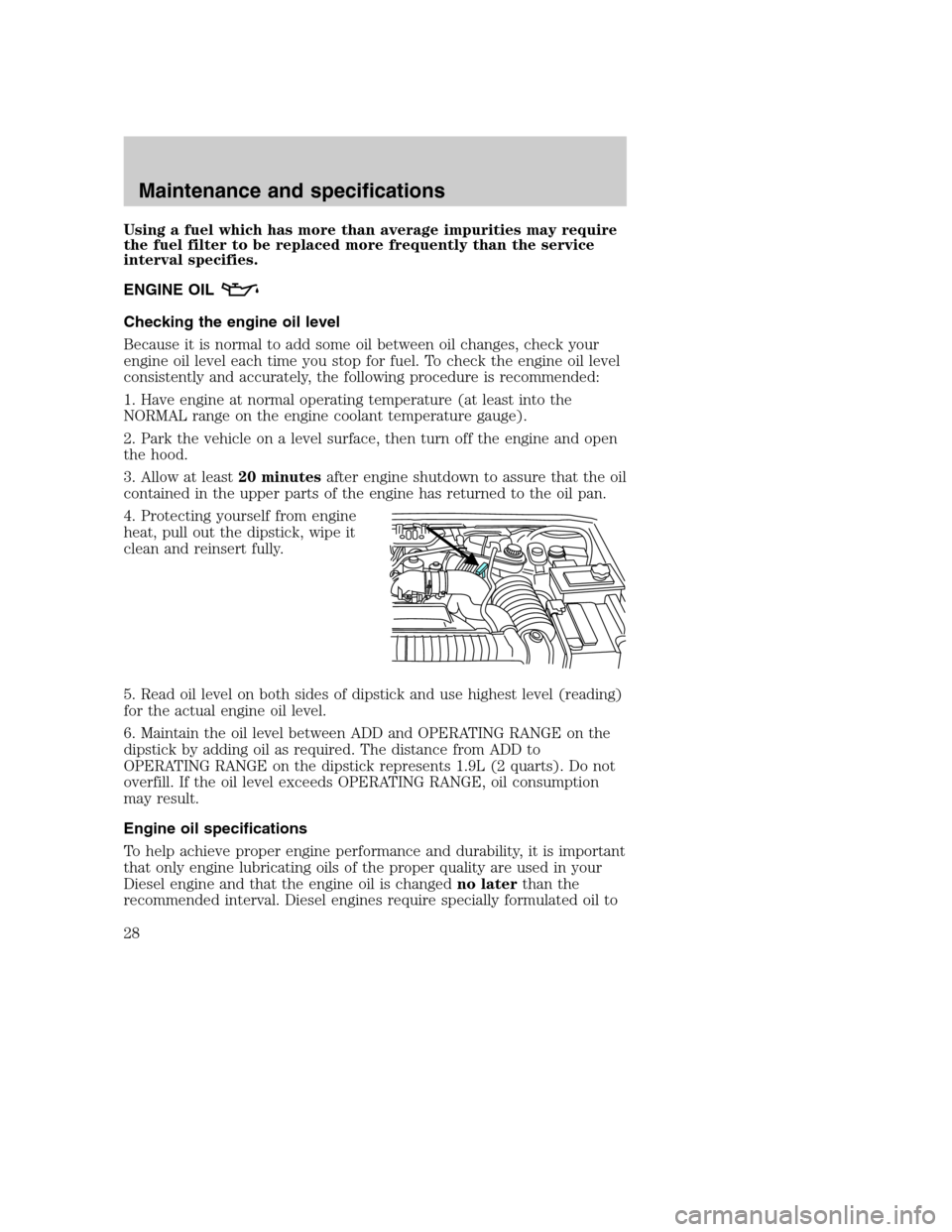
4. Protecting yourself from engine
heat, pull out the dipstick, wipe it
clean and reinsert fully.
5. Read oil level on both sides of dipstick and use highest level (reading)
for the actual engine oil level.
6. Maintain the oil level between ADD and OPERATING RANGE on the
dipstick by adding oil as required. The distance from ADD to
OPERATING RANGE on the dipstick represents 1.9L (2 quarts). Do not
overfill. If the oil level exceeds OPERATING RANGE, oil consumption
may result.
Engine oil specifications
To help achieve proper engine performance and durability, it is important
that only engine lubricating oils of the proper quality are used in your
Diesel engine and that the engine oil is changedno laterthan the
recommended interval. Diesel engines require specially formulated oil to
Maintenance and specifications
28