Page 1 of 240
Introduction 4
Instrument Cluster 10
Warning and control lights 10
Gauges 14
Entertainment Systems 18
AM/FM stereo with CD 18
AM/FM stereo with in-dash six CD 25
Climate Controls 33
Manual heating and air conditioning 33
Rear window defroster 34
Lights 35
Headlamps 35
Turn signal control 38
Bulb replacement 38
Driver Controls 43
Windshield wiper/washer control 43
Steering wheel adjustment 44
Power windows 45
Mirrors 46
Speed control 46
Locks and Security 54
Keys 54
Locks 54
Anti-theft system 57
2004 Mustang(mus)
Owners Guide (post-2002-fmt)
USA English(fus)
Table of Contents
1
Page 33 of 240
MANUAL HEATING AND AIR CONDITIONING
SYSTEM
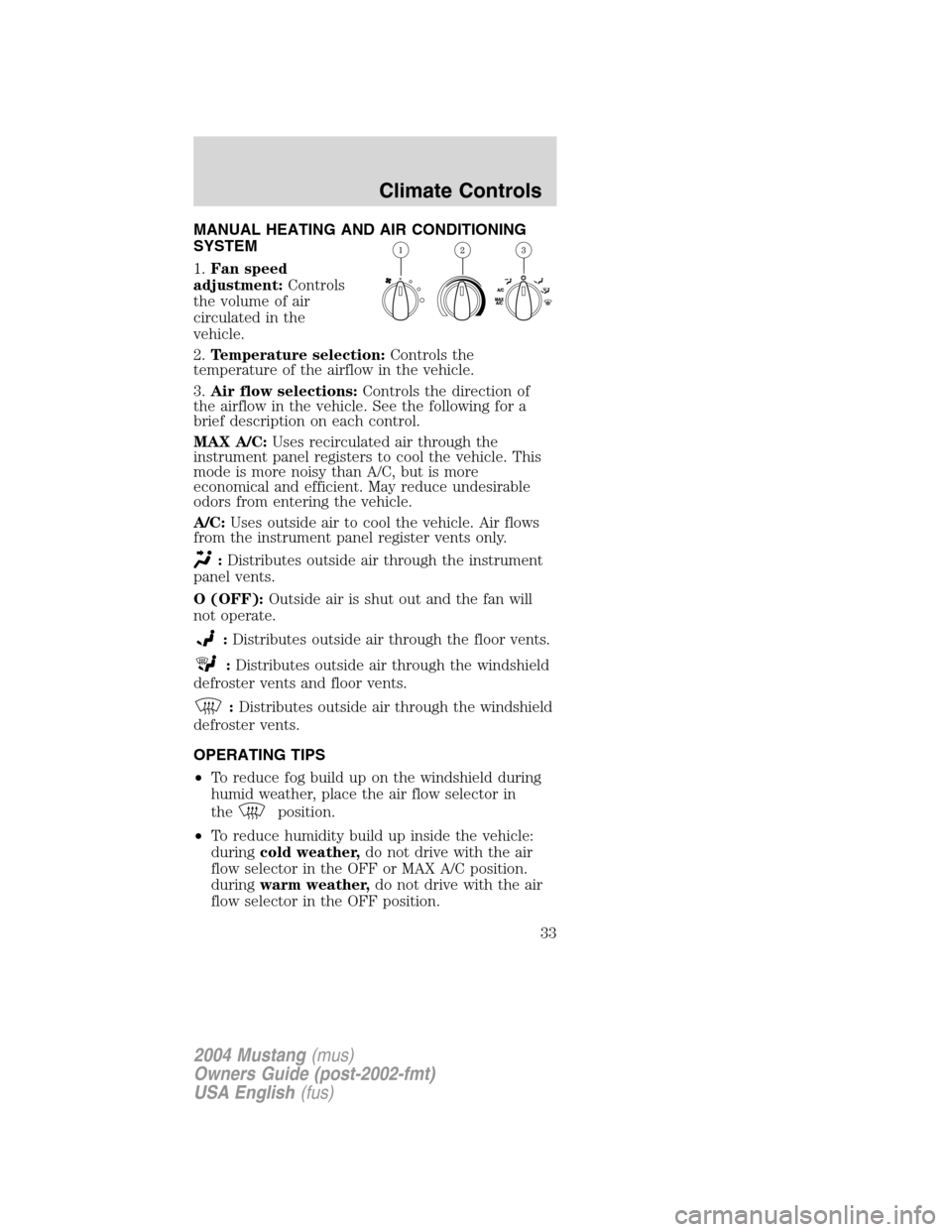
1.Fan speed
adjustment:Controls
the volume of air
circulated in the
vehicle.
2.Temperature selection:Controls the
temperature of the airflow in the vehicle.
3.Air flow selections:Controls the direction of
the airflow in the vehicle. See the following for a
brief description on each control.
MAX A/C:Uses recirculated air through the
instrument panel registers to cool the vehicle. This
mode is more noisy than A/C, but is more
economical and efficient. May reduce undesirable
odors from entering the vehicle.
A/C:Uses outside air to cool the vehicle. Air flows
from the instrument panel register vents only.
:Distributes outside air through the instrument
panel vents.
O (OFF):Outside air is shut out and the fan will
not operate.
:Distributes outside air through the floor vents.
:Distributes outside air through the windshield
defroster vents and floor vents.
:Distributes outside air through the windshield
defroster vents.
OPERATING TIPS
•To reduce fog build up on the windshield during
humid weather, place the air flow selector in
the
position.
•To reduce humidity build up inside the vehicle:
duringcold weather,do not drive with the air
flow selector in the OFF or MAX A/C position.
duringwarm weather,do not drive with the air
flow selector in the OFF position.
2004 Mustang(mus)
Owners Guide (post-2002-fmt)
USA English(fus)
Climate Controls
33
Page 34 of 240
•Under normal weather conditions, do not leave
the air flow selector in MAX A/C or OFF when the
vehicle is parked. This allows the vehicle to
“breathe”using the outside air inlet vents.
•Do not put objects under the front seats that will
interfere with the air flow to the back seats.
•Remove any snow, ice or leaves from the air
intake area at the base of the windshield.
Do not place objects on top of the
instrument panel as these objects may
become projectiles in a collision or sudden stop.
REAR WINDOW DEFROSTER
Ensure that the ignition
is in the ON position.
Press the control to
clear the rear window of thin ice and fog. The LED
will illuminate.
The defroster turns off automatically after 10
minutes or when the ignition is turned OFF. To
manually turn off the defroster before 10 minutes,
push the control again.
2004 Mustang(mus)
Owners Guide (post-2002-fmt)
USA English(fus)
Climate Controls
34
Page 127 of 240
Fuse/Relay
LocationFuse Amp
RatingPassenger Compartment
Fuse Panel Description
11 15A Back-up lamps
12 2A Heated PCV
13 15A Electronic flasher
14—Not used
15 15A Power lumbar
16—Not used
17 15A Speed control servo, Shift
lock actuator
18 15A Electronic flasher
19 15A Power mirror switch, GEM,
Anti-theft relay, Power door
locks, Door ajar switches
20 15A Convertible top switch
21 5A Instrument cluster and
engine control memory
22—Not used
23 15A A/C clutch, Defogger switch
24 30A Climate control blower
motor
25 25A Luggage compartment lid
release
26 30A Wiper/Washer motor, Wiper
relays
27 20A Radio
28 15A GEM, Overdrive cancel
switch
29 15A Anti-lock Brake System
(ABS) module
30 15A Daytime Running Lamps
(DRL) module
31 10A Data link connector
32 15A Radio, GEM
33 15A Stop lamp switch, Speed
control deactivation switch
2004 Mustang(mus)
Owners Guide (post-2002-fmt)
USA English(fus)
Roadside Emergencies
127
Page 201 of 240
Treadwear
The treadwear grade is a comparative rating based
on the wear rate of the tire when tested under
controlled conditions on a specified government test
course. For example, a tire graded 150 would wear
one and one-half (1 1/2) times as well on the
government course as a tire graded 100. The relative
performance of tires depends upon the actual
conditions of their use, however, and may depart
significantly from the norm due to variations in
driving habits, service practices, and differences in
road characteristics and climate.
Traction AA A B C
The traction grades, from highest to lowest are AA,
A, B, and C. The grades represent the tire’s ability to
stop on wet pavement as measured under controlled
conditions on specified government test surfaces of
asphalt and concrete. A tire marked C may have
poor traction performance.
The traction grade assigned to this tire is
based on straight-ahead braking traction
tests, and does not include acceleration, cornering,
hydroplaning or peak traction characteristics.
Temperature A B C
The temperature grades are A (the highest), B and
C, representing the tire’s resistance to the
generation of heat and its ability to dissipate heat
when tested under controlled conditions on a
specified indoor laboratory test wheel. Sustained
high temperature can cause the material of the tire
to degenerate and reduce tire life, and excessive
temperature can lead to sudden tire failure. The
grade C corresponds to a level of performance which
all passenger car tires must meet under the Federal
Motor Vehicle Safety Standard No. 109. Grades B
and A represent higher levels of performance on the
laboratory test wheel than the minimum required by
law.
2004 Mustang(mus)
Owners Guide (post-2002-fmt)
USA English(fus)
Maintenance and Specifications
201
Page 214 of 240
SNOW TIRES AND CHAINS
Driving too fast for conditions creates the
possibility of loss of vehicle control. Driving
at very high speeds for extended periods of time
may result in damage to vehicle components.
Snow tires must be the same size and grade
as the tires you currently have on your
vehicle.
The tires on your vehicle have all weather treads to
provide traction in rain and snow. However, in some
climates, you may need to use snow tires and
chains. Use chains on the tires only in an emergency
or if the law requires them.
Follow these guidelines when using snow tires and
chains:
•Chains may damage aluminum wheels.
•Use only Cable Type chains with size P225/55R16
or 245/45ZR17 tires. Use of SAE Class S chains
may damage your vehicle.
•Install chains securely, verifying that the chains do
not touch any wiring, brake lines or fuel lines.
•Drive cautiously. If you hear the chains rub or
bang against your vehicle, stop and re-tighten the
chains. If this does not work, remove the chains
to prevent damage to your vehicle.
•If possible, avoid fully loading your vehicle.
•Remove the tire chains when they are no longer
needed. Do not use tire chains on dry roads.
•The suspension insulation and bumpers will help
prevent vehicle damage. Do not remove these
components from your vehicle when using snow
tires and chains.
2004 Mustang(mus)
Owners Guide (post-2002-fmt)
USA English(fus)
Maintenance and Specifications
214