2004 FORD MUSTANG warning
[x] Cancel search: warningPage 99 of 240
STARTING
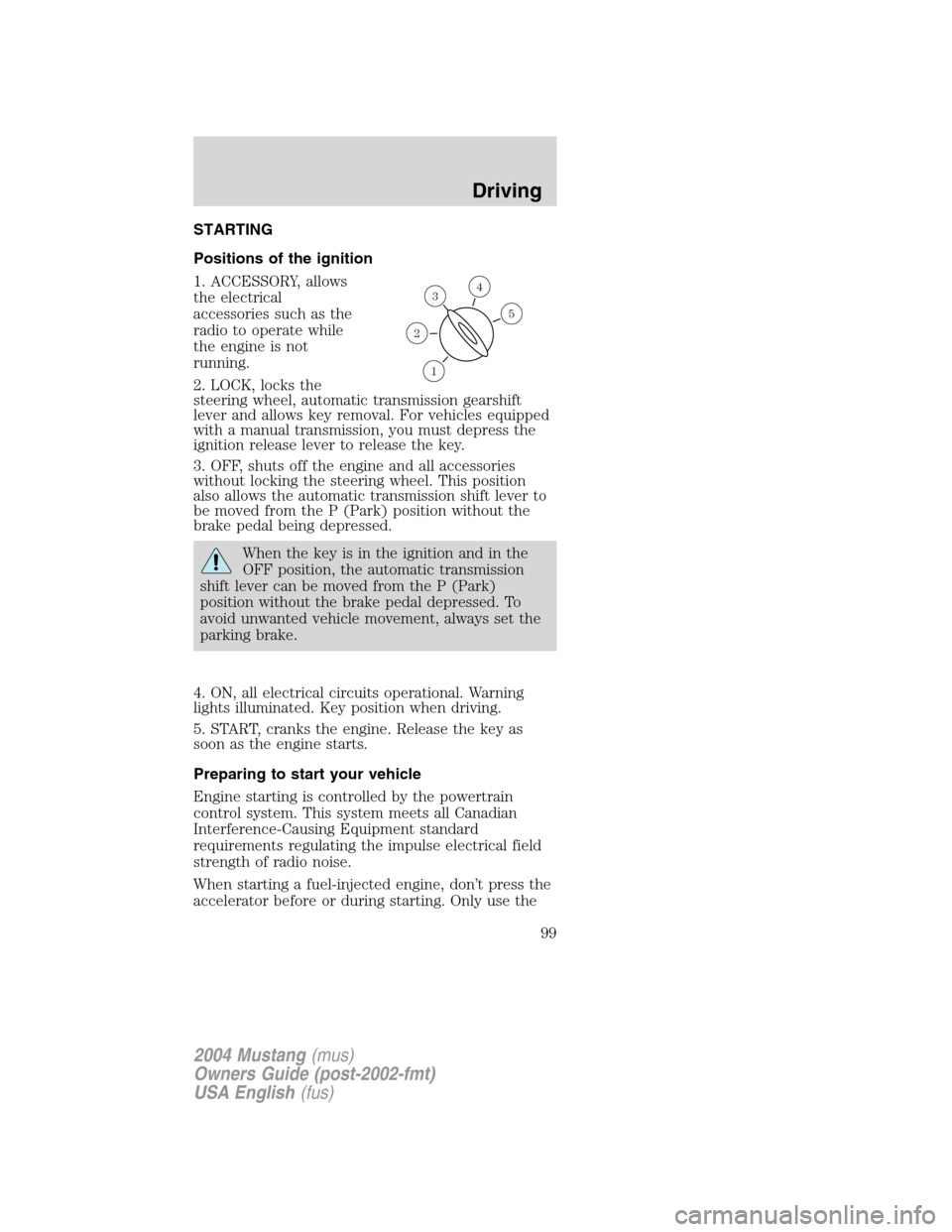
Positions of the ignition
1. ACCESSORY, allows
the electrical
accessories such as the
radio to operate while
the engine is not
running.
2. LOCK, locks the
steering wheel, automatic transmission gearshift
lever and allows key removal. For vehicles equipped
with a manual transmission, you must depress the
ignition release lever to release the key.
3. OFF, shuts off the engine and all accessories
without locking the steering wheel. This position
also allows the automatic transmission shift lever to
be moved from the P (Park) position without the
brake pedal being depressed.
When the key is in the ignition and in the
OFF position, the automatic transmission
shift lever can be moved from the P (Park)
position without the brake pedal depressed. To
avoid unwanted vehicle movement, always set the
parking brake.
4. ON, all electrical circuits operational. Warning
lights illuminated. Key position when driving.
5. START, cranks the engine. Release the key as
soon as the engine starts.
Preparing to start your vehicle
Engine starting is controlled by the powertrain
control system. This system meets all Canadian
Interference-Causing Equipment standard
requirements regulating the impulse electrical field
strength of radio noise.
When starting a fuel-injected engine, don’t press the
accelerator before or during starting. Only use the
3
1
2
5
4
2004 Mustang(mus)
Owners Guide (post-2002-fmt)
USA English(fus)
Driving
99
Page 104 of 240
Important ventilating information
If the engine is idling while the vehicle is stopped
for a long period of time, open the windows at least
2.5 cm (one inch) or adjust the heating or air
conditioning to bring in fresh air.
BRAKES
Occasional brake noise is normal. If a metal-to-metal,
continuous grinding or continuous squeal sound is
present, the brake linings may be worn-out and
should be inspected by a qualified service
technician. If the vehicle has continuous vibration or
shudder in the steering wheel while braking, the
vehicle should be inspected by a qualified service
technician.
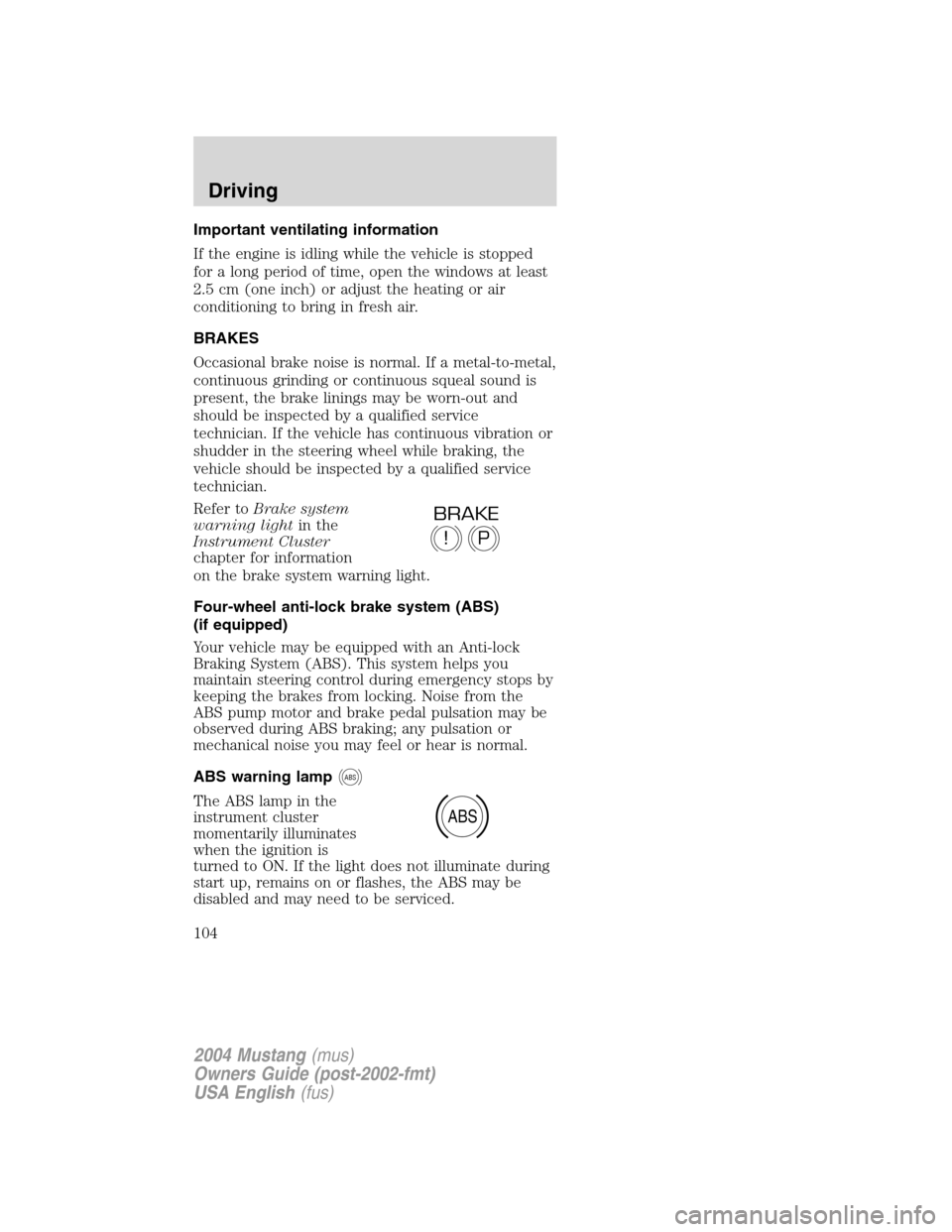
Refer toBrake system
warning lightin the
Instrument Cluster
chapter for information
on the brake system warning light.
Four-wheel anti-lock brake system (ABS)
(if equipped)
Your vehicle may be equipped with an Anti-lock
Braking System (ABS). This system helps you
maintain steering control during emergency stops by
keeping the brakes from locking. Noise from the
ABS pump motor and brake pedal pulsation may be
observed during ABS braking; any pulsation or
mechanical noise you may feel or hear is normal.
ABS warning lamp
ABS
The ABS lamp in the
instrument cluster
momentarily illuminates
when the ignition is
turned to ON. If the light does not illuminate during
start up, remains on or flashes, the ABS may be
disabled and may need to be serviced.
P!
BRAKE
ABS
2004 Mustang(mus)
Owners Guide (post-2002-fmt)
USA English(fus)
Driving
104
Page 105 of 240

Even when the ABS is
disabled, normal
braking is still effective.
(If your BRAKE
warning lamp illuminates with the parking brake
released, have your brake system serviced
immediately.)
Using ABS
When hard braking is required, apply continuous
force on the brake pedal; do not pump the brake
pedal since this will reduce the effectiveness of the
ABS and will increase your vehicle’s stopping
distance. The ABS will be activated immediately,
allowing you to retain full steering control during
hard braking and on slippery surfaces. However, the
ABS does not decrease stopping distance.
Hydraulic brake booster system (Hydroboost)
(if equipped)
The Hydroboost system receives fluid pressure from
the power steering pump to provide power assist
during braking.
For Hydroboost-equipped vehicles operating under
normal conditions, the noise of the fluid flowing
through the booster may be heard whenever the
brake is applied. This condition is normal; vehicle
service is not required.
If braking performance or pedal response becomes
very poor, even when the pedal is strongly
depressed, it may indicate the presence of air in the
hydraulic system or leakage of fluid. Stop the vehicle
safely as soon as possible and seek service
immediately.
P!
BRAKE
2004 Mustang(mus)
Owners Guide (post-2002-fmt)
USA English(fus)
Driving
105
Page 106 of 240

Parking brake
To set the parking
brake (1), pull the
parking brake handle
up as far as possible.
The BRAKE warning
lamp will illuminate and
will remain illuminated
until the parking brake
is released.
To release, press and hold the button (2), pull the
handle up slightly, then push the handle down.
Always set the parking brake fully and make
sure that the gearshift is securely latched in
P (Park) (automatic transmission) or in 1 (First)
(manual transmission).
If the parking brake is fully released, but the
brake warning lamp remains illuminated, the
brakes may not be working properly. See your
dealer or a qualified service technician.
STEERING
To prevent damage to the power steering system:
•Never hold the steering wheel at its furthest
turning points (until it stops) for more than a few
seconds when the engine is running.
•Do not operate the vehicle with a low power
steering pump fluid level (below the MIN mark on
the reservoir).
If the power steering system breaks down (or if the
engine is turned off), you can steer the vehicle
manually, but it takes more effort.
If the steering wanders or pulls, check for:
•an improperly inflated tire
12
P!
BRAKE
2004 Mustang(mus)
Owners Guide (post-2002-fmt)
USA English(fus)
Driving
106
Page 109 of 240
2. Insert the key and turn it to OFF.Apply the
brake pedal and shift to N (Neutral).
When the key is in the ignition and in the
OFF position, the automatic transmission
shift lever can be moved from the P (Park)
position without the brake pedal depressed. To
avoid unwanted vehicle movement, always set the
parking brake.
3. Start the vehicle.
If it is necessary to use the above procedure to
move the gearshift lever, it is possible that a fuse
has blown or the vehicle’s brakelamps are not
operating properly. Refer toFuses and relaysin the
Roadside emergencieschapter.
Do not drive your vehicle until you verify
that the brakelamps are working.
Always set the parking brake fully and make
sure the gearshift is latched in P (Park).
Turn the ignition to the LOCK position and remove
the key whenever you leave your vehicle.
If the parking brake is fully released, but the
brake warning lamp remains illuminated, the
brakes may not be working properly. See your
dealer or a qualified service technician.
Driving with an automatic overdrive
transmission with console gearshift and O/D off
switch
Your transmission is equipped with an adaptive
learning strategy found in the vehicle computer. This
feature is designed to increase durability and
provide consistent shift feel over the life of the
vehicle. A new vehicle or transmission may have firm
and/or soft shifts. This operation is considered
2004 Mustang(mus)
Owners Guide (post-2002-fmt)
USA English(fus)
Driving
109
Page 184 of 240
Use the following guidelines to avoid static build-up
when filling an ungrounded fuel container:
•Place approved fuel container on the ground.
•DO NOT fill a fuel container while it is in the
vehicle (including the cargo area).
•Keep the fuel pump nozzle in contact with the
fuel container while filling.
•DO NOT use a device that would hold the fuel
pump handle in the fill position.
Fuel Filler Cap
Your fuel tank filler cap has an indexed design with
a 1/8 turn on/off feature.
When fueling your vehicle:
1. Turn the engine off.
2. Carefully turn the filler cap counterclockwise 1/8
of a turn until it stops.
3. Pull to remove the cap from the fuel filler pipe.
4. To install the cap, align the tabs on the cap with
the notches on the filler pipe.
5. Turn the filler cap clockwise 1/8 of a turn until it
stops.
“Check Fuel Cap”illuminates when the ignition is
turned to the ON position to ensure your bulb is
working. When this light turns on, check the fuel
filler cap. Continuing to operate the vehicle with the
Check Fuel Cap light on, can activate the Service
Engine Soon warning. When the fuel filler cap is
properly re-installed, the light(s) will turn off after a
period of normal driving.It may take a long
period of time for the system to detect an
improperly installed fuel filler cap.
If you must replace the fuel filler cap, replace
it with a fuel filler cap that is designed for
your vehicle. The customer warranty may be
void for any damage to the fuel tank or fuel
system if the correct genuine Ford or
Motorcraft fuel filler cap is not used.
2004 Mustang(mus)
Owners Guide (post-2002-fmt)
USA English(fus)
Maintenance and Specifications
184
Page 192 of 240
•Have the items listed in your scheduled
maintenance guide performed according to the
specified schedule.
The scheduled maintenance items listed in the
scheduled maintenance guide are essential to the life
and performance of your vehicle and to its emissions
system.
If other than Ford, Motorcraft or Ford-authorized
parts are used for maintenance replacements or for
service of components affecting emission control,
such non-Ford parts should be equivalent to genuine
Ford Motor Company parts in performance and
durability.
Do not park, idle, or drive your vehicle in
dry grass or other dry ground cover. The
emission system heats up the engine compartment
and exhaust system, which can start a fire.
Illumination of the“Service Engine Soon”light,
charging system warning light or the temperature
warning light, fluid leaks, strange odors, smoke or
loss of engine power, could indicate that the
emission control system is not working properly.
Exhaust leaks may result in entry of harmful
and potentially lethal fumes into the
passenger compartment.
Do not make any unauthorized changes to your
vehicle or engine. By law, vehicle owners and anyone
who manufactures, repairs, services, sells, leases,
trades vehicles, or supervises a fleet of vehicles are
not permitted to intentionally remove an emission
control device or prevent it from working.
Information about your vehicle’s emission system is
on the Vehicle Emission Control Information Decal
located on or near the engine. This decal identifies
engine displacement and gives some tune up
specifications.
Please consult yourWarranty Guidefor complete
emission warranty information.
2004 Mustang(mus)
Owners Guide (post-2002-fmt)
USA English(fus)
Maintenance and Specifications
192
Page 193 of 240
On board diagnostics (OBD-II)
Your vehicle is equipped with a computer that
monitors the engine’s emission control system. This
system is commonly known as the On Board
Diagnostics System (OBD-II). This OBD-II system
protects the environment by ensuring that your
vehicle continues to meet government emission
standards. The OBD-II system also assists the
service technician in properly servicing your vehicle.
When theCheck Engine/Service Engine Soonlight
illuminates, the OBD-II system has detected a
malfunction. Temporary malfunctions may cause
yourCheck Engine/Service Engine Soonlight to
illuminate. Examples are:
1. The vehicle has run out of fuel. (The engine may
misfire or run poorly.)
2. Poor fuel quality or water in the fuel.
3. The fuel cap may not have been securely
tightened.
These temporary malfunctions can be corrected by
filling the fuel tank with good quality fuel and/or
properly tightening the fuel cap. After three driving
cycles without these or any other temporary
malfunctions present, theCheck Engine/Service
Engine Soonlight should turn off. (A driving cycle
consists of a cold engine startup followed by mixed
city/highway driving.) No additional vehicle service is
required.
If theCheck Engine/Service Engine Soonlight
remains on, have your vehicle serviced at the first
available opportunity.
Readiness for Inspection/Maintenance (I/M)
testing
In some localities, it may be a legal requirement to
pass an I/M test of the on-board diagnostics system.
If your“Check Engine/Service Engine Soon”light is
on, refer to the description in theWarning lights
and chimessection of theInstrument cluster
chapter. Your vehicle may not pass the I/M test with
the“Check Engine/Service Engine Soon”light on.
2004 Mustang(mus)
Owners Guide (post-2002-fmt)
USA English(fus)
Maintenance and Specifications
193