2004 FORD MUSTANG tow
[x] Cancel search: towPage 117 of 240
VEHICLE LOADING–WITH AND WITHOUT A
TRAILER
This section will guide you in the proper loading of
your vehicle and/or trailer, to keep your loaded
vehicle weight within its design rating capability,
with or without a trailer. Properly loading your
vehicle will provide maximum return of vehicle
design performance. Before loading your vehicle,
familiarize yourself with the following terms for
determining your vehicle’s weight ratings, with or
without a trailer, from the vehicle’s Safety
Certification Label and Tire and Load Information
Label:
Base Curb Weight–is the weight of the vehicle
including a full tank of fuel and all standard
equipment. It does not include passengers, cargo, or
optional equipment.
Vehicle Curb Weight–is the weight of your new
vehicle when you picked it up from your dealer plus
any aftermarket equipment.
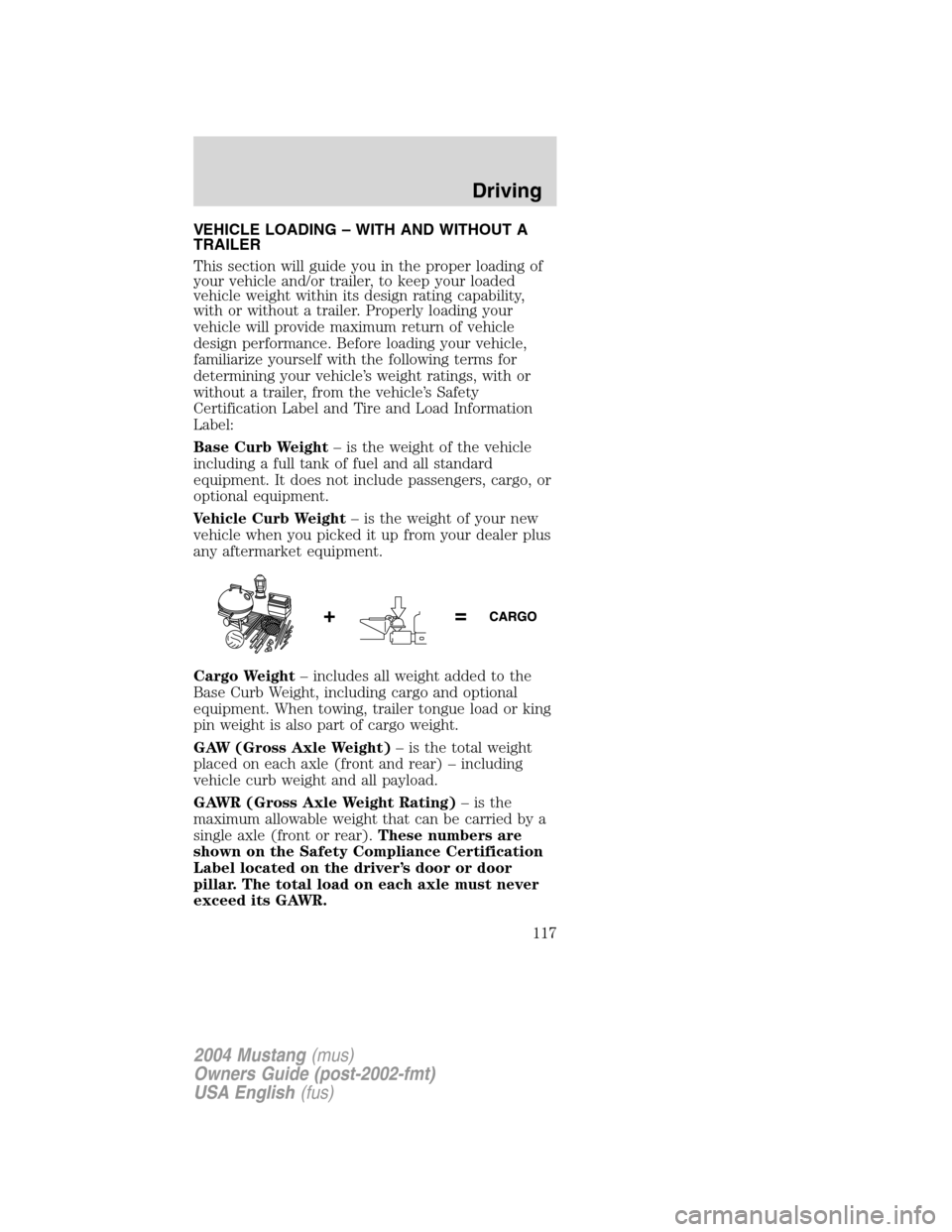
Cargo Weight–includes all weight added to the
Base Curb Weight, including cargo and optional
equipment. When towing, trailer tongue load or king
pin weight is also part of cargo weight.
GAW (Gross Axle Weight)–is the total weight
placed on each axle (front and rear)–including
vehicle curb weight and all payload.
GAWR (Gross Axle Weight Rating)–is the
maximum allowable weight that can be carried by a
single axle (front or rear).These numbers are
shown on the Safety Compliance Certification
Label located on the driver’s door or door
pillar. The total load on each axle must never
exceed its GAWR.
2004 Mustang(mus)
Owners Guide (post-2002-fmt)
USA English(fus)
Driving
117
Page 118 of 240
Exceeding the Safety Certification Label
axle weight rating limits could result in
substandard vehicle handling, performance, engine,
transmission and/or structural damage, serious
damage to the vehicle, loss of control and personal
injury.
Note:For trailer towing information refer toTrailer
Towingfound in this chapter or the RV and Trailer
Towing Guide provided by your dealership.
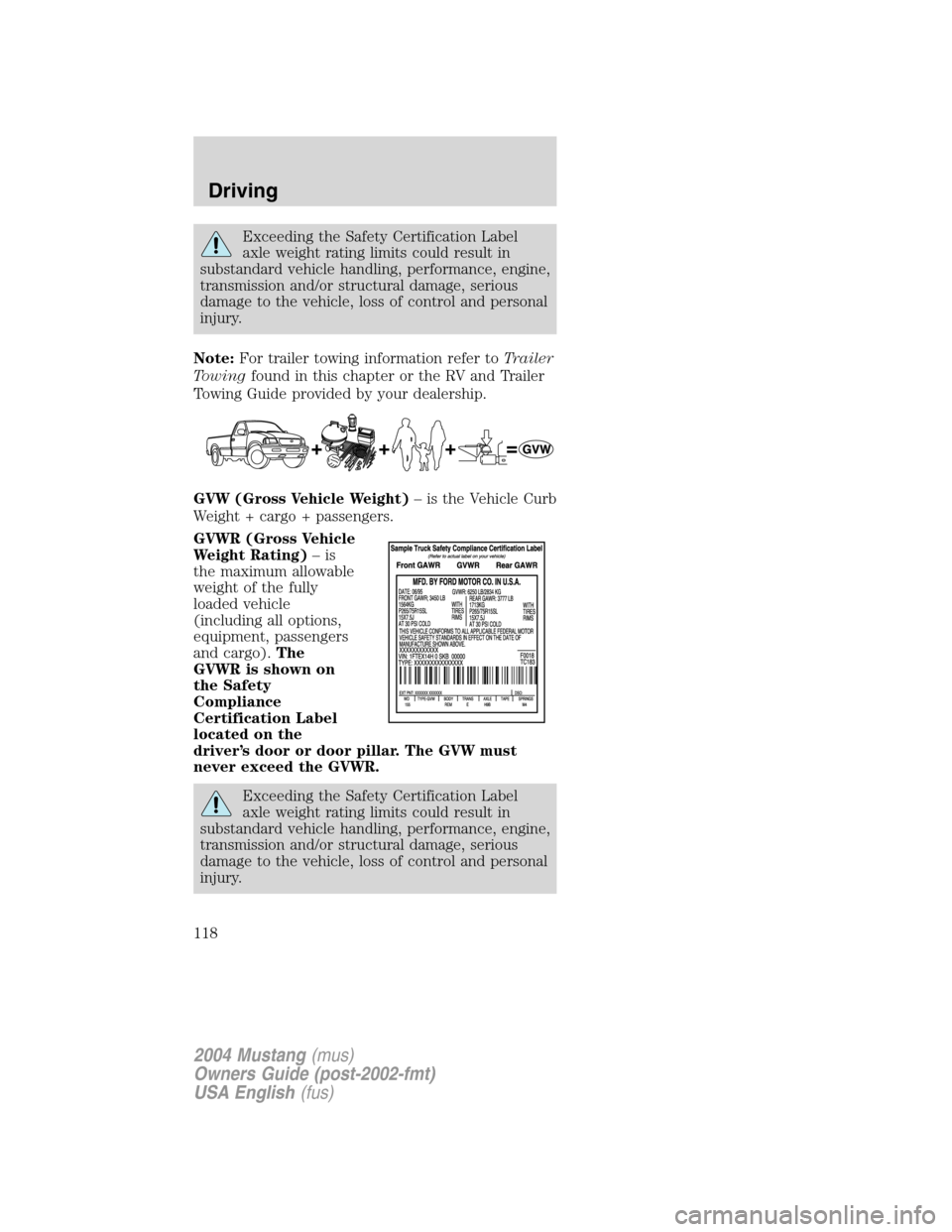
GVW (Gross Vehicle Weight)–is the Vehicle Curb
Weight + cargo + passengers.
GVWR (Gross Vehicle
Weight Rating)–is
the maximum allowable
weight of the fully
loaded vehicle
(including all options,
equipment, passengers
and cargo).The
GVWR is shown on
the Safety
Compliance
Certification Label
located on the
driver’s door or door pillar. The GVW must
never exceed the GVWR.
Exceeding the Safety Certification Label
axle weight rating limits could result in
substandard vehicle handling, performance, engine,
transmission and/or structural damage, serious
damage to the vehicle, loss of control and personal
injury.
2004 Mustang(mus)
Owners Guide (post-2002-fmt)
USA English(fus)
Driving
118
Page 119 of 240
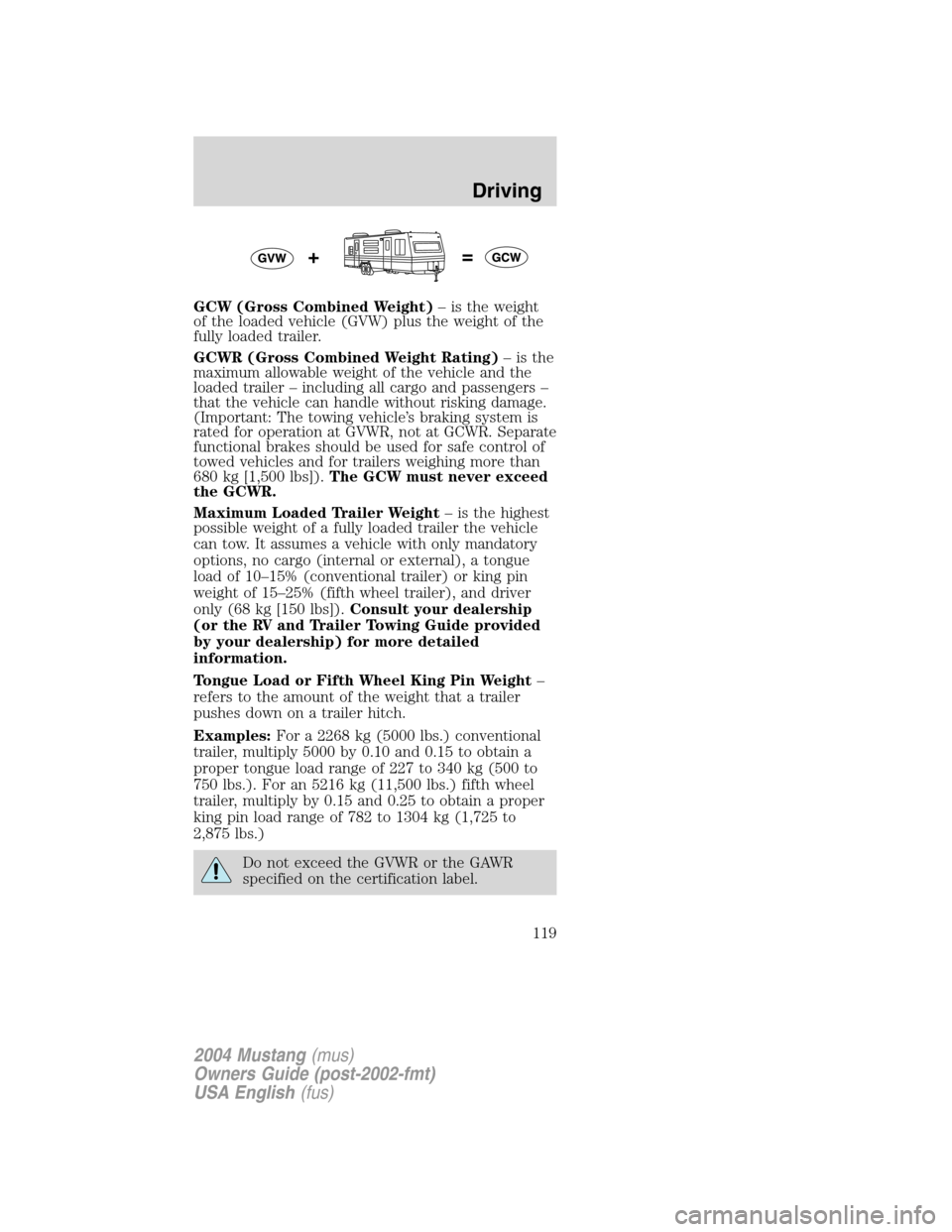
GCW (Gross Combined Weight)–is the weight
of the loaded vehicle (GVW) plus the weight of the
fully loaded trailer.
GCWR (Gross Combined Weight Rating)–is the
maximum allowable weight of the vehicle and the
loaded trailer–including all cargo and passengers–
that the vehicle can handle without risking damage.
(Important: The towing vehicle’s braking system is
rated for operation at GVWR, not at GCWR. Separate
functional brakes should be used for safe control of
towed vehicles and for trailers weighing more than
680 kg [1,500 lbs]).The GCW must never exceed
the GCWR.
Maximum Loaded Trailer Weight–is the highest
possible weight of a fully loaded trailer the vehicle
can tow. It assumes a vehicle with only mandatory
options, no cargo (internal or external), a tongue
load of 10–15% (conventional trailer) or king pin
weight of 15–25% (fifth wheel trailer), and driver
only (68 kg [150 lbs]).Consult your dealership
(or the RV and Trailer Towing Guide provided
by your dealership) for more detailed
information.
Tongue Load or Fifth Wheel King Pin Weight–
refers to the amount of the weight that a trailer
pushes down on a trailer hitch.
Examples:For a 2268 kg (5000 lbs.) conventional
trailer, multiply 5000 by 0.10 and 0.15 to obtain a
proper tongue load range of 227 to 340 kg (500 to
750 lbs.). For an 5216 kg (11,500 lbs.) fifth wheel
trailer, multiply by 0.15 and 0.25 to obtain a proper
king pin load range of 782 to 1304 kg (1,725 to
2,875 lbs.)
Do not exceed the GVWR or the GAWR
specified on the certification label.
2004 Mustang(mus)
Owners Guide (post-2002-fmt)
USA English(fus)
Driving
119
Page 120 of 240
Do not use replacement tires with lower
load carrying capacities than the originals
because they may lower the vehicle’s GVWR and
GAWR limitations. Replacement tires with a higher
limit than the originals do not increase the GVWR
and GAWR limitations.
Exceeding any vehicle weight rating
limitation could result in serious damage to
the vehicle and/or personal injury.
TRAILER TOWING
Your vehicle is not equipped to tow. No towing
packages are available through Ford or
Lincoln/Mercury dealers.
RECREATIONAL TOWING (ALL WHEELS ON
THE GROUND)
Follow these guidelines for your specific powertrain
combination to tow your vehicle with all four wheels
on the ground (such as behind a recreational
vehicle).
These guidelines are designed to ensure that your
transmission is not damaged due to insufficient
lubrication.
All Rear Wheel Drive (RWD) vehicles:
This applies to all cars and 4x2 trucks/sport utilities
with rear wheel drive capability.
•Place the transmission in N (Neutral)
•Maximum speed is 56 km/h (35 mph)
•Maximum distance is 80 km (50 miles)
If a distance of 80 km (50 miles) or a speed of
56 km/h (35 mph) must be exceeded, you must
disconnect the driveshaft. Ford recommends the
driveshaft be removed/installed only by a qualified
technician. See your local dealer for driveshaft
removal/installation.
2004 Mustang(mus)
Owners Guide (post-2002-fmt)
USA English(fus)
Driving
120
Page 122 of 240
GETTING ROADSIDE ASSISTANCE
To fully assist you should you have a vehicle
concern, Ford Motor Company offers a
complimentary roadside assistance program. This
program is separate from the New Vehicle Limited
Warranty. The service is available:
•24–hours, seven days a week
•for the New Vehicle Limited Warranty period of
three years or 60,000 km (36,000 miles),
whichever occurs first on Ford and Mercury
vehicles, and four years or 80,000 km
(50,000 miles) on Lincoln vehicles.
Roadside assistance will cover:
•changing a flat tire
•jump-starts
•lock-out assistance
•limited fuel delivery
•towing of your disabled vehicle to the nearest
Ford Motor Company dealership, or your selling
dealer if within 56.3 km (35 miles) of the nearest
Ford Motor Company dealership (one tow per
disablement). Even non-warranty related tows,
like accidents or getting stuck in the mud or
snow, are covered (some exclusions apply, such as
impound towing or repossession).
Canadian customers refer to your Owner
Information Guide for information on:
•coverage period
•exact fuel amounts
•towing of your disabled vehicle
•emergency travel expense reimbursement
•travel planning benefits
2004 Mustang(mus)
Owners Guide (post-2002-fmt)
USA English(fus)
Roadside Emergencies
122
Page 131 of 240
and is designed for emergency use only. Replace this
tire with a full-size tire as soon as possible.
Installing a tire on either or both sides of the driven
axle that is of a different size than the original road
tire is not recommended since this will affect the
accuracy of the speedometer and odometer. If
different size tires must be installed, it is important
that all four be the same size.
If one or more tires of the four are of a
different size, the ABS and traction control
system (if equipped) may not function correctly or
may not function at all. The temporary spare
supplied with the vehicle is the only different size
tire that should ever be installed.
If you use the temporary spare tire
continuously or do not follow these
precautions, the tire could fail, causing you to lose
control of the vehicle, possibly injuring yourself or
others.
When driving with the temporary spare tire do not:
• use more than one temporary spare tire at a time
• exceed 80 km/h (50 mph) or drive further than
3,200 km (2,000 miles) total under any
circumstances
• load the vehicle beyond maximum vehicle load
rating listed on the tire pressure label on the
driver’s side b-pillar
• tow a trailer
• use tire chains
• drive through an automatic car wash, because of
the vehicle’s reduced ground clearance
• try to repair the temporary spare tire or remove it
from its wheel
• use the wheel for any other type of vehicle
Use of a temporary spare tire at any one wheel
location can lead to impairment of the following:
2004 Mustang (mus)
Owners Guide (post-2002-fmt)
USA English (fus)
Roadside Emergencies
131
Page 141 of 240
WRECKER TOWING
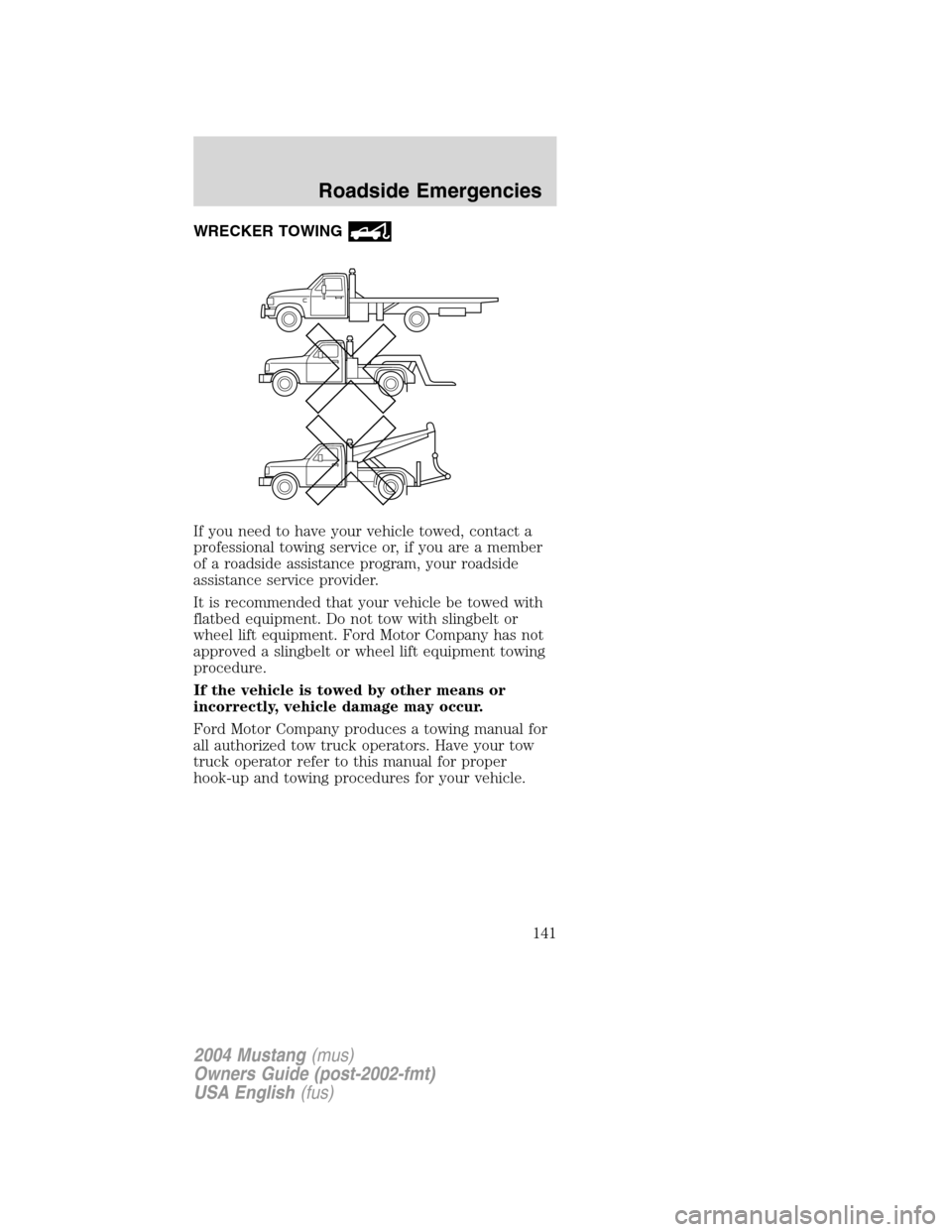
If you need to have your vehicle towed, contact a
professional towing service or, if you are a member
of a roadside assistance program, your roadside
assistance service provider.
It is recommended that your vehicle be towed with
flatbed equipment. Do not tow with slingbelt or
wheel lift equipment. Ford Motor Company has not
approved a slingbelt or wheel lift equipment towing
procedure.
If the vehicle is towed by other means or
incorrectly, vehicle damage may occur.
Ford Motor Company produces a towing manual for
all authorized tow truck operators. Have your tow
truck operator refer to this manual for proper
hook-up and towing procedures for your vehicle.
2004 Mustang(mus)
Owners Guide (post-2002-fmt)
USA English(fus)
Roadside Emergencies
141
Page 145 of 240
dealer. There are several plans available in various
time, distance and deductible combinations which
can be tailored to fit your own driving needs. Ford
ESP also offers reimbursement benefits for towing
and rental coverage.
When you buy Ford ESP, you receive Peace-of-Mind
protection throughout the United States and Canada,
provided by a network of more than 5,000
participating Ford or Lincoln Mercury and Ford of
Canada dealers.
If you did not take advantage of the Ford Extended
Service Plan at the time of purchasing your vehicle,
you may still be eligible. Since this information is
subject to change, please ask your dealer for
complete details about Ford Extended Service Plan
coverage options, or visit the Ford ESP website at
www.ford-esp.com.
THE DISPUTE SETTLEMENT BOARD
(U.S. ONLY)
The Dispute Settlement Board is:
•an independent, third-party arbitration program
for warranty disputes.
•available free to owners and lessees of qualifying
Ford Motor Company vehicles.
The Dispute Settlement Board may not be available in
all states. Ford Motor Company reserves the right to
change eligibility limitations, modify procedures and/or
to discontinue this service without notice and without
incurring obligations per applicable state law.
What kinds of cases does the Board review?
Unresolved warranty repair concerns or vehicle
performance concerns as on Ford and Lincoln
Mercury cars and Ford and Lincoln Mercury light
trucks which are within the terms of any applicable
written new vehicle warranty are eligible for review,
except those involving:
•a non-Ford product
•a non-Ford dealership
2004 Mustang(mus)
Owners Guide (post-2002-fmt)
USA English(fus)
Customer Assistance
145