Page 124 of 240

HAZARD FLASHER
The hazard flasher is
located on the steering
column, just behind the
steering wheel. The
hazard flashers will
operate when the
ignition is in any
position or if the key is
not in the ignition.
Push in the flasher control and all front and rear
direction signals will flash. Press the flasher control
again to turn them off. Use it when your vehicle is
disabled and is creating a safety hazard for other
motorists.
Note:With extended use, the flasher may run down
your battery.
FUEL PUMP SHUT-OFF SWITCH
FUEL
RESET
This device stops the electric fuel pump from
sending fuel to the engine when your vehicle has
had a substantial jolt.
After an accident, if the engine cranks but does not
start, this switch may have been activated.
The fuel pump shut-off
switch is located on
the left side of the
trunk between the left
rear tail light and the
trunk liner, and to the
left of the hole in the
trunk liner
To reset the switch:
1. Turn the ignition OFF.
2. Check the fuel system for leaks.
3. If no leaks are apparent, reset the switch by
pushing in on the reset button.
4. Turn the ignition ON.
2004 Mustang(mus)
Owners Guide (post-2002-fmt)
USA English(fus)
Roadside Emergencies
124
Page 128 of 240

Fuse/Relay
LocationFuse Amp
RatingPassenger Compartment
Fuse Panel Description
34 20A Instrument Cluster, CCRM,
Data link connector,
Securilock transceiver
module
35 15A Shift lock actuator,
Powertrain Control Module
(PCM), Speed control servo,
ABS module
36 15A Air bag control module
37 5A Adjustable illumination
38 20A High beams
39 5A GEM
40—Not used
41 15A Brake lamp
42—Not used
43 20A CB Power windows
44—Not used
Power distribution box
The power distribution box is located in the engine
compartment. The power distribution box contains
high-current fuses that protect your vehicle’s main
electrical systems from overloads.
Always disconnect the battery before
servicing high current fuses.
Always replace the cover to the power
distribution box before reconnecting the
battery or refilling fluid reservoirs
If the battery has been disconnected and
reconnected, refer to theBatterysection of the
Maintenance and specificationschapter.
2004 Mustang(mus)
Owners Guide (post-2002-fmt)
USA English(fus)
Roadside Emergencies
128
Page 136 of 240
When a wheel is installed, always remove
any corrosion, dirt or foreign materials
present on the mounting surfaces of the wheel or
the surface of the front disc brake hub and rotor
that contacts the wheel. Installing wheels without
correct metal-to-metal contact at the wheel
mounting surfaces can cause the wheel nuts to
loosen and the wheel to come off while the vehicle
is in motion, resulting in loss of control.
JUMP STARTING YOUR VEHICLE
The gases around the battery can explode if
exposed to flames, sparks, or lit cigarettes. An
explosion could result in injury or vehicle damage.
Batteries contain sulfuric acid which can
burn skin, eyes and clothing, if contacted.
Do not attempt to push-start your vehicle.
Automatic transmissions do not have
push-start capability; doing so may damage the
catalytic converter.
Preparing your vehicle
When the battery is disconnected or a new battery is
installed, the transmission must relearn its shift
strategy. As a result, the transmission may have firm
and/or soft shifts. This operation is considered
normal and will not affect function or durability of
the transmission. Over time, the adaptive learning
process will fully update transmission operation.
1.
Use only a 12–volt supply to start your vehicle.
2. Do not disconnect the battery of the disabled
vehicle as this could damage the vehicle’s electrical
system.
3. Park the booster vehicle close to the hood of the
disabled vehicle making sure the two vehiclesdo
nottouch. Set the parking brake on both vehicles
and stay clear of the engine cooling fan and other
moving parts.
2004 Mustang(mus)
Owners Guide (post-2002-fmt)
USA English(fus)
Roadside Emergencies
136
Page 137 of 240
4. Check all battery terminals and remove any
excessive corrosion before you attach the battery
cables. Ensure the vent caps are tight and level.
5. Turn the heater fan on in both vehicles to protect
any electrical surges. Turn all other accessories off.
Connecting the jumper cables
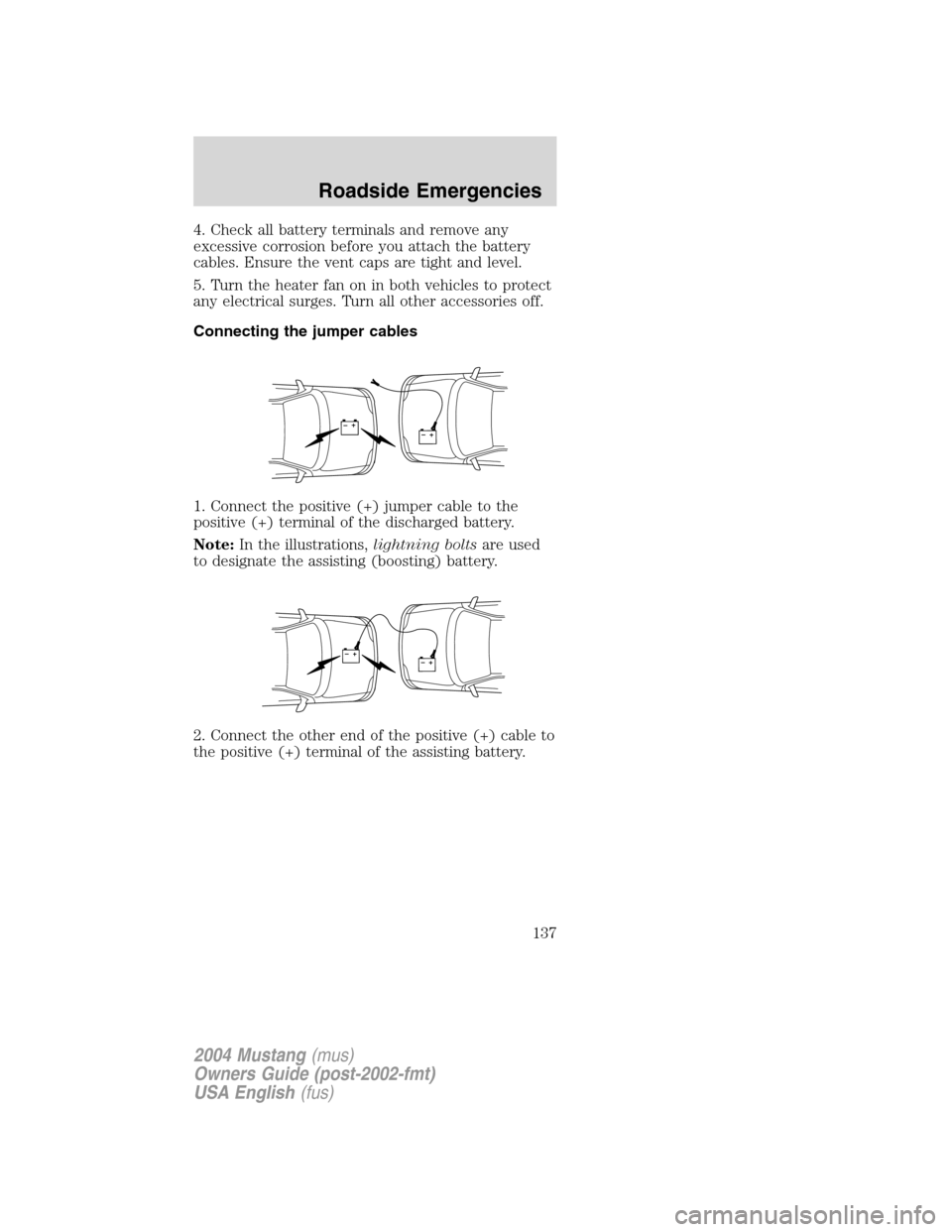
1. Connect the positive (+) jumper cable to the
positive (+) terminal of the discharged battery.
Note:In the illustrations,lightning boltsare used
to designate the assisting (boosting) battery.
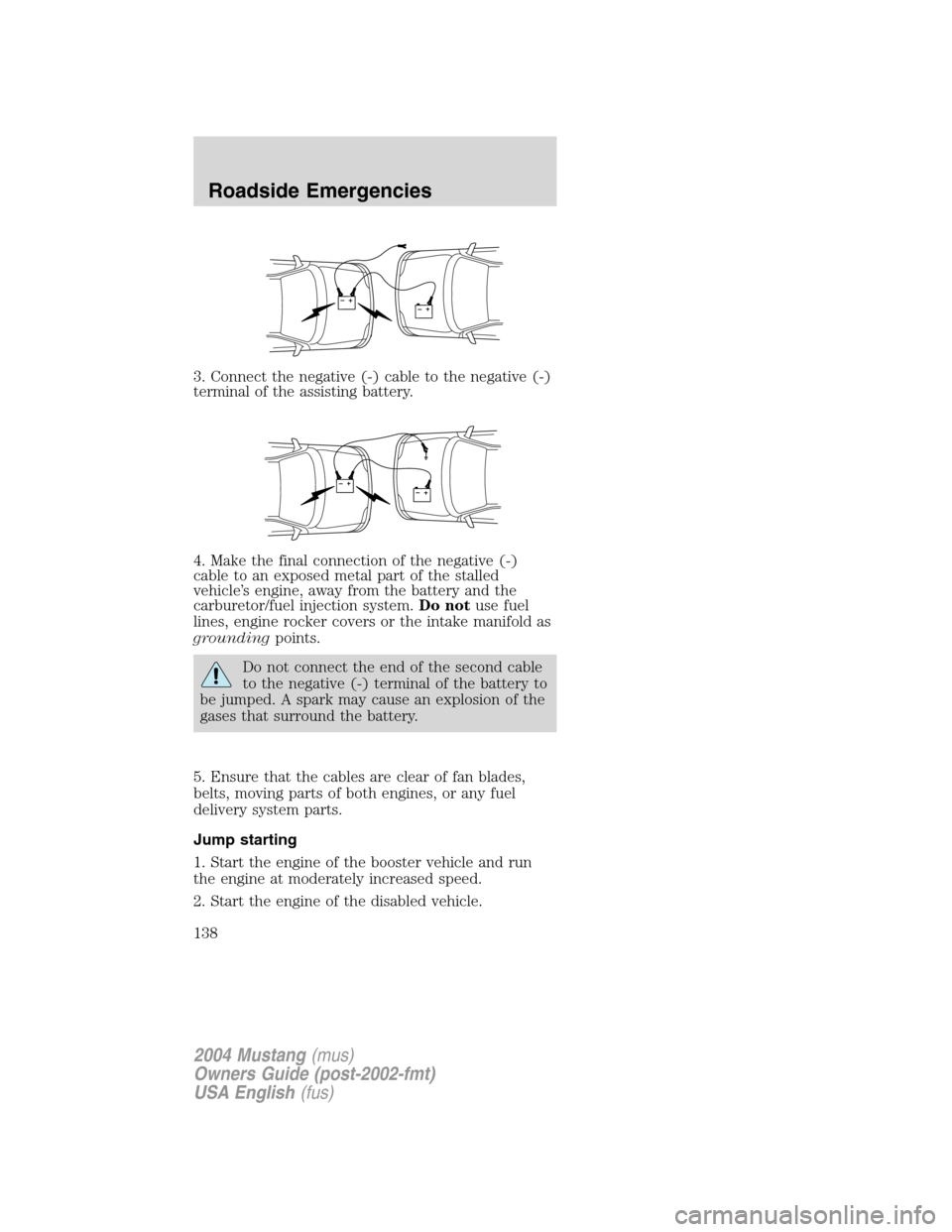
2. Connect the other end of the positive (+) cable to
the positive (+) terminal of the assisting battery.
+–+–
+–+–
2004 Mustang(mus)
Owners Guide (post-2002-fmt)
USA English(fus)
Roadside Emergencies
137
Page 138 of 240
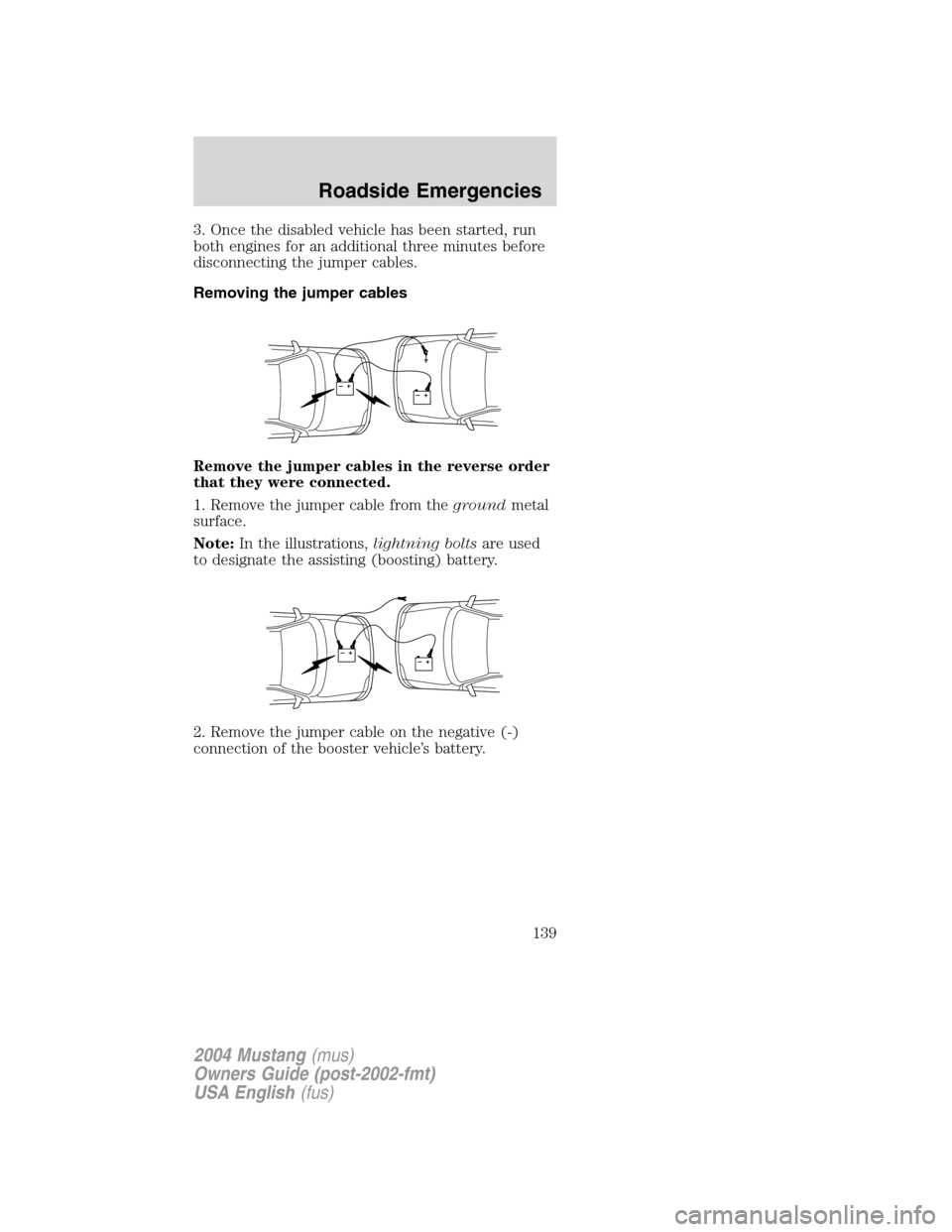
3. Connect the negative (-) cable to the negative (-)
terminal of the assisting battery.
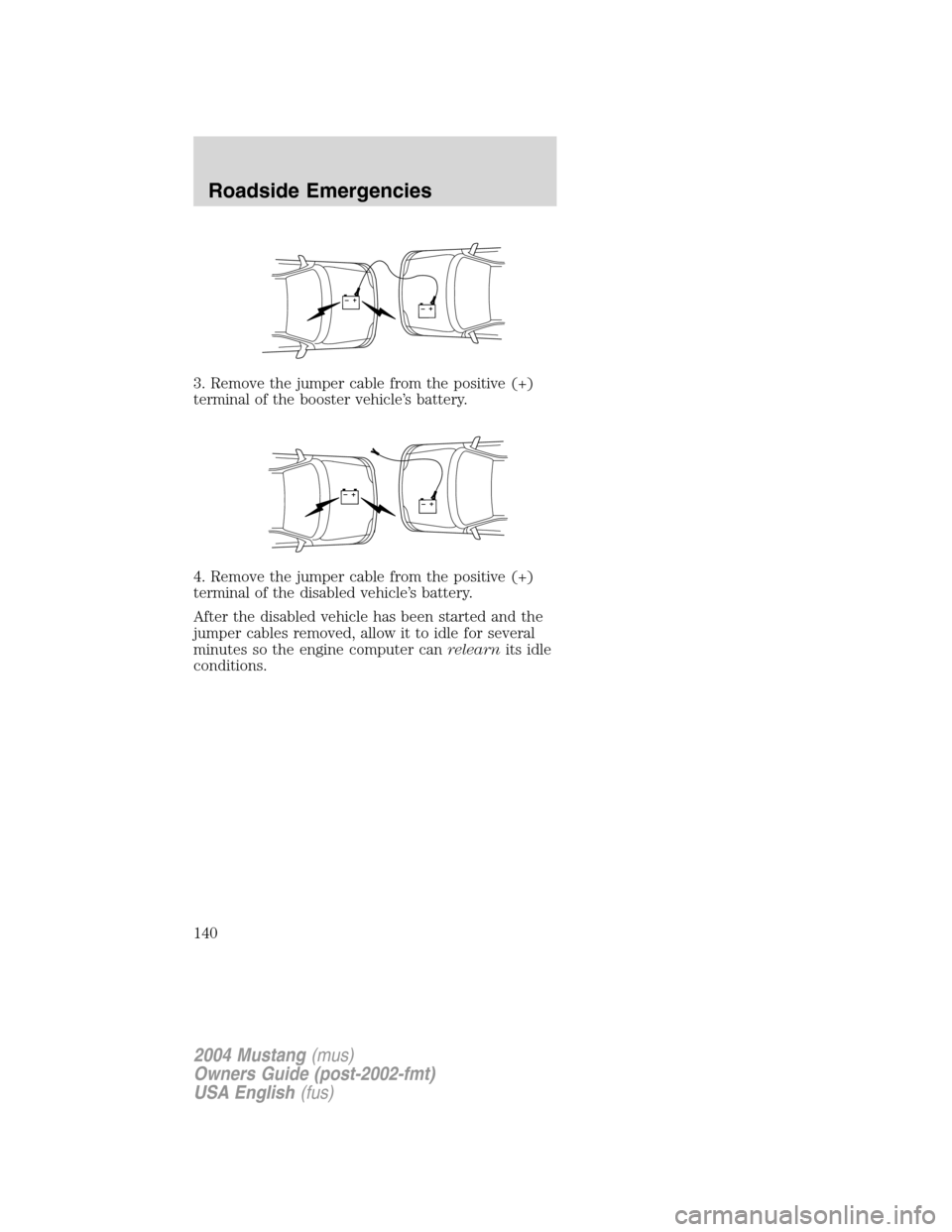
4. Make the final connection of the negative (-)
cable to an exposed metal part of the stalled
vehicle’s engine, away from the battery and the
carburetor/fuel injection system.Do notuse fuel
lines, engine rocker covers or the intake manifold as
groundingpoints.
Do not connect the end of the second cable
to the negative (-) terminal of the battery to
be jumped. A spark may cause an explosion of the
gases that surround the battery.
5. Ensure that the cables are clear of fan blades,
belts, moving parts of both engines, or any fuel
delivery system parts.
Jump starting
1. Start the engine of the booster vehicle and run
the engine at moderately increased speed.
2. Start the engine of the disabled vehicle.
+–+–
+–+–
2004 Mustang(mus)
Owners Guide (post-2002-fmt)
USA English(fus)
Roadside Emergencies
138
Page 139 of 240
3. Once the disabled vehicle has been started, run
both engines for an additional three minutes before
disconnecting the jumper cables.
Removing the jumper cables
Remove the jumper cables in the reverse order
that they were connected.
1. Remove the jumper cable from thegroundmetal
surface.
Note:In the illustrations,lightning boltsare used
to designate the assisting (boosting) battery.
2. Remove the jumper cable on the negative (-)
connection of the booster vehicle’s battery.
+–+–
+–+–
2004 Mustang(mus)
Owners Guide (post-2002-fmt)
USA English(fus)
Roadside Emergencies
139
Page 140 of 240
3. Remove the jumper cable from the positive (+)
terminal of the booster vehicle’s battery.
4. Remove the jumper cable from the positive (+)
terminal of the disabled vehicle’s battery.
After the disabled vehicle has been started and the
jumper cables removed, allow it to idle for several
minutes so the engine computer canrelearnits idle
conditions.
+–+–
+–+–
2004 Mustang(mus)
Owners Guide (post-2002-fmt)
USA English(fus)
Roadside Emergencies
140
Page 161 of 240
SERVICE RECOMMENDATIONS
To help you service your vehicle:
•We highlight do-it-yourself items in the engine
compartment for easy location.
•We provide a scheduled maintenance guide which
makes tracking routine service easy.
If your vehicle requires professional service, your
dealership can provide the necessary parts and
service. Check yourWarranty Guide/Owner
Information Guideto find out which parts and
services are covered.
Use only recommended fuels, lubricants, fluids and
service parts conforming to specifications. Motorcraft
parts are designed and built to provide the best
performance in your vehicle.
PRECAUTIONS WHEN SERVICING YOUR
VEHICLE
•Do not work on a hot engine.
•
Make sure that nothing gets caught in moving parts.
•Do not work on a vehicle with the engine running
in an enclosed space, unless you are sure you
have enough ventilation.
•Keep all open flames and other burning
(cigarettes) material away from the battery and
all fuel related parts.
Working with the engine off
•Automatic transmission:
1. Set the parking brake and shift to P (Park).
2. Turn off the engine and remove the key.
3. Block the wheels.
•Manual transmission:
1. Set the parking brake, depress the clutch and
place the gearshift in 1 (First).
2. Turn off the engine and remove the key.
3. Block the wheels.
2004 Mustang(mus)
Owners Guide (post-2002-fmt)
USA English(fus)
Maintenance and Specifications
161