Page 138 of 280
7. Before placing the child into the child seat, forcibly tilt the child seat
from side to side and in forward direction to make sure that the seat is
held securely in place. If the child seat moves excessively, repeat steps 5
through 7, try a different child safety seat, or properly install the child
seat in a different position.
Attaching child safety seats with tether straps
Most new forward-facing child safety seats include a tether strap which
goes over the back of the seat and hooks to an anchoring point. Tether
straps are available as an accessory for many older safety seats. Contact
the manufacturer of your child seat for information about ordering a
tether strap.
The passenger seats of your vehicle are equipped with built-in tether
strap anchors located behind the seats as described below.
The tether anchors in your vehicle may be loops of webbing above the
seatback or an anchor bracket behind the seat on the rear edge of the
seat cushion.
The rear seat in the SuperCab and SuperCrew has three straps along the
top of the seatback that function as both routing loops for the tether
straps and anchor loops.
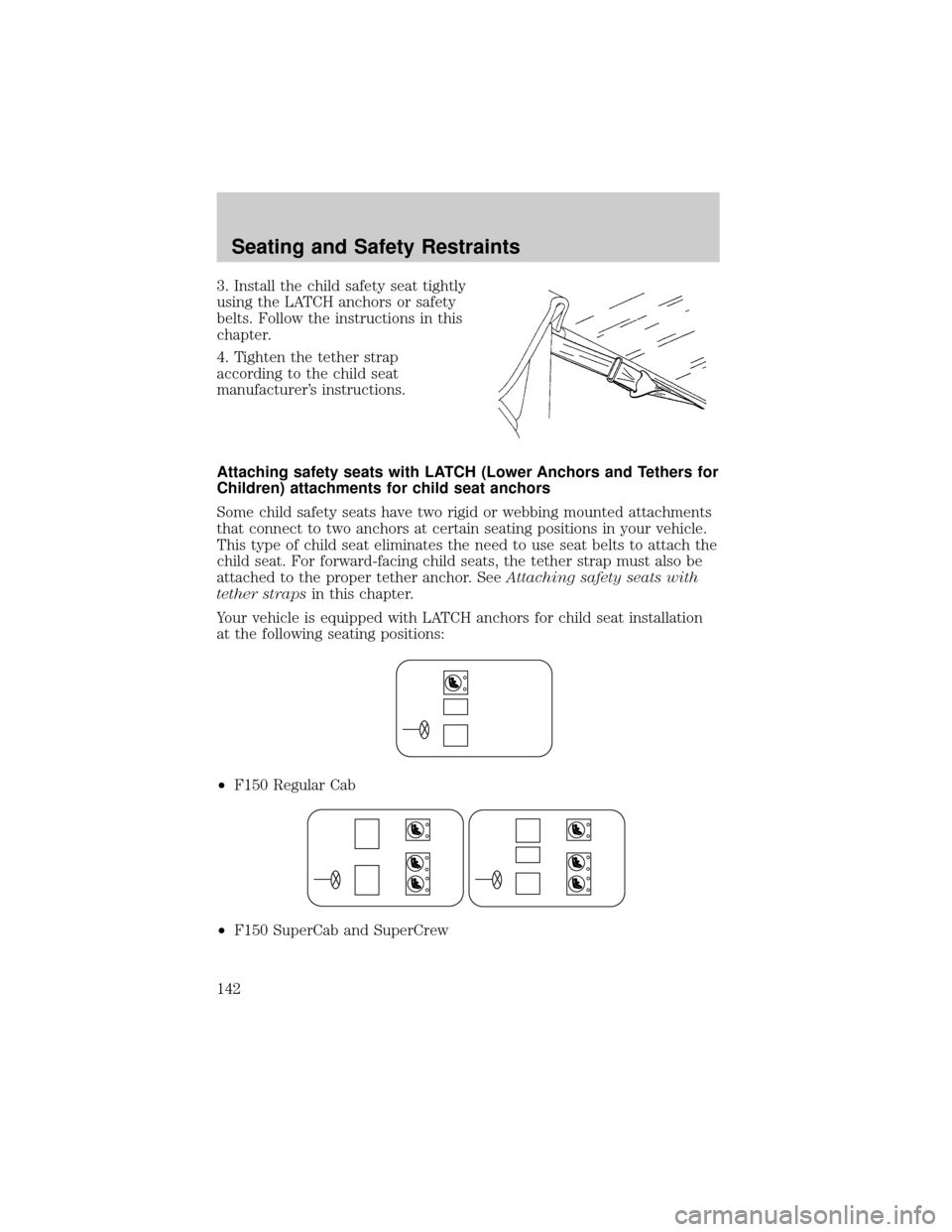
The tether strap anchors in your vehicle are in the following positions
(shown from top view):
Attach the tether strap only to the appropriate tether anchor as
shown. The tether strap may not work properly if attached
somewhere other than the correct tether anchor.
²F150 Regular Cab
Seating and Safety Restraints
138
Page 141 of 280
Rear seat tether strap attachment
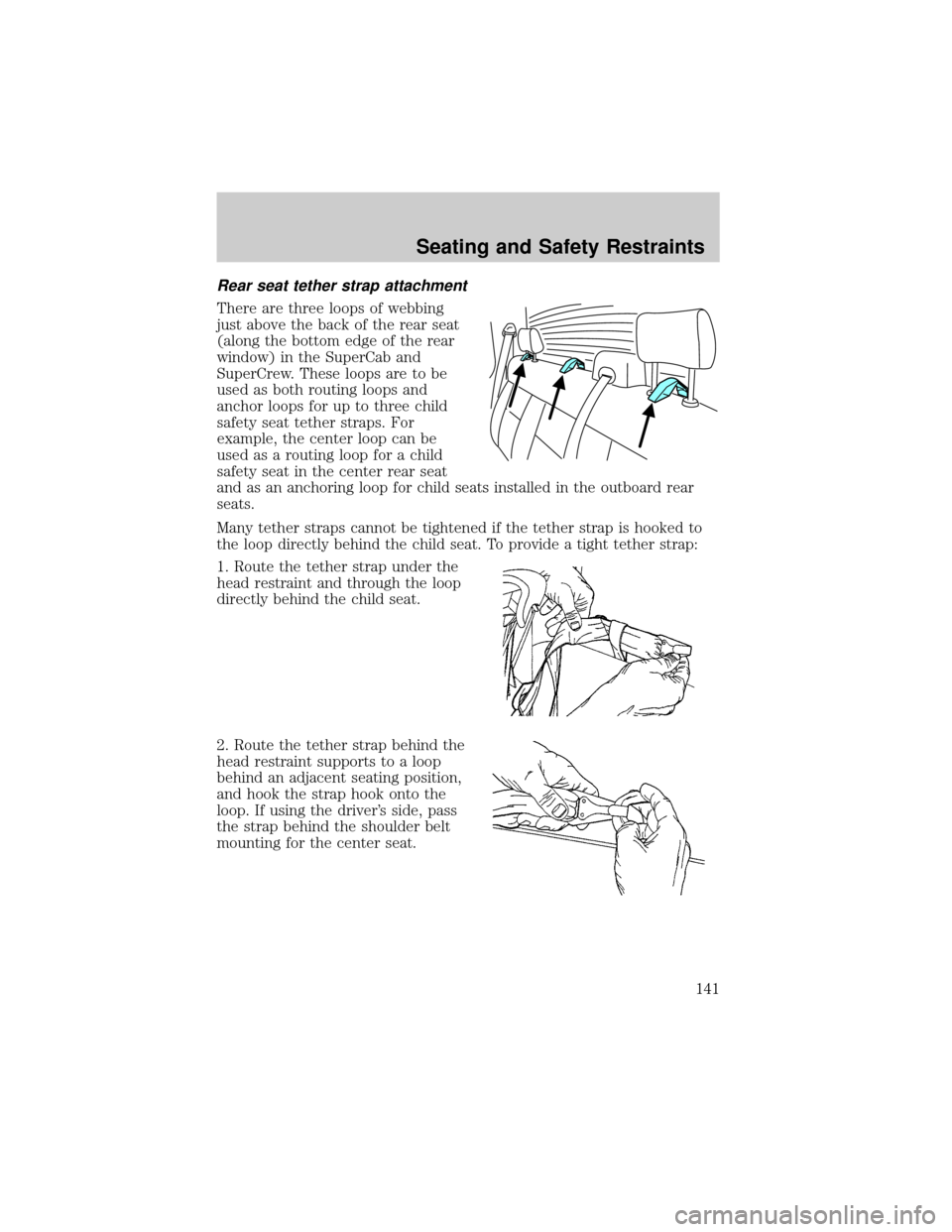
There are three loops of webbing
just above the back of the rear seat
(along the bottom edge of the rear
window) in the SuperCab and
SuperCrew. These loops are to be
used as both routing loops and
anchor loops for up to three child
safety seat tether straps. For
example, the center loop can be
used as a routing loop for a child
safety seat in the center rear seat
and as an anchoring loop for child seats installed in the outboard rear
seats.
Many tether straps cannot be tightened if the tether strap is hooked to
the loop directly behind the child seat. To provide a tight tether strap:
1. Route the tether strap under the
head restraint and through the loop
directly behind the child seat.
2. Route the tether strap behind the
head restraint supports to a loop
behind an adjacent seating position,
and hook the strap hook onto the
loop. If using the driver's side, pass
the strap behind the shoulder belt
mounting for the center seat.
Seating and Safety Restraints
141
Page 142 of 280
3. Install the child safety seat tightly
using the LATCH anchors or safety
belts. Follow the instructions in this
chapter.
4. Tighten the tether strap
according to the child seat
manufacturer's instructions.
Attaching safety seats with LATCH (Lower Anchors and Tethers for
Children) attachments for child seat anchors
Some child safety seats have two rigid or webbing mounted attachments
that connect to two anchors at certain seating positions in your vehicle.
This type of child seat eliminates the need to use seat belts to attach the
child seat. For forward-facing child seats, the tether strap must also be
attached to the proper tether anchor. SeeAttaching safety seats with
tether strapsin this chapter.
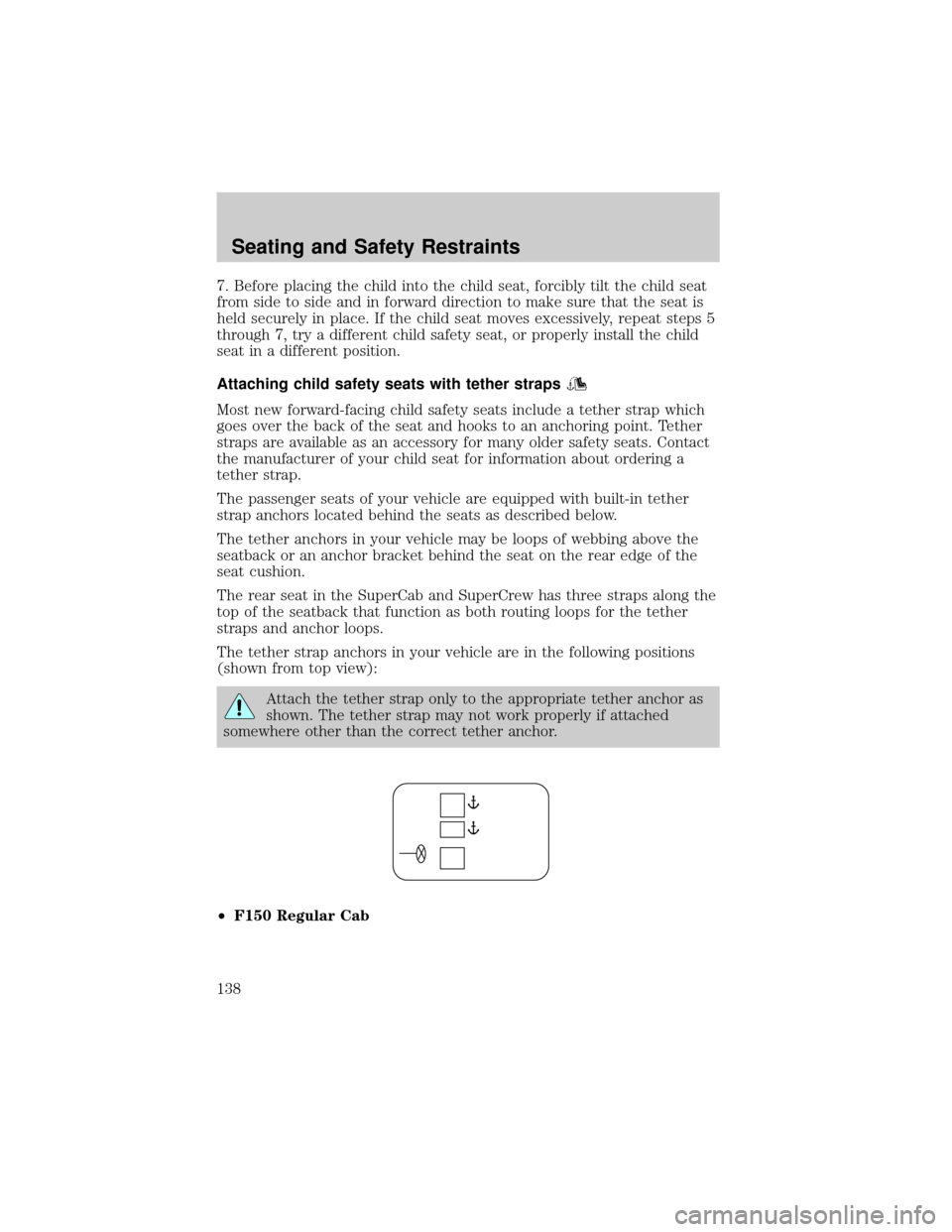
Your vehicle is equipped with LATCH anchors for child seat installation
at the following seating positions:
²F150 Regular Cab
²F150 SuperCab and SuperCrew
Seating and Safety Restraints
142
Page 143 of 280
Connectors on the LATCH child seat
and the child seat instructions may
use the symbol shown here. Your
vehicle seat may have plain buttons,
instead of this symbol, to indicate the location of the LATCH lower
anchors.
Never attach two LATCH child safety seats to the same anchor.
In a crash, one anchor may not be strong enough to hold two
child safety seat attachments and may break, causing serious injury or
death.
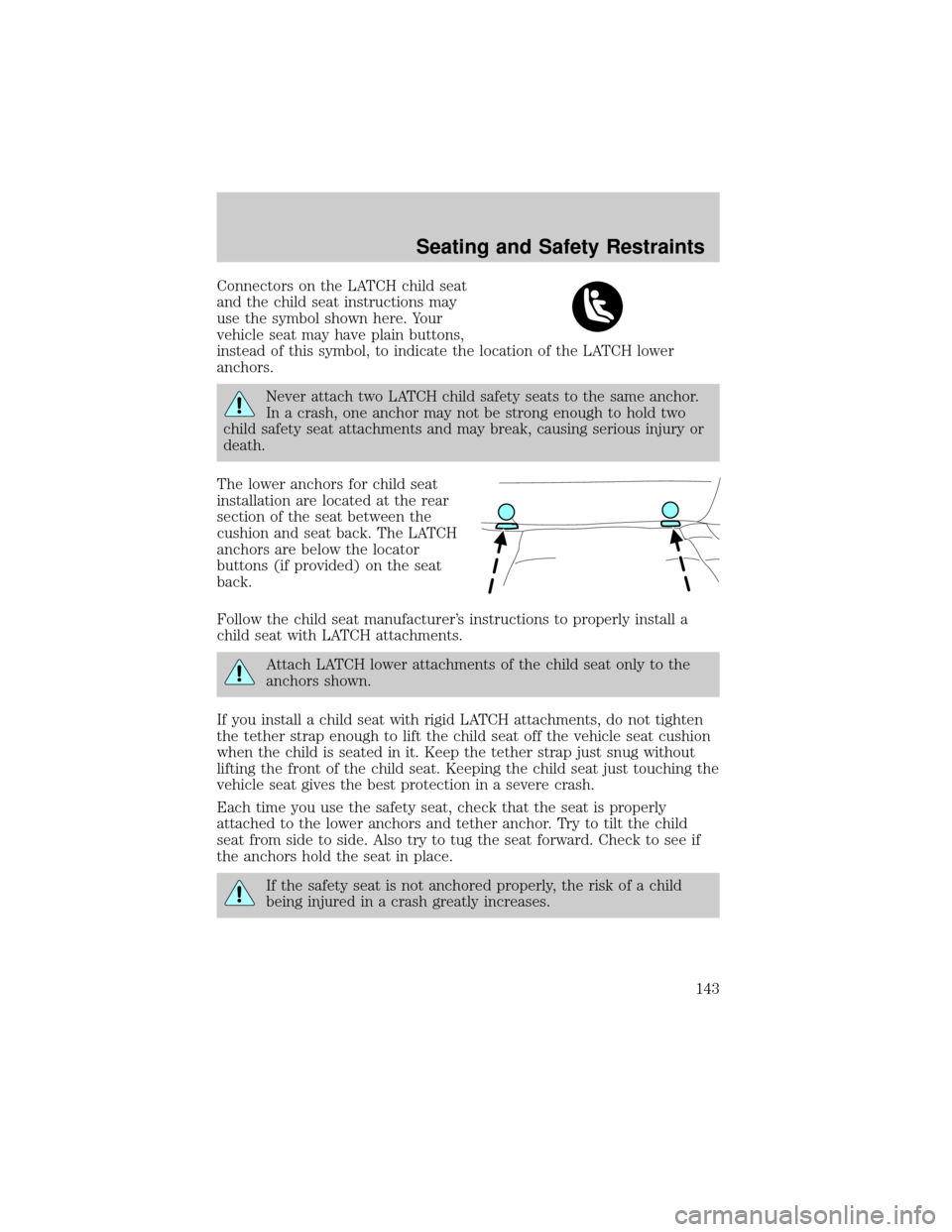
The lower anchors for child seat
installation are located at the rear
section of the seat between the
cushion and seat back. The LATCH
anchors are below the locator
buttons (if provided) on the seat
back.
Follow the child seat manufacturer's instructions to properly install a
child seat with LATCH attachments.
Attach LATCH lower attachments of the child seat only to the
anchors shown.
If you install a child seat with rigid LATCH attachments, do not tighten
the tether strap enough to lift the child seat off the vehicle seat cushion
when the child is seated in it. Keep the tether strap just snug without
lifting the front of the child seat. Keeping the child seat just touching the
vehicle seat gives the best protection in a severe crash.
Each time you use the safety seat, check that the seat is properly
attached to the lower anchors and tether anchor. Try to tilt the child
seat from side to side. Also try to tug the seat forward. Check to see if
the anchors hold the seat in place.
If the safety seat is not anchored properly, the risk of a child
being injured in a crash greatly increases.
Seating and Safety Restraints
143
Page 190 of 280
The fuses are coded as follows.
Fuse/Relay
LocationFuse Amp
RatingPassenger Compartment Fuse
Panel Description
1 10A* Run/Accessory - Wipers,
Instrument cluster
2 20A* Stop/Turn lamps, Speed control
deactivate switch
3 5A* Power mirrors, Memory logic
power, Memory seats and pedals
4 10A* DVD battery power
5 7.5A* Keep alive memory for Powertrain
Control Module (PCM) and
climate control module
6 15A* Parklamps, BSM, Instrument
panel illumination
7 5A* Radio (start signal)
8 10A* Heated mirrors, Switch indicator
9 Ð Not used
Roadside Emergencies
190
Page 191 of 280
Fuse/Relay
LocationFuse Amp
RatingPassenger Compartment Fuse
Panel Description
10 20A* Trailer tow back-up lamps relay
(PCB1), Trailer tow parklamp
relay (R201)
11 10A* A/C clutch, 4x4 solenoid
12 Ð Not used
13 10A* Climate control module power
14 10A* Back-up lamp and Daytime
Running Lamps (DRL) relay coil,
A/C pressure switch, Brake-shift
interlock solenoid
15 5A* Overdrive cancel, Cluster,
Brake-Shift Interlock (BSI)
16 10A* ABS module (Run/Start power)
17 15A* Fog lamp relay (R202)
18 10A* Run/Start feed - Flasher relay,
Electrochromatic mirror, Heated
seats, BSM, Compass, RSS
(Reverse Sensing System)
19 10A* Restraints (Air bag module)
20 15A* PCM 4x4 power
21 15A* Cluster keep alive power
22 10A* Delayed accessory power for
audio, power door lock switch and
moonroof switch illumination
23 10A* RH low beam headlamp
24 15A* Battery saver power for demand
lamps
25 10A* LH low beam headlamp
26 20A* Horn relay (PCB3), Horn power
Roadside Emergencies
191
Page 193 of 280
Fuse/Relay
LocationFuse Amp
RatingPassenger Compartment Fuse
Panel Description
107 30A** Power door locks (BSM)
108 30A** Passenger power seat
109 30A** Driver power seat, Adjustable
pedals
110 Ð Not used
111 30A** 4x4 relays
112 40A** ABS pump power
113 30A** Wipers and washer pump
114 40A** Heated backlite, Heated mirror
power
115 Ð Not used
116 30A** Blower motor
117 Ð Not used
118 30A** Heated seats
401 30A Circuit
breakerPower windows, Moonroof, Power
sliding backlite
R01 Full ISO relay Starter solenoid
R02 Full ISO relay Accessory delay
R03 Full ISO relay Hi-beam headlamps
R04 Full ISO relay Heated backlite
R05 Full ISO relay Trailer tow battery charge
R06 Full ISO relay Blower motor
R201 Half ISO relay Trailer tow park lamps
R202 Half ISO relay Fog lamps
R203 Half ISO relay PCM
* Mini fuses ** Cartridge fuses
Roadside Emergencies
193
Page 219 of 280
WINDOWS AND WIPER BLADES
The windshield, rear window and wiper blades should be cleaned regularly.
If the wiper does not wipe properly, substances on the windshield, rear
window or the wiper blades may be the cause. These may include hot wax
treatments used by commercial car washes, tree sap, or other organic
contamination. To clean these items, please follow these tips:
²The windshield or rear window may be cleaned with a non-abrasive
cleaner such as Motorcraft Ultra Clear Spray Glass Cleaner (ZC-23),
available from your dealer.
²Do not use abrasives, as they may cause scratches.
²Do not use fuel, kerosene, or paint thinner to clean any parts.
²Wiper blades can be cleaned with isopropyl (rubbing) alcohol or
windshield washer solution. Be sure to replace wiper blades when they
appear worn or do not function properly.
INSTRUMENT PANEL AND CLUSTER LENS
Clean the instrument panel with a damp cloth, then dry with a dry cloth.
²Avoid cleaners or polish that increase the gloss of the upper portion of
the instrument panel. The dull finish in this area helps protect the
driver from undesirable windshield reflection.
Do not use chemical solvents or strong detergents when cleaning
the steering wheel or instrument panel to avoid contamination of
the air bag system.
²Be certain to wash or wipe your hands clean if you have been in
contact with certain products such as insect repellent and suntan
lotion in order to avoid possible damage to the interior painted
surfaces.
INTERIOR TRIM
²Clean the interior trim areas with a damp cloth, then dry by wiping
with a dry, soft, clean cloth.
²
Do not use household or glass cleaners as these may damage the finish.
INTERIOR
For fabric, carpets, cloth seats and safety belts:
²Remove dust and loose dirt with a vacuum cleaner.
²Remove light stains and soil with Motorcraft Extra Strength
Upholstery Cleaner (ZC-41).
Cleaning
219