2004 FORD EXPEDITION fuel pump
[x] Cancel search: fuel pumpPage 249 of 344
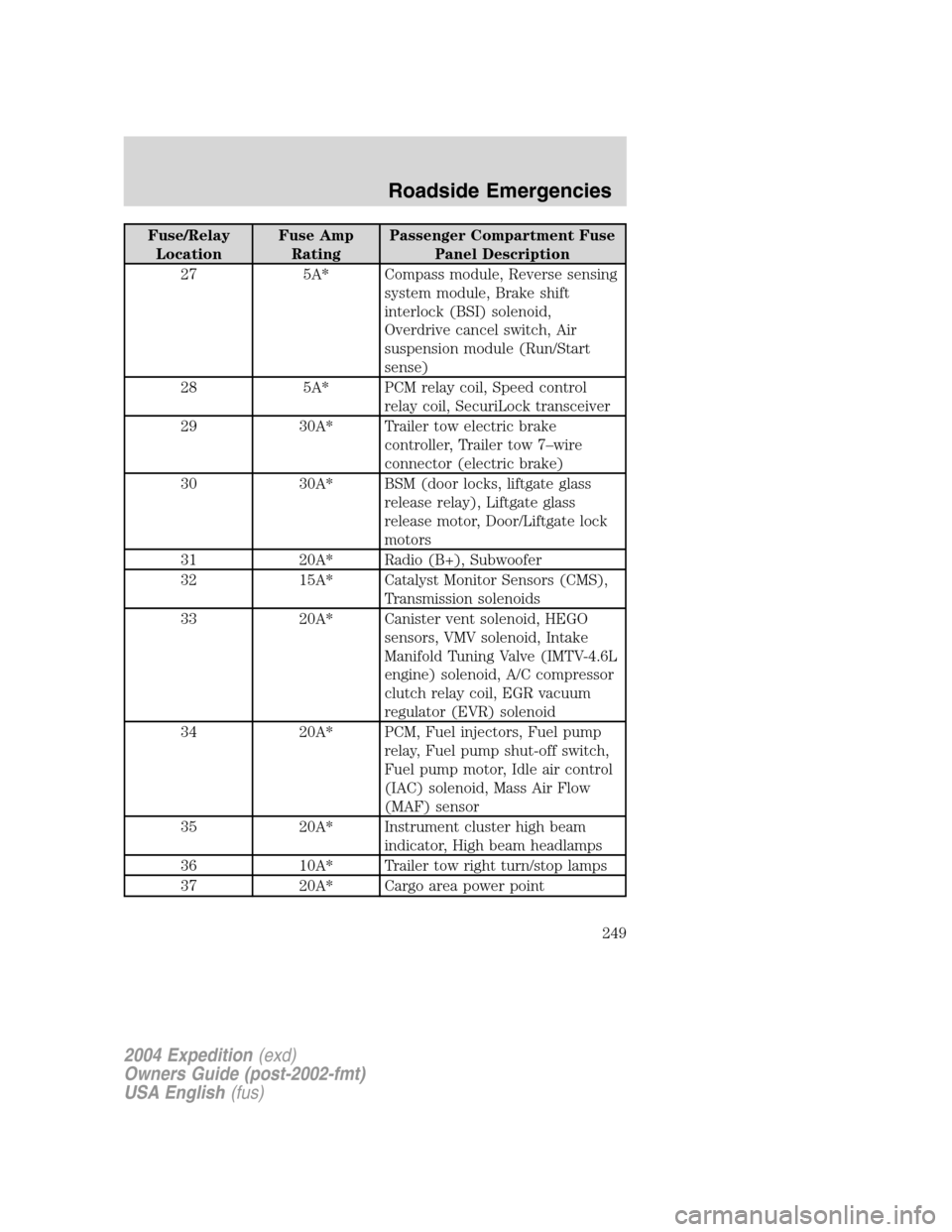
Fuse/Relay
LocationFuse Amp
RatingPassenger Compartment Fuse
Panel Description
27 5A* Compass module, Reverse sensing
system module, Brake shift
interlock (BSI) solenoid,
Overdrive cancel switch, Air
suspension module (Run/Start
sense)
28 5A* PCM relay coil, Speed control
relay coil, SecuriLock transceiver
29 30A* Trailer tow electric brake
controller, Trailer tow 7–wire
connector (electric brake)
30 30A* BSM (door locks, liftgate glass
release relay), Liftgate glass
release motor, Door/Liftgate lock
motors
31 20A* Radio (B+), Subwoofer
32 15A* Catalyst Monitor Sensors (CMS),
Transmission solenoids
33 20A* Canister vent solenoid, HEGO
sensors, VMV solenoid, Intake
Manifold Tuning Valve (IMTV-4.6L
engine) solenoid, A/C compressor
clutch relay coil, EGR vacuum
regulator (EVR) solenoid
34 20A* PCM, Fuel injectors, Fuel pump
relay, Fuel pump shut-off switch,
Fuel pump motor, Idle air control
(IAC) solenoid, Mass Air Flow
(MAF) sensor
35 20A* Instrument cluster high beam
indicator, High beam headlamps
36 10A* Trailer tow right turn/stop lamps
37 20A* Cargo area power point
2004 Expedition(exd)
Owners Guide (post-2002-fmt)
USA English(fus)
Roadside Emergencies
249
Page 252 of 344

Fuse/Relay
LocationFuse Amp
RatingPassenger Compartment Fuse
Panel Description
R03 Hi-beam relay Fuse # 35, Hi-beam headlamps,
Hi-beam indicator
R04 Rear window
defrost relayFuse 8 (heated mirrors), Rear
window defroster, Heated outside
mirrors, Rear window defroster
indicator (climate control head)
R05 Trailer tow
battery charge
relayTrailer tow 7–wire connector
(battery charge)
R06 Front blower
relayFront blower motor
R201 Trailer tow park
lamp relayTrailer tow 7–wire and 4–wire
connectors (park lamps)
R202 Foglamp relay Front foglamps
R203 PCM relay Fuse 32, Fuse 33, Fuse 34, Fuel
pump relay, Fuel pump, PCM
solenoids and sensors
R301 Trailer tow
back-up lamp
relayTrailer tow 7–wire connector
(back-up lamps)
R302 Speed control
relaySpeed control servo
R303 Fuel pump relay Fuel pump shut-off switch, PCM
(fuel pump monitor), Fuel pump
R304 Battery saver
relayRoof rail lamps, Vanity mirror
lamps, Map/Dome lamp, Glove box
lamp, Cargo area lamp, Outside
mirror puddle lamps, Instrument
cluster (interior lamps)
R305 Horn relay Dual note horn
* Mini Fuses ** Maxi Fuses
Note:Relays R301–R305 are not serviceable components; see your
dealer or a qualified technician for assistance.
2004 Expedition(exd)
Owners Guide (post-2002-fmt)
USA English(fus)
Roadside Emergencies
252
Page 298 of 344
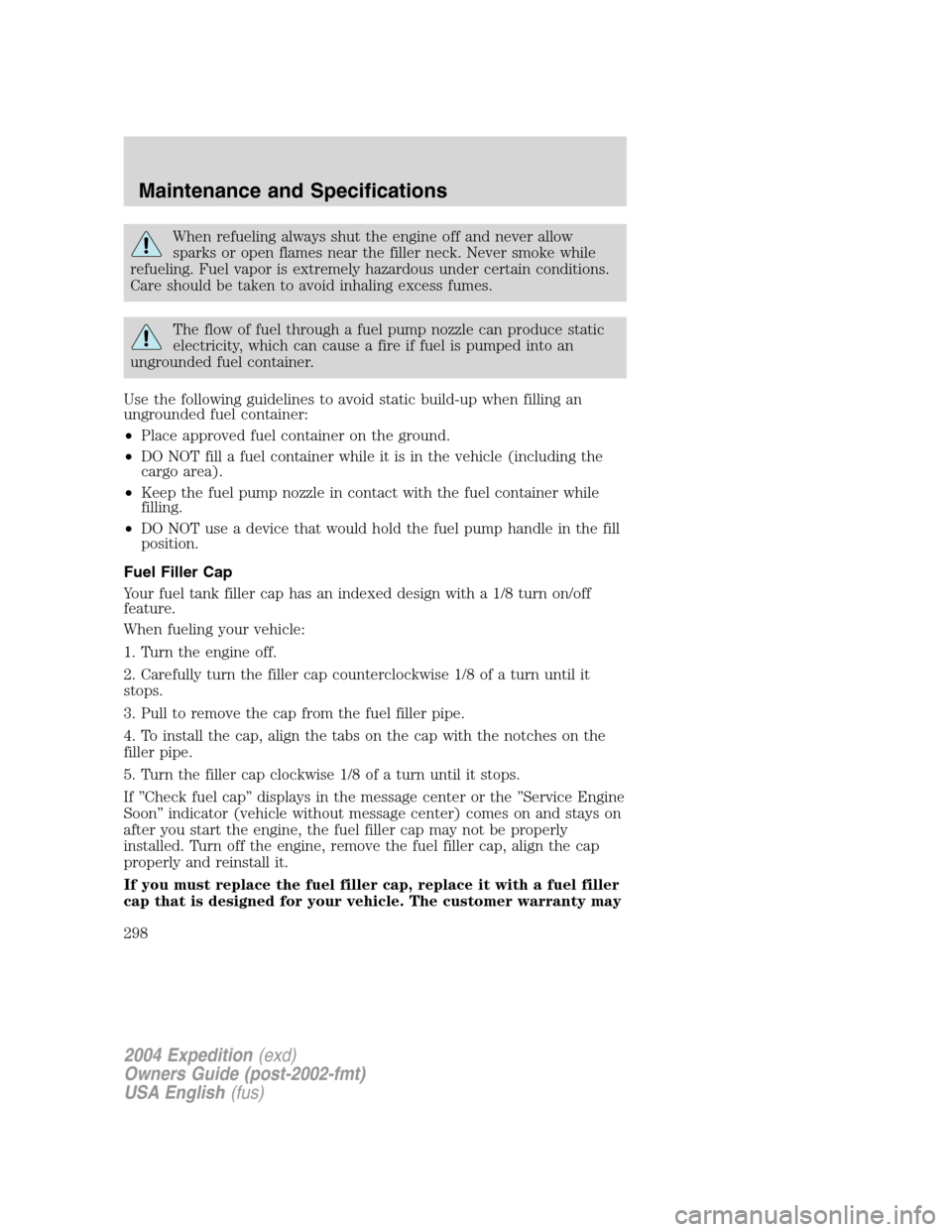
When refueling always shut the engine off and never allow
sparks or open flames near the filler neck. Never smoke while
refueling. Fuel vapor is extremely hazardous under certain conditions.
Care should be taken to avoid inhaling excess fumes.
The flow of fuel through a fuel pump nozzle can produce static
electricity, which can cause a fire if fuel is pumped into an
ungrounded fuel container.
Use the following guidelines to avoid static build-up when filling an
ungrounded fuel container:
•Place approved fuel container on the ground.
•DO NOT fill a fuel container while it is in the vehicle (including the
cargo area).
•Keep the fuel pump nozzle in contact with the fuel container while
filling.
•DO NOT use a device that would hold the fuel pump handle in the fill
position.
Fuel Filler Cap
Your fuel tank filler cap has an indexed design with a 1/8 turn on/off
feature.
When fueling your vehicle:
1. Turn the engine off.
2. Carefully turn the filler cap counterclockwise 1/8 of a turn until it
stops.
3. Pull to remove the cap from the fuel filler pipe.
4. To install the cap, align the tabs on the cap with the notches on the
filler pipe.
5. Turn the filler cap clockwise 1/8 of a turn until it stops.
If”Check fuel cap”displays in the message center or the”Service Engine
Soon”indicator (vehicle without message center) comes on and stays on
after you start the engine, the fuel filler cap may not be properly
installed. Turn off the engine, remove the fuel filler cap, align the cap
properly and reinstall it.
If you must replace the fuel filler cap, replace it with a fuel filler
cap that is designed for your vehicle. The customer warranty may
2004 Expedition(exd)
Owners Guide (post-2002-fmt)
USA English(fus)
Maintenance and Specifications
298
Page 299 of 344
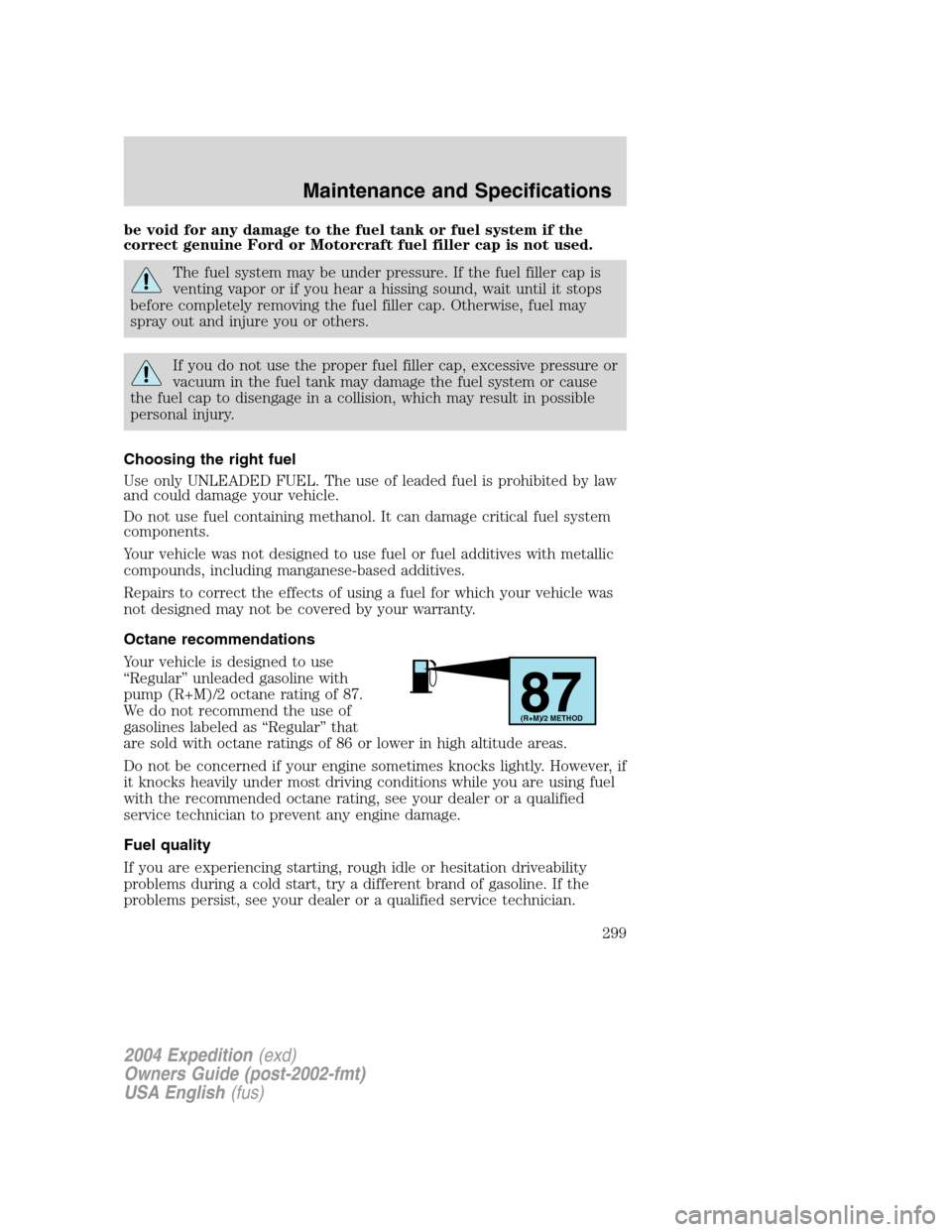
be void for any damage to the fuel tank or fuel system if the
correct genuine Ford or Motorcraft fuel filler cap is not used.
The fuel system may be under pressure. If the fuel filler cap is
venting vapor or if you hear a hissing sound, wait until it stops
before completely removing the fuel filler cap. Otherwise, fuel may
spray out and injure you or others.
If you do not use the proper fuel filler cap, excessive pressure or
vacuum in the fuel tank may damage the fuel system or cause
the fuel cap to disengage in a collision, which may result in possible
personal injury.
Choosing the right fuel
Use only UNLEADED FUEL. The use of leaded fuel is prohibited by law
and could damage your vehicle.
Do not use fuel containing methanol. It can damage critical fuel system
components.
Your vehicle was not designed to use fuel or fuel additives with metallic
compounds, including manganese-based additives.
Repairs to correct the effects of using a fuel for which your vehicle was
not designed may not be covered by your warranty.
Octane recommendations
Your vehicle is designed to use
“Regular”unleaded gasoline with
pump (R+M)/2 octane rating of 87.
We do not recommend the use of
gasolines labeled as“Regular”that
are sold with octane ratings of 86 or lower in high altitude areas.
Do not be concerned if your engine sometimes knocks lightly. However, if
it knocks heavily under most driving conditions while you are using fuel
with the recommended octane rating, see your dealer or a qualified
service technician to prevent any engine damage.
Fuel quality
If you are experiencing starting, rough idle or hesitation driveability
problems during a cold start, try a different brand of gasoline. If the
problems persist, see your dealer or a qualified service technician.
87(R+M)/2 METHOD
2004 Expedition(exd)
Owners Guide (post-2002-fmt)
USA English(fus)
Maintenance and Specifications
299
Page 300 of 344
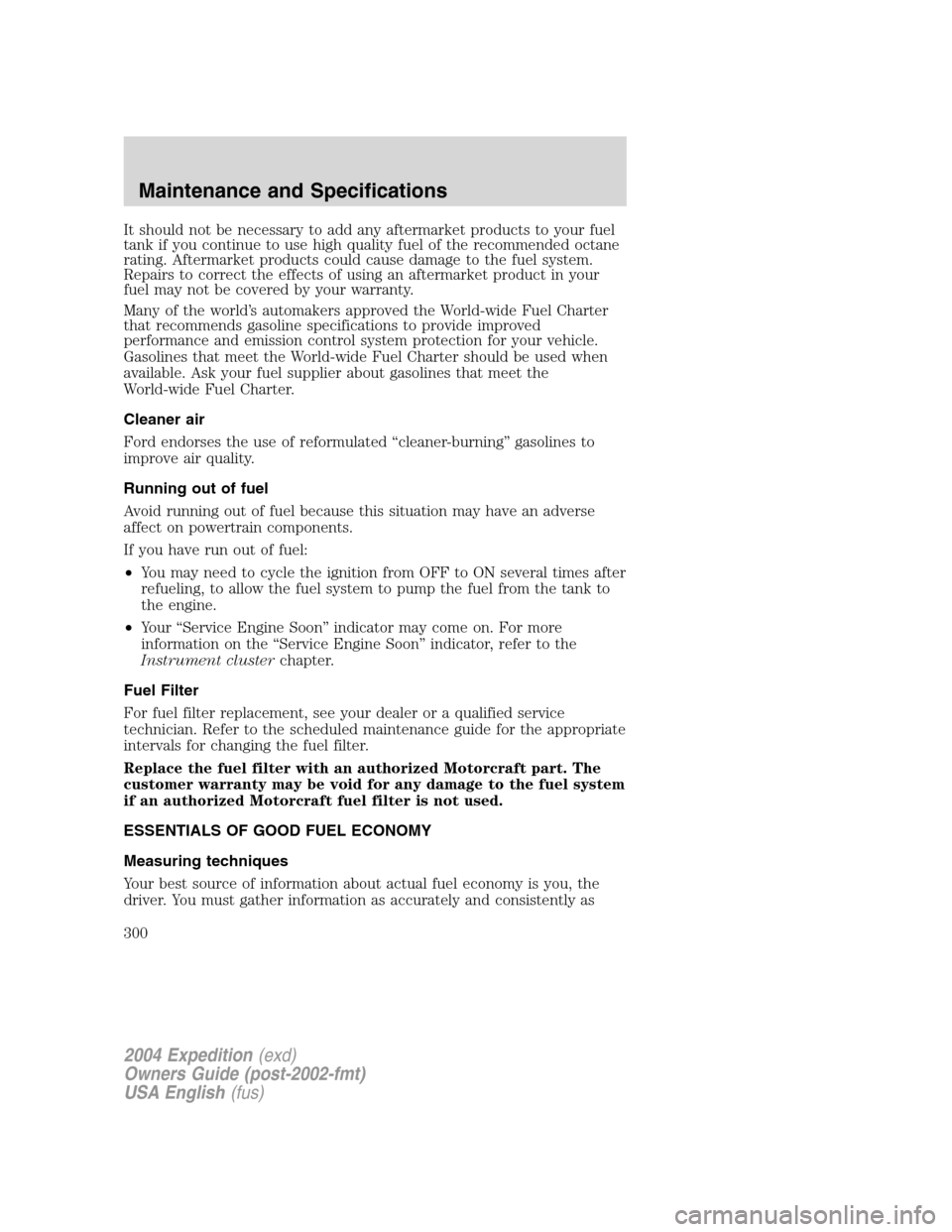
It should not be necessary to add any aftermarket products to your fuel
tank if you continue to use high quality fuel of the recommended octane
rating. Aftermarket products could cause damage to the fuel system.
Repairs to correct the effects of using an aftermarket product in your
fuel may not be covered by your warranty.
Many of the world’s automakers approved the World-wide Fuel Charter
that recommends gasoline specifications to provide improved
performance and emission control system protection for your vehicle.
Gasolines that meet the World-wide Fuel Charter should be used when
available. Ask your fuel supplier about gasolines that meet the
World-wide Fuel Charter.
Cleaner air
Ford endorses the use of reformulated“cleaner-burning”gasolines to
improve air quality.
Running out of fuel
Avoid running out of fuel because this situation may have an adverse
affect on powertrain components.
If you have run out of fuel:
•You may need to cycle the ignition from OFF to ON several times after
refueling, to allow the fuel system to pump the fuel from the tank to
the engine.
•Your“Service Engine Soon”indicator may come on. For more
information on the“Service Engine Soon”indicator, refer to the
Instrument clusterchapter.
Fuel Filter
For fuel filter replacement, see your dealer or a qualified service
technician. Refer to the scheduled maintenance guide for the appropriate
intervals for changing the fuel filter.
Replace the fuel filter with an authorized Motorcraft part. The
customer warranty may be void for any damage to the fuel system
if an authorized Motorcraft fuel filter is not used.
ESSENTIALS OF GOOD FUEL ECONOMY
Measuring techniques
Your best source of information about actual fuel economy is you, the
driver. You must gather information as accurately and consistently as
2004 Expedition(exd)
Owners Guide (post-2002-fmt)
USA English(fus)
Maintenance and Specifications
300
Page 301 of 344

possible. Fuel expense, frequency of fill-ups or fuel gauge readings are
NOT accurate as a measure of fuel economy. We do not recommend
taking fuel economy measurements during the first 1,600 km (1,000 miles)of driving (engine break-in period). You will get a more accurate
measurement after 3,000 km–5,000 km (2,000 miles-3,000 miles).
Filling the tank
The advertised fuel capacity of the fuel tank on your vehicle is equal to
the rated refill capacity of the fuel tank as listed in theRefill capacities
section of this chapter.
The advertised capacity is the amount of the indicated capacity and the
empty reserve combined. Indicated capacity is the difference in the
amount of fuel in a full tank and a tank when the fuel gauge indicates
empty. Empty reserve is the small amount of fuel remaining in the fuel
tank after the fuel gauge indicates empty.
The amount of usable fuel in the empty reserve varies and should
not be relied upon to increase driving range. When refueling your
vehicle after the fuel gauge indicates empty, you might not be
able to refuel the full amount of the advertised capacity of the
fuel tank due to the empty reserve still present in the tank.
For consistent results when filling the fuel tank:
•Turn the engine/ignition switch to the off position prior to refueling,
an error in the reading will result if the engine is left running.
•Use the same filling rate setting (low—medium—high) each time
the tank is filled.
•Allow no more than 2 automatic click-offs when filling.
•Always use fuel with the recommended octane rating.
•Use a known quality gasoline, preferably a national brand.
•Use the same side of the same pump and have the vehicle facing the
same direction each time you fill up.
•Have the vehicle loading and distribution the same every time.
Your results will be most accurate if your filling method is consistent.
Calculating fuel economy
1. Fill the fuel tank completely and record the initial odometer reading
(in kilometers or miles).
2. Each time you fill the tank, record the amount of fuel added (in liters
or gallons).
2004 Expedition(exd)
Owners Guide (post-2002-fmt)
USA English(fus)
Maintenance and Specifications
301
Page 341 of 344
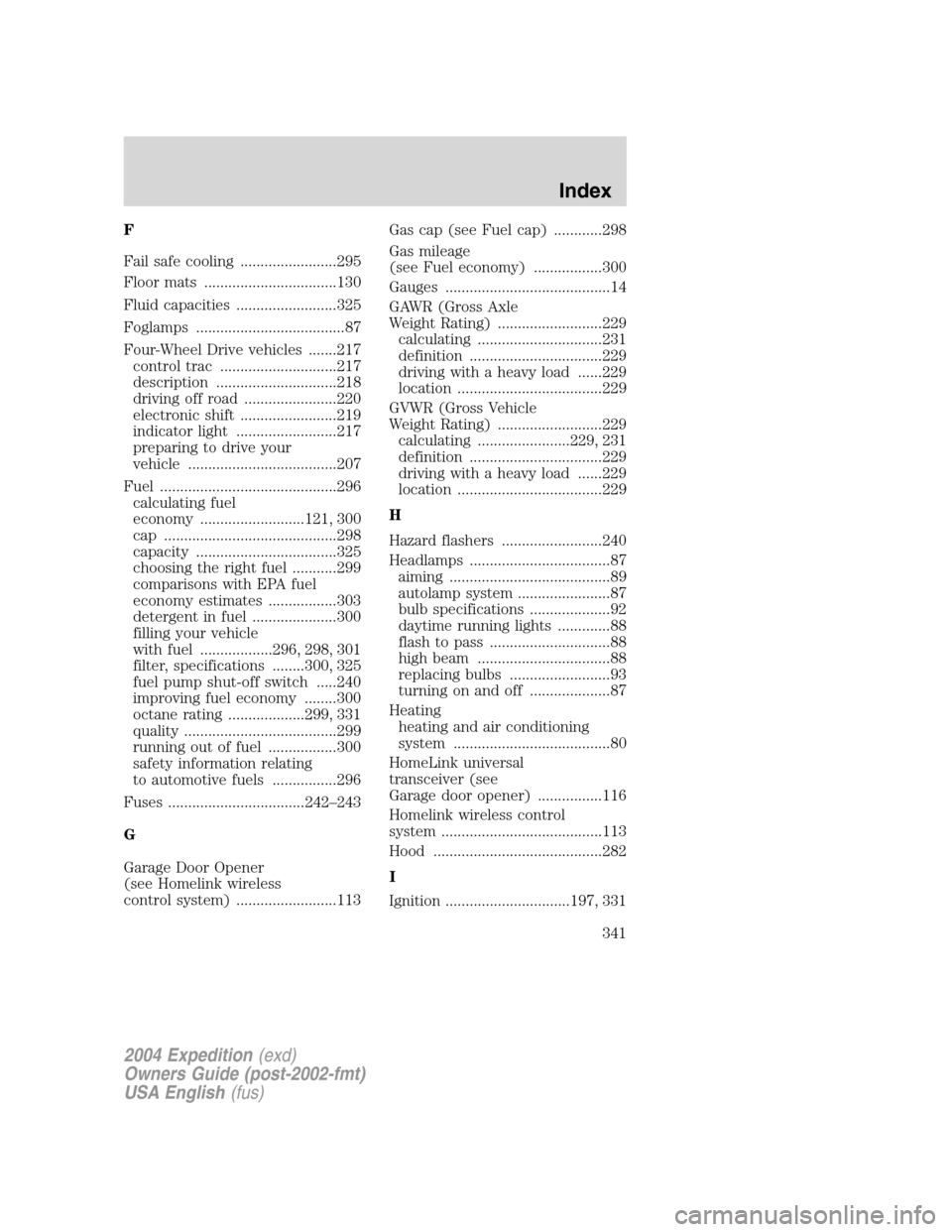
F
Fail safe cooling ........................295
Floor mats .................................130
Fluid capacities .........................325
Foglamps .....................................87
Four-Wheel Drive vehicles .......217
control trac .............................217
description ..............................218
driving off road .......................220
electronic shift ........................219
indicator light .........................217
preparing to drive your
vehicle .....................................207
Fuel ............................................296
calculating fuel
economy ..........................121, 300
cap ...........................................298
capacity ...................................325
choosing the right fuel ...........299
comparisons with EPA fuel
economy estimates .................303
detergent in fuel .....................300
filling your vehicle
with fuel ..................296, 298, 301
filter, specifications ........300, 325
fuel pump shut-off switch .....240
improving fuel economy ........300
octane rating ...................299, 331
quality ......................................299
running out of fuel .................300
safety information relating
to automotive fuels ................296
Fuses ..................................242–243
G
Garage Door Opener
(see Homelink wireless
control system) .........................113Gas cap (see Fuel cap) ............298
Gas mileage
(see Fuel economy) .................300
Gauges .........................................14
GAWR (Gross Axle
Weight Rating) ..........................229
calculating ...............................231
definition .................................229
driving with a heavy load ......229
location ....................................229
GVWR (Gross Vehicle
Weight Rating) ..........................229
calculating .......................229, 231
definition .................................229
driving with a heavy load ......229
location ....................................229
H
Hazard flashers .........................240
Headlamps ...................................87
aiming ........................................89
autolamp system .......................87
bulb specifications ....................92
daytime running lights .............88
flash to pass ..............................88
high beam .................................88
replacing bulbs .........................93
turning on and off ....................87
Heating
heating and air conditioning
system .......................................80
HomeLink universal
transceiver (see
Garage door opener) ................116
Homelink wireless control
system ........................................113
Hood ..........................................282
I
Ignition ...............................197, 331
2004 Expedition(exd)
Owners Guide (post-2002-fmt)
USA English(fus)
Index
341