2004 FORD EXCURSION door lock
[x] Cancel search: door lockPage 176 of 272

Do not use”aftermarket lift kits” or other suspension modifications,
whether or not they are used with larger tires and wheels.
These “aftermarket lift kits” could adversely affect the vehicle’s handling
characteristics, which could lead to loss of vehicle control or roll over
and serious injury.
Tires can be damaged during off-road use. For your safety, tires that are
damaged should not be used for highway driving because they are more
likely to blow out or fail.
You should carefully observe the recommended tire inflation pressure
found on the safety compliance certification label attached to the left
front door lock facing or door latch post pillar. Failure to follow tire
pressure recommendations can adversely affect the way your vehicle
handles. Do not exceed the Ford Motor Company recommended pressure
even if it is less than the maximum pressure allowed for the tire.
Each day before you drive, check
your tires. If one looks lower than
the others, use a tire gauge to check
pressure of all tires, and adjust if
required. Check tire pressure with a
tire gauge every few weeks
(including spare). Safe operation
requires tires that are neither
underinflated nor overloaded.
Periodically inspect the tire treads and remove stones, nails, glass or
other objects that may be wedged in the tread grooves. Check for holes
or cuts that may permit air leakage from the tire and make necessary
repairs.
Inspect the tire side walls for cuts, bruises and other damage. If internal
damage to the tire is suspected, have the tire demounted and inspected
in case it needs to be repaired or replaced.
Maintenance and Modifications
The suspension and steering systems on your vehicle have been designed
and tested to provide both reasonably safe, predictable performance
whether loaded or empty and durable load carrying capability. For this
reason, Ford Motor Company strongly recommends that you do not make
modifications such as adding or removing parts (such as lift kits or
stabilizer bars) or by using replacement parts not equivalent to the
original factory equipment.
Driving
176
Page 191 of 272

Fuse/Relay
LocationFuse Amp
RatingPassenger Compartment Fuse Panel
Description
30 15A* Highbeam headlamps
31 15A* Clutch interlock switch
32 5A* Radio (start)
33 15A* Front wiper
34 10A* Brake on-off switch
35 10A* Instrument cluster
36 10A* PCM Keep-Alive
37 15A* Horn
38 20A* Trailer tow park lamps and backup lamps
39 — Not used
40 20A* Fuel pump
41 10A* Instrument cluster
42 15A* Delayed accessory
43 10A* Fog lamps
44 10A* PATS module, transceiver
45 10A* Ignition switch Run/ Start feed
46 10A* Left-hand lowbeam
47 10A* Right-hand lowbeam
48 10A* Rear wiper motor
101 30A** Trailer tow electric brake
102 30A** Door locks/Body security module
103 50A** Ignition switch
104 40A** Heated backlite
105 30A** Injector driver module
106 30A** Front wiper main
107 40A** Front blower motor
108 40A** Auxiliary blower motor
109 30A** Heated seats
110 50A** Ignition switch
111 30A** 4WD/Shift on the fly
112 30A** Left-hand power seats
Roadside Emergencies
191
Page 192 of 272

Fuse/Relay
LocationFuse Amp
RatingPassenger Compartment Fuse Panel
Description
113 30A** Starter motor
114 30A** Right-hand power seats
115 20A** Trailer tow battery charge
116 30A** Ignition switch
601 30A CB Door window motors
602 60A** 4-Wheel Anti-Lock Brake System
(4WABS) module
210 — Not used
211 — Not used
212 — Not used
301 — Front blower motor relay
302 — Powertrain (EEC) relay
303 — Injector driver module relay (Diesel
only)
304 — Heated backlite relay
305 — Trailer tow battery charge relay
306 — Delayed accessory relay
307 — Starter relay
* Mini Fuses ** Maxi Fuses
CHANGING THE TIRES
If you get a flat tire while driving, do not apply the brake heavily.
Instead, gradually decrease your speed. Hold the steering wheel firmly
and slowly move to a safe place on the side of the road.
The use of tire sealants is not recommended and may compromise the
integrity of your tires. The use of tire sealants may also affect your tire
pressure monitoring system (if equipped).
Spare tire information
Your vehicle may be equipped with a spare tire that can be used as
either a spare or a regular tire. The spare tire is not equipped with wheel
trim. The wheel trim from the original wheel/tire may be used on the
spare.
Your vehicle is equipped with 4WD, a spare tire of a different size
than the road tires should not be used. Such a tire could result in
damage to driveline components and make the vehicle difficult to
control.
Roadside Emergencies
192
Page 263 of 272

FORD ACCESSORIES FOR YOUR VEHICLE
A wide selection of genuine Ford accessories are available for your
vehicle through your local authorized Ford, Lincoln, Mercury or Ford of
Canada dealer. These quality accessories have been specifically
engineered to fulfill your automotive needs; they are custom designed to
complement the style and aerodynamic appearance of your vehicle. In
addition, each accessory is made from high quality materials and meets
or exceeds Ford’s rigorous engineering and safety specifications. Ford
Motor Company will repair or replace any properly dealer-installed Ford
accessory found to be defective in factory-supplied materials or
workmanship during the warranty period, as well as any component
damaged by the defective accessory. The accessory will be warranted for
whichever provides you the greatest benefit:
•12 months or 20 000 km (12 000 miles) (whichever occurs first), or
•the remainder of your new vehicle limited warranty.
This means that genuine Ford accessories purchased along with your
new vehicle and installed by the dealer are covered for the full length of
your New Vehicle’s Limited Warranty — 3 years or 60 000 km (36 000
miles) (whichever occurs first). Contact your dealer for details and a
copy of the warranty.
Not all accessories are available for all models.
Vehicle Security
Styled wheel protector locks
Vehicle security systems
Underbody Lighting
Comfort and convenience
Cargo organizers
Cargo shades
Cargo trays
Cell phone holder
Dash trim
Engine block heaters
Battery warmer/blanket
Cellar phone holder
Rear door storage bins
Tire step
Accessories
263
Page 264 of 272

Travel equipment
Adjustable Towing Systems
Auto headlamp system with DRL (Daytime Running Lights)
Battery Warmer
Box Aluminum Rack cargo storage systems
Daytime running lights
Factory luggage rack adaptors
Fog lights
Framed luggage covers
Hard and soft sided roof box
Highway safety and first aid kit
Multi sport track rider cross bars
Multi sport track rider adaptors
Spare tire soft storage cover
Seat back pack storage
Soft luggage cover
Trailgate tables
Towing mirrors
Trailer hitch mounted bike carrier
Trailer hitch bars and balls
Trailer hitch swivel
Tubular running bars
TV/video system
Protection and appearance equipment
Air bag anti-theft locks
Carpeted cargo mat
Door edge guards
Truck covers
Cargo liners, interior
Carpet floor mats
Cleaners, waxes and polishes
Flat splash guards
Front end covers (full)
Grill guards/brush guards
Accessories
264
Page 265 of 272

Hood deflectors
Locking gas cap
Lubricants and oils
Molded splash guards
Molded vinyl floor mats
Rear air deflectors
Side window air deflectors
Stainless grill insert
Step bumpers
Sun roof deflector
Touch-up paint
Universal floor mats — carpeted
For maximum vehicle performance, keep the following information in
mind when adding accessories or equipment to your vehicle:
•
When adding accessories, equipment, passengers and luggage to your
vehicle, do not exceed the total weight capacity of the vehicle or of the
front or rear axle (GVWR or GAWR as indicated on the Safety compliance
certification label). Consult your dealer for specific weight information.
•The Federal Communications Commission (FCC) and Canadian Radio
Telecommunications Commission (CRTC) regulate the use of mobile
communications systems - such as two-way radios, telephones and theft
alarms - that are equipped with radio transmitters. Any such equipment
installed in your vehicle should comply with FCC or CRTC regulations
and should be installed only by a qualified service technician.
•Mobile communications systems may harm the operation of your
vehicle, particularly if they are not properly designed for automotive
use or are not properly installed. When operated, such systems may
cause the engine to stumble or stall or cause the transmission to be
damaged or operate improperly. In addition, such systems may be
damaged or their performance may be affected by operating your
vehicle. (Citizens band [CB] transceivers, garage door openers and
other transmitters with outputs of five watts or less will not ordinarily
affect your vehicle’s operation.)
•Ford cannot assume responsibility for any adverse effects or damage
that may result from the use of such equipment.
Accessories
265
Page 267 of 272

attaching with tether straps ..149
in front seat ............................147
in rear seat ..............................147
Cleaning your vehicle
engine compartment ..............214
exterior ....................................217
instrument panel ....................216
interior .....................................216
plastic parts ............................215
washing ....................................213
waxing .....................................213
wheels ......................................214
wiper blades ....................215–216
woodtone trim ........................216
Climate control (see Air
conditioning or Heating) ......57, 60
Clock ......................................23, 32
Compass, electronic ..............86, 95
calibration .................................96
set zone adjustment .................96
Console ......................................101
overhead ..............................82–83
Controls
power seat ...............................119
steering column ........................93
Coolant
checking and adding ..............227
refill capacities ................231, 254
specifications ..................257, 259
Cruise control (see Speed
control) ........................................89
Customer Assistance ................185
Ford accessories for your
vehicle .............................217–218
Ford Extended Service
Plan ..........................................206
Getting assistance outside the
U.S. and Canada .....................210
Getting roadside assistance ...185Getting the service you
need .........................................204
Ordering additional owner’s
literature .................................211
The Dispute Settlement
Board .......................................206
Utilizing the
Mediation/Arbitration
Program ...................................209
D
Daytime running lamps
(see Lamps) ................................72
Defrost
rear window ..............................70
Dipstick
automatic transmission
fluid ..........................................245
engine oil .................................222
Doors
door ajar warning .....................14
lubricant specifications ..........257
Driving under special
conditions ..........................171, 173
sand .........................................172
snow and ice ...........................174
through water .................173, 177
E
Emergencies, roadside
jump-starting ..........................197
Emission control system ..........241
Engine ................................259–260
check engine/service engine
soon light ..................................10
cleaning ...................................214
coolant .....................................227
diesel ...........................................7
Index
267
Page 268 of 272
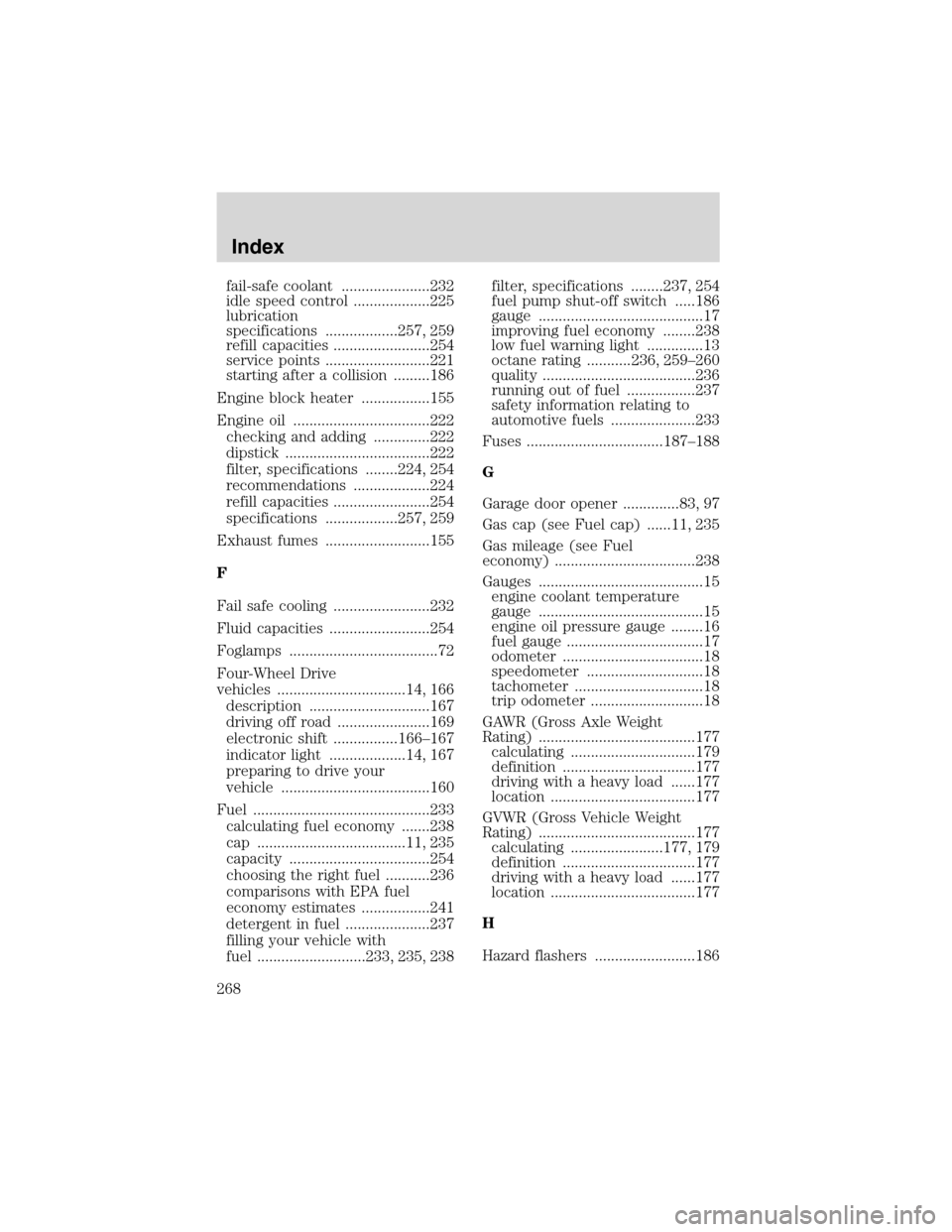
fail-safe coolant ......................232
idle speed control ...................225
lubrication
specifications ..................257, 259
refill capacities ........................254
service points ..........................221
starting after a collision .........186
Engine block heater .................155
Engine oil ..................................222
checking and adding ..............222
dipstick ....................................222
filter, specifications ........224, 254
recommendations ...................224
refill capacities ........................254
specifications ..................257, 259
Exhaust fumes ..........................155
F
Fail safe cooling ........................232
Fluid capacities .........................254
Foglamps .....................................72
Four-Wheel Drive
vehicles ................................14, 166
description ..............................167
driving off road .......................169
electronic shift ................166–167
indicator light ...................14, 167
preparing to drive your
vehicle .....................................160
Fuel ............................................233
calculating fuel economy .......238
cap .....................................11, 235
capacity ...................................254
choosing the right fuel ...........236
comparisons with EPA fuel
economy estimates .................241
detergent in fuel .....................237
filling your vehicle with
fuel ...........................233, 235, 238filter, specifications ........237, 254
fuel pump shut-off switch .....186
gauge .........................................17
improving fuel economy ........238
low fuel warning light ..............13
octane rating ...........236, 259–260
quality ......................................236
running out of fuel .................237
safety information relating to
automotive fuels .....................233
Fuses ..................................187–188
G
Garage door opener ..............83, 97
Gas cap (see Fuel cap) ......11, 235
Gas mileage (see Fuel
economy) ...................................238
Gauges .........................................15
engine coolant temperature
gauge .........................................15
engine oil pressure gauge ........16
fuel gauge ..................................17
odometer ...................................18
speedometer .............................18
tachometer ................................18
trip odometer ............................18
GAWR (Gross Axle Weight
Rating) .......................................177
calculating ...............................179
definition .................................177
driving with a heavy load ......177
location ....................................177
GVWR (Gross Vehicle Weight
Rating) .......................................177
calculating .......................177, 179
definition .................................177
driving with a heavy load ......177
location ....................................177
H
Hazard flashers .........................186
Index
268