Page 22 of 56
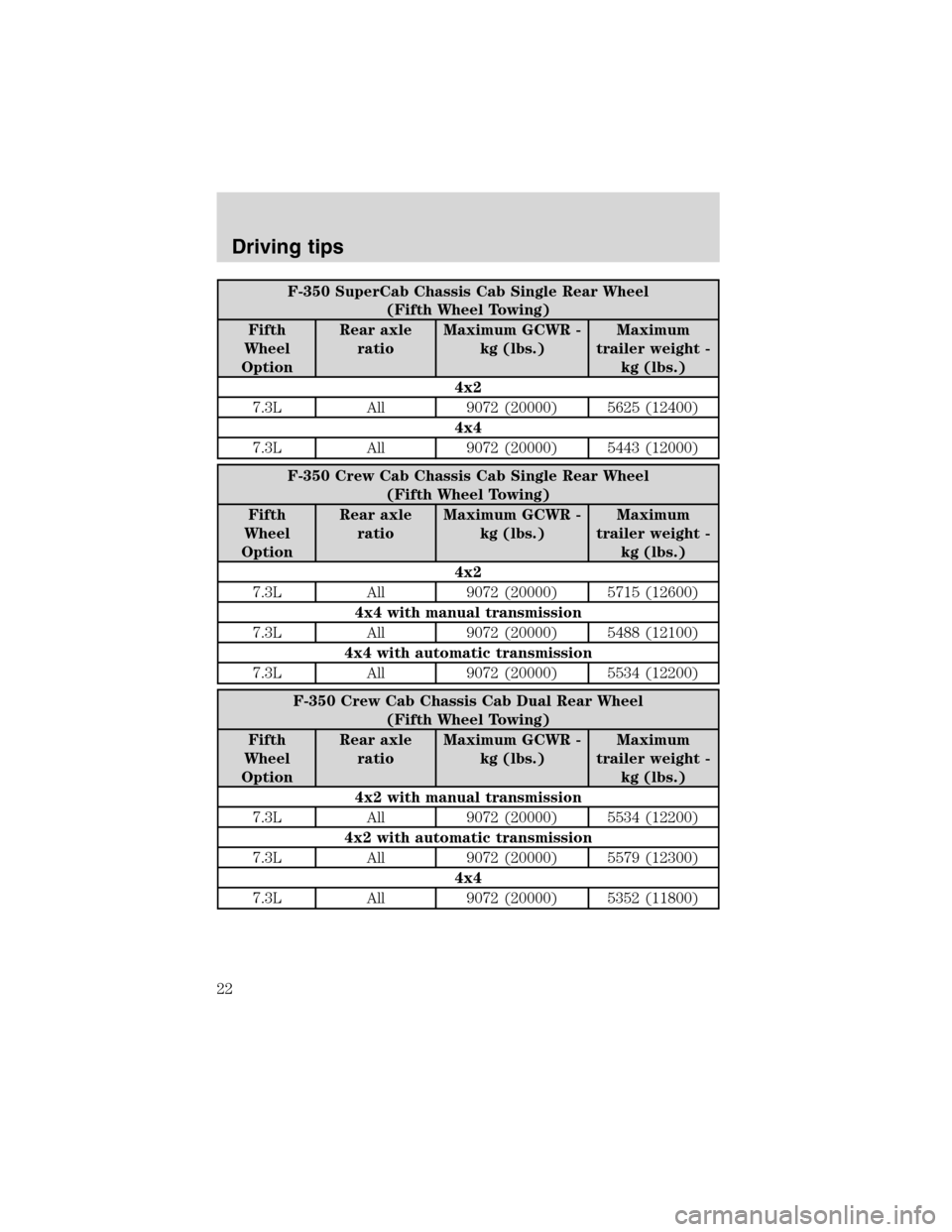
F-350 SuperCab Chassis Cab Single Rear Wheel
(Fifth Wheel Towing)
Fifth
Wheel
OptionRear axle
ratioMaximum GCWR -
kg (lbs.)Maximum
trailer weight -
kg (lbs.)
4x2
7.3L All 9072 (20000) 5625 (12400)
4x4
7.3L All 9072 (20000) 5443 (12000)
F-350 Crew Cab Chassis Cab Single Rear Wheel
(Fifth Wheel Towing)
Fifth
Wheel
OptionRear axle
ratioMaximum GCWR -
kg (lbs.)Maximum
trailer weight -
kg (lbs.)
4x2
7.3L All 9072 (20000) 5715 (12600)
4x4 with manual transmission
7.3L All 9072 (20000) 5488 (12100)
4x4 with automatic transmission
7.3L All 9072 (20000) 5534 (12200)
F-350 Crew Cab Chassis Cab Dual Rear Wheel
(Fifth Wheel Towing)
Fifth
Wheel
OptionRear axle
ratioMaximum GCWR -
kg (lbs.)Maximum
trailer weight -
kg (lbs.)
4x2 with manual transmission
7.3L All 9072 (20000) 5534 (12200)
4x2 with automatic transmission
7.3L All 9072 (20000) 5579 (12300)
4x4
7.3L All 9072 (20000) 5352 (11800)
Driving tips
22
Page 23 of 56
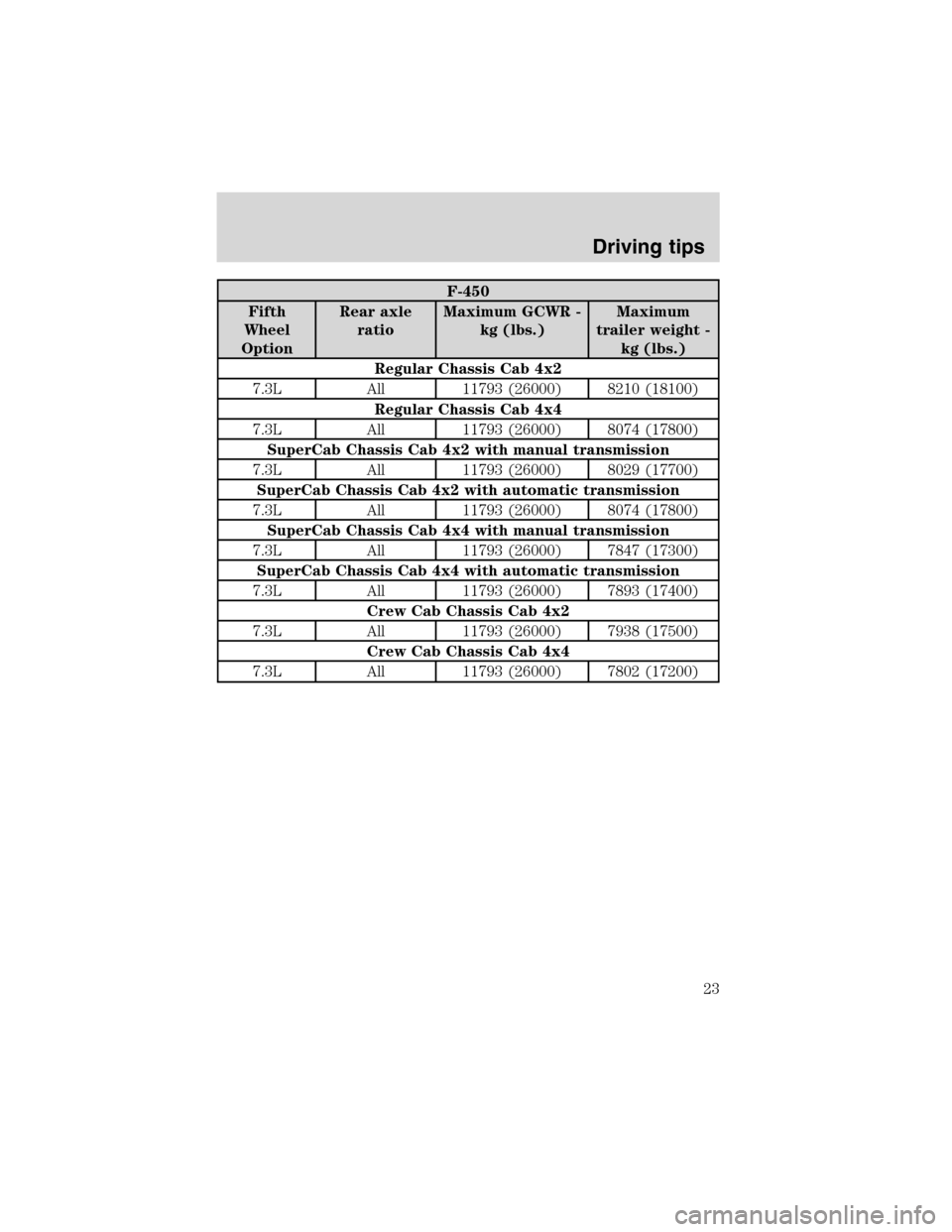
F-450
Fifth
Wheel
OptionRear axle
ratioMaximum GCWR -
kg (lbs.)Maximum
trailer weight -
kg (lbs.)
Regular Chassis Cab 4x2
7.3L All 11793 (26000) 8210 (18100)
Regular Chassis Cab 4x4
7.3L All 11793 (26000) 8074 (17800)
SuperCab Chassis Cab 4x2 with manual transmission
7.3L All 11793 (26000) 8029 (17700)
SuperCab Chassis Cab 4x2 with automatic transmission
7.3L All 11793 (26000) 8074 (17800)
SuperCab Chassis Cab 4x4 with manual transmission
7.3L All 11793 (26000) 7847 (17300)
SuperCab Chassis Cab 4x4 with automatic transmission
7.3L All 11793 (26000) 7893 (17400)
Crew Cab Chassis Cab 4x2
7.3L All 11793 (26000) 7938 (17500)
Crew Cab Chassis Cab 4x4
7.3L All 11793 (26000) 7802 (17200)
Driving tips
23
Page 24 of 56
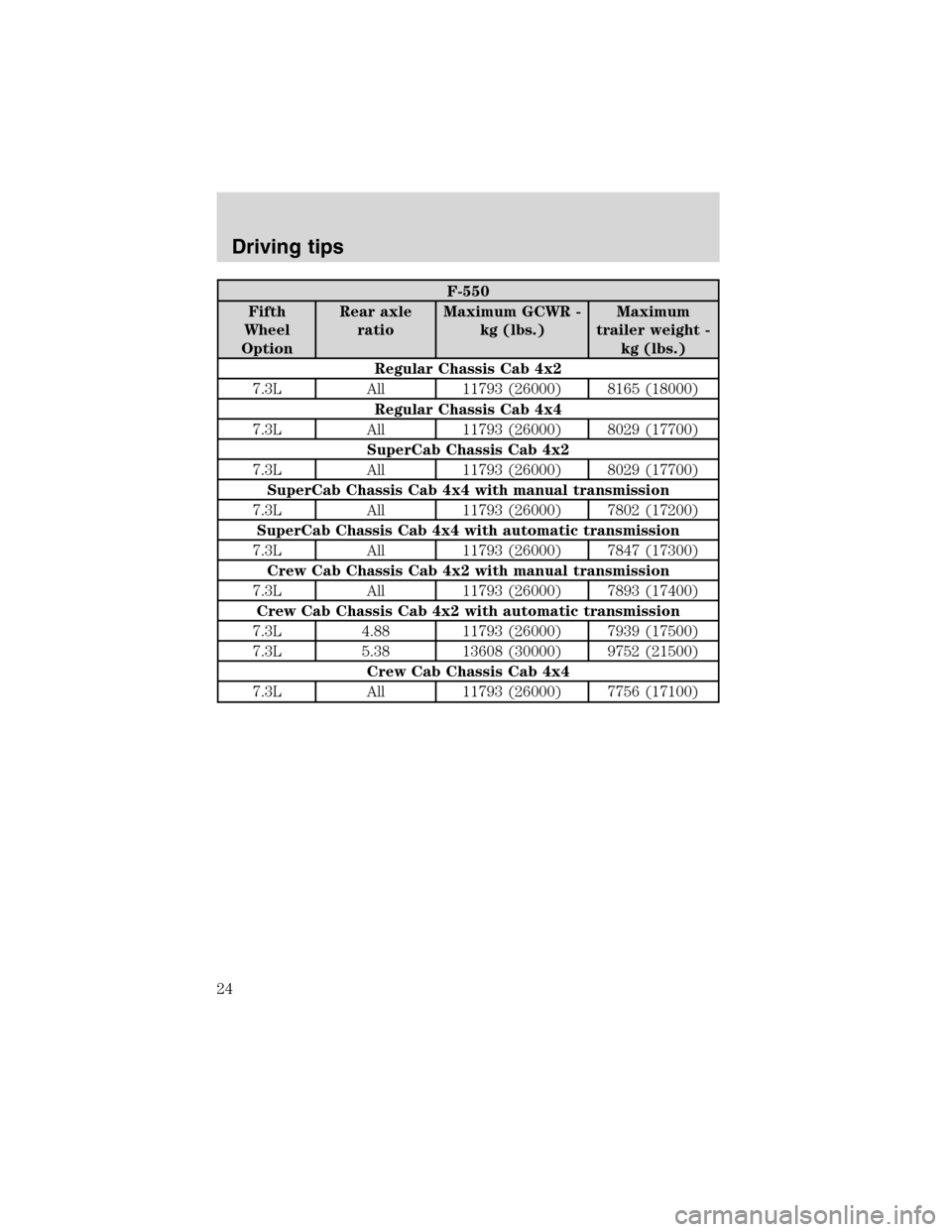
F-550
Fifth
Wheel
OptionRear axle
ratioMaximum GCWR -
kg (lbs.)Maximum
trailer weight -
kg (lbs.)
Regular Chassis Cab 4x2
7.3L All 11793 (26000) 8165 (18000)
Regular Chassis Cab 4x4
7.3L All 11793 (26000) 8029 (17700)
SuperCab Chassis Cab 4x2
7.3L All 11793 (26000) 8029 (17700)
SuperCab Chassis Cab 4x4 with manual transmission
7.3L All 11793 (26000) 7802 (17200)
SuperCab Chassis Cab 4x4 with automatic transmission
7.3L All 11793 (26000) 7847 (17300)
Crew Cab Chassis Cab 4x2 with manual transmission
7.3L All 11793 (26000) 7893 (17400)
Crew Cab Chassis Cab 4x2 with automatic transmission
7.3L 4.88 11793 (26000) 7939 (17500)
7.3L 5.38 13608 (30000) 9752 (21500)
Crew Cab Chassis Cab 4x4
7.3L All 11793 (26000) 7756 (17100)
Driving tips
24
Page 32 of 56
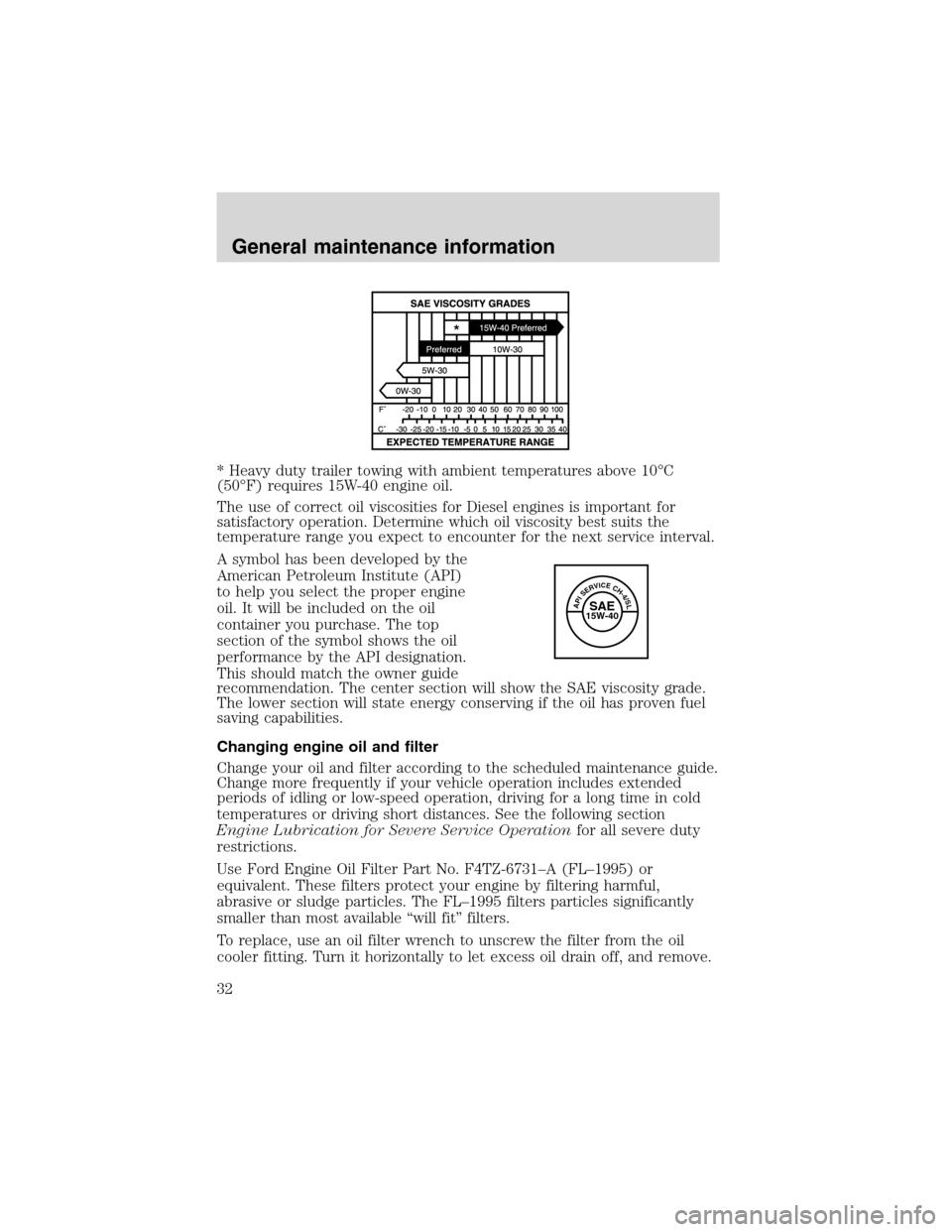
* Heavy duty trailer towing with ambient temperatures above 10°C
(50°F) requires 15W-40 engine oil.
The use of correct oil viscosities for Diesel engines is important for
satisfactory operation. Determine which oil viscosity best suits the
temperature range you expect to encounter for the next service interval.
A symbol has been developed by the
American Petroleum Institute (API)
to help you select the proper engine
oil. It will be included on the oil
container you purchase. The top
section of the symbol shows the oil
performance by the API designation.
This should match the owner guide
recommendation. The center section will show the SAE viscosity grade.
The lower section will state energy conserving if the oil has proven fuel
saving capabilities.
Changing engine oil and filter
Change your oil and filter according to the scheduled maintenance guide.
Change more frequently if your vehicle operation includes extended
periods of idling or low-speed operation, driving for a long time in cold
temperatures or driving short distances. See the following section
Engine Lubrication for Severe Service Operationfor all severe duty
restrictions.
Use Ford Engine Oil Filter Part No. F4TZ-6731–A (FL–1995) or
equivalent. These filters protect your engine by filtering harmful,
abrasive or sludge particles. The FL–1995 filters particles significantly
smaller than most available“will fit”filters.
To replace, use an oil filter wrench to unscrew the filter from the oil
cooler fitting. Turn it horizontally to let excess oil drain off, and remove.
APISERVICECH-4/SLSAE15W-40
General maintenance information
32
Page 33 of 56

Do not handle a hot oil filter with bare hands.
Clean the filter mounting area on the oil cooler, lightly coat the gasket
surface of the new filter with clean engine oil and hand tighten until the
gasket contacts the base.Then tighten another 1–1/4 to 2 turns.Fill
the crankcase and run the engine to check for leaks.
Continuous contact with USED motor oil has caused cancer in
laboratory mice. Protect your skin by washing with soap and
water.
Engine lubrication for severe service operation
The following severe service operating conditions require unique engine
maintenance procedures:
•towing a trailer over 1,600 km (1,000 miles)
•sustained, high speed driving at Gross Vehicle Weight Rating
(maximum loaded weight for vehicle operation during hot
weather-above 32°C [90°F]).
•frequent or extended idling (over 10 minutes per hour of normal
driving).
•operating in severe dust conditions.
•frequent, short trips of 16 km (10 miles) or less during freezing
weather
If you are operating your vehicle under any of these conditions, observe
the following service procedures:
•Change engine oil and filter every 5,000 km (3,000 miles).
•Use Motorcraft oil or an equivalent oil conforming to Ford
Specification WSS-M2C171–C or API categories CH-4, CH-4/SJ,
CH-4/SL or DHD-1. If CH-4 oil is not available, CG-4 is acceptable..
For more information refer theSevere Duty Maintenance Schedulein
the“Service Guide”.
REPLACING THE AIR FILTER ELEMENT
When replacing the air filter element, use the Motorcraft air filter
element listed. Refer toLubricant and Maintenance Materials
Specificationsin this supplement.
General maintenance information
33
Page 47 of 56

IF THE ENGINE RUNS HOT
The following could cause the engine to overheat:
•Lack of coolant.
•Dirty cooling system.
•Plugged radiator fins, charge air cooler, A/C condenser and/or oil
cooler.
•Driving with frozen coolant.
•Sticking thermostat.
•Overloading or pulling heavy trailers during hot weather.
•Grill or radiator air blockage.
•Slipping or missing drive belt.
•Plugged or very dirty air cleaner element.
IF FUSES BURN OUT
Burned-out or blown fuses usually indicate an electrical short-circuit,
although a fuse may occasionally burn out from vibration. Insert a second
fuse. If this fuse immediately burns out and you cannot locate the cause,
return your vehicle to your dealer for a circuit check.
Replacement fuses and circuit breakers must always be the same
rating as the original equipment shown. Never replace a fuse or
circuit breaker with one of a higher rating. Higher rated fuses or circuit
breakers could allow circuit overloading in the event of a circuit
malfunction, resulting in severe vehicle damage or personal injury.
Refer to the“Owner Guide”for replacement of fuses.
Minor troubleshooting guide
47