2004 FORD E-450 brake light
[x] Cancel search: brake lightPage 108 of 240
STARTING
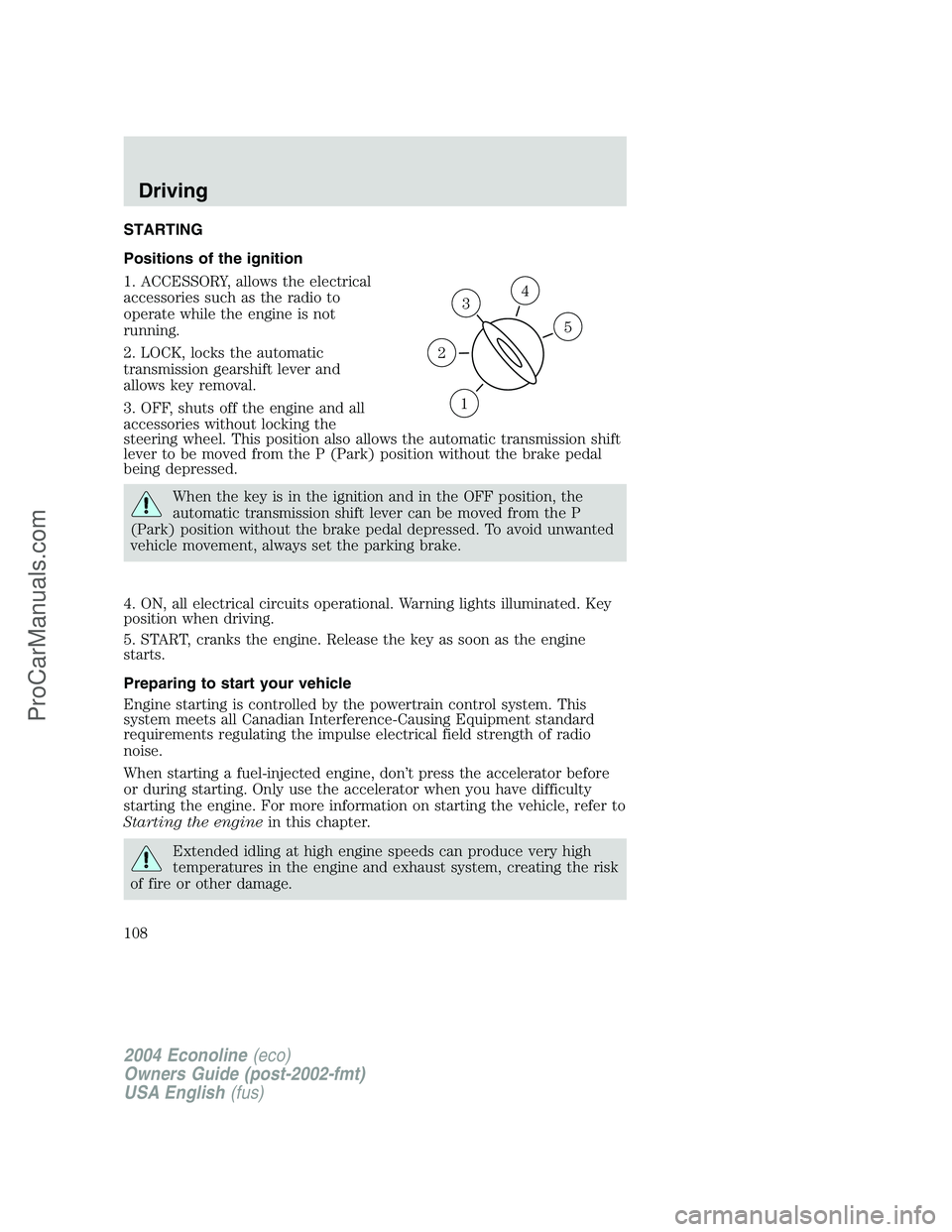
Positions of the ignition
1. ACCESSORY, allows the electrical
accessories such as the radio to
operate while the engine is not
running.
2. LOCK, locks the automatic
transmission gearshift lever and
allows key removal.
3. OFF, shuts off the engine and all
accessories without locking the
steering wheel. This position also allows the automatic transmission shift
lever to be moved from the P (Park) position without the brake pedal
being depressed.
When the key is in the ignition and in the OFF position, the
automatic transmission shift lever can be moved from the P
(Park) position without the brake pedal depressed. To avoid unwanted
vehicle movement, always set the parking brake.
4. ON, all electrical circuits operational. Warning lights illuminated. Key
position when driving.
5. START, cranks the engine. Release the key as soon as the engine
starts.
Preparing to start your vehicle
Engine starting is controlled by the powertrain control system. This
system meets all Canadian Interference-Causing Equipment standard
requirements regulating the impulse electrical field strength of radio
noise.
When starting a fuel-injected engine, don’t press the accelerator before
or during starting. Only use the accelerator when you have difficulty
starting the engine. For more information on starting the vehicle, refer to
Starting the enginein this chapter.
Extended idling at high engine speeds can produce very high
temperatures in the engine and exhaust system, creating the risk
of fire or other damage.
3
1
2
5
4
2004 Econoline(eco)
Owners Guide (post-2002-fmt)
USA English(fus)
Driving
108
ProCarManuals.com
Page 111 of 240
Note:If the engine does not start within five seconds on the first try,
turn the key to 3 (OFF), wait 10 seconds and try again. If the engine still
fails to start, press the accelerator to the floor and try again; this will
allow the engine to crank with the fuel shut off in case the engine is
flooded with fuel.
Using the engine block heater (if equipped)
Use of an engine block heater is strongly recommended if you live in a
region where temperatures reach -23°C (-10°F) or below. For best
results, plug the heater in at least three hours before starting the vehicle.
The heater can be plugged in the night before starting the vehicle.
To reduce the risk of electrical shock, do not use your heater
with ungrounded electrical systems or two-pronged (cheater)
adapters.
Guarding against exhaust fumes
Carbon monoxide is present in exhaust fumes. Take precautions to avoid
its dangerous effects.
If you smell exhaust fumes inside your vehicle, have your dealer
inspect your vehicle immediately. Do not drive if you smell
exhaust fumes.
Important ventilating information
If the engine is idling while the vehicle is stopped for a long period of
time, open the windows at least 2.5 cm (one inch) or adjust the heating
or air conditioning to bring in fresh air.
BRAKES
Occasional brake noise is normal. If a metal-to-metal, continuous grinding
or continuous squeal sound is present, the brake linings may be worn-out
and should be inspected by a qualified service technician. If the vehicle
has continuous vibration or shudder in the steering wheel while braking,
the vehicle should be inspected by a qualified service technician.
Refer toBrake system warning
lightin theInstrument Cluster
chapter for information on the brake
system warning light.
2004 Econoline(eco)
Owners Guide (post-2002-fmt)
USA English(fus)
Driving
111
ProCarManuals.com
Page 112 of 240
Four-wheel anti-lock brake system (ABS)
Your vehicle is equipped with an Anti-lock Braking System (ABS). This
system helps you maintain steering control during emergency stops by
keeping the brakes from locking. Noise from the ABS pump motor and
brake pedal pulsation may be observed during ABS braking; this is
normal and should be no reason for concern.
ABS warning lamp
The ABS lamp in the instrument
cluster momentarily illuminates
when the ignition is turned on. If
the light does not illuminate during
start up, remains on or flashes, the
ABS may be disabled and may need to be serviced.
Even when the ABS is disabled,
normal braking is still effective. (If
your BRAKE warning lamp
illuminates with the parking brake
released, have your brake system serviced immediately.)
Using ABS
When hard braking is required, apply continuous force on the brake
pedal; do not pump the brake pedal since this will reduce the
effectiveness of the ABS and will increase your vehicle’s stopping
distance. The ABS will be activated immediately, allowing you to retain
full steering control during hard braking and on slippery surfaces.
However, the ABS does not decrease stopping distance.
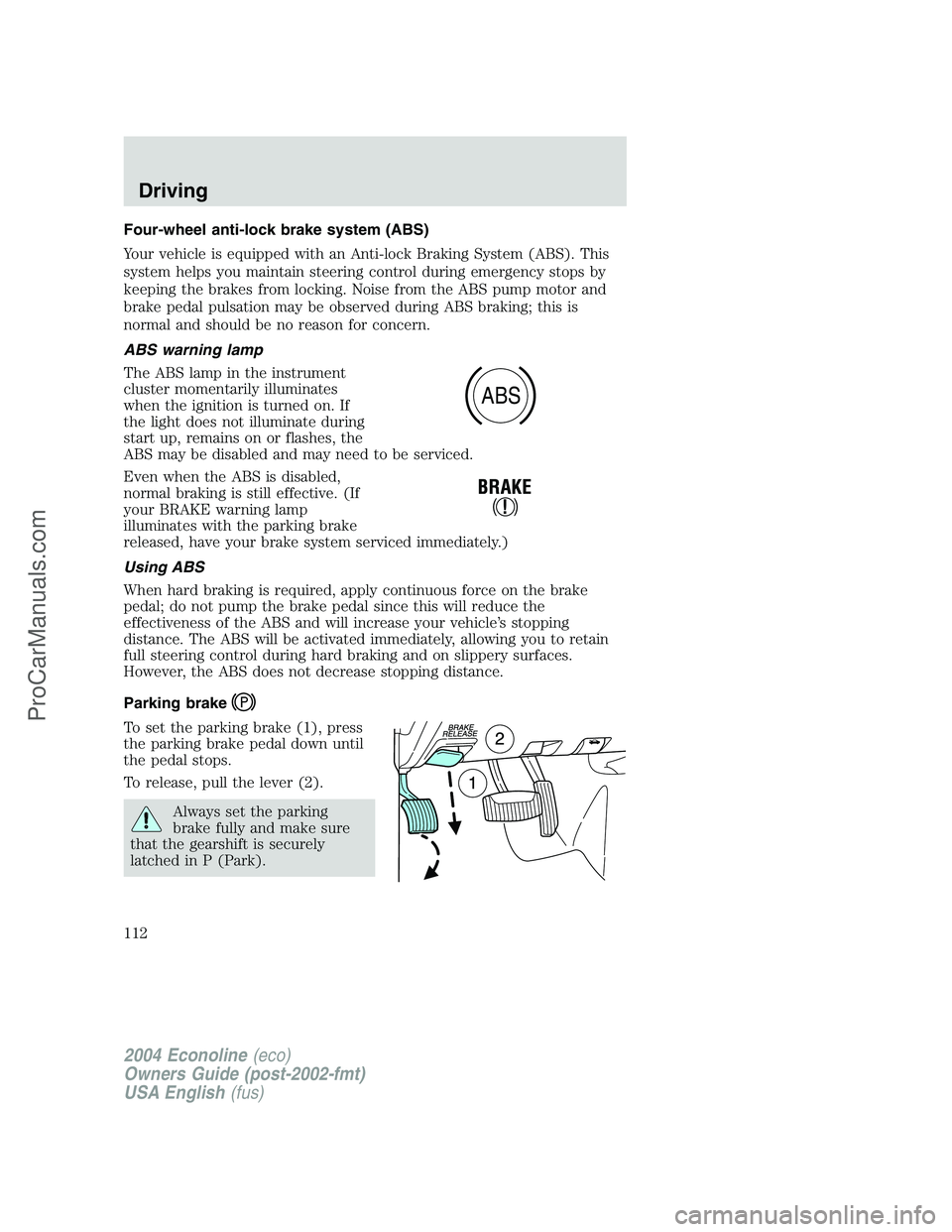
Parking brake
To set the parking brake (1), press
the parking brake pedal down until
the pedal stops.
To release, pull the lever (2).
Always set the parking
brake fully and make sure
that the gearshift is securely
latched in P (Park).
ABS
2004 Econoline(eco)
Owners Guide (post-2002-fmt)
USA English(fus)
Driving
112
ProCarManuals.com
Page 119 of 240
If your vehicle gets stuck in mud or snow
If your vehicle gets stuck in mud or snow, it may be rocked out by
shifting from forward and reverse gears, stopping between shifts in a
steady pattern. Press lightly on the accelerator in each gear.
Do not rock the vehicle if the engine is not at normal operating
temperature or damage to the transmission may occur.
Do not rock the vehicle for more than a minute or damage to the
transmission and tires may occur, or the engine may overheat.
DRIVING THROUGH WATER
If driving through deep or standing water is unavoidable, proceed very
slowly especially if the depth is not known. Never drive through water
that is higher than the bottom of the hubs (for trucks) or the bottom of
the wheel rims (for cars). Traction or brake capability may be limited
and your vehicle may stall. Water may also enter your engine’s air intake
and severely damage your engine.
Once through the water, always dry the brakes by moving your vehicle
slowly while applying light pressure on the brake pedal. Wet brakes do
not stop the vehicle as quickly as dry brakes.Driving through deep
water where the transmission vent tube is submerged may allow
water into the transmission and cause internal transmission
damage.
EMERGENCY MANEUVERS
•In an unavoidable emergency situation where a sudden sharp turn
must be made, remember to avoid“over-driving”your vehicle, i.e.,
turn the steering wheel only as rapidly and as far as required to avoid
the emergency. Excessive steering will result in less vehicle control,
not more. Additionally, smooth variations of the accelerator and/or
brake pedal pressure should be utilized if changes in vehicle speed are
called for. Avoid abrupt steering, acceleration or braking which could
result in an increased risk of loss of vehicle control, vehicle rollover
and/or personal injury. Use all available road surface to return the
vehicle to a safe direction of travel.
•In the event of an emergency stop, avoid skidding the tires and do not
attempt any sharp steering wheel movements.
2004 Econoline(eco)
Owners Guide (post-2002-fmt)
USA English(fus)
Driving
119
ProCarManuals.com
Page 129 of 240
Safety chains
Always connect the trailer’s safety chains to the frame or hook retainers
of the vehicle hitch. To connect the trailer’s safety chains, cross the
chains under the trailer tongue and allow slack for turning corners.
If you use a rental trailer, follow the instructions that the rental agency
gives to you.
Do not attach safety chains to the bumper.
Trailer brakes
Electric brakes and manual, automatic or surge-type trailer brakes are
safe if installed properly and adjusted to the manufacturer’s
specifications. The trailer brakes must meet local and Federal
regulations.
Do not connect a trailer’s hydraulic brake system directly to your
vehicle’s brake system. Your vehicle may not have enough
braking power and your chances of having a collision greatly increase.
The braking system of the tow vehicle is rated for operation at the
GVWR not GCWR.
Trailer lamps
Trailer lamps are required on most towed vehicles. Make sure all running
lights, brake lights, turn signals and hazard lights are working. See your
dealer or trailer rental agency for proper instructions and equipment for
hooking up trailer lamps.
Using a step bumper (if equipped)
The rear bumper is equipped with an integral hitch and only requires a
ball with a 25.4 mm (one inch) shank diameter. The bumper has a 2,270
kg (5,000 lb.) trailer weight and 227 kg (500 lb.) tongue weight capacity.
If it is necessary to relocate the trailer hitch ball position, a
frame-mounted trailer hitch must be installed.
Driving while you tow
When towing a trailer:
•Turn off the speed control. The speed control may shut off
automatically when you are towing on long, steep grades.
•Consult your local motor vehicle speed regulations for towing a trailer.
2004 Econoline(eco)
Owners Guide (post-2002-fmt)
USA English(fus)
Driving
129
ProCarManuals.com
Page 137 of 240
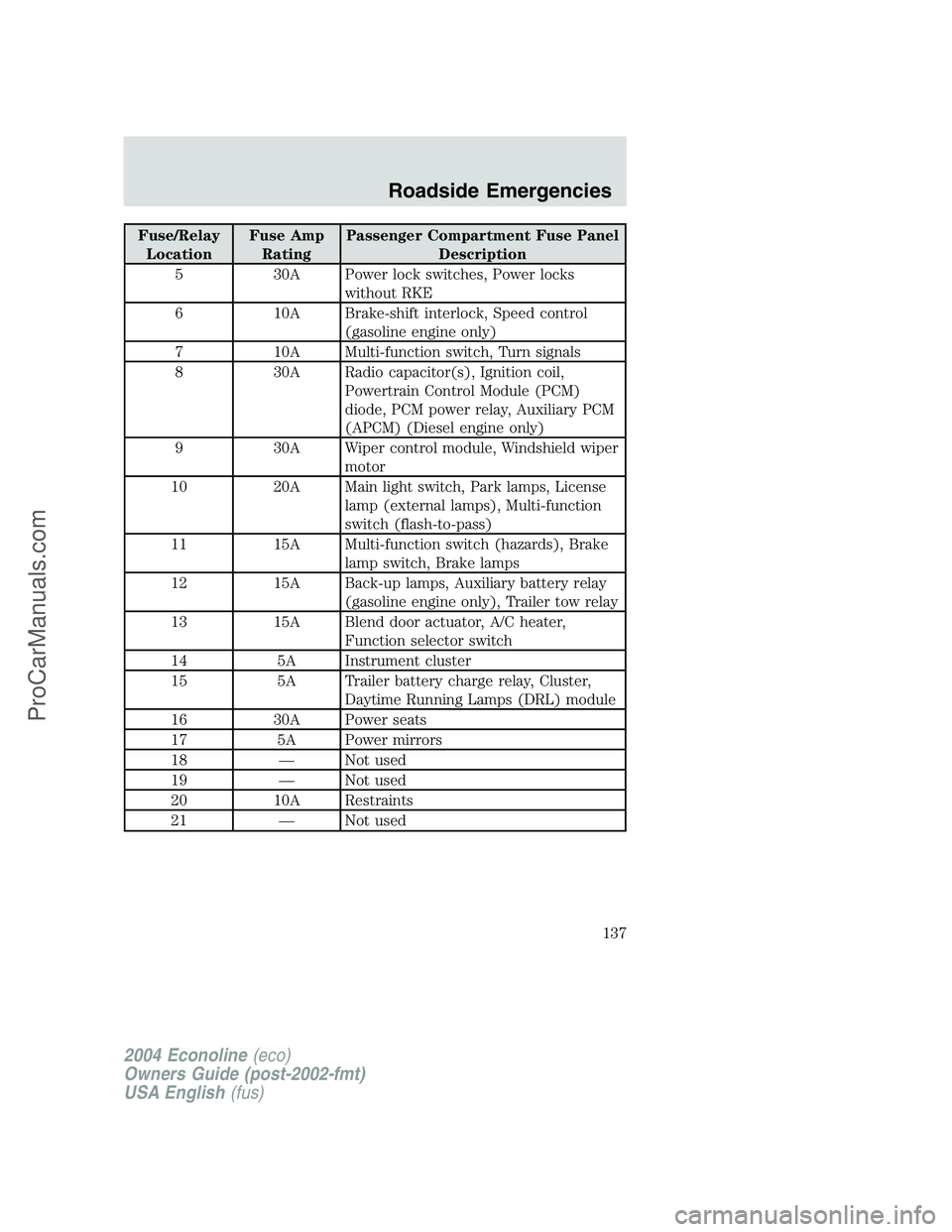
Fuse/RelayLocation Fuse Amp
Rating Passenger Compartment Fuse Panel
Description
5 30A Power lock switches, Power locks without RKE
6 10A Brake-shift interlock, Speed control (gasoline engine only)
7 10A Multi-function switch, Turn signals
8 30A Radio capacitor(s), Ignition coil, Powertrain Control Module (PCM)
diode, PCM power relay, Auxiliary PCM
(APCM) (Diesel engine only)
9 30A Wiper control module, Windshield wiper motor
10 20A Main light switch, Park lamps, License lamp (external lamps), Multi-function
switch (flash-to-pass)
11 15A Multi-function switch (hazards), Brake lamp switch, Brake lamps
12 15A Back-up lamps, Auxiliary battery relay (gasoline engine only), Trailer tow relay
13 15A Blend door actuator, A/C heater, Function selector switch
14 5A Instrument cluster
15 5A Trailer battery charge relay, Cluster, Daytime Running Lamps (DRL) module
16 30A Power seats
17 5A Power mirrors
18 —Not used
19 —Not used
20 10A Restraints
21 —Not used
2004 Econoline (eco)
Owners Guide (post-2002-fmt)
USA English (fus)
Roadside Emergencies
137
ProCarManuals.com
Page 138 of 240
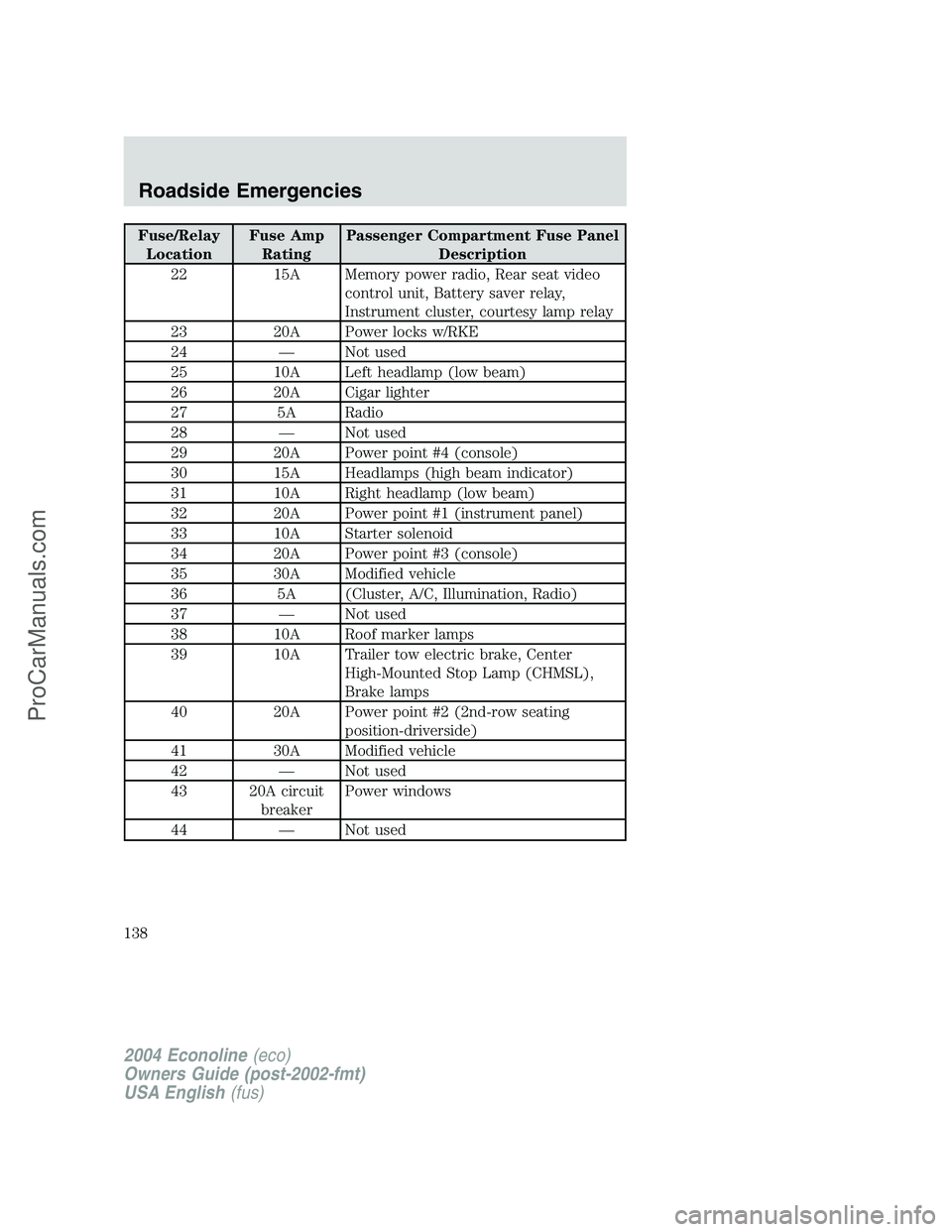
Fuse/RelayLocation Fuse Amp
Rating Passenger Compartment Fuse Panel
Description
22 15A Memory power radio, Rear seat video control unit, Battery saver relay,
Instrument cluster, courtesy lamp relay
23 20A Power locks w/RKE
24 —Not used
25 10A Left headlamp (low beam)
26 20A Cigar lighter
27 5A Radio
28 —Not used
29 20A Power point #4 (console)
30 15A Headlamps (high beam indicator)
31 10A Right headlamp (low beam)
32 20A Power point #1 (instrument panel)
33 10A Starter solenoid
34 20A Power point #3 (console)
35 30A Modified vehicle
36 5A (Cluster, A/C, Illumination, Radio)
37 —Not used
38 10A Roof marker lamps
39 10A Trailer tow electric brake, Center High-Mounted Stop Lamp (CHMSL),
Brake lamps
40 20A Power point #2 (2nd-row seating position-driverside)
41 30A Modified vehicle
42 —Not used
43 20A circuit breakerPower windows
44 —Not used
2004 Econoline (eco)
Owners Guide (post-2002-fmt)
USA English (fus)
Roadside Emergencies
138
ProCarManuals.com
Page 140 of 240
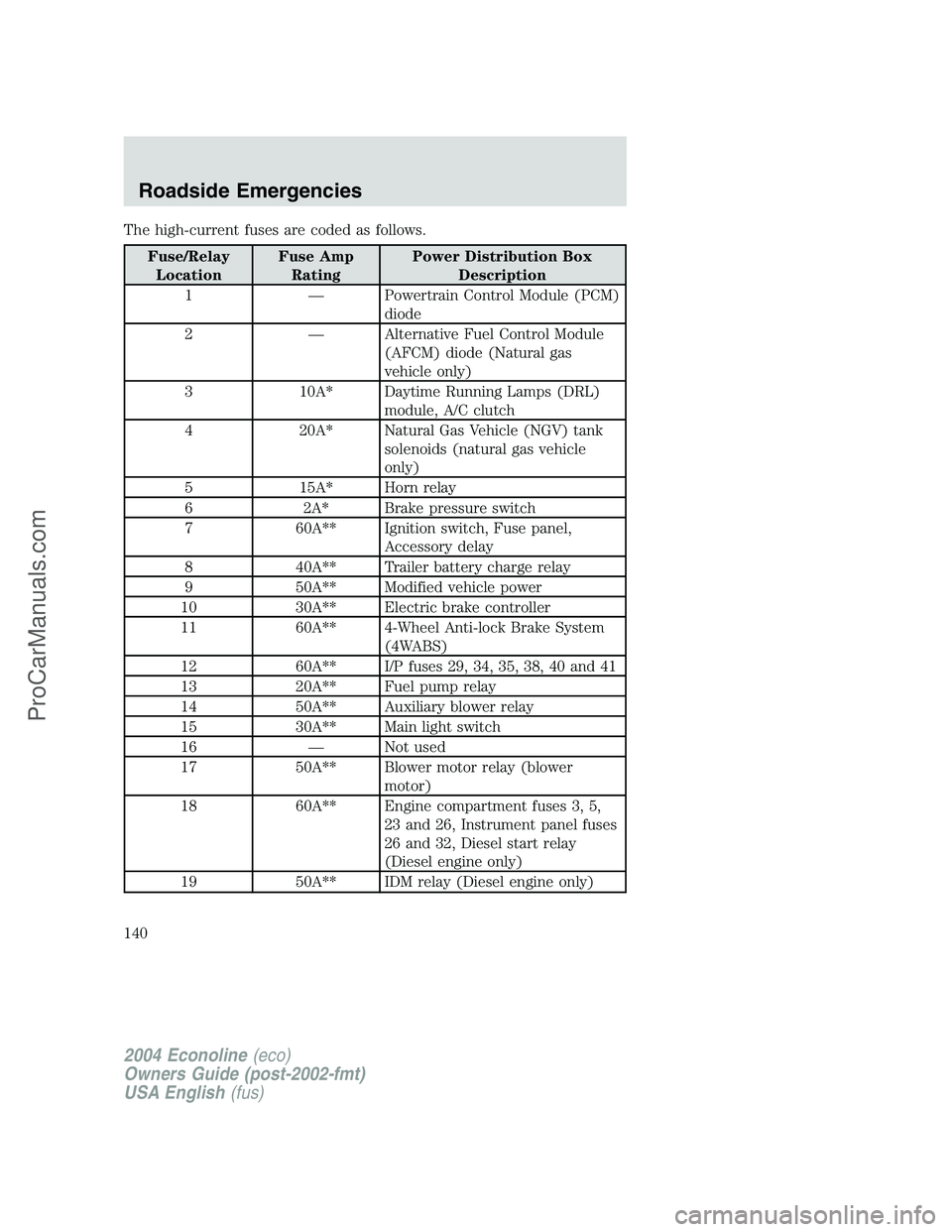
The high-current fuses are coded as follows.
Fuse/RelayLocation Fuse Amp
Rating Power Distribution Box
Description
1 — Powertrain Control Module (PCM) diode
2 — Alternative Fuel Control Module (AFCM) diode (Natural gas
vehicle only)
3 10A* Daytime Running Lamps (DRL) module, A/C clutch
4 20A* Natural Gas Vehicle (NGV) tank solenoids (natural gas vehicle
only)
5 15A* Horn relay
6 2A* Brake pressure switch
7 60A** Ignition switch, Fuse panel, Accessory delay
8 40A** Trailer battery charge relay
9 50A** Modified vehicle power
10 30A** Electric brake controller
11 60A** 4-Wheel Anti-lock Brake System (4WABS)
12 60A** I/P fuses 29, 34, 35, 38, 40 and 41
13 20A** Fuel pump relay
14 50A** Auxiliary blower relay
15 30A** Main light switch
16 — Not used
17 50A** Blower motor relay (blower motor)
18 60A** Engine compartment fuses 3, 5, 23 and 26, Instrument panel fuses
26 and 32, Diesel start relay
(Diesel engine only)
19 50A** IDM relay (Diesel engine only)
2004 Econoline (eco)
Owners Guide (post-2002-fmt)
USA English (fus)
Roadside Emergencies
140
ProCarManuals.com