Page 171 of 236

hose routing to be sure hoses do not touch any heat
source or moving component that may cause heat dam-
age or mechanical wear.
Insure nylon tubing in these areas has not melted or
collapsed.
Inspect all hose connections such as clamps and cou-
plings to make sure they are secure and no leaks are
present.
Components should be replaced immediately if there is
any evidence of degradation that could result in failure.
Brake System
To assure brake system performance, all brake system
components should be inspected periodically. Suggested
service intervals can be found in Section 8 of this manual.
WARNING!
Riding the brakes can lead to brake failure and
possibly an accident. Driving with your foot resting
or riding on the brake pedal can result in abnormally
high brake temperatures, excessive lining wear, and
possible brake damage. You wouldn't have your full
braking capacity in an emergency.
Brake, Power Steering, and Fuel System Hoses
When servicing the vehicle for scheduled maintenance,
inspect surface of hoses and nylon tubing for evidence of
heat and mechanical damage. Hard and brittle rubber,
cracking, checking, tears, cuts, abrasion, and excessive
swelling suggest deterioration of the rubber. Particular
attention should be made to examining those hose sur-
faces nearest to high heat sources, such as the exhaust
manifold.
MAINTAINING YOUR VEHICLE 171
7
Page 176 of 236

the transmission. The fluid level should be at the bottom
of the fill hole. Add fluid, if necessary, to maintain the
proper level.
Frequency of Fluid Change
Under normal operating conditions, the fluid installed at
the factory will give satisfactory lubrication for the life of
the vehicle. If the vehicle is operated under severe
conditions, change the fluid as specified in Maintenance
ScheduleB. If contaminated with water, the fluid should
be changed immediately.
Rear Axle
Fluid Level Check
Every 12 months or 6,000 miles (10 000 km) the exterior of
the axle should be checked for evidence of gear oil
leakage. This check should be made with the vehicle in a
level position, supported by the suspension, on an axle
and wheel type hoist, or on the ground. The axle fluidlevel should be between the bottom of the filler plug and
a point approximately 3/8 inch (9.5mm) below the filler
plug.
Lubricant Selection
Use only the manufacturer's recommended transmission
fluid. Refer to the Recommended Fluids, Lubricants and
Genuine Parts section for correct fluid type. This Limited
Slip Differential requires that a friction control additive
be added to the gear oil whenever a fluid change is made.
Frequency of Oil Change
Drain and fill the axle at the interval specified in the
Maintenance Schedules. Change the fluid immediately if
contaminated with water.
176 MAINTAINING YOUR VEHICLE
Page 199 of 236
MAINTENANCE SCHEDULES
CONTENTS
mEmission Control System Maintenance........200
mMaintenance Schedules...................200NSchedule ªBº........................203
NSchedule ªAº........................210
8
M
A
I
N
T
E
N
A
N
C
E
S
C
H
E
D
U
L
E
S
Page 200 of 236
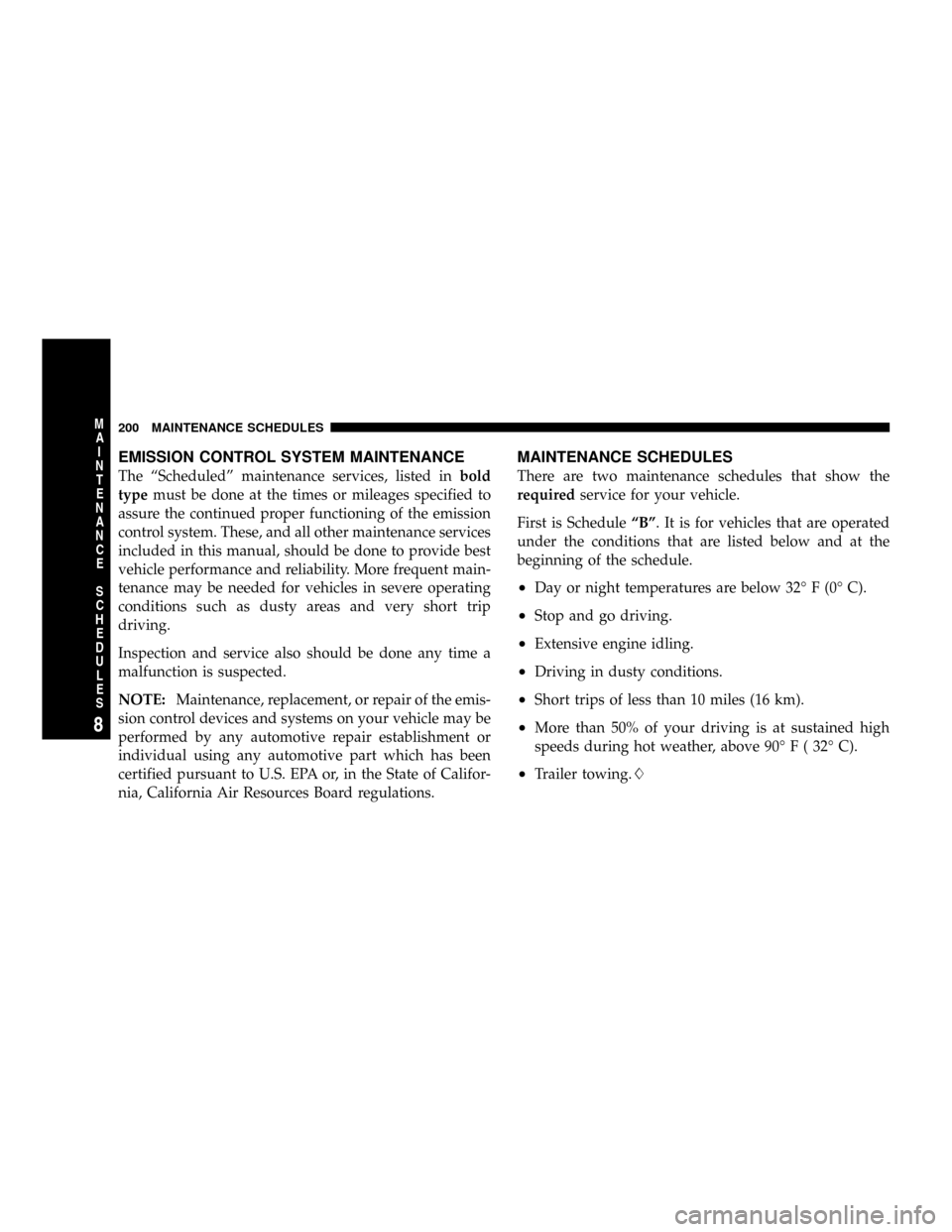
EMISSION CONTROL SYSTEM MAINTENANCE
The ªScheduledº maintenance services, listed inbold
typemust be done at the times or mileages specified to
assure the continued proper functioning of the emission
control system. These, and all other maintenance services
included in this manual, should be done to provide best
vehicle performance and reliability. More frequent main-
tenance may be needed for vehicles in severe operating
conditions such as dusty areas and very short trip
driving.
Inspection and service also should be done any time a
malfunction is suspected.
NOTE:Maintenance, replacement, or repair of the emis-
sion control devices and systems on your vehicle may be
performed by any automotive repair establishment or
individual using any automotive part which has been
certified pursuant to U.S. EPA or, in the State of Califor-
nia, California Air Resources Board regulations.
MAINTENANCE SCHEDULES
There are two maintenance schedules that show the
requiredservice for your vehicle.
First is ScheduleªBº. It is for vehicles that are operated
under the conditions that are listed below and at the
beginning of the schedule.
²Day or night temperatures are below 32É F (0É C).
²Stop and go driving.
²Extensive engine idling.
²Driving in dusty conditions.
²Short trips of less than 10 miles (16 km).
²More than 50% of your driving is at sustained high
speeds during hot weather, above 90É F ( 32É C).
²Trailer towing.L
200 MAINTENANCE SCHEDULES
8
M
A
I
N
T
E
N
A
N
C
E
S
C
H
E
D
U
L
E
S
Page 201 of 236

²Taxi, police, or delivery service (commercial ser-
vice).L
²Off-road or desert operation.
²If equipped for and operating with E-85 (ethanol)
fuel.
NOTE:Most vehicles are operated under the conditions
listed for Schedule9B9.
Second is ScheduleªAº. It is for vehicles that are not
operated under any of the conditions listed under Sched-
ule9B9.
Use the schedule that best describes your driving condi-
tions. Where time and mileage are listed, follow the
interval that occurs first.
CAUTION!
Failure to perform the required maintenance items
may result in damage to the vehicle.
At Each Stop for Fuel
²Check the engine oil level about 5 minutes after a fully
warmed engine is shut off. Checking the oil level while
the vehicle is on level ground will improve the accu-
racy of the oil level reading. Add oil only when the
level is at or below the ADD or MIN mark.
²Check the windshield washer solvent and add if
required.
MAINTENANCE SCHEDULES 201
8
M
A
I
N
T
E
N
A
N
C
E
S
C
H
E
D
U
L
E
S
Page 202 of 236
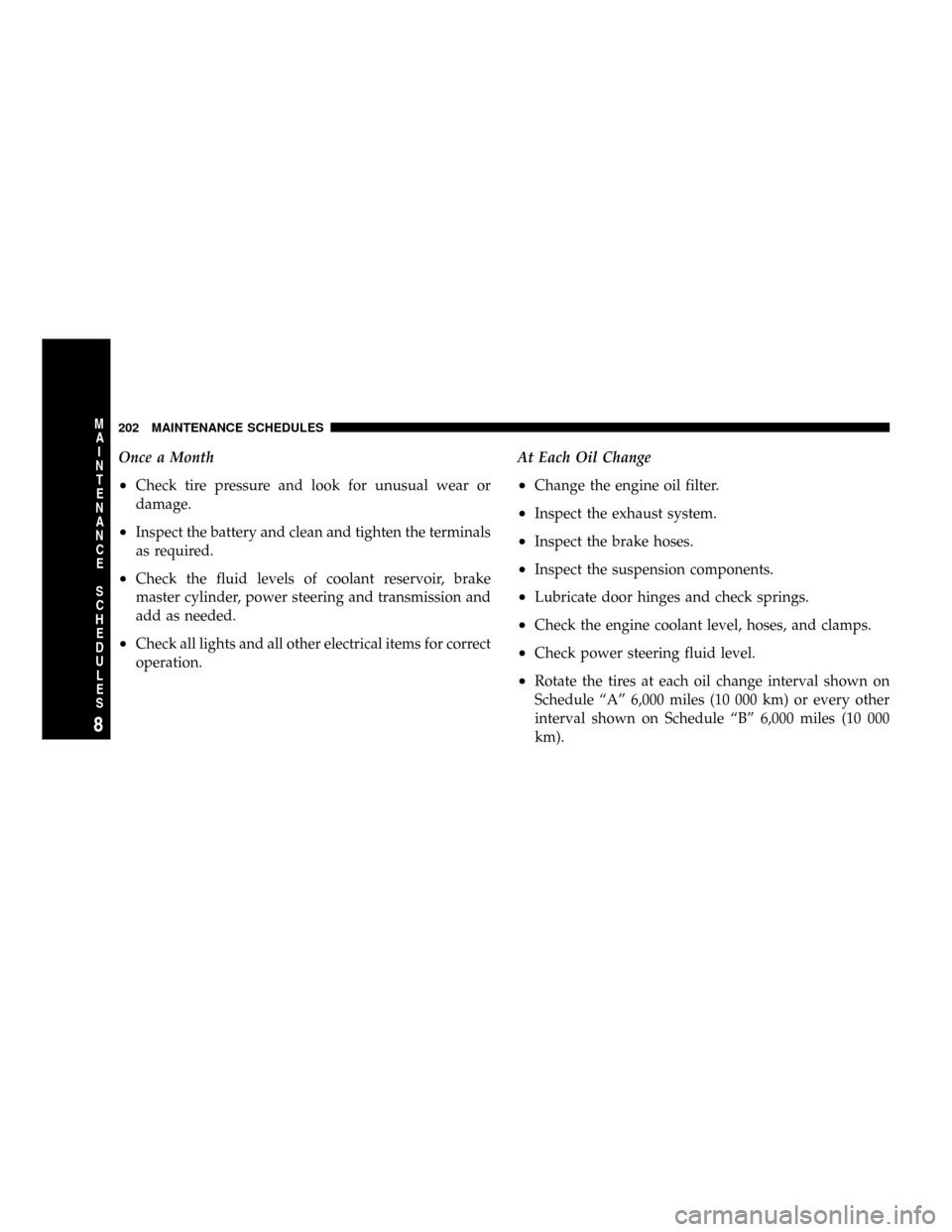
Once a Month
²Check tire pressure and look for unusual wear or
damage.
²Inspect the battery and clean and tighten the terminals
as required.
²Check the fluid levels of coolant reservoir, brake
master cylinder, power steering and transmission and
add as needed.
²Check all lights and all other electrical items for correct
operation.At Each Oil Change
²Change the engine oil filter.
²Inspect the exhaust system.
²Inspect the brake hoses.
²Inspect the suspension components.
²Lubricate door hinges and check springs.
²Check the engine coolant level, hoses, and clamps.
²Check power steering fluid level.
²Rotate the tires at each oil change interval shown on
Schedule ªAº 6,000 miles (10 000 km) or every other
interval shown on Schedule ªBº 6,000 miles (10 000
km).
202 MAINTENANCE SCHEDULES
8
M
A
I
N
T
E
N
A
N
C
E
S
C
H
E
D
U
L
E
S
Page 209 of 236
Miles 93,000 96,000 99,000 102,000 105,000
(Kilometers) (149 000) (154 000) (158 000) (163 000) (168 000)
Change engine oil and engine oil filter.XXXXX
Inspect the brake linings. X
Change the rear axle fluid. X
Inspect and replace, if necessary, theengine air
cleaner filter.X
Lubricate the front and rear suspension ball joints. X
Change the transmission fluid.X
Inspect and replace the Auto Tension Drive Belt as
needed. Not required if the belt was previously re-
placed.X
Flush and replace engine coolant. X
* This maintenance is recommended by DaimlerChrysler
Corporation to the owner but is not required to maintain
the warranty on the PCV orifice.
³ This maintenance is not required if previously replaced.Inspection and service should also be performed anytime
a malfunction is observed or suspected. Retain all re-
ceipts.
SCHEDULE ªBº 209
8
M
A
I
N
T
E
N
A
N
C
E
S
C
H
E
D
U
L
E
S
Page 213 of 236
* This maintenance is recommended by DaimlerChrysler
Corporation to the owner but is not required to maintain
the warranty on the PCV orifice.
³ This maintenance is not required if previously replaced.
Inspection and service should also be performed anytime
a malfunction is observed or suspected. Retain all re-
ceipts.WARNING!
You can be badly injured working on or around a
motor vehicle. Do only that service work for which
you have the knowledge and the right equipment. If
you have any doubt about your ability to perform a
service job, take your vehicle to a competent me-
chanic.
SCHEDULE ªAº 213
8
M
A
I
N
T
E
N
A
N
C
E
S
C
H
E
D
U
L
E
S