Page 284 of 388
WARNING!
²Always wear protective clothing and goggles
when working near the battery.
²Keep the battery out of the reach of children.
If your vehicle has anti-lock brakes
If the vehicle is driven without sufficient battery charge,
after the engine has been started by using booster cables,
the engine may misfire. This can cause the anti-lock
braking system warning light to blink on and off. This is
a result of insufficient battery voltage; it is not a malfunc-
tion of the brake system. If this happens, fully charge the
battery before driving.
TOWING
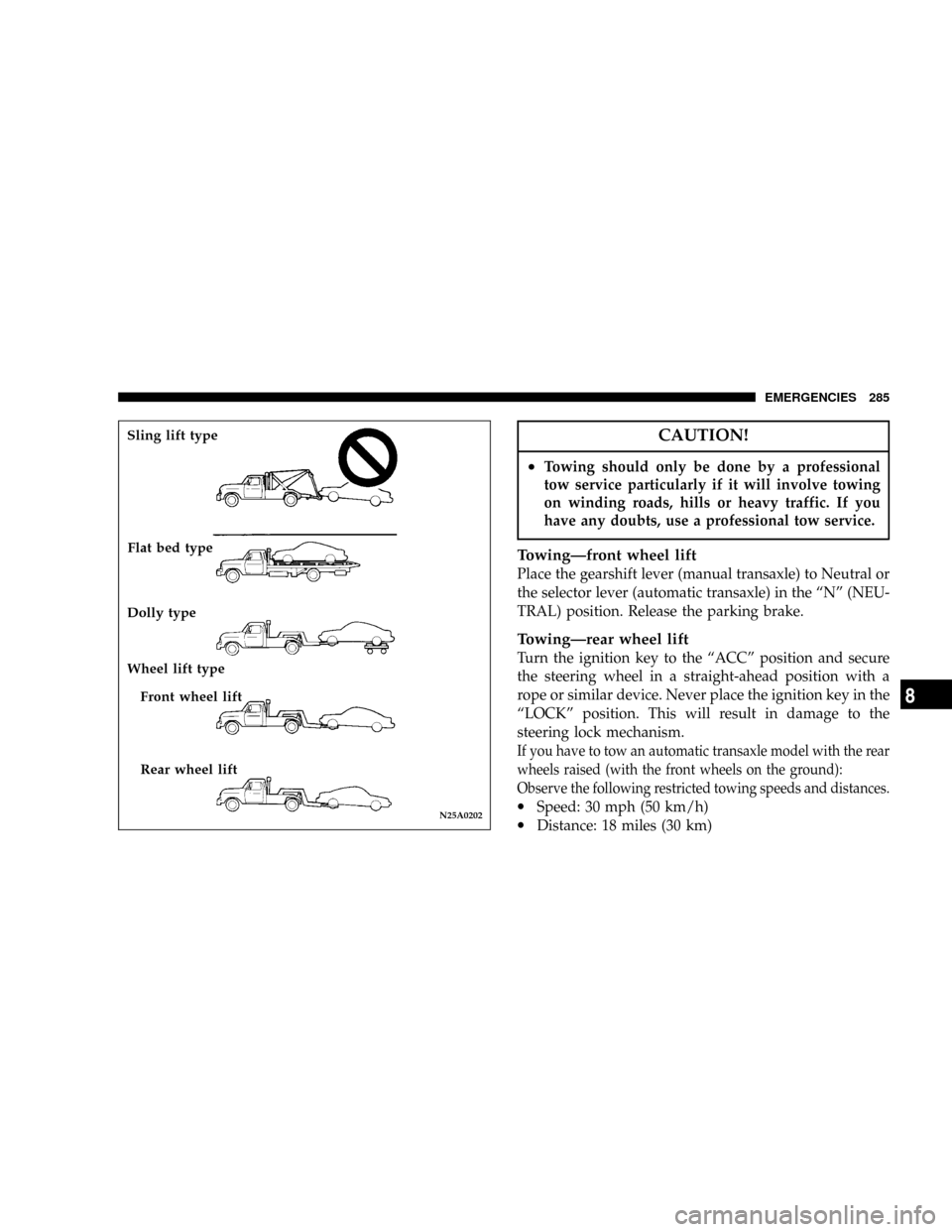
When towing your vehicle, all state and local regulations for
towing must be followed. Incorrect towing equipment could
damage your vehicle. When towing is required, contact a
professional towing service and make sure that flat bed type,
dolly type or wheel lift type towing equipment is used. Do
not attempt to be towed by another vehicle with a rope using
the tie-down hooks.
CAUTION!
²Tie-down hooks should never be used for towing
purposes.
²This vehicle can NOT be towed by a tow truck
using sling lift type equipment. This is to prevent
the bumper from deformation. If this vehicle is
towed, use wheel lift, dolly type or flat bed
equipment.
²Use the flat bed type, dolly type or dolly type
equipment if a vehicle has the following condi-
tions:
·Any of the transaxle, axles, steering system or
power train is damaged.
·Automatic transaxle fluid level is low.
284 EMERGENCIES
Page 285 of 388
CAUTION!
²Towing should only be done by a professional
tow service particularly if it will involve towing
on winding roads, hills or heavy traffic. If you
have any doubts, use a professional tow service.
TowingÐfront wheel lift
Place the gearshift lever (manual transaxle) to Neutral or
the selector lever (automatic transaxle) in the ªNº (NEU-
TRAL) position. Release the parking brake.
TowingÐrear wheel lift
Turn the ignition key to the ªACCº position and secure
the steering wheel in a straight-ahead position with a
rope or similar device. Never place the ignition key in the
ªLOCKº position. This will result in damage to the
steering lock mechanism.
If you have to tow an automatic transaxle model with the rear
wheels raised (with the front wheels on the ground):
Observe the following restricted towing speeds and distances.
·Speed: 30 mph (50 km/h)
·Distance: 18 miles (30 km)N25A0202
Sling lift type
Flat bed type
Dolly type
Wheel lift type
Front wheel lift
Rear wheel lift
EMERGENCIES 285
8
Page 309 of 388

MAINTENANCE
CONTENTS
mView of engine compartment..............311
mService precautions.....................312
mEmission-control system maintenance.......313
mEmissions Testing......................314
mOnboard Diagnostic System (OBD II)........314
mReplacement Parts......................315
NFuel system (tank, filler tube, connections,
and fuel tank filler cap).................315
NFuel hoses...........................315
NAir cleaner filter......................316
NEvaporative emission control system
(except evaporative emission canister).......316
NSpark plugs..........................317
NIgnition cables........................317NDistributor cap and rotor................317
mGeneral maintenance....................318
NEngine oil and oil filter..................318
mEngine coolant.........................322
NTo check the coolant level................322
NTo add coolant........................322
mBrake fluid...........................323
mClutch fluid (manual transaxle)............324
NTo check the clutch fluid.................324
NTo replace the fluid....................324
mBattery..............................325
NDuring cold weather...................325
9
Page 310 of 388

NDisconnection and connection.............325
mAutomatic transaxle.....................327
NTo check the fluid level..................328
NProcedure for checking the fluid level.......328
mManual transaxle.......................329
mDisc brake pads, rear drum brake linings
and rear wheel cylinders.................329
mBrake hoses...........................329
mBall joint, steering linkage seal and drive
shaft boots...........................329
mSupplemental Restraint System (SRS)........329
mDoor hinges, rear hatch hinges, hood lock
release mechanism and safety catch
.........330
mExhaust system........................330
mWindshield wiper blades.................331
NWindshield washers....................331
mParking brake.........................332
mDrive belt (for generator, water pump, power
steering pump)
........................333
mTiming belt...........................334
mTi re s................................334
NTire inflation pressures..................334
NRadial ply tires.......................336
N
Tire pressure for sustained high-speed driving...336
NOversize tires........................336
NTire maintenance......................337
NCargo loads..........................337
NTread wear indicators...................337
NTire rotation.........................338
NTire chains...........................339
NSnow tires...........................339
mRegular Maintenance Schedule.............340
mSevere Maintenance Schedule..............349
310 MAINTENANCE
Page 311 of 388
VIEW OF ENGINE COMPARTMENT
1. Power steering fluid reservoir
2. Engine coolant reservoir
3. Engine oil filler cap
4. Engine oil level dipstick
5. Battery
6. Clutch fluid reservoir (manual transaxle only)7. Brake fluid reservoir
8. Windshield washer reservoir
9. Drive belt
10. Radiator cap
11. Automatic transaxle fluid level dipstick
12. Air cleaner filter
Q02A2510
2.4 liter engine
Q02A2520
3.0 liter engine
MAINTENANCE 311
9
Page 323 of 388

Radiator cap
The radiator cap must be fully tightened to prevent loss
of coolant and engine damage.
WARNING!
Make sure that the engine is thoroughly cooled
down before removing the radiator cap, otherwise
hot steam or boiling coolant may gush from the filler
port and scald you.
Points to remember
1. Do not overfill the reserve tank.
2. A special radiator cap is used to ensure sealing and to
allow the coolant to return from the reserve tank to the
radiator when the engine cools. If cap replacement is
necessary, use the proper cap.
3. Check the coolant freeze point in the radiator using
proper instruments, when it is safe to do so. If antifreeze
is added, the contents of the reserve tank must be
protected against freezing.
4. Keep the front of the radiator clean. If your vehicle is
equipped with air conditioning, keep the front of the
condenser clean.5. If the temperature of the engine coolant does not rise
normally after engine warm-up, take the vehicle to an
authorized dealer to have the thermostat checked, and
replaced if necessary.
BRAKE FLUID
Recommended brake fluid conforming to DOT 3 or DOT 4
should be used. The reservoir cap must be fully tightened
to avoid contamination from foreign matter or moisture.
CAUTION!
²Do not allow petroleum-based fluid to contact,
mix with, or otherwise contaminate the brake
fluid. Seal damage will result.
²Take care in handling brake fluid as it may cause
damage to painted surfaces.
²Use only the specified brake fluid. Also, the
additives in different brands may result in a
chemical reaction when mixed together, so avoid
mixing different brands if possible.
²Keep the reservoir tank cap closed to prevent the
brake fluid from evaporating or absorbing moisture.
MAINTENANCE 323
9
Page 324 of 388
CLUTCH FLUID (MANUAL TRANSAXLE)
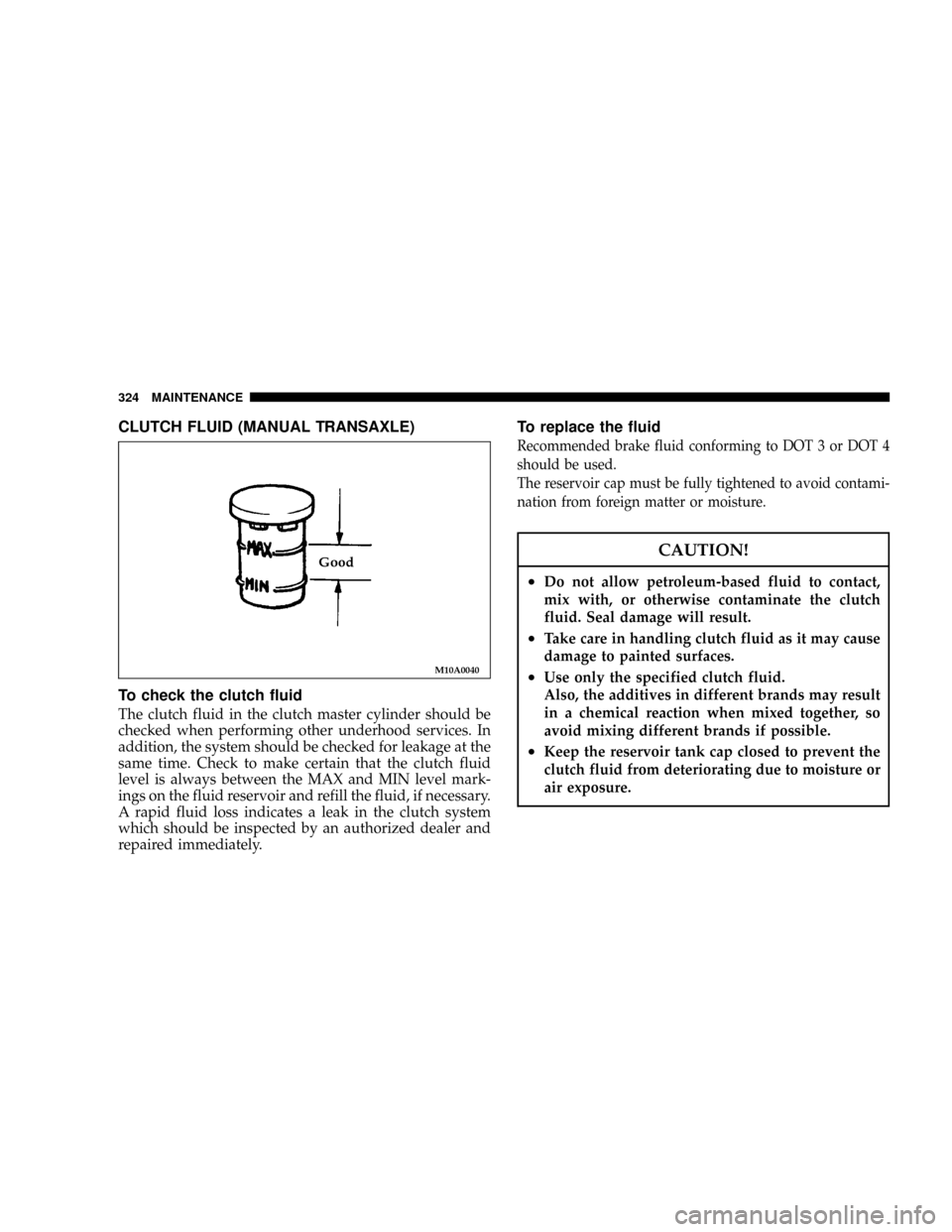
To check the clutch fluid
The clutch fluid in the clutch master cylinder should be
checked when performing other underhood services. In
addition, the system should be checked for leakage at the
same time. Check to make certain that the clutch fluid
level is always between the MAX and MIN level mark-
ings on the fluid reservoir and refill the fluid, if necessary.
A rapid fluid loss indicates a leak in the clutch system
which should be inspected by an authorized dealer and
repaired immediately.
To replace the fluid
Recommended brake fluid conforming to DOT 3 or DOT 4
should be used.
The reservoir cap must be fully tightened to avoid contami-
nation from foreign matter or moisture.
CAUTION!
²Do not allow petroleum-based fluid to contact,
mix with, or otherwise contaminate the clutch
fluid. Seal damage will result.
²Take care in handling clutch fluid as it may cause
damage to painted surfaces.
²Use only the specified clutch fluid.
Also, the additives in different brands may result
in a chemical reaction when mixed together, so
avoid mixing different brands if possible.
²Keep the reservoir tank cap closed to prevent the
clutch fluid from deteriorating due to moisture or
air exposure.
M10A0040
Good
324 MAINTENANCE
Page 328 of 388

To check the fluid level
The fluid level should be checked when the engine
temperature gauge indicates a normal warmed up con-
dition and the fluid in the transaxle is heated to its
normal operating temperature. Operation with an im-
proper fluid level will greatly reduce the life of the
transaxle and the fluid.
Procedure for checking the fluid level
1. With the parking brake engaged and the engine idling,
select each gear momentarily, ending with the selector
lever in the ªNº (NEUTRAL) position.
2. The fluid level should be at the HOT mark, but never
above the HOT mark when the engine is at its normal
warmed up condition. Add or drain as necessary to bring
the fluid to this prescribed level.
3. Make certain that the dipstick cap is reseated properly
to prevent dirt and water from entering the transaxle.
WARNING!
Transaxle fluid is extremely flammable and poison-
ous. Do not spill fluid when adding or draining.
To add or change the fluid
Use only recommended Mopar ATF+4 automatic trans-
mission fluid to ensure optimum transaxle performance.
M05A0460
Drain plug
328 MAINTENANCE