2004 DODGE SPRINTER tires
[x] Cancel search: tiresPage 162 of 272

162 STARTING AND OPERATINGNOTE: If the ABS is malfunctioning or the voltage in
the vehicle’s electrical system drops below 10 volts, the
indicator lamp will also light up in the instrument
cluster and the ESP will be deactivated. The indicator
lamp will go out as soon as the voltage reaches this
level again or the ABS is operational again
– the ESP is
then reactivated.
Electronic Stability Program (ESP) (Cargo/
passenger vans type 2500 C/HC/SHC only)The Electronic Stability Program (ESP) monitors the
vehicle’s traction (force of adhesive friction between
the tires and the road surface) and handling.
The ESP recognizes when a wheel is spinning or if the
vehicle starts to skid. By applying brakes to the
appropriate wheel and by limiting engine output, the
ESP works to stabilize the vehicle. The ESP is especially
useful while driving off and on wet or slippery wet
surfaces.
The warning lamp v in the speedometer flashes
when the ESP is engaged, refer also to
"Warning Lamp
Acceleration Skid Control (ASR) and Electronic
Stability Program (ESP)
".
If wheels with tires of a different size than those offered
by an authorized Sprinter Dealer are used, the correct
operation of the ESP cannot be guaranteed.
WARNING!
If the ESP indicator lamp remains on, the
electronic stability program (ESP) is malfunction-
ing. The vehicle stability will no longer be auto-
matically regulated in good time.
The danger that your vehicle breaks into a skid, is
increased in certain driving situations. Drive with
extra caution.
Have the ESP repaired as soon as possible by an
authorized Spinter Dealer.
Freightliner-all.book Pag e 162 Monday, December 1, 2003 2:54 PM
Page 163 of 272

STARTING AND OPERATING 163
5
STEERINGWhen the engine is not running, there is no power
assistance for the steering. Greater force will be
required to steer the vehicle.WHEELS AND TIRESCheck tires regularly for even tread wear, tread depth
(note legal requirements) and signs of external
damage.
Only use wheels and tires of the same size, make and
pattern.
Do not install tires that are not approved for the size
and type of wheel installed or the vehicle itself. Only
use those wheel sizes which were delivered to you by
your authorized Sprinter Dealer.
Use only wheels and tires which have been tested and
approved by the vehicle manufacturer.
Break in new tires at moderate speeds for a distance of
about 65 miles (about 100 km).
WARNING!
ESP cannot prevent the natural laws of physics
from acting on the vehicle, nor can it increase the
traction afforded.
The ESP cannot prevent accidents, including
those resulting from excessive speed in turns,
following another vehicle too closely, or
hydroplaning. Only a safe, attentive, and skillful
driver can prevent accidents.
The capabilities of an ESP equipped vehicle must
never be exploited in a reckless or dangerous
manner which could jeopardize the user’s safety
or the safety of others.If the vehicle is to be towed away with the front
wheels clear of the ground, or if the brakes are to be
tested on a brake dynamometer, do not put the key
in position 2 in the ignition lock because the ESP
would engage the brakes to stabilize the vehicle.If the ESP function is used for a prolonged period
of time, the rear axle brakes may fail due to
overheating.
Freightliner-all.book Pag e 163 Monday, December 1, 2003 2:54 PM
Page 164 of 272

164 STARTING AND OPERATING
WARNING!
Fitting other wheel sizes to the vehicle will change
the vehicle’s handling characteristics and may
lead to an accident resulting in severe personal in-
juries, death and property damage.
Do not use retreaded/ remolded tires. This process
does not always permit previous damage to the
detected. Therefore vehicle safety cannot be
guaranteed if retreaded/remolded tires are fitted
.
WARNING!
A wheel could work loose. To avoid the risk of serious or
fatal injuries or vehicle damage, please bear the follow-
ing points in mind: Always replace wheel bolts that are damaged or
rusted.
Never apply oil or grease to wheel bolts. If a wheel hub thread is damaged, you must not drive the
vehicle. Consult a qualified specialist workshop. Be sure to use correct mounting bolts. Check
tightness of wheel bolts or nuts regularly and
retighten with a torque wrench, if necessary.
Tighten wheel bolts or nuts in a cross-pattern
sequence.Mounting bolts and tightening torque, see Chapter 12,
‘‘Installing a Wheel’’. After changing a wheel, the wheel bolts or nuts
must be tightened once the vehicle has been
driven for about 30 miles (50 km).If new or repainted wheels are fitted, the wheel bolts or
nuts must be retightened again after about 600 to 3,000
miles (about 1,000 to 5,000 km).
Freightliner-all.book Pag e 164 Monday, December 1, 2003 2:54 PM
Page 165 of 272
STARTING AND OPERATING 165
5
Tire GripTire grip is greatly reduced on a wet or icy road. Speed
and driving style must therefore be adapted to suit
road conditions.
In winter, install M+S radial tires.
Below a tread depth of 1/8 inch (3 mm), tire grip
begins to decrease rapidly on wet roads.HydroplaningDepending on the depth of the water layer on the road,
hydroplaning may occur, even at low speeds and with
new tires. Reduce vehicle speed, avoid grooves in the
road, and apply brakes cautiously in the rain.
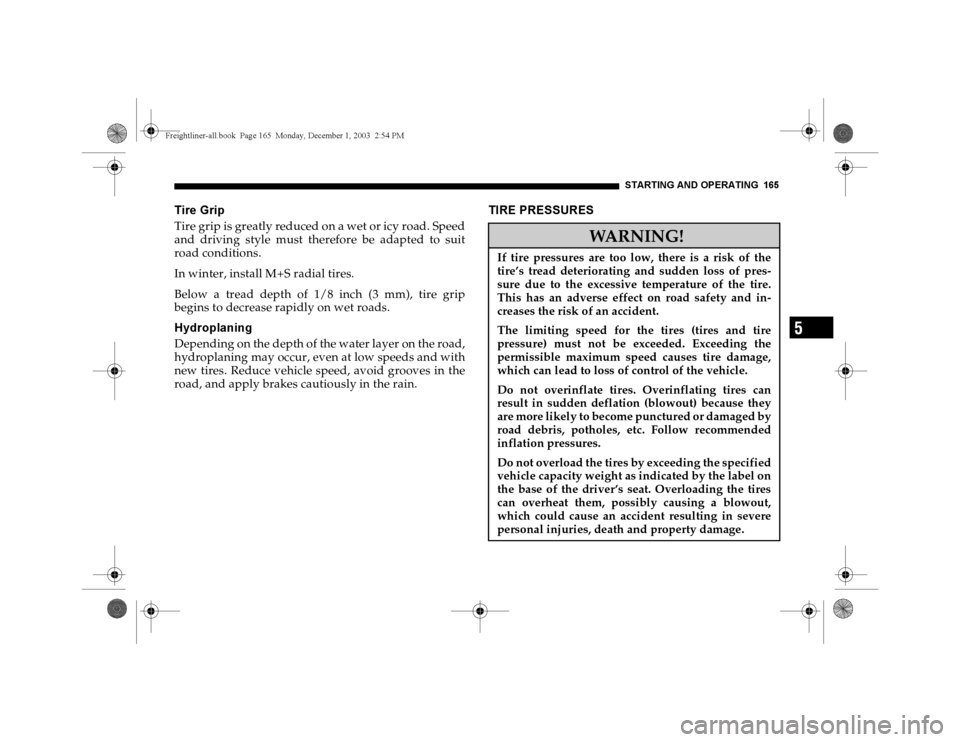
TIRE PRESSURES
WARNING!
If tire pressures are too low, there is a risk of the
tire’s tread deteriorating and sudden loss of pres-
sure due to the excessive temperature of the tire.
This has an adverse effect on road safety and in-
creases the risk of an accident.
The limiting speed for the tires (tires and tire
pressure) must not be exceeded. Exceeding the
permissible maximum speed causes tire damage,
which can lead to loss of control of the vehicle.
Do not overinflate tires. Overinflating tires can
result in sudden deflation (blowout) because they
are more likely to become punctured or damaged by
road debris, potholes, etc. Follow recommended
inflation pressures.
Do not overload the tires by exceeding the specified
vehicle capacity weight as indicated by the label on
the base of the driver’s seat. Overloading the tires
can overheat them, possibly causing a blowout,
which could cause an accident resulting in severe
personal injuries, death and property damage.
Freightliner-all.book Pag e 165 Monday, December 1, 2003 2:54 PM
Page 166 of 272
166 STARTING AND OPERATINGThe vehicle’s safety on the road depends to a great
extent on tire condition and correct tire pressure.
If tire pressures are too high or too low, handling
characteristics will be adversely affected and fuel
consumption and tire wear will increase. Check tire
pressures regularly (each time the vehicle is refueled).
Check tire pressures (including the spare wheel) with
the tires cold. The pressure difference between the tires
on a single axle should not exceed 1.5 psi (10 kPa). If
tire pressure in individual tires is too low: check the
valves, wheels and tires for signs of leaks.
After a period of fast driving, or in hot weather, tire
pressures can increase by as much as 14.5 psi (100 kPa).
Never release air from a warm tire or else the tire
pressure will be too low.NOTE: Tire pressure changes by about 1.5 psi (10 kPa)
for every 18
°F (+10
°C) change in air temperature. For
this reason, do not release pressure from tires when
they are warm.
Remember to allow for this when checking tire
pressures indoors, particularly in winter.
Example:
Room temperature: about 68
°F (+20
°C)
Outside temperature: about 32
°F (0
°C)
Required tire pressure, specified tire pressure 3 psi
(20 kPa).
Information on tires can be obtained from any
authorized Sprinter Dealer.
WARNING!
Correct the tire pressures before loading the
vehicle fully. If the tire pressure is too low driving
safety and tire mileage are decreased.
Freightliner-all.book Pag e 166 Monday, December 1, 2003 2:54 PM
Page 170 of 272

170 STARTING AND OPERATINGSNOW CHA INSInstall snow chains on rear wheels only. Install snow
chains on exterior wheel in vehicles with double tires.
Comply with the manufacturer’s installation
instructions.
NOTE: Vehicles with snow chains installed are only to
be driven on a snow-covered surface. The snow chains
must be removed on road surfaces free of snow.FUELSUse only commercially available vehicular diesel fuels
No. 2 or No. 1 (ASTM D 975 No. 2-D or No. 1-D).
If diesel fuels are used with a sulphur content
exceeding 0.05 % by weight, engine oil change
intervals must be shortened. Please contact your
Sprinter Dealer to obtain the necessary information.
Marine diesel fuel, heating oil or the like must not be
used.
Refueling from drums or canisters may lead to the fuel
becoming contaminated. This in turn can cause faults
in the fuel system. Always filter the fuel before adding
it to the vehicle’s tank.
Fuel Filter with Water SeparatorCheck the water separator when the fuel indicator
lamp does not go out or comes on while the engine
is running. For more information on the indicator
lamp .
The interval for changing the fuel filter is reduced to
10,000 miles (about 15,000 km).
Freightliner-all.book Pag e 170 Monday, December 1, 2003 2:54 PM
Page 173 of 272

STARTING AND OPERATING 173
5
NOTE: Only fill the fuel tank until the fill nozzle cuts
off, do not overfill.
NOTE: Holder on the inside of the fuel filler flap only
for cargo/passenger vans.
CapacityFuel tank including reserve fuel about 26.4 US gal
(100 l).PROGRAMMED TOP SPEED (OPTIONAL)NOTE: The top speed of this vehicle can be
electronically limited to a speed between 19 mph
(30 km / h) and 82 mph (132 km / h). The vehicle’s
electronic speed controller should be programmed
only by a qualified technician by an authorized
Sprinter Dealer.
When programming the electronic speed controller,
the circumference of the specific tires actually mounted
on the vehicle must be determined and that
circumference must be correctly programmed into the
vehicle’s electronic speed controller. It is critical that
the correct tire circumference be programmed
accurately into the vehicle’s electronic speed
controller. Accurate tire circumference information
should be confirmed each time the electronic speed
controller is programmed and each time new wheels or
tires are mounted on the vehicle.
WARNING!
Always handle fuel with great care.
Shut off the engine and the auxiliary heater before
refueling.
Fuel is flammable and explosive. Keep open
flames away from the fuel.
Refrain from smoking as well as use of any
electrical equipment (such as cell phones). This
also applies to places where the characteristic
smell of fuel is evident.
If diesel fumes are noticed inside the vehicle, have
the cause traced and rectified immediately by an
authorized Sprinter Dealer.
Freightliner-all.book Pag e 173 Monday, December 1, 2003 2:54 PM
Page 174 of 272

174 STARTING AND OPERATING
BLEEDING DIESEL FUEL SYSTEMIf the fuel tank was run empty, the diesel fuel system
must be bled after refueling before starting the engine.– Turn the key in the ignition lock to position 2 for at
least 30 seconds.– Return the key to position 0.– Start the engine.
NOTE: Too many attempts to start the engine could
drain the battery. If the engine does not start after
several attempts, consult an authorized Sprinter
Dealer.
WARNING!
Possible tire damage resulting in serious personal
injury or death may occur if the vehicle’s electron-
ic speed controller is programmed at a speed
above the maximum speed allowed by the manu-
facturer of the specific tires mounted on the vehi-
cle. The maximum speed of the tires prescribed by
the tire manufacturer must be determined and ac-
curately programmed into the electronic speed
controller. The electronic speed controller must
never be programmed at a speed greater than the
maximum allowable tire speed as prescribed by
the manufacturer of the specific tires mounted on
the vehicle.
Freightliner-all.book Pag e 174 Monday, December 1, 2003 2:54 PM