Page 321 of 426
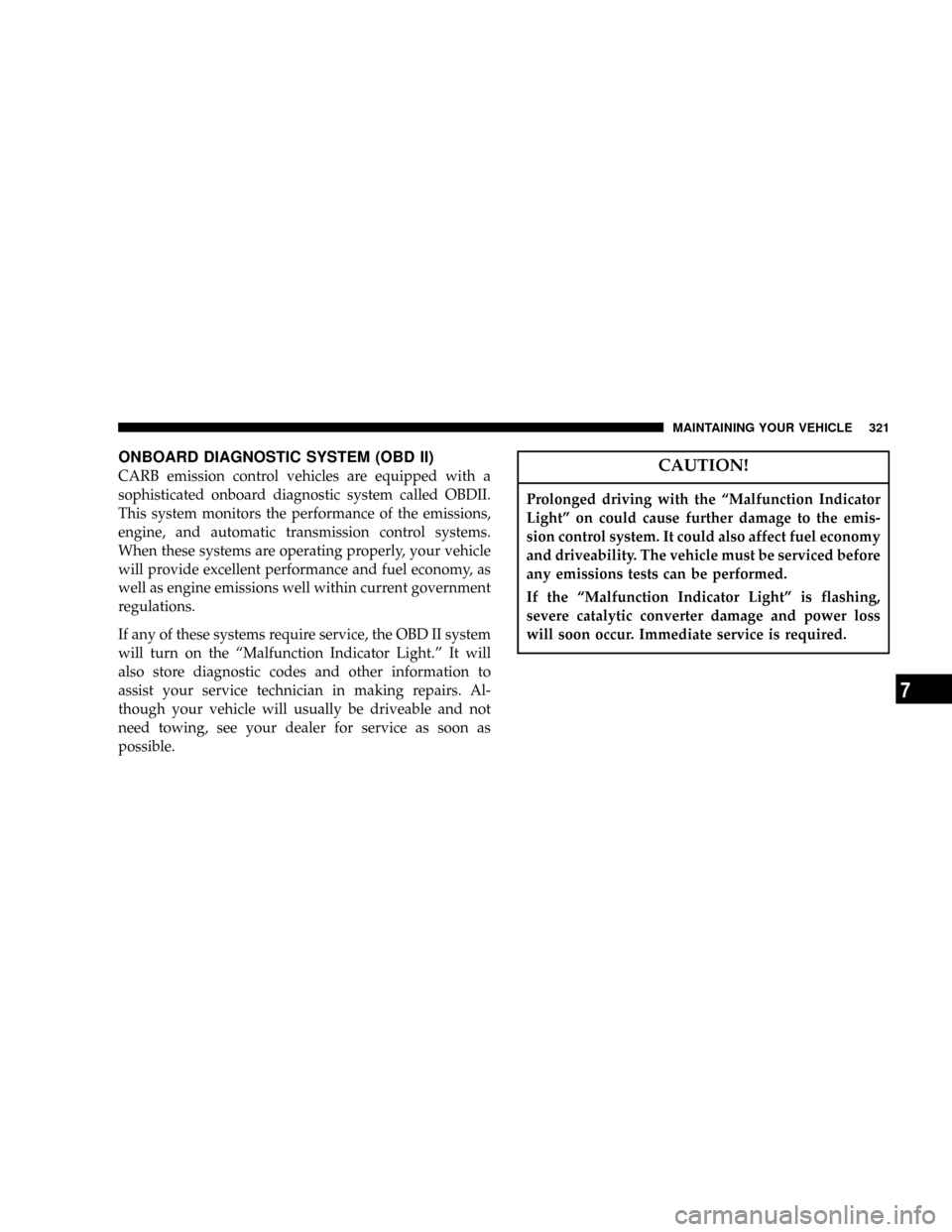
ONBOARD DIAGNOSTIC SYSTEM (OBD II)
CARB emission control vehicles are equipped with a
sophisticated onboard diagnostic system called OBDII.
This system monitors the performance of the emissions,
engine, and automatic transmission control systems.
When these systems are operating properly, your vehicle
will provide excellent performance and fuel economy, as
well as engine emissions well within current government
regulations.
If any of these systems require service, the OBD II system
will turn on the ªMalfunction Indicator Light.º It will
also store diagnostic codes and other information to
assist your service technician in making repairs. Al-
though your vehicle will usually be driveable and not
need towing, see your dealer for service as soon as
possible.CAUTION!
Prolonged driving with the ªMalfunction Indicator
Lightº on could cause further damage to the emis-
sion control system. It could also affect fuel economy
and driveability. The vehicle must be serviced before
any emissions tests can be performed.
If the ªMalfunction Indicator Lightº is flashing,
severe catalytic converter damage and power loss
will soon occur. Immediate service is required.
MAINTAINING YOUR VEHICLE 321
7
Page 343 of 426

Cooling System
Cooling System Maintenance
At the intervals shown in the Maintenance Schedules
Section of the manual, the system should be drained,
flushed and filled.
Inspection
Coolant protection checks should be made every 12
months (prior to the onset of freezing weather, where
applicable). If coolant is dirty or rusty in appearance, the
system should be drained, flushed and refilled with fresh
coolant as specified.
Inspect the entire cooling system for leaks. Check the face
of the radiator for any accumulation of bugs, leaves, or
other foreign matter. If dirty, clean the radiator core with
a garden hose. With the engine OFF, gently spray water
from the back of the radiator core. Check coolant bottle
tube for condition and tightness of connections at coolant
bottle and radiator.Check the coolant pressure cap and coolant bottle for
proper vacuum sealing. With the engine at normal oper-
ating temperature, note the level of the coolant in the
coolant bottle. Without removing the pressure cap (with
the engine off), drain a small amount of coolant from the
radiator drain cock. If the coolant level in the coolant
bottle drops, the system is sealing properly.
Extremely cold ambient temperature may require the
addition of a ªwinter frontº for effective operation of the
cab heating/cooling system. Make certain that a percent-
age of the radiator is exposed for adequate air flow
through the charge air cooler and automatic transmission
oil cooler. The percentage of opening must be increased
with the increasing ambient air temperature and/or
engine load. If the cooling fan can be heard cycling
frequently, increase the size of the opening in the winter
front.
MAINTAINING YOUR VEHICLE 343
7
Page 353 of 426

Lubricant Selection for NV-5600 (6-Speed Manual
Transmission) Ð If Equipped
This transmission does not require periodic changing. If
it becomes necessary to add fluid or change the fluid, be
sure to use the same lubricant or equivalent. Refer to
Recommended Fluids, Lubricants and Genuine Parts for
the correct lubricant type.
Automatic Transmission
Fluid Level Check
The fluid level should be checked when the engine is
fully warmed up and the fluid in the transmission is at
normal operating temperature. Operation of the trans-
mission with an improper fluid level will greatly reduce
the life of the transmission and of the fluid. Check the
fluid level whenever the vehicle is serviced.
Procedure For Checking Fluid Level
To properly check the automatic transmission fluid level,
the following procedure must be used:
1. The vehicle must be on level ground.
2. The engine should be running at curb idle speed for a
minimum of 60 seconds.
3. Fully apply parking brake.
4. Place the gear selector briefly in each gear position
ending with the lever in N (Neutral).
5. Remove the dipstick and determine if the fluid is hot
or warm. Hot fluid is approximately 180ÉF (82ÉC) which
is the normal operating temperature after the vehicle has
been driven at least 15 miles. The fluid can not be
comfortably held between the finger tips. Warm is when
fluid is between 85É - 125ÉF (29É - 52ÉC).
MAINTAINING YOUR VEHICLE 353
7
Page 354 of 426
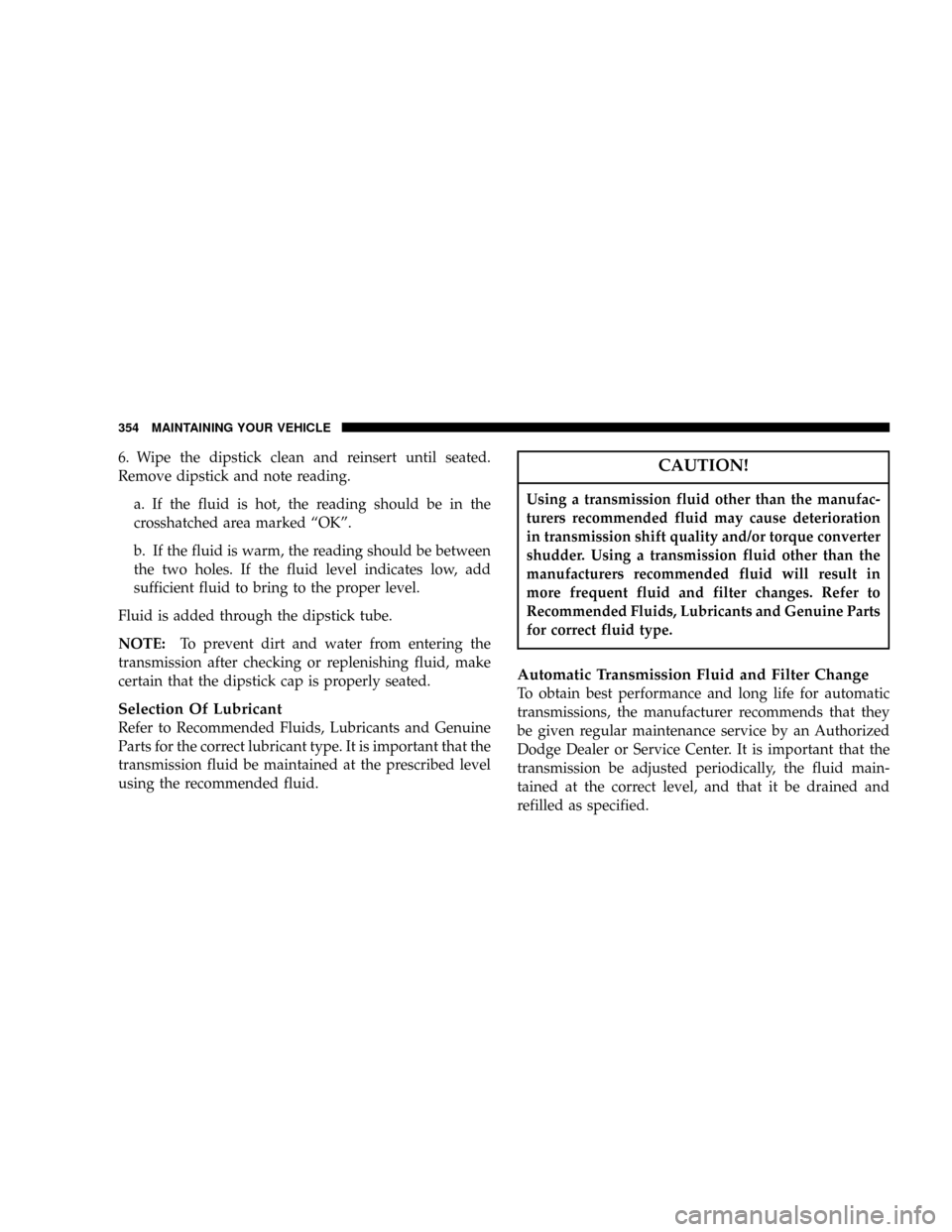
6. Wipe the dipstick clean and reinsert until seated.
Remove dipstick and note reading.
a. If the fluid is hot, the reading should be in the
crosshatched area marked ªOKº.
b. If the fluid is warm, the reading should be between
the two holes. If the fluid level indicates low, add
sufficient fluid to bring to the proper level.
Fluid is added through the dipstick tube.
NOTE:To prevent dirt and water from entering the
transmission after checking or replenishing fluid, make
certain that the dipstick cap is properly seated.
Selection Of Lubricant
Refer to Recommended Fluids, Lubricants and Genuine
Parts for the correct lubricant type. It is important that the
transmission fluid be maintained at the prescribed level
using the recommended fluid.
CAUTION!
Using a transmission fluid other than the manufac-
turers recommended fluid may cause deterioration
in transmission shift quality and/or torque converter
shudder. Using a transmission fluid other than the
manufacturers recommended fluid will result in
more frequent fluid and filter changes. Refer to
Recommended Fluids, Lubricants and Genuine Parts
for correct fluid type.
Automatic Transmission Fluid and Filter Change
To obtain best performance and long life for automatic
transmissions, the manufacturer recommends that they
be given regular maintenance service by an Authorized
Dodge Dealer or Service Center. It is important that the
transmission be adjusted periodically, the fluid main-
tained at the correct level, and that it be drained and
refilled as specified.
354 MAINTAINING YOUR VEHICLE
Page 381 of 426
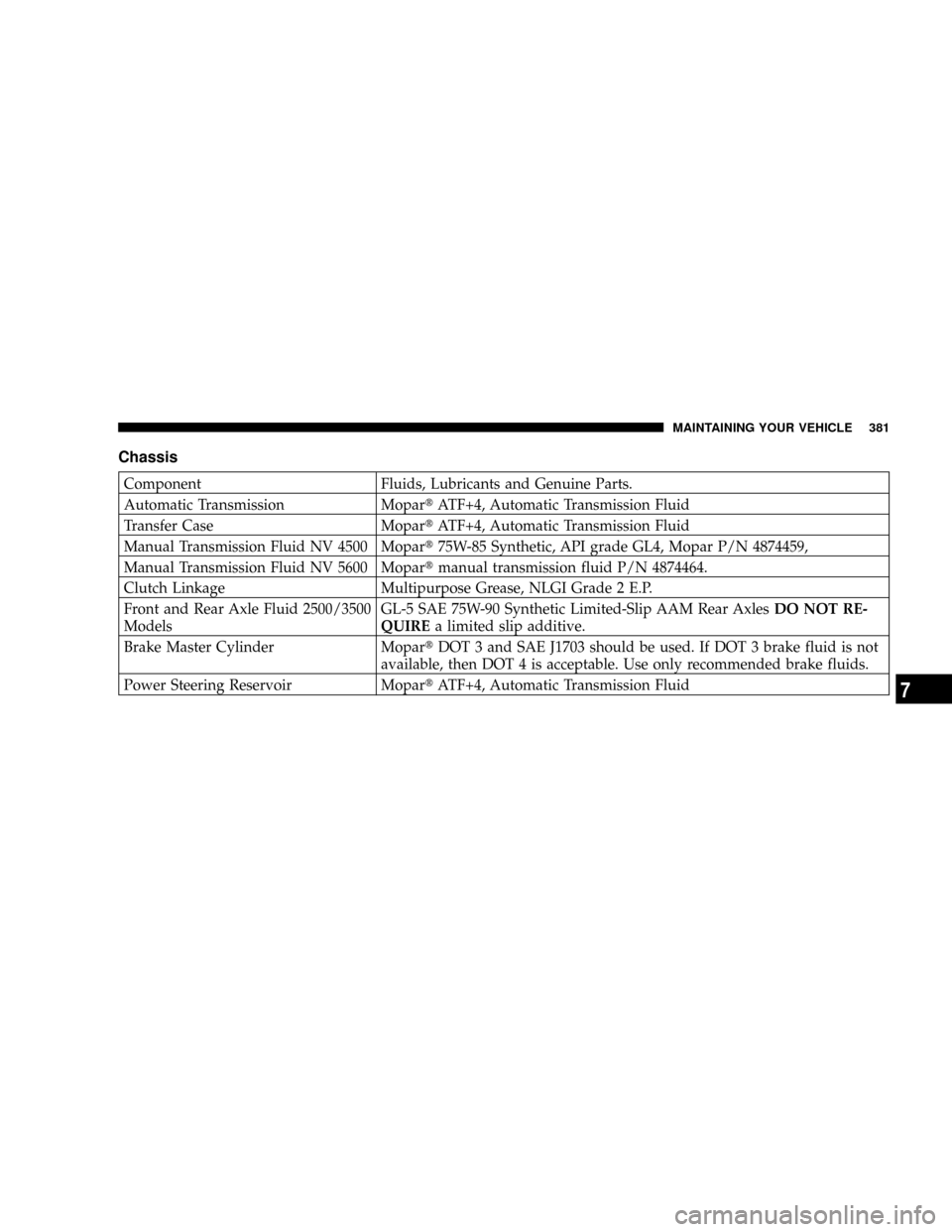
Chassis
Component Fluids, Lubricants and Genuine Parts.
Automatic Transmission MopartATF+4, Automatic Transmission Fluid
Transfer Case MopartATF+4, Automatic Transmission Fluid
Manual Transmission Fluid NV 4500 Mopart75W-85 Synthetic, API grade GL4, Mopar P/N 4874459,
Manual Transmission Fluid NV 5600 Mopartmanual transmission fluid P/N 4874464.
Clutch Linkage Multipurpose Grease, NLGI Grade 2 E.P.
Front and Rear Axle Fluid 2500/3500
ModelsGL-5 SAE 75W-90 Synthetic Limited-Slip AAM Rear AxlesDO NOT RE-
QUIREa limited slip additive.
Brake Master Cylinder MopartDOT 3 and SAE J1703 should be used. If DOT 3 brake fluid is not
available, then DOT 4 is acceptable. Use only recommended brake fluids.
Power Steering Reservoir MopartATF+4, Automatic Transmission Fluid
MAINTAINING YOUR VEHICLE 381
7
Page 386 of 426
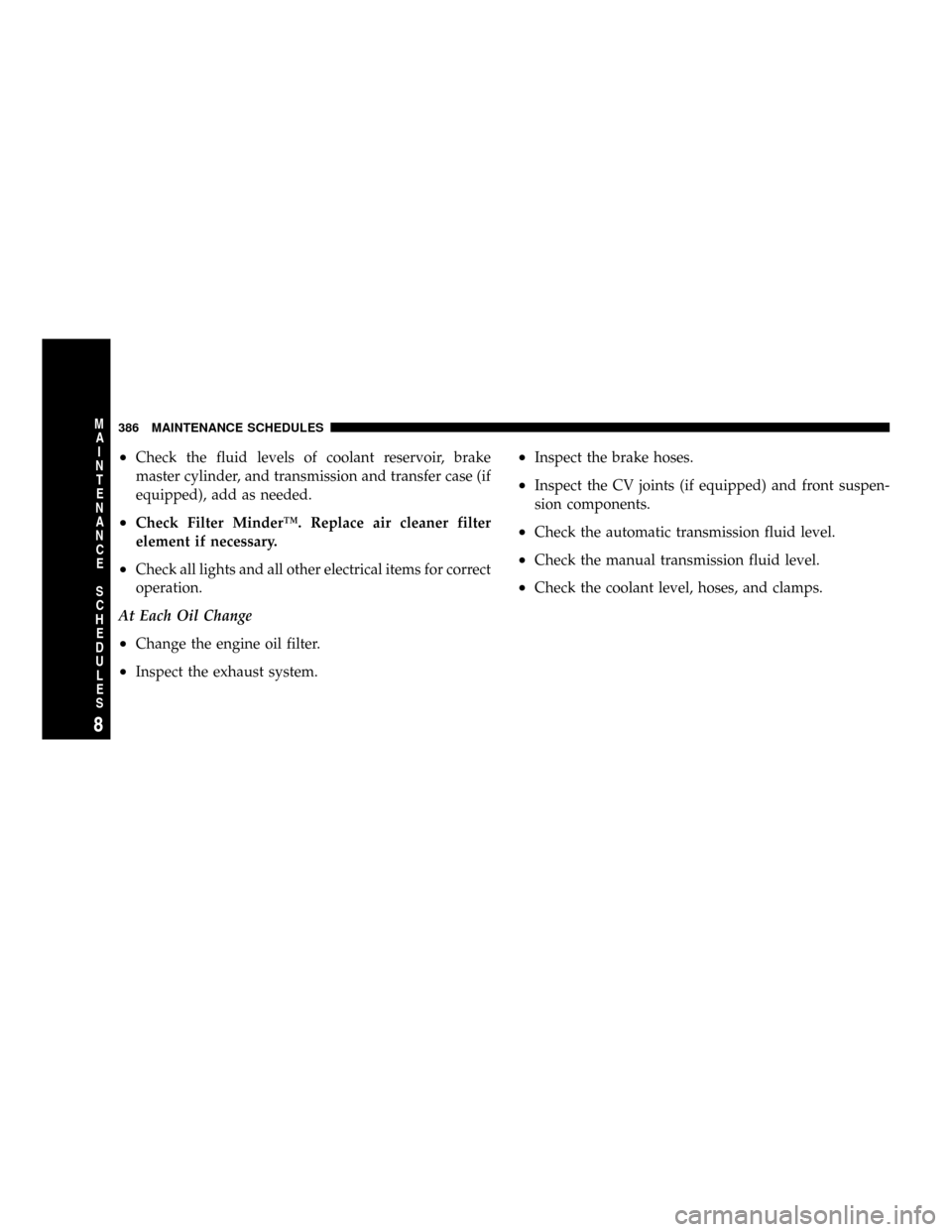
²Check the fluid levels of coolant reservoir, brake
master cylinder, and transmission and transfer case (if
equipped), add as needed.
²Check Filter MinderŸ. Replace air cleaner filter
element if necessary.
²Check all lights and all other electrical items for correct
operation.
At Each Oil Change
²Change the engine oil filter.
²Inspect the exhaust system.
²Inspect the brake hoses.
²Inspect the CV joints (if equipped) and front suspen-
sion components.
²Check the automatic transmission fluid level.
²Check the manual transmission fluid level.
²Check the coolant level, hoses, and clamps.
386 MAINTENANCE SCHEDULES
8
M
A
I
N
T
E
N
A
N
C
E
S
C
H
E
D
U
L
E
S
Page 389 of 426
Miles 22,500 26,250 30,000 33,750 37,500
(Kilometers) (36 000) (42 000) (48 000) (54 000) (60 000)
Change engine oil and engine oil filter. X X X
Rotate tires. X X X
Lubricate outer tie rod ends 2500/3500 (4X4) mod-
els only.XXX
Inspect drive belt, replace as required. X
Inspect fan hub. X
Inspect damper. X
Inspect water pump weep hole for blockage. X
Replace fuel filter element. Clean the water in fuel
sensor.X
Change rear axle fluid. X
Change front axle fluid (4X4). X
Check transfer case fluid level (4X4). X
Drain and refill automatic transmission fluid. Re-
place filter and adjust bands.X
SCHEDULE ªBº 389
8
M
A
I
N
T
E
N
A
N
C
E
S
C
H
E
D
U
L
E
S
Page 391 of 426
Miles 60,000 63,750 67,500 71,250 75,000
(Kilometers) (96 000) (102 000) (108 000) (114 000) (120 000)
Change engine oil and engine oil filter. X X X
Rotate tires. X X X
Lubricate outer tie rod ends 2500/3500 (4X4) models only. X X X
Inspect drive belt, replace as required. X
Inspect fan hub. X
Inspect damper. X
Inspect water pump weep hole for blockage. X X
Replace fuel filter element. Clean the water in fuel sensor. X X
Inspect front wheel bearings. X
Change rear axle fluid. X X
Change front axle fluid (4X4). X X
Inspect brake linings. X X
Inspect and adjust parking brake if necessary. X X
Drain and refill transfer case fluid (4X4). X
Drain and refill automatic transmission fluid. Replace fil-
ter and adjust bands.X
SCHEDULE ªBº 391
8
M
A
I
N
T
E
N
A
N
C
E
S
C
H
E
D
U
L
E
S