2004 DODGE RAM 1500 GAS tow
[x] Cancel search: towPage 213 of 429

high gear. When the vehicle speed drops or during
acceleration when the transmission downshifts to second
gear, the clutch automatically disengages.
NOTE:The torque converter clutch will not engage
until the transmission fluid and engine coolant are warm
[usually after 1-3 miles (1.6 - 4.8 km) of driving]. Because
the engine speed is higher when the torque converter
clutch is not engaged, it may seem as if the transmission
is not shifting into Overdrive when cold. This is normal.
Pressing the ªTOW/HAULº button, when the transmis-
sion is sufficiently warm, will demonstrate that the
transmission is able to shift into and out of overdrive.
NOTE:If the vehicle has not been driven in several
days, the first few seconds of operation after shifting the
transmission into gear may seem sluggish. This is due tothe fluid partially draining from the torque converter into
the transmission. This condition is normal and will not
cause damage to the transmission. The torque converter
will refill within five seconds of shifting from Park into
any other gear position.
Manual Transmission Ð 5-Speed
NOTE:The parking brake should be engaged before
leaving the vehicle, especially on an incline.
Truck models with manual transmission are equipped
with a clutch interlocking ignition system. The clutch
pedal must be fully depressed to start the vehicle.
Fully depress the clutch pedal before shifting gears. As
you release the clutch pedal, lightly depress the accelera-
tor pedal.
STARTING AND OPERATING 213
5
Page 214 of 429

Manual Transmission Ð 5±Speed (NV3500)
1500 models are equipped with the NV3500 manual
transmission. Be sure the transmission is in 1st gear when
starting from a standing position. Damage to the clutch
can result from starting in 2nd or 3rd gear. Use each gear
in numerical order ± do not skip a gear.
For most city driving you may find it
easier to use only 1st through 4th gear
ranges. For steady highway driving
with light accelerations, 5th gear is rec-
ommended. To shift into 5th gear, move
the shift lever to the right beyond the
spring pressure point and push it forward. When shifting
from 5th to 4th gear, pull the lever down toward you in
one motion. Do not pull the lever sharply left as you may
shift accidentally into 2nd gear and damage the trans-
mission.To shift into Reverse, come to a complete stop. Depress
the clutch and pause briefly to allow the gear train to
stop. Move the shift lever from the Neutral position
straight across and back into Reverse.
Never drive with your foot resting on the clutch pedal, or
attempt to hold the vehicle on a hill with the clutch pedal
partially engaged, as this will cause abnormal wear on
the clutch.
Recommended Vehicle Shift Speeds
To utilize your manual transmission efficiently for both
fuel economy and performance, it should be upshifted as
listed in the following chart. Shift at the vehicle speeds
listed for acceleration. Earlier upshifts during cruise
conditions (steady speeds) will result in increased fuel
economy, and may be used as indicated.
214 STARTING AND OPERATING
Page 215 of 429
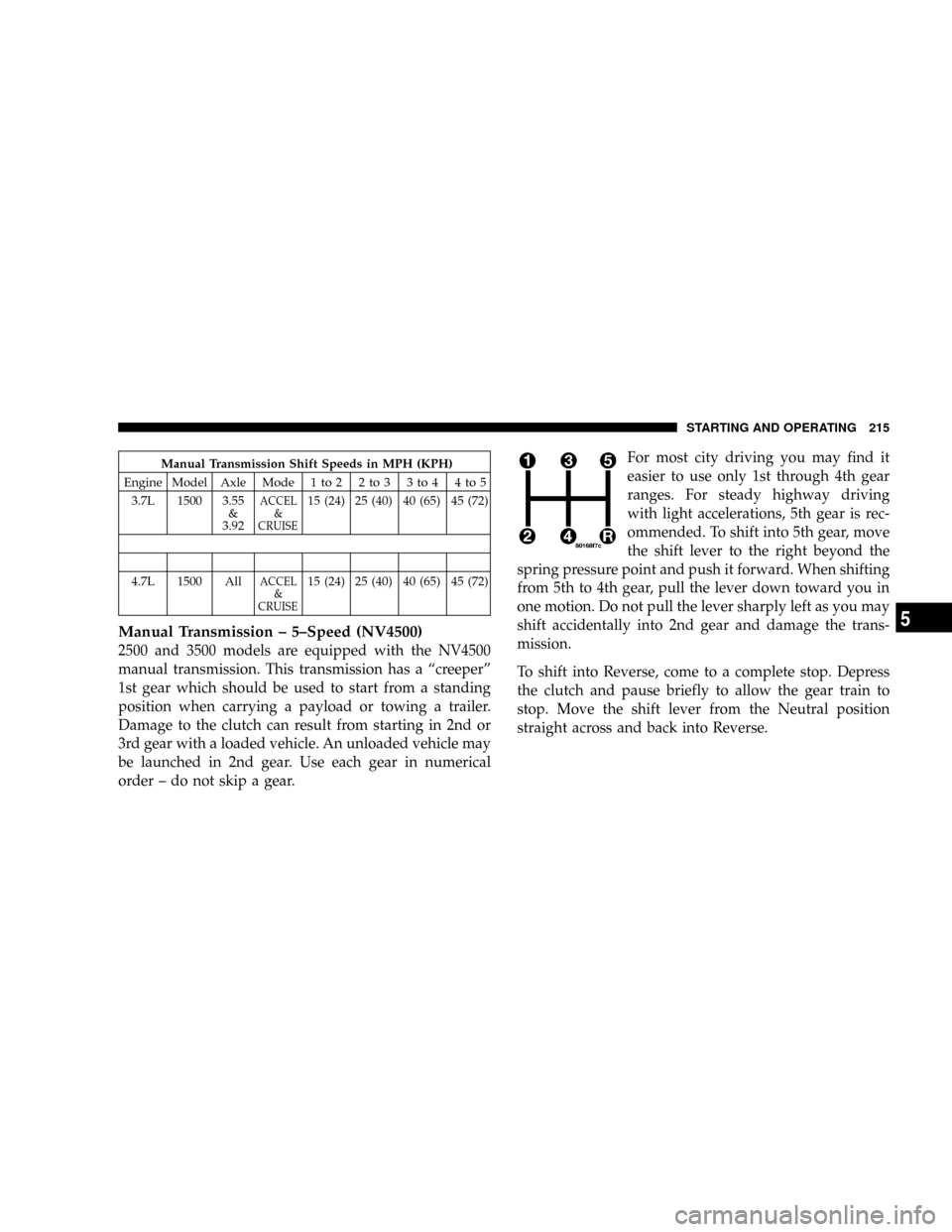
Manual Transmission Shift Speeds in MPH (KPH)
Engine Model Axle Mode 1 to 2 2 to 3 3 to 4 4 to 5
3.7L 1500 3.55
&
3.92
ACCEL
&
CRUISE15 (24) 25 (40) 40 (65) 45 (72)
4.7L 1500 All
ACCEL
&
CRUISE15 (24) 25 (40) 40 (65) 45 (72)
Manual Transmission ± 5±Speed (NV4500)
2500 and 3500 models are equipped with the NV4500
manual transmission. This transmission has a ªcreeperº
1st gear which should be used to start from a standing
position when carrying a payload or towing a trailer.
Damage to the clutch can result from starting in 2nd or
3rd gear with a loaded vehicle. An unloaded vehicle may
be launched in 2nd gear. Use each gear in numerical
order ± do not skip a gear.For most city driving you may find it
easier to use only 1st through 4th gear
ranges. For steady highway driving
with light accelerations, 5th gear is rec-
ommended. To shift into 5th gear, move
the shift lever to the right beyond the
spring pressure point and push it forward. When shifting
from 5th to 4th gear, pull the lever down toward you in
one motion. Do not pull the lever sharply left as you may
shift accidentally into 2nd gear and damage the trans-
mission.
To shift into Reverse, come to a complete stop. Depress
the clutch and pause briefly to allow the gear train to
stop. Move the shift lever from the Neutral position
straight across and back into Reverse.
STARTING AND OPERATING 215
5
Page 219 of 429

4H
4-Wheel-Drive High Range - Locks the front and rear
driveshafts together. Forces the front and rear wheels to
rotate at the same speed. Additional traction for loose,
slippery road surfaces only.
N
Neutral - Disengages both the front and rear driveshafts
from the powertrain. To be used for flat towing behind
another vehicle. See Recreational Towing for more infor-
mation.
4L
4-Wheel-Drive Low Range - Low speed 4-wheel-drive.
Locks the front and rear driveshafts together. Forces the
front and rear wheels to rotate at the same speed.
Additional traction and maximum pulling power for
loose, slippery road surfaces only. Do not exceed 25 mph
(40 km/h).
Shifting Procedure - Manually Shifted Transfer
Case
2H,4H
Shifting between 2H and 4H can be made with the
vehicle stopped or in motion. If the vehicle is in motion,
shifts can be made up to 55 mph (88 km/h). With the
STARTING AND OPERATING 219
5
Page 221 of 429

Electronically Shifted Transfer Case Operating
Information/Precautions
This is an electric shift transfer case and is operated by
the 4WD Control Switch (Transfer Case Switch), which is
located on the instrument panel.
The Electronically Shifted transfer case provides 4 mode
positions: 2 (rear) wheel drive high range or all wheel
drive high range, 4 wheel drive high range, 4 wheel drive
low range, and neutral.
The Electronically Shifted transfer case is designed to be
driven in the 2 wheel drive position (2WD) or all wheel
drive position (AWD) for normal street and highway
conditions (dry hard surfaced roads).
When additional traction is required, the transfer case
4HI and 4LO positions can be used to lock the front andrear driveshafts together and force the front and rear
wheels to rotate at the same speed. This is accomplished
by rotating the 4WD Control Switch to the desired
position - see Shifting Procedure section for specific
shifting instructions. The 4HI and 4LO positions are
designed for loose, slippery road surfaces only. Driving
in the 4HI and 4LO positions on dry hard surfaced roads
may cause increased tire wear and damage to the driv-
eline components.
NOTE:The transfer case Neutral (N) position is selected
by depressing the recessed button located on the lower
left hand corner of the 4WD Control Switch. The transfer
case Neutral (N) position is to be used for recreational
towing only. See the Recreational Towing section for
specific procedures on shifting into and out of Neutral
(N).
STARTING AND OPERATING 221
5
Page 224 of 429

WARNING!
You or others could be injured if you leave the
vehicle unattended with the transfer case in the
Neutral (N) position without first fully engaging the
parking brake. The transfer case Neutral (N) position
disengages both the front and rear driveshafts from
the powertrain and will allow the vehicle to move
regardless of the transmission position. The parking
brake should always be applied when the driver is
not in the vehicle.
For additional information on the appropriate use of each
transfer case mode position see the information below:
2WD/AWD
Rear Wheel Drive High Range - Normal street and
highway driving. Dry hard surfaced roads.4HI
4 Wheel Drive High Range - Locks the front and rear
driveshafts together. Forces the front and rear wheels to
rotate at the same speed. Additional traction for loose,
slippery road surfaces only.
4LO
4 Wheel Drive Low Range - Low speed 4 wheel drive.
Locks the front and rear driveshafts together. Forces the
front and rear wheels to rotate at the same speed.
Additional traction and maximum pulling power for
loose, slippery road surfaces only. Do not exceed 25 mph
(40 km/h).
N
Neutral - Disengages both the front and rear driveshafts
from the powertrain. To be used for flat towing behind
another vehicle. See Recreational Towing for more infor-
mation.
224 STARTING AND OPERATING
Page 230 of 429

WARNING!
²Always fully apply the parking brake when leav-
ing your vehicle, or it may roll and cause damage
or injury. Also be certain to leave an automatic
transmission in Park, a manual transmission in
Reverse or first gear. Failure to do so may allow
the vehicle to roll and cause damage or injury.
²Leaving children in a vehicle unattended is dan-
gerous for a number of reasons. A child or others
could be injured. Children should be warned not
to touch the parking brake or the gear selector
lever. Don't leave the keys in the ignition. A child
could operate power windows, other controls, or
move the vehicle.
²Be sure the parking brake is fully disengaged before
driving, failure to do so can lead to brake problems
due to excessive heating of the rear brakes.
When parking on a hill, turn the front wheels toward the
curb on a downhill grade and away from the curb on an
uphill grade.
The parking brake should always be applied whenever
the driver is not in the vehicle.
BRAKE SYSTEM
If power assist is lost for any reason (for example,
repeated brake applications with the engine off), the
brakes will still function. However, you will experience a
substantial increase in braking effort to stop the vehicle.
If either the front or rear hydraulic systems lose normal
capability, the remaining system will still function with
some loss of overall braking effectiveness. This will be
evident by increased pedal travel during application,
greater pedal force required to slow or stop, and activa-
tion of the BRAKE warning lamp and the ABS lamp (if
equipped) during brake use.
230 STARTING AND OPERATING
Page 240 of 429

Loading
The vehicle maximum load on the tire must not exceed
the load carrying capacity of the tire on your vehicle. You
will not exceed the tire's load carrying capacity if you
adhere to the loading conditions, tire size and cold tire
inflation pressures specified on the Tire and Loading
Information placard and the Vehicle Loading section of
this manual.
NOTE:Under a maximum loaded vehicle condition,
gross axle weight ratings (GAWR's) for the front and rear
axles must not be exceeded. For further information on
GAWR's, vehicle loading and trailer towing, see the
Vehicle Loading section of this manual.
To determine the maximum loading conditions of your
vehicle, locate the statement ªThe combined weight of
occupants and cargo should never exceed XXX kg or XXX
lbs.º on the Tire and Loading Information placard. Thecombined weight of occupants, cargo/luggage and
trailer tongue weight (if applicable) should never exceed
the weight referenced here.
Steps for Determining Correct Load Limit
1. Locate the statement ªThe combined weight of occu-
pants and cargo should never exceed XXX poundsº on
your vehicle's placard.
2. Determine the combined weight of the driver and
passengers that will be riding in your vehicle.
3. Subtract the combined weight of the driver and pas-
sengers from XXX kilograms or XXX pounds.
4. The resulting figure equals the available amount of
cargo and luggage load capacity. For example, if ªXXXº
amount equals 1400 lbs. and there will be five 150 lb.
passengers in your vehicle, the amount of available cargo
and luggage load capacity is 650 lb. (1400±750 (5 x 150) =
650 lb.)
240 STARTING AND OPERATING