Page 144 of 429

2. Voltage Gauge
When the engine is running, the gauge indicates
the electrical system voltage. The pointer should
stay within the normal range if the battery is charged. If
the pointer moves to either extreme left or right and
remains there during normal driving, the electrical sys-
tem should be serviced.
NOTE:If the gauge pointer moves to either extreme of
the gauge, the ªCheck Gagesº indicator will illuminate
and a single chime will sound.
3. Turn Signal Indicators
Lights in instrument cluster flash when outside turn
signals are operating.
4. Tachometer
The tachometer indicates engine speed in revolutions per
minute.CAUTION!
Do not operate the engine with the tachometer
pointer at high rpm for extended periods. Engine
damage may occur.
5. Airbag Indicator Light
The indicator lights and remains lit for 6 to 8 seconds
when the ignition is first turned on. If the light stays on,
flickers or comes on while driving, have the airbag
system checked by an authorized dealer.
6. High Beam Indicator
This indicator shows that headlights are on high
beam.
144 UNDERSTANDING YOUR INSTRUMENT PANEL
Page 145 of 429

7. Seat Belt Reminder Light
When the ignition switch is first turned ON, this
light will turn on for 5 to 8 seconds as a bulb check.
During the bulb check, if the driver's seat belt is
unbuckled, a chime will sound. After the bulb check or
when driving, if the driver seat belt remains unbuckled,
the Seat Belt Warning Light will flash or remain on
continuously. Refer to9Enhanced Driver Seat Belt Re-
minder System (BeltAlertŸ)9in the Occupant Restraints
section for more information.
8. Speedometer
The speedometer shows the vehicle speed in miles per
hour and/or kilometers per hour.
9. Oil Pressure Gauge
The pointer should always indicate some oil pres-
sure when the engine is running. A continuous
high or low reading, under normal driving conditions,
may indicate a lubrication system malfunction. Immedi-
ate service should be obtained.NOTE:If the gauge pointer moves to either extreme of
the gauge, the ªCheck Gagesº indicator will illuminate
and a single chime will sound.
10. Cargo Lamp
The Cargo Lamp light will illuminate when the Cargo
Lamp is activated from the dimmer control switch,
located next to the headlight switch.
11. Door Ajar
The Door Ajar light will illuminate when any
door is opened. When the ignition is ON the
Door Ajar light will stay illuminated until the
open door is closed. When the ignition is OFF
the Door Ajar light will stay illuminated until the open
door is closed or the battery saver feature automatically
turns the light off.
UNDERSTANDING YOUR INSTRUMENT PANEL 145
4
Page 273 of 429

2500/3500 Models
²
The Axles on 2500/3500 Modelsare trailer tow ready
andDO NOT REQUIREany special axle lubes or
additives.
Trailer Towing Recommendations
²
All trailer hitches should be professionally installed on
your vehicle.
²Safety chains must always be used between your
vehicle and trailer.
²Donotinterconnect the hydraulic brake system or
vacuum system of your vehicle with that of the trailer.
This could cause inadequate braking and possible
personal injury. An electrically±actuated electric trailer
brake controller is recommended.
²Trailer brakes are recommended for trailers over 1000
lbs (454 kg) and are required for trailers in excess of
2,000 lbs (907 kg)
²Use an approved wiring harness connector on the
trailer. Standard equipment on all RAM pickup mod-
els provides a 4-way trailer tow connector located
under the bumper. This connector contains the follow-
ing vehicle circuits: park/tail lamps, left stop/turn
lamp, right stop/turn lamp, and ground. With the
optional Trailer Tow Prep package a 7-way connector
is provided with the following additional circuits:
backup lamp, trailer battery and electric brake.
NOTE:Connect trailer lighting and brakes using factory
harnesses only. Do not cut or splice wiring to the brake
circuits.
STARTING AND OPERATING 273
5
Page 275 of 429

Connecting Trailer Lighting And Electric Trailer
Brakes
NOTE:A 4-way trailer tow connector, located behind
the bumper, is standard equipment on all Ram pickup
models. This connector contains the following vehicle
circuits: park/tail lamps, left stop/turn lamp, right stop/
turn lamp, and ground. With the optional Trailer Tow
Prep package a 7-way connector is also provided with the
following additional circuits: backup lamp, trailer battery
and electric brake.
NOTE:There is also a 4±way connector located under
the instrument panel, located to the left of the brake
pedal that is used for the electric brake. This connector
contains the following vehicle circuits; power ground,
battery, stop lamp switch and electric brake feed. The
4±way is optional with the trailer tow prep package.
CAUTION!
Adding lights or electrical devices to the headlamp/
park lamp circuit can be accomplished by connecting
to the standard 4-way trailer tow connector located
behind the rear bumper. The maximum current ca-
pacity for the park lamp circuit should not exceed 15
amps total (a typical park lamp bulb can draw from
0.5 to 1.0 amperes of current).
No connections can be made to the headlamp switch
itself, because it is not designed for high current
applications. Connections to the headlamp switch
will cause the exterior lights to malfunction.
STARTING AND OPERATING 275
5
Page 284 of 429

General Maintenance
Snowplows should be maintained in accordance with the
plow manufacturer's instructions. Whenever the plow is
disconnected from the vehicle, coat the exposed angling
cylinder rods with chassis lubricant. The lift cylinder
should be extended upward and chassis lubricant ap-
plied to the lift rod. The hydraulic hoses interconnect to
keep the couplers clean.
Keep all snowplow electrical connections and battery
terminals clean and free of corrosion.
When plowing snow, to avoid transmission and driv-
etrain damage, the following precautions should be ob-
served.
²Operate with transfer case in 4L when plowing small
or congested areas where speeds are not likely to
exceed 15 mph (24 km/h). At higher speeds operate in
4H.
²Do not shift the transmission unless the engine has
returned to idle and wheels have stopped. Make a
practice of stepping on the brake pedal before shifting
the transmission.
RECREATIONAL TOWING Ð 4±WHEEL DRIVE
VEHICLES (BEHIND MOTORHOME, ETC.)
CAUTION!
Internal damage to the transfer case will occur if a
front or rear wheel lift is used when recreational
towing.
NOTE:Both the Manual Shift and Electronic Shift
transfer cases must be shifted into Neutral (N) for
recreational towing. Automatic transmissions must be
placed in P (Park) position for recreational towing.
Manual transmissions must be left in gear (not in neutral)
284 STARTING AND OPERATING
Page 294 of 429
HAZARD WARNING LIGHTS
The Hazard Warning switch is mounted on the top of the
steering column as shown in the illustration.
To engage the Hazard Warning lights, depress the button
on the top of the steering column. When the Hazard
Warning switch is activated, all directional turn signalswill flash off and on to warn oncoming traffic of an
emergency. Push the button a second time to turn off the
flashers.
This is an emergency warning system and should not be
used when the vehicle is in motion. Use it when your
vehicle is disabled and is creating a safety hazard for
other motorists.
When you must leave the vehicle to seek assistance, the
Hazard Warning lights will continue to operate even
though the ignition switch is OFF.
NOTE:With extended use, the Hazard Warning lights
may discharge your battery.
294 WHAT TO DO IN EMERGENCIES
Page 312 of 429

Attach the wheel wrench to the extension tube. Rotate the
winch mechanism until the wheel is drawn into place
against the underside of the vehicle. Continue to rotate
until you feel the winch mechanism slip or click 3 or 4
times. It cannot be overtightened. Push against the tire
several times to be sure it is firmly in place.
HOISTING
A conventional floor jack may be used at the jacking
locations, refer to the graphics that show jacking loca-
tions. However, a floor jack or frame hoist must never be
used on any other parts or the underbody.
CAUTION!
Never use a floor jack directly under the differential
housing of a loaded truck or damage to your vehicle
may result.
JUMP-STARTING
You should not try to start your vehicle by pushing or
towing. Vehicles equipped with an automatic transmis-
sion cannot be started this way and pushing or towing a
vehicle equipped with a manual transmission may over-
heat and damage the catalytic converter. Also, there is a
greater risk of an accident when a vehicle is being pushed
or towed. If the vehicle has a discharged battery, booster
cables may be used to obtain a start from a booster
battery or the battery in another vehicle. This type of start
can be dangerous if done improperly, so follow this
procedure carefully.
312 WHAT TO DO IN EMERGENCIES
Page 313 of 429
WARNING!
Battery fluid is a corrosive acid solution; do not
allow battery fluid to contact eyes, skin or clothing.
Don't lean over battery when attaching clamps or
allow the clamps to touch each other. If acid splashes
in eyes or on skin, flush contaminated area immedi-
ately with large quantities of water.
A battery generates hydrogen gas which is flam-
mable and explosive. Keep flame or spark away
from the vent holes.
Do not use a booster battery or any other booster
source that has a greater than 12 volt system, i.e. Do
not use a 24 volt power source.
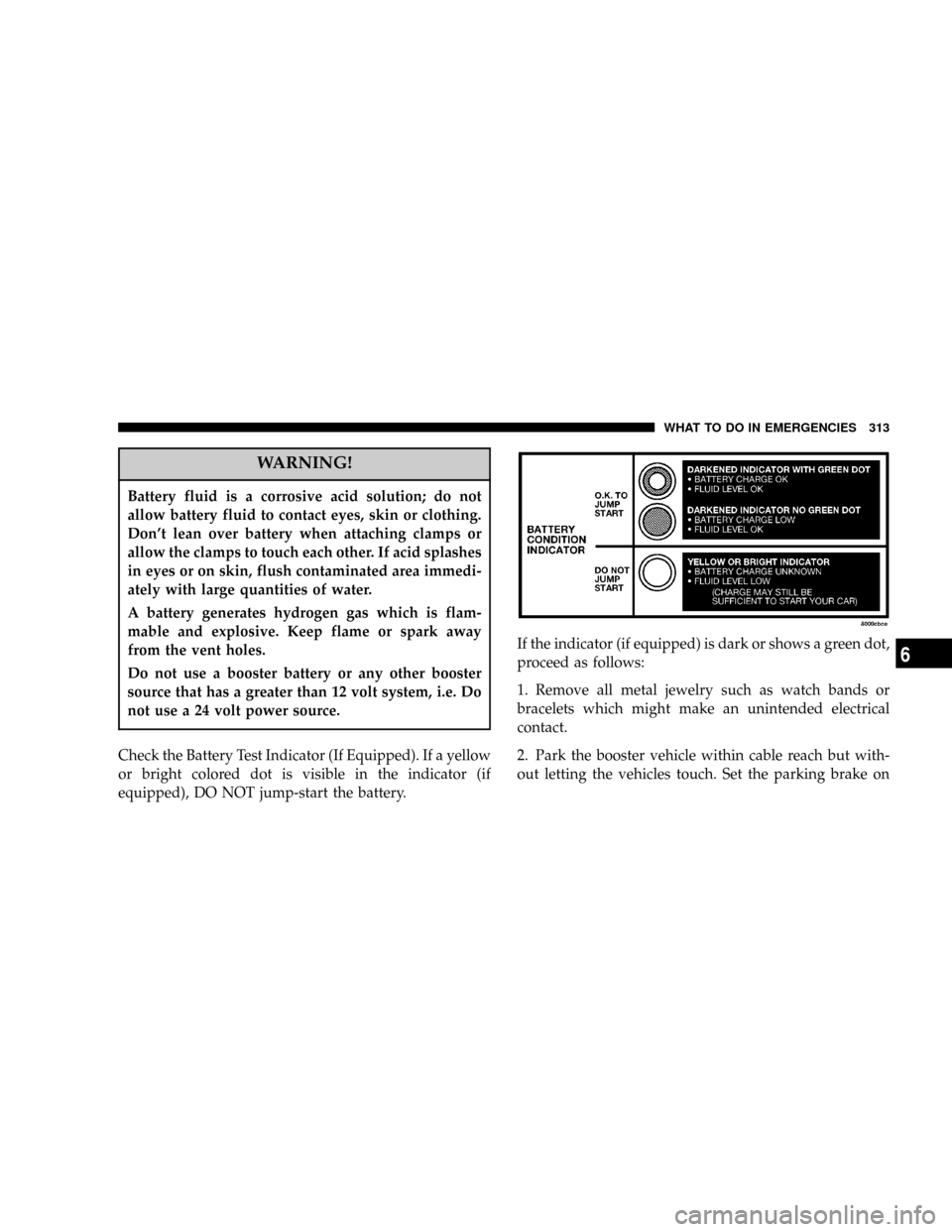
Check the Battery Test Indicator (If Equipped). If a yellow
or bright colored dot is visible in the indicator (if
equipped), DO NOT jump-start the battery.If the indicator (if equipped) is dark or shows a green dot,
proceed as follows:
1. Remove all metal jewelry such as watch bands or
bracelets which might make an unintended electrical
contact.
2. Park the booster vehicle within cable reach but with-
out letting the vehicles touch. Set the parking brake on
WHAT TO DO IN EMERGENCIES 313
6