Page 203 of 300

6. Using the point of a ballpoint pen or similar object,
depress the recessed transfer case Neutral (N) button for
4 seconds.
7. After shift is completed and the Neutral (N) light
comes on release Neutral (N) button.
8. Start engine.
9. Shift automatic transmission into Reverse (R).
10. Release brake pedal for five seconds and ensure that
there is no vehicle movement.
11. Repeat steps 9 and 10 with the transmission in Drive
(D).
12. Shut engine OFF and place ignition key to the
unlocked OFF position.
13. Shift automatic transmission into Park (P). Shift
Manual transmissions into 4th gear.
14. Attach vehicle to tow vehicle with tow bar.NOTE:Items 1 through 5 are requirements that must be
met prior to depressing the Neutral (N) selection button,
and must continue to be met until the 4 seconds elaspes
and the shift has been completed. If any of these require-
ments (with the exception of 3 - Key ON) are not met
prior to depressing the Neutral (N) button or are no
longer met during the 4 second timer, then the Neutral
(N) indicator light will flash continuously until all re-
quirements are met or until the Neutral (N) button is
released.
NOTE:The ignition key must be ON for a shift to take
place and for the position indicator lights to be operable.
If the key in not ON, the shift will not take place and no
position indicator lights will be on or flashing.
NOTE:Flashing neutral (N) position indicator light
indicates that shift requirements have not been met.
STARTING AND OPERATING 203
5
Page 204 of 300

CAUTION!
Damage to the transmission may occur if the trans-
mission is shifted into Park (P) with the transfer case
in Neutral (N) and the engine RUNNING. With the
transfer case in Neutral (N) ensure that the engine is
OFF prior to shifting the transmission into Park (P).
Returning to Normal Operation
Use the following procedure to prepare your vehicle for
normal usage.
1. Bring vehicle to a complete stop.
2. Shut engine OFF.
3. Place ignition key in the ON position.
4. Depress brake pedal.
5. Shift automatic transmission to Neutral (N) or depress
clutch on manual transmission.6. Using the point of a ballpoint pen or similar object,
depress the recessed transfer case Neutral (N) button for
1 second.
7. After the Neutral (N) indicator light turns off release
the Neutral (N) button.
8. After the Neutral (N) button has been released the
transfer case will shift to the position identified by the
selector switch.
9. Shift automatic transmission into Drive (D), release
the clutch on manual transmission.
NOTE:Items 1 through 5 are requirements that must be
met prior to depressing the Neutral (N) selection button,
and must continue to be met until 1 second elapses and
the shift has been completed. If any of these requirements
(with the exception of 3 - key ON) are not met prior to
depressing the Neutral (N) button or are no longer met
during the 1 second time, then all of the mode position
indicator lights will flash continuously until all require-
ments are met or until the Neutral (N) button is released.
204 STARTING AND OPERATING
Page 205 of 300

NOTE:The ignition key must be ON for a shift to take
place and for the position indicator lights to be operable.
If the key is not ON, the shift will not take place and no
position indicator lights will be on or flashing.
NOTE:Flashing neutral (N) position indicator light
indicates that shift requirements have not been met.
WARNING!
You or others could be injured if you leave the
vehicle unattended with the transfer case in the
Neutral (N) position without first fully engaging the
parking brake. The transfer case Neutral (N) position
disengages both the front and rear driveshafts from
the powertrain and will allow the vehicle to move
despite the transmission position. The parking
brake should always be applied when the driver is
not in the vehicle.
CAUTION!
²Do not use a bumper mounted clamp-on tow bar
on your vehicle. The bumper face bar will be
damaged.
²Do not disconnect the rear driveshaft because
fluid will leak from the transfer case and damage
internal parts.
STARTING AND OPERATING 205
5
Page 208 of 300
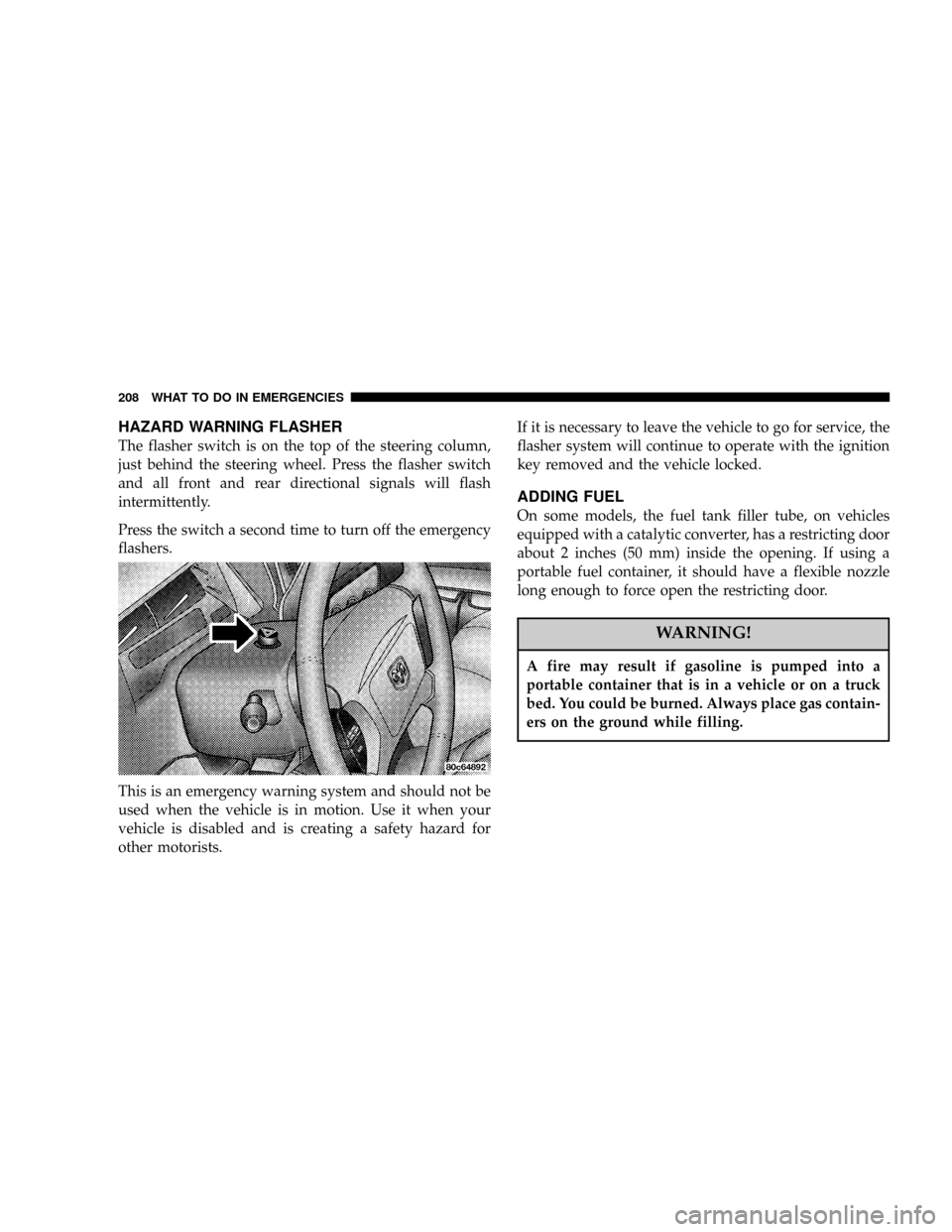
HAZARD WARNING FLASHER
The flasher switch is on the top of the steering column,
just behind the steering wheel. Press the flasher switch
and all front and rear directional signals will flash
intermittently.
Press the switch a second time to turn off the emergency
flashers.
This is an emergency warning system and should not be
used when the vehicle is in motion. Use it when your
vehicle is disabled and is creating a safety hazard for
other motorists.If it is necessary to leave the vehicle to go for service, the
flasher system will continue to operate with the ignition
key removed and the vehicle locked.
ADDING FUEL
On some models, the fuel tank filler tube, on vehicles
equipped with a catalytic converter, has a restricting door
about 2 inches (50 mm) inside the opening. If using a
portable fuel container, it should have a flexible nozzle
long enough to force open the restricting door.
WARNING!
A fire may result if gasoline is pumped into a
portable container that is in a vehicle or on a truck
bed. You could be burned. Always place gas contain-
ers on the ground while filling.
208 WHAT TO DO IN EMERGENCIES
Page 216 of 300
If the indicator (if equipped) is dark or shows a green dot,
proceed as follows:
1. Wear eye protection and remove all metal jewelry such
as watch bands or bracelets which might make an
unintended electrical contact.
2. Park the booster vehicle within cable reach but with-
out letting the vehicles touch. Set the parking brake, place
the automatic transmission in PARK or the manual
transmission in NEUTRAL and turn the ignition OFF on
both vehicles.
3. Turn OFF heater, radio and all unnecessary electrical
loads.
4. Connect one end of a jumper cable to the positive
terminal of the booster battery. Connect the other end of
the same cable to the positive terminal of the discharged
battery.WARNING!
Do not permit vehicles to touch each other as this
could establish a ground connection and personal
injury could result.
5. Connect the other cable, first to the negative terminal
of the booster battery and then to the engine of the
vehicle with the discharged battery. Make sure you have
a good contact on the engine.
216 WHAT TO DO IN EMERGENCIES
Page 218 of 300
Four-Wheel Drive Vehicles
The manufacturer recommends towing with all wheels
off the ground. Acceptable methods are to tow the vehicle
on a flatbed or with one end of the vehicle raised and the
opposite end on a towing dolly.
Two-Wheel Drive Vehicles
Provided that the transmission is operable, tow with the
transmission in Neutral and the ignition key in the OFF
position along with the front wheels raised and the rear
wheels on the ground. The speed must not exceed 30
mph (50 km/h) and the distance must not exceed 15
miles (25 km).If the vehicle is to be towed more than 15 miles (25 km),
it must be towed on a flatbed, or with the rear wheels
raised and the front wheels on the ground, or with the
front end raised and the rear wheels on a towing dolly.
218 WHAT TO DO IN EMERGENCIES
Page 219 of 300

MAINTAINING YOUR VEHICLE
CONTENTS
mEngine Compartment 3.7L V6.............221
mEngine Compartment 4.7L V-8............222
mOnboard Diagnostic System Ð OBD II......223
mEmissions Inspection And Maintenance
Programs
............................224
mReplacement Parts.....................225
mDealer Service........................225
mMaintenance Procedures.................226
NEngine Oil..........................226
NEngine Oil Filter......................229
NDrive Belts Ð Check Condition And Tension . . 230
NSpark Plugs.........................230NIgnition Cables.......................230
NEngine Air Cleaner Filter................230
NEngine Fuel Filter.....................231
NCatalytic Converter....................231
NMaintenance-Free Battery................232
NAir Conditioner Maintenance.............233
NPower Steering Ð Fluid Check............234
NFront Suspension Ball Joints..............235
NSteering Linkage......................235
NDrive Shaft Constant Velocity
Joints Ð 4X4 Models...................235
NBody Lubrication.....................235
7
Page 224 of 300

EMISSIONS INSPECTION AND MAINTENANCE
PROGRAMS
In some localities, it may be a legal requirement to pass
an inspection of your vehicle's emissions control system.
Failure to pass could prevent vehicle registration.
For states which have an I/M (Inspection and
Maintenance) requirement, this check verifies the
following: the MIL (Malfunction Indicator Lamp)
is functioning and is not on when the engine is running,
and that the OBD (On Board Diagnostic) system is ready
for testing.
Normally, the OBD system will be ready. The OBD
system maynotbe ready if your vehicle was recently
serviced, if you recently had a dead battery, or a battery
replacement. If the OBD system should be determined
not ready for the I/M test, your vehicle may fail the test.
Your vehicle has a simple ignition key actuated test
which you can use prior to going to the test station. To
check if your vehicle's OBD system is ready, you must do
the following:
1. Insert your ignition key into the ignition switch.2. Turn the ignition to the ON position, but do not crank
or start the engine.
3. If you crank or start the engine, you will have to start
this test over.
4. As soon as you turn your key to the ON position, you
will see your MIL symbol come on as part of a normal
bulb check.
5. Approximately 15 seconds later, one of two things will
happen:
a. The MIL light will blink for approximately 5
seconds and then remain on until the first engine
crank or the key is turned off. This means that your
vehicle's OBD system isnot readyand you should
notproceed to the I/M station.
b. The MIL light will remain fully illuminated until
the first engine crank or the key is turned off. This
means that your vehicle's OBD system isreadyand
you can proceed to the I/M station.
If your OBD system isnot ready,you should see your
dealer or repair facility. If your vehicle was recently
224 MAINTAINING YOUR VEHICLE